wayground logo

Free Printable Worksheets

Font size

S
M
L
XL
Worksheets

Cell Cycle and Cell Differentiation Review

Total questions: 72

Worksheet time: 51mins
Name
Class
Date
1.
Which of the following happens when a cell divides?
a)
The cell’s volume increases.
b)
It becomes more difficult for the cell to get rid of wastes.
c)
Each daughter cell receives its own copy of the parent cell’s DNA.
d)
It becomes more difficult for the cell to get enough oxygen and nutrients.
2.
The process by which a cell divides into two daughter cells is called
a)
cell division.
b)
metaphase.
c)
interphase.
d)
anaphase.
3.
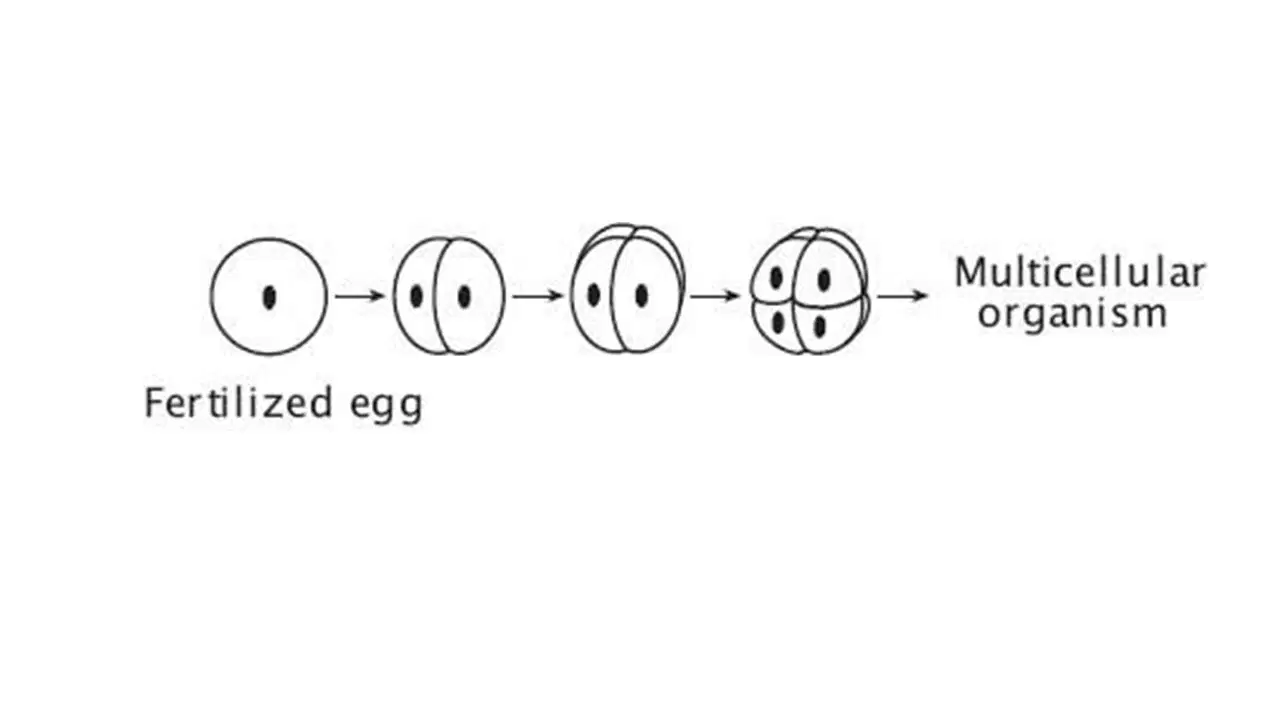
A multicellular organism begins life as a single cell—a fertilized egg with a complete set of chromosomes. The picture shows how the cell divides to become two cells, then four cells, eight cells, and so on. Which of the following statements best describes what happens during this process?
a)
Chromosomes are duplicated before cell division so that each new daughter cell has a complete set.
b)
Chromosomes are divided evenly during cell division so that each new daughter cell has an equal share of the original set.
c)
Chromosomes are stored in the original cell to direct the division of all daughter cells, which do not have their own chromosomes.
d)
Chromosomes are randomly distributed during cell division so that some new cells have partial sets while others have complete sets.
4.
When during the cell cycle are chromosomes visible?
a)
only during interphase
b)
only when they are being replicated
c)
only during cell division
d)
only during the G1 phase
5.
During which phase in the cell cycle does mitosis happen?
a)
M phase
b)
G1 phase
c)
G2 phase
d)
s phase
6.
Which pair includes a phase of the cell cycle and a cellular process that occurs during that phase?
a)
G1 phase, DNA replication
b)
G2 phase, preparation for mitosis
c)
S phase, cell division
d)
M phase, cell growth
7.
When during the cell cycle is a cell’s DNA replicated?
a)
G1 phase
b)
G2 phase
c)
S phase
d)
M phase
8.
Which event occurs during interphase?
a)
The cytoplasm divides
b)
Centrioles duplicate.
c)
Spindle fibers begin to form.
d)
Centromeres divide.
9.
Which of the following is a correct statement about the events of the cell cycle?
a)
Little happens during the G1 and G2 phases.
b)
DNA replicates during cytokinesis.
c)
The M phase is usually the longest phase.
d)
Interphase consists of the G1, S, and G2 phases.
10.
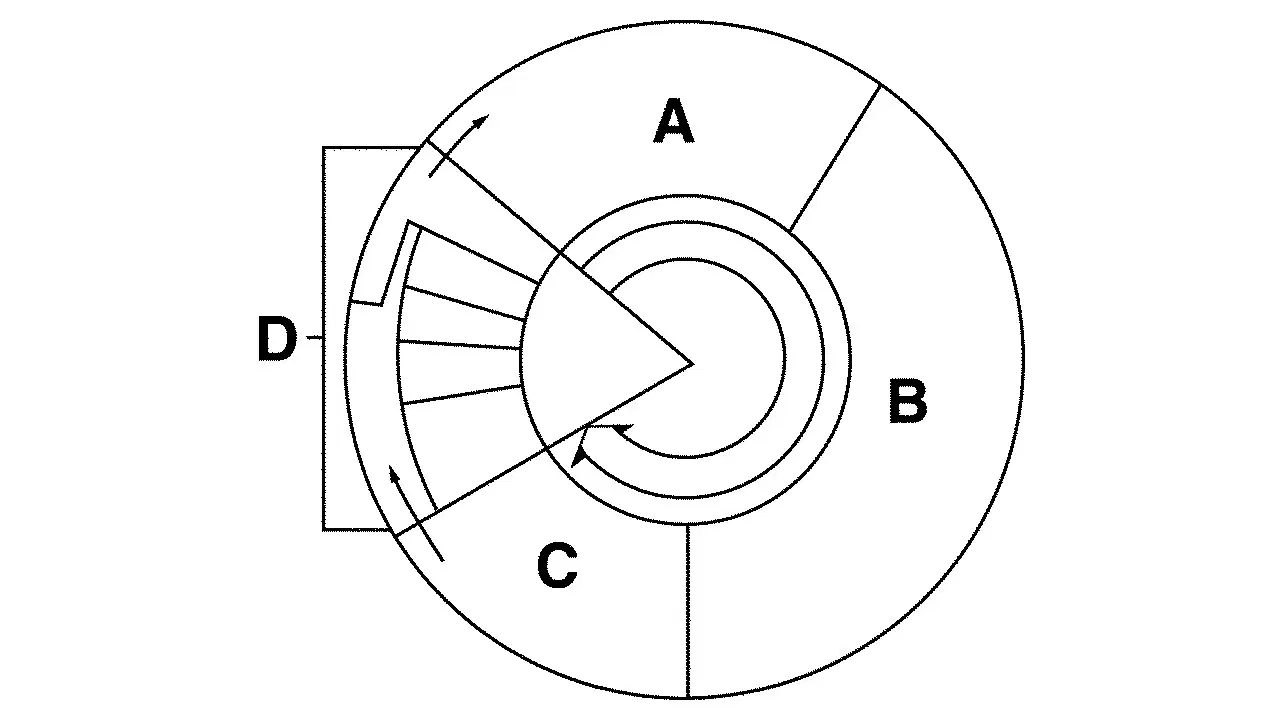
Cell division is represented in Figure 10–3 by the letter
a)
A
b)
B
c)
C
d)
D
11.
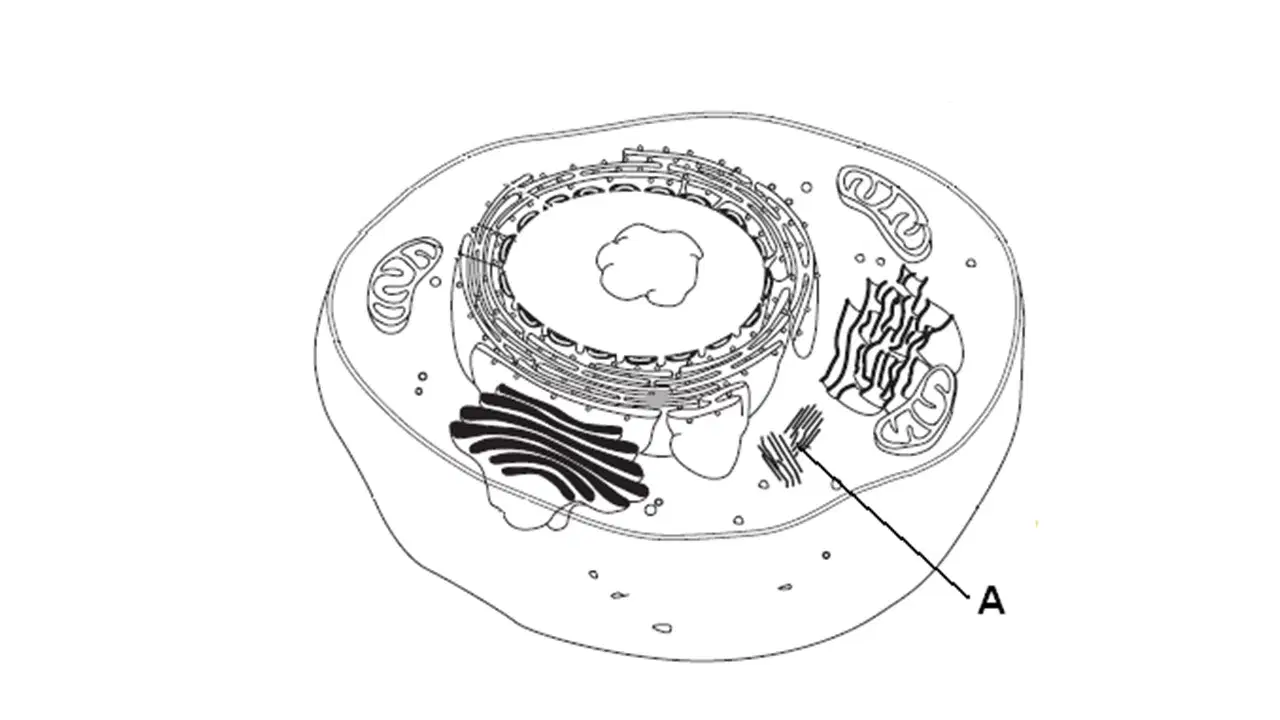
In Figure 10–4, what role does structure A play in mitosis?
a)
replicate DNA
b)
increase cell volume
c)
connect to spindle fibers
d)
dissolve nuclear envelope
12.
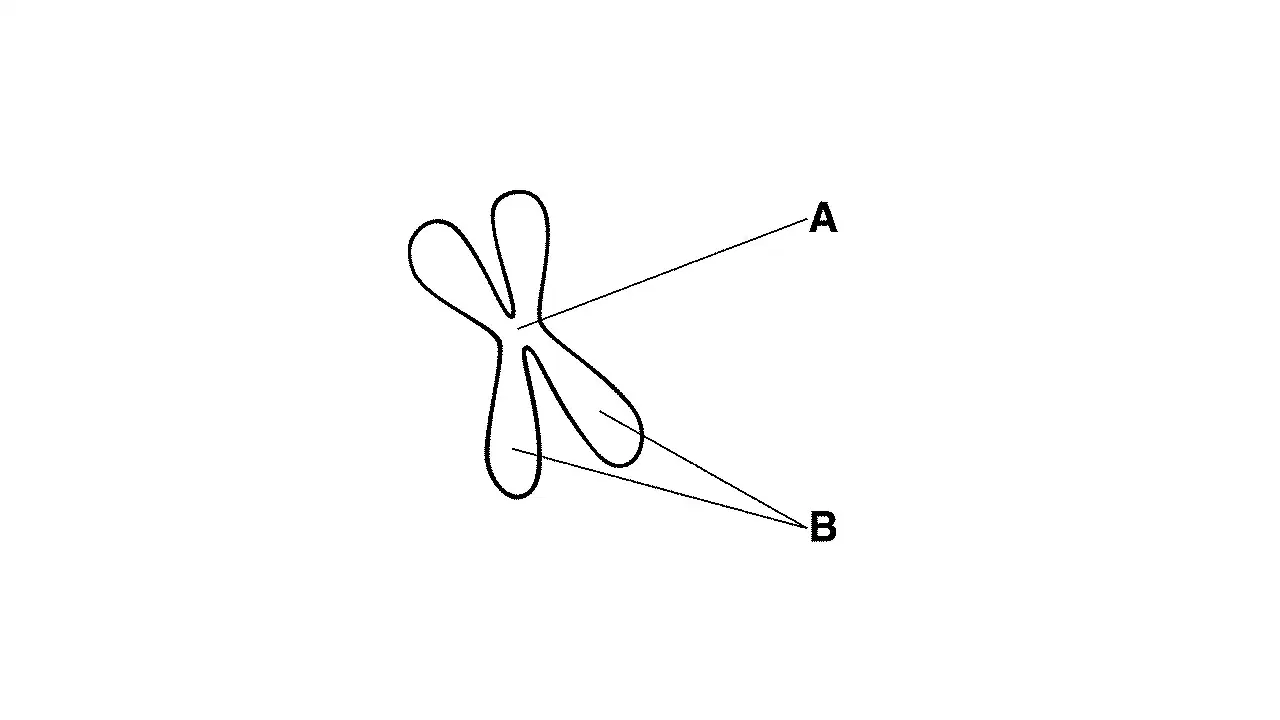
During which phase(s) of mitosis are structures like the one shown in Figure 10–5 visible?
a)
anaphase only
b)
prophase, metaphase, and anaphase
c)
metaphase only
d)
anaphase and interphase
13.
Which of the following is a phase of mitosis?
a)
cytokinesis
b)
interphase
c)
prophase
d)
S phase
14.
The first phase of mitosis is called
a)
prohase
b)
anaphase
c)
metaphase
d)
interphase
e)
telophase
15.
During which phase of mitosis do the chromosomes line up along the middle of the dividing cell?
a)
prophase
b)
telophase
c)
metaphase
d)
anaphase
e)
interphase
16.
Which of the following represents the phases of mitosis in their proper sequence?
a)
prophase, metaphase, anaphase, telophase
b)
interphase, prophase, metaphase, anaphase, telophase
c)
interphase, prophase, metaphase, telophase
d)
prophase, anaphase, metaphase, telophase
17.
What is the role of the spindle fibers during mitosis?
a)
They help separate the chromosomes.
b)
They break down the nuclear membrane.
c)
They duplicate the DNA.
d)
They make the chromosomes visible.
18.
The two main stages of cell division are called
a)
mitosis and cytokinesis.
b)
the M phase and the S phase.
c)
synthesis and cytokinesis.
d)
mitosis and interphase.
19.
During normal mitotic cell division, a parent cell that has four chromosomes will produce two daughter cells, each containing
a)
two chromosomes.
b)
four chromosomes.
c)
eight chromosomes.
d)
sixteen chromosomes.
20.
One difference between cell division in plant cells and in animal cells is that plant cells have
a)
centrioles.
b)
centromeres
c)
cell plate
d)
chromatin
21.
Some cells form a cell plate during cytokinesis. Which of the following is true of the cells in Figure 10–6 above?
a)
Both cells form cell plates during cytokinesis.
b)
Neither cell forms a cell plate during cytokinesis.
c)
Only cell A forms a cell plate during cytokinesis.
d)
Only cell B forms a cell plate during cytokinesis.
22.
Most of a cell’s growth takes place during the M phase of the cell cycle.
a)
True
b)
False
23.
In eukaryotes, the spindle breaks down during prophase and re-forms during telophase.
a)
True
b)
False
24.
Typically, the longest phase of mitosis is metaphase. _________________________
a)
True
b)
False
25.
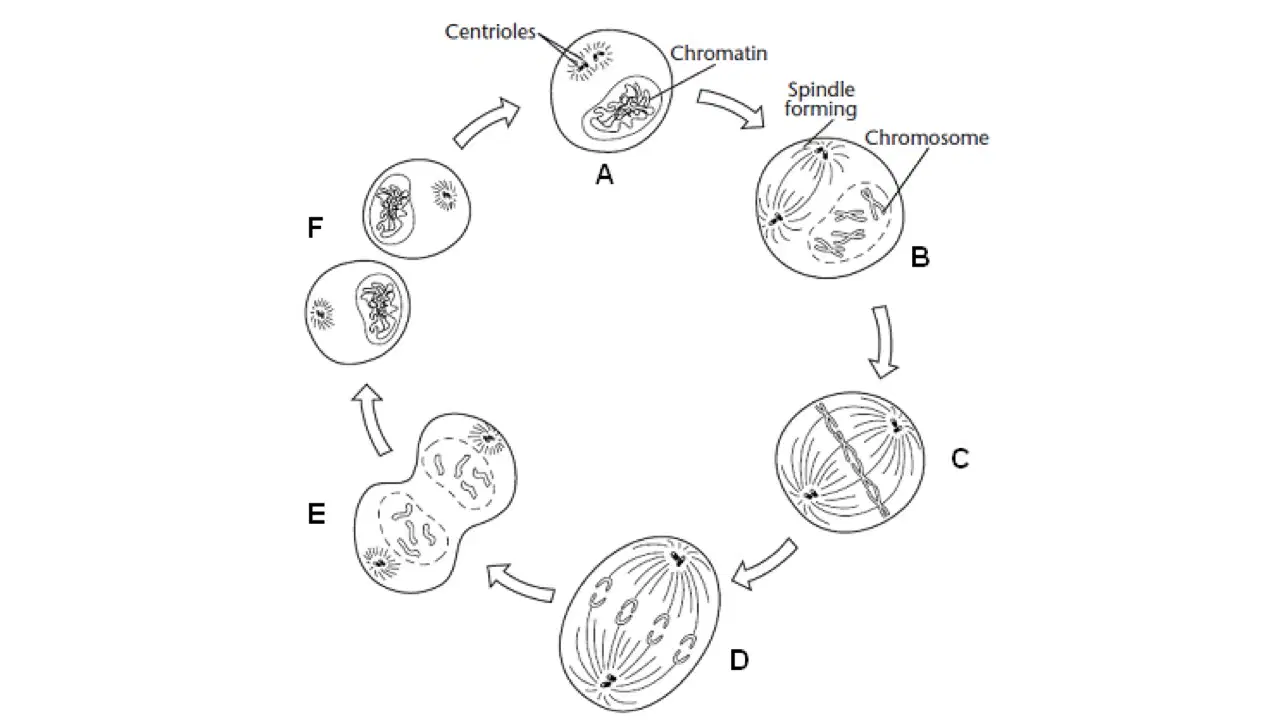
The cell shown in step E in Figure 10-7 above is undergoing telophase.
a)
True
b)
False
26.
During cytokinesis, a cell undergoing cell division finally splits into two daughter cells.
a)
True
b)
False
27.
When cells are grown in a laboratory, which of the following is a factor that can stop normal cells from dividing?
a)
contact with other cells
b)
growth factors
c)
a cut in the skin
d)
injection of cyclin
28.
Cells grown in a petri dish tend to divide until they form a thin layer covering the bottom of the dish. If cells are removed from the middle of the dish, the cells bordering the open space will begin dividing until they have filled the empty space. What does this experiment show?
a)
Cell division is a completely random process.
b)
Once cells divide, they can never divide again.
c)
The controls on cell growth and division can be turned on and off.
d)
There is only a limited amount of DNA available to a given group of cells.
29.
Which of the following explains why normal cells grown in a petri dish tend to stop growing once they have covered the bottom of the dish?
a)
The cells lack cyclin.
b)
The petri dish inhibits cell growth.
c)
Contact with other cells stops cell growth.
d)
Most cells grown in petri dishes have a defective p53.
30.
In eukaryotic cells, the timing of the cell cycle is regulated by
a)
centrioles
b)
cyclins
c)
spindle fibers
d)
the nuclear envelopes
31.
Cyclins are a family of closely related proteins that
a)
regulate the cell cycle.
b)
produce p53.
c)
cause cancer.
d)
work to heal wounds.
32.
Which of the following are external regulators of the cell cycle?
a)
cyclins
b)
growth factors
c)
mitotic spindles
d)
cancer cells
33.
Cancer is a disorder in which some cells have lost the ability to control their
a)
size
b)
spindle fibers
c)
growth rate
d)
surface area
34.
Cancer cells form masses of cells called
a)
tumors
b)
cyclins
c)
growth factors
d)
p53
35.
A cell with a defective p53 gene is likely to
a)
stop responding to growth regulators.
b)
stop dividing to produce daughter cells.
c)
generate hormones that combat tumors.
d)
produce cells without a defective p53 gene.
36.
Cancer affects
a)
humans only
b)
unicellular organisms only
c)
multicellular organisms only
d)
multicellular and unicellular organisms.
37.
One difference between cyclins and growth factors is that each cell produces its own cyclins, but growth factors are signals that can be sent from one cell to another.
a)
True
b)
False
38.
Cancer is a disorder in which some of the body’s cells lose the ability to control growth and division.
a)
True
b)
False
39.
During early development, all cells in the embryo of a multicellular organism are identical. Later on in development, the cells will become specialized through a process called
a)
apoptosis.
b)
cytokinesis.
c)
differentiation.
d)
interphase.
40.
A single-celled organism would not be expected to undergo cell differentiation.
a)
True
b)
False
41.
Stem cells taken from embryos are totipotent. _________________________
a)
True
b)
False
42.
People opposed to stem cell research argue that it is unethical to collect embryonic stem cells because it usually preserves an embryo.
a)
True
b)
False
43.
What is the cell cycle?
a)
The gradual development of something, especially from a simple to a more complex form.
b)
The study of heredity and the variation of inherited characteristics.
c)
The branch of biology that deals with the relations of organisms to one another and to their physical surroundings.
d)
The series of events that take place in a cell leading to its division and duplication of its DNA to produce two daughter cells.
44.
Which part of the Cell Cycle takes the longest?
a)
Interphase
b)
Mitosis
c)
Prophase
d)
Cytokinesis
45.

What can occur to an organism if the cell cycle is not regulated properly?

a)

The organism will require more food energy because of the cell growth will increase

b)

The cell cycle will proceed faster and create more cells causing it to grow faster

c)

Some cells will go through apoptosis but nothing will change for the organism

d)

Cancer can be caused and non-functioning cells can be produced

46.
What phase is this cell in?
a)
Cytokinesis
b)
Mitosis
c)
Prophase
d)
Metaphase
47.
What phase is this cell in?
a)
Mitosis
b)
Interphase
c)
Anaphase
d)
Telophase
48.
What phase is this cell in?
a)
Mitosis
b)
Cytokinesis
c)
Prophase
d)
Telophase
49.
What phase is this cell in?
a)
Mitosis
b)
Interphase
c)
Prophase
d)
Telophase
50.
What part of the cell cycle is this cell in?
a)
Mitosis
b)
Interphase
c)
Telophase
d)
Cytokinesis
51.

What would be the outcome for an organism if its cells cannot grow and divide properly?

a)

It will die because specialized & functioning cells are not being replaced

b)

Nothing, it will continue to live and reproduce as normal

c)

It will slow down because its cells will be old

d)

It will get smaller because no new cells are being made to grow

52.

Cancer is...

a)

Uncontrolled cell growth

b)

Normal cell growth

c)

A protein

d)

A cell cycle regulator

53.

What is Apoptosis?

a)

A tumor

b)

A protein

c)

Programmed cell death

d)

Cell cycle checkpoints

54.

Why is it necessary for the cell cycle to have regulation (checkpoints)?

a)

To ensure the cell functions properly before division

b)

To ensure that the old cell is still functional

c)

To ensure that the new cell is functional after division

d)

So that the DNA unfolds properly

55.

What occurs during the S phase of interphase?

a)

Cell growth & normal functions

b)

DNA replication

c)

Cell growth, normal function, duplication of organelles

d)

Cell growth, DNA replication, and normal functions

56.

What occurs during the G2 phase of interphase?

a)

Cell growth & normal functions

b)

DNA replication

c)

Cell growth, normal function, duplication of organelles

d)

Cell growth, DNA replication, and normal functions

57.

During prophase

a)

DNA lines up in the middle of the cell and DNA attaches to spindle fibers

b)

DNA condenses into chromosomes, centrioles and spindle fibers appear

c)

2 new identical cells are created

d)

DNA gets copied

58.

During metaphase

a)

DNA lines up in the middle of the cell and DNA attaches to spindle fibers

b)

centrioles and spindle fibers appear

c)

2 new identical cells are created

d)

DNA gets copied

59.

During anaphase

a)

DNA lines up in the middle of the cell and DNA attaches to spindle fibers

b)

centrioles and spindle fibers appear

c)

Each DNA gets pull to the opposite sides of the cell

d)

DNA gets copied

60.

During telophase

a)

DNA lines up in the middle of the cell and DNA attaches to spindle fibers

b)

centrioles and spindle fibers appear

c)

Each DNA gets pull to the opposite sides of the cell

d)

2 new nuclei form

61.

During cytokinesis

a)

DNA lines up in the middle of the cell and DNA attaches to spindle fibers

b)

Cell membrane pinches to make 2 new identical daughter cells

c)

Each DNA gets pull to the opposite sides of the cell

d)

2 new nuclei form

62.

Which phase is shown here?

a)

metaphase

b)

prophase

c)

anaphase

d)

telophase

63.

Which phase is shown here?

a)

metaphase

b)

prophase

c)

anaphase

d)

telophase

64.
a)

metaphase

b)

prophase

c)

anaphase

d)

telophase

65.
Mitosis results in the formation of...
a)
Two identical cells with all of the original chromosomes
b)
Two different cells with half of the original chromosomes
c)
Four identical cells with all of the original chromosomes
d)
Four different cells with half of the original chromosomes
66.
What is the purpose of mitosis?
a)
To increase the surface area of a cell
b)
To allow cells to divide for growth, repair, and renewal
c)
For increasing genetic variation within a species
d)
To allow for DNA replication and protein synthesis
67.
What is the longest stage of the cell cycle called?
a)
Cytokinesis
b)
M phase
c)
Interphase
d)
G1 Phase
68.

Why is the synthesis stage called this?

a)

because protein synthesis is taking place

b)

because DNA synthesis is taking place

c)

because it combines several smaller stages into one

d)

because the chromosomes come together

69.

What happens during G1 phase?

a)

The cell grows, develops, and does protein synthesis.

b)

DNA is Synthesized through Replication

c)

Cell organelles are produced to prepare for division.

d)

Where the chromosomes (DNA) divide.

e)

Where the two daughter cells split off.

70.

What happens during S phase?

a)

The cell grows, develops, and does protein synthesis.

b)

DNA is Synthesized through Replication

c)

Cell organelles are produced to prepare for division.

d)

Where the chromosomes (DNA) divide.

e)

Where the two daughter cells split off.

71.

What happens during M phase?

a)

The cell grows, develops, and does protein synthesis.

b)

DNA is Synthesized through Replication

c)

Cell organelles are produced to prepare for division.

d)

Where the nucleus becomes two nuclei and the DNA divides.

e)

Where the two daughter cells split off.

72.

Interphase consists of....

a)

G1 phase

b)

S phase

c)

G2 phase

d)

Mitosis

e)

Cytokinesis