
Font size
 Worksheets
Checkpoint 6 Quiz
Total questions: 23
Worksheet time: 14mins
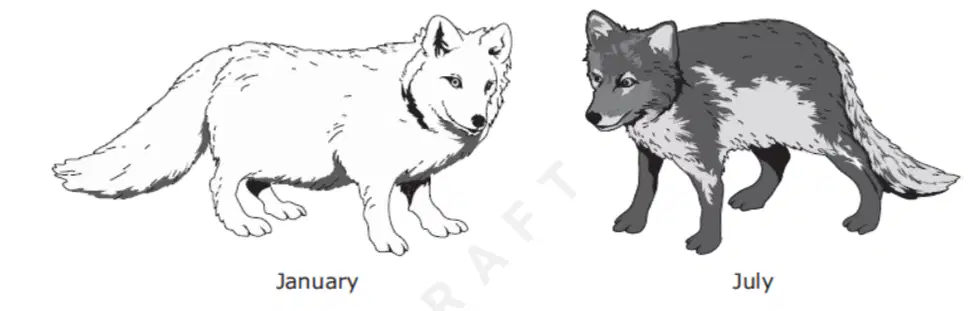
The arctic fox inhabits northern areas of North America. The same arctic fox is shown in the drawing at different times of the year. What causes this change in fur color?
The alleles for fur color change as the arctic fox grows older.
Gene expression for fur color is regulated by latitude.
The arctic fox has two traits for fur color that are determined at birth.
Gene expression for fur color is regulated by temperature.
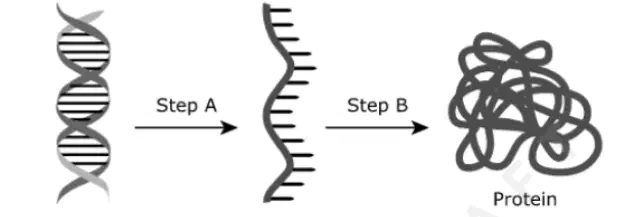
A diagram of the steps in the production of a protein is shown. Which description identifies the purpose of Step A in this process?
To correct mutations in the DNA sequence
To produce an exact copy of the DNA molecules
To copy the DNA of a gene sequence onto a strand of mRNA
To assist in the folding of a protein

The diagram shows a process that occurs during the development of an organism. Which statement explains how the different cell types in the image formed?
Each cell type uses its own unique replication process.
Each cell type expresses different genes at different times.
Each cell type contains a different part of the original DNA.
Each cell type has different enzymes to replicate genetic material.
A genetic cross involving two unlinked genes is represented: AaGg x aaGg. Which genotype is NOT possible in the offspring produced by the cross?
AAGG
Aagg
aaGg
aaGG
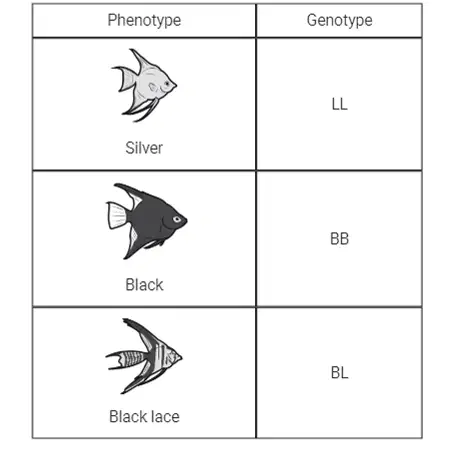
Some angelfish colors are determined by codominance. Possible phenotypes and genotypes of angelfish colors are shown. Which answer shows the expected phenotypes of offspring resulting from a cross between a black angelfish and a black-lace angelfish?
Phenotypic probability of offspring - Silver (–), Black (50%), Black Lace (50%)
Phenotypic probability of offspring - Silver (50%), Black (50%), Black Lace (–)
Phenotypic probability of offspring - Silver (25%), Black (25%), Black Lace (50%)
Phenotypic probability of offspring - Silver (25%), Black (50%), Black Lace (25%)
There are approximately 113 species and subspecies of snakes in Texas. Why would it be important for scientists to use a standardized taxonomic system when naming each species of snake?
To ensure that all species of snakes are located in the fossil record
To avoid confusion in the identification of a variety of snake species
To place snakes in various groups based on their habitats in the ecosystem
To determine the impact of removing one species of snake from their habitat in the ecosystem
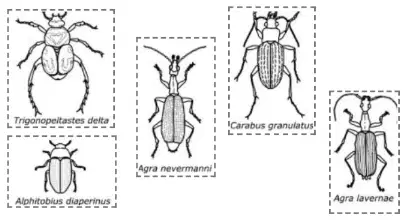
Which insects are MOST CLOSELY related? Select TWO correct answers.
Trigonopterus delta
Carabus granulatus
Agra nevadana
Agra vetteri
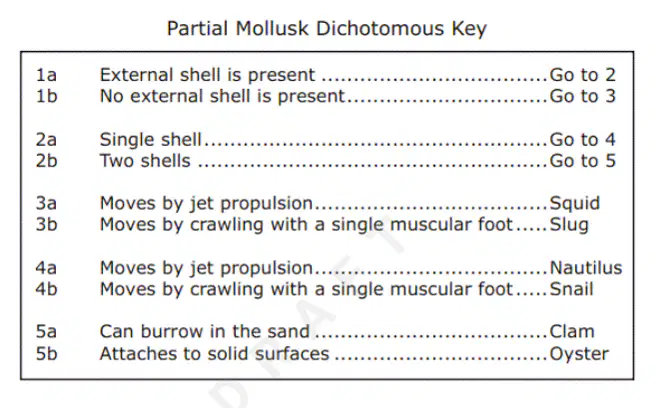
A dichotomous key of different mollusks is shown. Which mollusk moves by jet propulsion and does not have an external shell?
Squid
Slug
Nautilus
Snail
Which characteristic do all organisms in Kingdoms Animalia, Protista, and Fungi have in common?
They are eukaryotic.
They are prokaryotic.
They are unicellular.
They are multicellular.
After a wheat field is cleared, wild grasses and weeds begin growing. This process is considered —
primary succession because pioneer species appear
primary succession because there are no large trees
secondary succession because soil is already present
secondary succession because the field contains inorganic matter
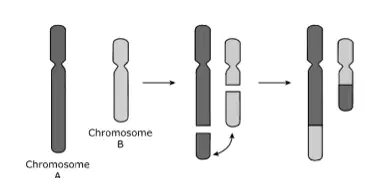
The diagram shows a type of chromosomal mutation. What type of mutation is shown?
Deletion
Insertion
Duplication
Translocation
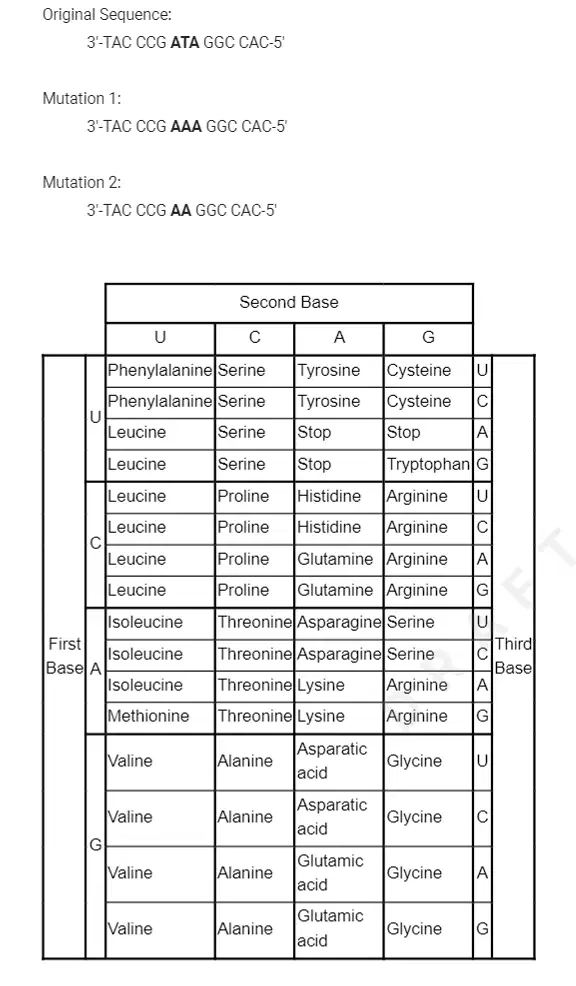
Two mutations of a genetic sequence are shown. A DNA codon chart is also shown. Original Sequence: 3'-TAC CCG AAA GGG CAC-5' Mutation 1: 3'-TAC CCG AAA GGC CAC-5' Mutation 2: 3'-TAC CCG AA GGC CAC-5' - Which mutation would have the MOST significant impact on the gene product? - Why would the impact be so significant?
In a Mendelian cross between two heterozygous pea plants (Tt), what is the probability of obtaining a pea plant with tall stature (assuming tall is dominant over short)?
25%
50%
75%
100%
What is the significance of meiosis in sexual reproduction?
It allows for the repair of genetic defects.
It increases genetic variation in the offspring.
It results in the production of identical offspring.
It ensures that offspring inherit traits from only one parent.
Which of the following best describes the concept of 'binomial nomenclature' in taxonomy?
It is a system that uses a two-part name for each species.
It refers to the classification of species based on genetic similarities only.
It is the process of naming new species based on their ecological niches.
It describes the use of a single name to identify organisms in different languages.
In the Linnaean system of classification, which rank comes directly below 'Order'?
Species
Genus
Family
Class
What is the significance of crossing over during meiosis?
It ensures that daughter cells are genetically identical.
It increases genetic variation among offspring.
It results in the production of additional chromosomes.
It prevents the pairing of homologous chromosomes.
Which of the following is an example of incomplete dominance in genetics?
Red and white flowers producing pink offspring
A tall plant and a short plant producing only tall plants
Two brown-eyed parents having a blue-eyed child
Attached earlobes being a dominant trait over detached earlobes
In the context of blood types, which of the following illustrates the concept of co-dominance?
A person with type A blood having a child with type B blood
A person with type AB blood
A person with type O blood donating to any blood type
A person with type B blood receiving type A blood
What is the primary effect of a point mutation in a gene sequence?
It can change a single amino acid in the protein encoded by the gene.
It results in the addition of a completely new chromosome.
It always renders the gene completely nonfunctional.
It has no effect on the gene or the protein it encodes.
Which type of mutation is most likely to have no effect on the phenotype?
A missense mutation that changes an amino acid to a similar one.
A nonsense mutation that introduces a premature stop codon.
A frameshift mutation early in the coding sequence.
A silent mutation that does not change the amino acid sequence.
During protein synthesis, what is the process of assembling a protein based on the mRNA sequence called?
Replication
Transcription
Translation
Modification
How does a frameshift mutation differ from a point mutation?
A frameshift mutation involves the insertion or deletion of a base, altering the reading frame of the gene.
A frameshift mutation changes only one base pair, while a point mutation can change many.
A frameshift mutation does not affect the protein produced, while a point mutation does.
A frameshift mutation occurs only in non-coding regions, while a point mutation occurs in coding regions.

