wayground logo

Free Printable Worksheets

Font size

S
M
L
XL
Worksheets

Foundation and Universal Science Final Exam Review Quiz

Total questions: 46

Worksheet time: 30mins

Name
Class
Date
1.

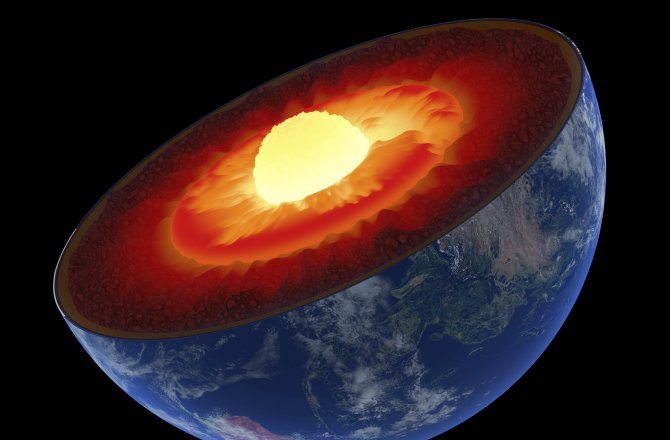
True or False. The mantle is hotter than the crust.

a)

True

b)

False

2.

True or False. The Earth's crust is thicker than the inner layers.

a)

True

b)

False

3.
This layer is completely liquid
a)
crust
b)
inner core
c)
mantle
d)
outer core
4.
The core is made-up of what two elements?
a)
iron and nickel
b)
iron and oxygen
c)
nickel and silicon
d)
oxygen and silicon
5.
Made mostly of silicon, oxygen and aluminum.
a)
inner core
b)
outer core
c)
crust
d)
mantle
6.

Which layer can be described as either Oceanic or Continental?

a)

crust

b)

mantle

c)

outer core

d)

inner core

7.
Which statement is true about oceanic crust?
a)
It is made of melted rock.
b)
It is the thinner than continental crust.
c)
It is thicker than continental crust.
d)
It is made of liquid metal.
8.

Which compositional layer is represented by the yellow layer?

a)

inner core

b)

outer core

c)

mantle

d)

crust

9.
What is the hottest layer?
a)
Crust
b)
Mantle
c)
Core
10.

The tallest sand dunes in North America are found in Great Sand Dunes National Park and Preserve in Colorado. These dunes were formed from the sand at the bottom of a dry lake bed. Which of the following agents is most likely responsible for the formation of the sand dunes?

a)

Wind

b)

Water

c)

Ice

d)

Gravity

11.

________________ is the breaking off and/ or disintegration of larger rocks into smaller rocks.

a)

Erosion

b)

Weathering

c)

Deposition

d)

Decomposition

12.

_____________ is the dropping off/ depositing of rocks.

a)

Metamorphosis

b)

Deposition

c)

Weathering

d)

Erosion

13.

Which of the following is NOT one of the main factors that cause Weathering?

a)

plant roots

b)

fast flowing water

c)

cycle of water freezing and melting in cracks

d)

gravity

14.

Plant roots grow in a rock and cause it to split.

a)

Weathering

b)

Erosion

c)

Deposition

15.

A fast-moving river carries rocks downstream.

a)

Weathering

b)

Erosion

c)

Deposition

16.

Waves dropping sand on the beach.

a)

Weathering

b)

Erosion

c)

Deposition

17.

Flood water pounds against a wall and wears it down.

a)

Weathering

b)

Erosion

c)

Deposition

18.

Wind blowing sand from one location to another.

a)

Weathering

b)

Erosion

c)

Deposition

19.

Layers of sediment forming at the bottom of the ocean.

a)

Weathering

b)

Erosion

c)

Deposition

20.

Rocks get ​ (a)   by weathering, ​ (b)   through erosion, and ​ (c)   somewhere else through deposition.

Choose from the below words
broken down
moved
deposited or dropped
21.

All of the following types of energy are renewable except _____.

a)

Nuclear

b)

Solar

c)

Hydroelectric

d)

Geothermal

22.

There are 3 main fossil fuels. We know them as --

a)
Carbon Dioxide, Oxygen, Nitrogen
b)
Cookies, Nutella, Granola
c)
Coal, Oil, Natural Gas
d)
Canyons, Oceans, Nymph
23.
__________ is an energy resource that WILL NOT run out in the next several hundred years.
a)
Renewable Energy Resource
b)
Nonrenewable Energy Resource
c)
Fossil Fuel
d)
Forever Fuel
24.
One disadvantage to using coal to produce electricity is that coal -
a)
forms in a short amount of time.
b)
is abundant over a wide area.
c)
is not environmentally friendly.
d)
is relatively quite affordable.
25.

Match the following energy source to it being renewable or not renewable.

a)

solar energy

1.

renewable

b)

wind energy

2.

renewable

c)

nuclear energy

3.

non-renewable

d)

fossil fuel energy

4.

non-renewable

26.

Match the following energy source types to their examples:

a)

wind energy

1.

wind turbines

b)

sun energy

2.

solar panels

c)

water energy

3.

hydroelectric power plant

d)

biofuels/biomass

4.

firewood, vegetable oil, whale oil, buffalo dung

e)

geothermal energy

5.

volcano, hot springs

27.
Soil is composed of all of these natural materials EXCEPT
a)
weathered rock
b)
plant matter
c)
plastic substances
d)
animal remains
28.
Which of the following processes will most likely contribute to the development of soil?
a)
Volcanic eruptions that make new land
b)
Building up of snow in very cold areas
c)
Migration of animals to warmer climates
d)
Breaking down of rock by wind, water, and ice
29.
Plants and animals become part of soil when they -- 
a)
Die and Decay
b)
Produce offspring
c)
Grow and Develop
d)
Take in nutrients
30.

One component of soil is decayed plant and animal remains, but the major part of soil is .... 

a)
Fossil Fuels
b)
Weathered rocks
c)

Iron

d)
Salt water
31.

Which letter represents amplitude?

a)

A

b)

B

c)

C

d)

D

e)

E

32.

Which distances represent one wavelength? Select all that are correct.

a)

A to F

b)

B to F

c)

E to G

d)

B to G

33.
4. What part of a wave is represented by letter D?
a)

A. Crest

b)

B. Compression

c)

C. Rarefaction

d)

D. Trough

34.
5. What part of a wave is represented by letter E?
a)

A. Crest

b)

B. Compression

c)

C. Rarefaction

d)

D. Trough

35.
6. Which of the following can act as media for a wave?
a)
A. Solids only
b)
B. Liquids only
c)
C. Gases only
d)
D. Solids, liquids, and gases
36.
7. Which of the following occurs as the frequency of a wave decreases?
a)
A. The wavelength increases
b)
B. The wavelength decreases
c)
C. The wavelength increases and then decreases
d)
D. The wavelength remains the same
37.
8. The lowest part of a transverse wave is known as a ____________________.
a)
Trough
b)
Crest
c)
Compression
d)
Rarefaction
e)
Medium
38.
9. The frequency of a wave is measured in ____________________.
a)
Hertz
b)
Crest
c)
Trough
d)
Compression
e)
Rarefaction
39.
16. The highest part of a transverse wave is known as a ____________________.
a)
Crest
b)
Trough
c)
Compression
d)
Rarefaction
e)
Medium
40.

Which wave is pictured? (a)  

Choose from the below words
Transverse
Longitudinal
Both
Neither
41.

 A wave has a frequency of 50 Hz and a wavelength of 10 m. What is the speed of the wave? (a)  

Choose from the below words
500 m/s
50 m/s
5 m/s
0.5 m/s
42.

Which organisms would be at the top or last trophic level?

a)

plant

b)

herbivore

c)

omnivore

d)

carnivore

43.

The monkey would be a

a)

decomposer

b)

producer

c)

primary consumer

d)

secondary consumer

44.

These organisms are often not shown in a food chain, but are important for recycling nutrients

a)

producers

b)

decomposers

c)

primary consumers

d)

carnivores

45.

Many biotic and abiotic factors combined together in an area is called a(n) _______________

a)

ecosystem

b)

organism

c)

community

d)

population

46.

Many insects of different species living together is called a ______________

a)

ecosystem

b)

population

c)

community

d)

organism