
 Worksheets
Practice Test 1 (Ch 8, 16, 17, 18 & 19)
Total questions: 246
Worksheet time: 4hrs 33mins
Preserved remains or traces of an organism that lived in the past.
vertebrates
carbon films
invertebrates
fossils

Which technique can be used to determine the exact age of a rock?
Radiometric dating
Relative dating

Which letter matches with the OLDEST layer of rock?
W
X
Y
Z
What type of absolute dating is used for determining the age of VERY OLD fossils?
Carbon 14
Uranium 238
Potassium-40
Oxygen 8
From our simulation, what does Carbon 14 turn into when it decays and does not become radioactive anymore.
Oxygen 14
Nitrogen 14
Helium 14
Carbon 14

what's the half life of this substance?
1 day
7.5 days
3.5 days
9 days
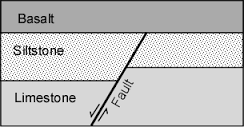


What division of time was the longest ?
Paleozoic
Mesozoic
Cenozoic
Precambrian
When did Precambrian time end and the phanerozoic eon begin?
542 million years ago
4.5 Billion years ago
3.65 Billion years ago
3.8 Billion years
What era closed with the K2 event and the extinction of the dinosaurs?
Paleozoic
Mesozoic
Cenozoic
What era started with the Cambrian explosion (cambrian period)?
phanerozoic
paleozoic
mesozoic
proterozoic
Multicellular algae and the first animals evolved towards the end of the precambrian eon (the proterozoic). This was most likely due to
Decreased oxygen levels in the atmosphere due to photosynthetic organisms
Predators
Genetic Drift
Increased oxygen levels in the atmosphere due to very tiny marine photosynthetic microorganisms.
What can reflect Geological Time?
The Fossil Record
The Calendar
Moon Phases
The Sun
This is about the time that invisible microbial life appears on earth.
There is no life on earth
13.7 Billion Years Ago
About 2 Million years ago
About 3.5 Billion Years Ago

Second largest time unit in the geologic time scale, defined by differences in life forms that are preserved in rocks
geological time scale
era
classification
relative age

This era is characterized by the formation of modern continents and the diversification of mammals and plants
periods
Cenozoic Era
unijforitarianism
key bed
What is Uniformitarianism?
states, physical, chemical and biological laws that operate today also operated across the vast time of geologic past
mineral-rich groundwater permeates porous tissue (bone/wood), minerals will fall out of solution and fill pores
widespread geographically and limited to a short span of geologic time
used when index fossils are not present for particular rock formation
Law of Cross-cutting may be defined as
fragments of one rock unit that have been enclosed within another
geologic features that intrude into rocks that must have been present before the intrusion occurred
unreformed sequence of sedimentary rocks, each bed is older than the one above
layers of sediment are generally deposited in a horizontal position
What is an Unconformity?
intrusion of a igneous rock into the sedimentary layers above it
gap in the rock record that represents a period during which erosion rather than deposition occurred, but for an unknown amount of time.
younger sedimentary strata overlie older metamorphic/intrusive igneous rocks
tilted/folded sedimentary rocks that are overlain by younger flat-lying strata
What is Nonconformity?
tilted/folded sedimentary rocks that are overlain by younger flat-lying strata
gap in the rock record that represents a period during which erosion rather than deposition occurred
younger sedimentary strata that overlies older eroded metamorphic/intrusive igneous rocks
layers of rock that have deposited without interruption/change
What are Index Fossils?
fossils that are widespread geographically but limited to a short span of geologic time
1700s specific types of fossils found in certain sedimentary layers and not in others
Fossils document the evolution of life through time
Allows us to recognize what intervals of time are not represented by strata and thus missing from fossil record

In this rock layer diagram there are two events of note, a fault (E) and an intrusion (D). Which occurred first? How do you know?
Intrusion D occurred first because the instrusion has been moved by the fault.
The fault occurred first because it has moved the intrusion D.
Intrusion D occurred first because it can be seen in all of the rock layers.
Fault E occurred first because it is a normal fault.

Trilobite fossils are found in Cambrian rocks but not in Triassic rocks. Which statement best explains why trilobite fossils are missing from Triassic rocks?
trilobites went extinct before the Triassic
fossils did not form during the Triassic
volcanoes and earthquakes destroyed only trilobite fossils during the Triassic
trilobite fossils just haven’t been found yet

Considering just the choices, which of the following events is most recent?
A. Deposition of Unit C
B. Deposition of Unit B
C. Deposition of Unit F
D. Tilting of C, D, E, and F


What is the last event to happen?
Deposition of Breccia
Igneous Intrusion
Faulting
Deposition of Limestone


Cenozoic
What event usually marks the end of each geologic area?
1 million years
burst of new life forms
mass extinction
ice age
Which of the following are eras? mark all that apply
Proterozoic
Mesozoic
Precambrian
Hadean
Paleozoic
What is the geological time scale ?
A clock
A calendar
Something that divides Earths history into groups
A procedure you carry out under controlled conditions to test a hypothesis.
hypothesis
inquiry
experiment
investigation
This era is characterized by the development of marine life
Mesozoic
Cenozoic Era
Paleozoic
Hadean
Archean is an example of an_________.
an epoch
an era
a period
an eon
Paleozoic, Mesozoic & Cenozoic are all
Epochs
Eras
Periods
Eons
Which is the most recent era of time- the one that we are currently in?
Mesozoic
Cenozoic
Paleozoic
Precambrian
The eon that began 542 million years ago, a term that means visible life.
Geologic time scale
Eons
Phanerozoic
Eras
Paleozoic
How many years ago did the moon first form?
4.5 Billion Years Ago
3.2 Million Years Ago
10 Billion Years Ago
4.9 Billion Years Ago
The moon formed during this eon, this eon occured before life and before the crust had solidified. Lava and magma was everywhere, and lots of comets bombarded the earth, giving the earth the large amounts of water you see today. Which eon is this?
Hadean
Archean
Proterozoic
Phanerozoic


What are the two types of surface waves?
P and S waves
Surface and Underground waves
Rayleigh waves and Love waves
Compression and Transverse waves


The location on the earth's surface which sits above the fault plane where the earthquake was most expressed is called the...
Epicenter
Hypocenter (focus)
Surface
Crust


What are the two types of body waves? (remember, there are various names)
compression and transverse waves
Surface and Underground waves
Rayleigh and Love waves
P-wave and longitudinal wave


What is the approximate lag time shown in this seismogram?
30 sec
86 sec
56 sec
140 sec


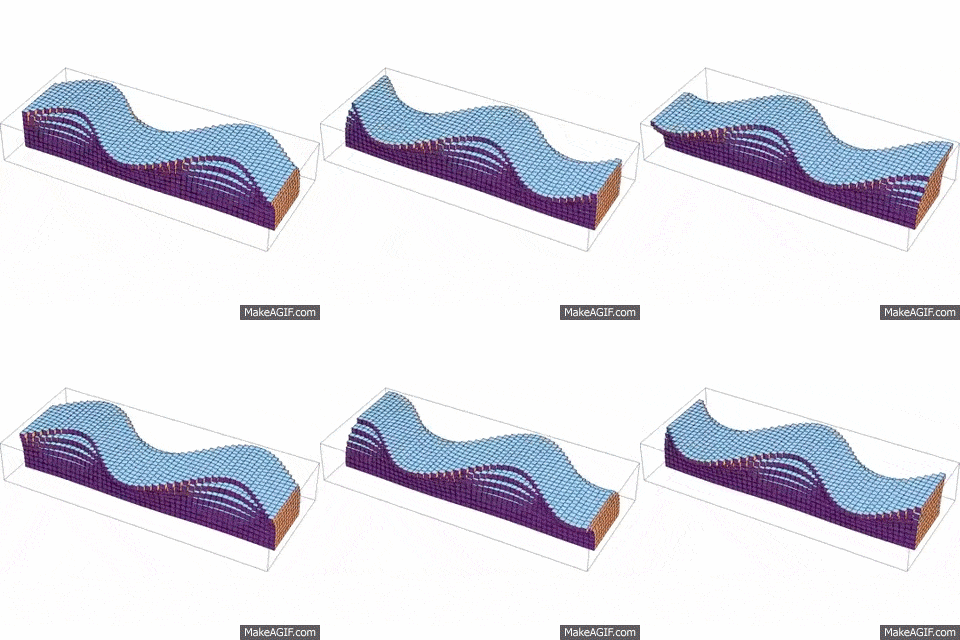
What type of surface wave illustrated here? (There is side to side motion)
P-Wave
S-Wave
Rayleigh Wave
Love Wave
How many different seismic waves are created during an Earthquake?
1
4
6
5
What are the two body waves?
Primary and Secondary
Love and Rayleigh
Love and Secondary
Primary and Rayleigh
Which seismic wave is described as a transverse wave and cannot travel through the liquid layers of our planet?
Love
Rayleigh
Secondary
Primary
Tectonic plates can bend and stretch until their ________ limit is reached and energy is then released in the form of seismic waves.
Rock
Elastic
Richter
Stretchy
A paleoseismologist is often found working...
in a pit across a fault line
in a station with a seismograph
Near a mountain where convergence has occured
Near a coastline where an abyssal flow of sediment has occured
To better understand future earthquakes, paleoseismologists look at
current earthquakes
past earthquakes
past tsunamis
plate movement
A sudden shift in the earth's crust
Earthquake
Flood
Drought
Volcano
What is the zig-zag record made by a seismograph called?
A. Seismograph
B. Seismologist
C. Seismic wave
D. Seismogram
What is the tool that records earthquakes?
A. Seismograph
B. Seismologists
C. Seismic wave
D. Seismogram
When plate boundaries move horizontally past each other?
reverse fault
normal fault
abnormal fault
strike-slip fault

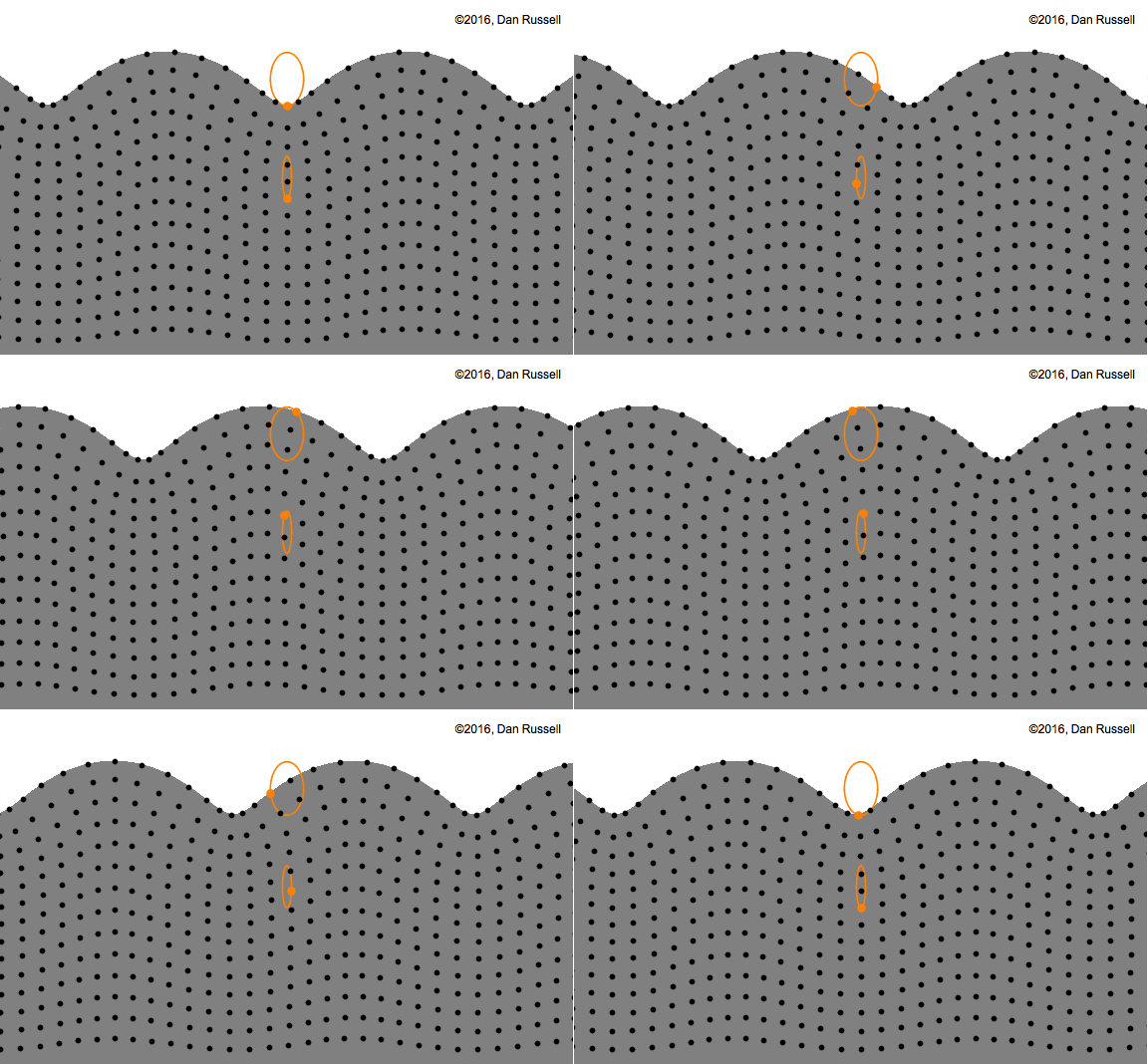
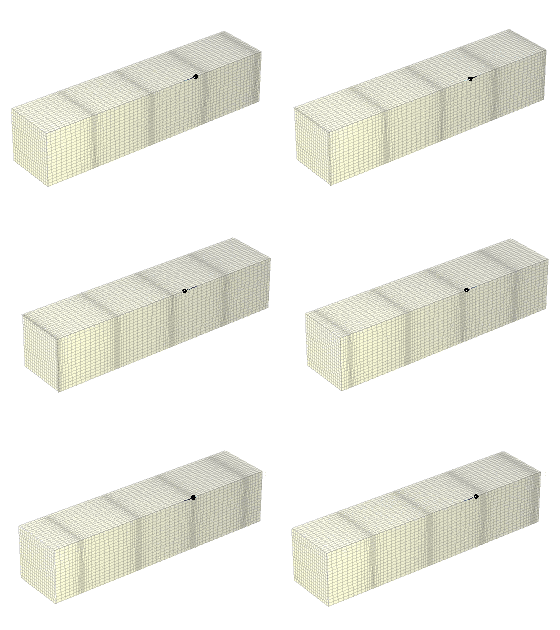
Which best models a P wave moving through Earth's crust?


When plates break or slip past each other they form these
mountains
tectonic plates
Fault lines
earthquakes
These waves travel slowly. They are the most destructive.
Seismic Waves
Primary Waves
Secondary Waves
Surface Waves
A Earthquake that is 8 on the Richter Scale will be approximately _____ times as intense as one that is 7 on the Richter Scale
4
10
1000
10000

Oceanic crust is
thick and porous
sandy and thin
thin and dense
thick and dense

Continental crust is
thin and sandy
dense and thin
thick and less dense
rough and dense


Which layer of earth is completely molten?
inner core
outer core
crust
mantle

Which layer of Earth is solid and made mostly of iron?
The outer core.
The mantle
The inner core.
The crust

A p-wave is an example of
Longitudinal (or compression)
Transverse
Converse
Ocean
It can travel through solids only
Love waves
Rayleigh waves
Primary waves
Secondary waves

In geology gravity meters and magnetometers are often used to measure
gravitational and magnetic variations over the surface of the earth
gravitational and magnetic changes that occur with polarity flips
changes in the pull of the earth and the moon
changes in the temperature of various layers within the earth's crust


When S waves leave the Mantle and enter the outer core, they...
speed up
slow down
get absorbed
When P waves leave the mantle and enter the outer core, they...
slow down
speed up
get absorbed
When P waves leave the outer core and enter the inner core, they...
speed up
slow down
get absorbed
Which shadow zone is larger?
S wave shadow
P waves shadow
P and S shadow zones are equal in size
If the Earth did NOT have a liquid outer core, how would earthquake waves travel differently.
P and S waves would both be absorbed.
Only S waves would travel through the Earth's core.
S-shadow zones would not exist.
S waves would travel faster than P waves.
Oceanic crust is
about 5 miles thick
about 1 mile thick
about 50 miles thick
about 100 miles thick
Continental crust is
about 1 mile thick
about 5 miles thick
about 50 miles thick
about 100 miles thick
What layer is completely molten?
Mantle
outer core
inner core
asthenosphere
Which kind of waves travel fastest??
P waves
S waves
Both move at the same speed
Magnetic anomalies are often present in earth because of ____________________
silica rich minerals
Iron rich minerals
Carbon rich minerals
Cavities within the earth
How thick is the oceanic crust?
3 to 5 miles thick
10 miles thick
up to 25 miles thick
4,000 feet
Which is the outermost compositional layer of Earth?
Asthenosphere
Crust
Mantle
Outer core

Which layer of the Earth is the only LIQUID layer?
Mantle
Inner Core
Outer Core
Lithosphere
Choose the statement that is TRUE
Oceanic crust is thinner and denser than Continental Crust
Oceanic crust is thicker and denser than Continental Crust
Continental crust is thinner and denser than Oceanic Crust
Continental crust is thicker and denser than Oceanic Crust
P and S waves are body waves caused by
oceans
mountains
the tides
Earthquakes

No p-waves or s-waves are received in the shadow zone because...
P-waves are absorbed and S-waves are refracted by Earth's outer core
P-waves are refracted and S-waves are absorbed by the Earth's core
both the p-waves and s-waves are refracted by the Earth's core
both p-waves and s-waves are absorbed by the Earth's core


S - waves are commonly known as ...
seismometer waves
sound waves
secondary waves
slippery waves

A device that can detect small changes in magnetic fields is called a(n)
sonar
magnetometer
spectrograph
underwater telescope
What happens when the flow in the outer core changes, and Earth's magnetic field changes direction?
magnetic symmetry
paleomagnetism
core reversal
magnetic reversal
A magnetic field that is opposite to the present field has ______________ polarity.
normal
reversed
retrograde
backward
What did scientists learn by matching magnetic patterns on the seafloor with known patterns of magnetic reversals on land?
the temperature of the ocean floor
the depth of the ocean floor
the age of the ocean floor

What is structure C?
coastline
continental slope
continental shelf
continental rise

What is structure E?
coastline
continental shelf
continental slope
continental rise

What is structure J?
continental slope
continental shelf
continental rise
coastline

What are structures K?
seamounts
atolls
guyots
volcanoes
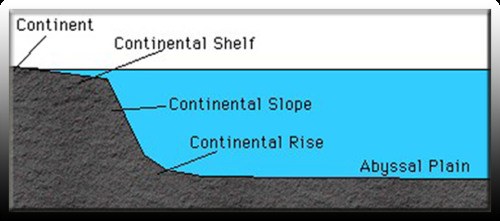
Which ocean floor feature is the steep cliff-like drop beyond the continental shelf?
Continental Shelf
Continental Slope
Abyssal Plain
Ocean Trench

Where are you walking when you are wading in the ocean?
Ocean Trench
Abyssal Plain
Continental Slope
Continental Shelf

What answer choice best describe ring-shaped islands of coral reefs and coral debris which are often formed from sinking inactive volcanoes?
hot spots
atolls
terranes
ophiolites
turbidity currents
What answer selection best describe curving chains of volcanic islands and seamounts almost always found paralleling the concave edge of a trench?
transform faults
fracture zones
hydrothermal vents
abyssal hills
island arcs
The structure of Ophiolites from the bottom to top is
gabbro, pillow basalts, dikes and sediment
sediment, pillow basalts, dikes and gabbro
gabbro, dikes, pillow basalts and sediment
gabbro, pillow basalts, dikes and sediment
What are valleys between the mountain ridges?
rift zones (or rift valley)
trenches
abyssal plains
continental slope
How does the age of the ocean floor change as you swim away from the mid ocean ridge and swim east towards Africa?
The ocean floor gets older
The ocean floor gets younger
Nothing
There are more fish
What is one piece of evidence of seafloor spreading?
Everything points to the north
There are alternating stripes of magnetism in the rock around the mid-oceanic ridges
seafloor contains magma
Glacial Striation
The build up of sediment before the abyssal plain and at the bottom of the continental slope.
Continental Rise
Continental Shelf
Continental Slope
None of the Above
The part of the ocean that extends out from the shoreline and into the ocean at a depth of about 200 - 300 feet.
Abyssal plain
Glacier
Continental Shelf
Continental Rise
What are underwater isolated mountains called? These are usually old volcanoes that have died out.
Dunes
Deltas
Mountains
Seamounts
From shore to sea, ocean features appear in this order:
continental slope, continental rise, abyssal plain, continental shelf
continental rise, abyssal plain, continental shelf, continental slope
abyssal plain, continental shelf, continental slope, continental rise
continental shelf, continental slope, continental rise, abyssal plain

The image shows a(n)
plateau
atoll
gulf
bay
The deepest part of the ocean is the ....
trenches
abyssal plain
ocean basin
rift
About __________ of the oxygen we breath is generated by ______________
70% , plankton
70% , organisms
80% , Stromatolites
80% , insects
Oceans cover about ______ of the surface of the earth.
60%
70%
80%
90%
Underwater volcanoes with flat tops are known as
shelf
abyss
guyots
slope

About _____% of the Earth's living species can be found in our oceans.
25%
67%
72%
94%

Steep v-shaped depressions that cut through the continental slope and shelf
continental rise
submarine canyon
seamount
guyots
An area on the ocean floor that allows magma to break through to create islands as the crustal plate moves
island arc
hot spot
seamount
guyot
The Ring of Fire are a series plate boundaries that have many trenches. Volcanic activity in this area can create this type of land mass.
seamount
island arc
guyot
hot spot
Linear region of unusually irregular ocean bottom that runs perpendicular to ocean ridges.
transform fault
fracture zones
continental drift
midocean ridge
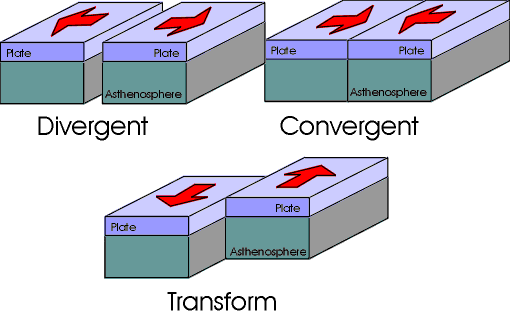

At which type of boundary are mountains often formed?
Convergent
Divergent
Subductive Zone
Transform


The formation of the Hawaiian Islands is associated with the movement of the pacific plate over a ____.
transform boundary
hot spot
convergent boundary
divergent boundary
Oceanic crust is
thick and porous
sandy and thin
thin and dense
thick and dense
Continental crust is
thin and sandy
dense and thin
thick and less dense
rough and dense
At which boundary are volcanoes often seen?
Transform
Convergent
Divergent
None of the above
Which continent was in the southern hemisphere but migrated to the northern hemisphere?
Africa
North America
India
Australia
Which mountain range was created by the collision of two continental plates?
Japanese Mountains
Cascades
Andes
Himalayas
Which pair of the names was given to the two parts of pangea
mesozoic & cenozoic
Laurasia & Gondwana
Ingoria & Gondwana
Laurasia & Golan
What is the current understanding of the magnetic moments locked in the iron of basaltic oceanic rock?
The poles (magnetic north and magnetic south) have moved slowly but significantly while the continents have always been in the places they are today
Sea floor spreading has occurred over millions of years and in this time there have been pole reversals which has resulted in strips of basalt that have very different magnetic moments.
Polar flips have occurred only in the last 1000 years and as such the sea floor is fairly uniform in its magnetic moment
Around what century mark did Alfred Wegener propose "Tectonic Plate Theory?
1910's
1920's
1880's
1940's
What final evidence secured or strengthened greatly Plate Tectonic Theory? It was evidence that came after the 1950's.
Geological Formations from Ancient Ice Caps
Discovery of Alternating magnetic moments in the iron of the sea floor
Continuity of geological formations between continents
Similarity of fossil records between continents
Who was the first to propose convection currents in the mantle that may drive continental movement at the crust?
Harry Hess in 1962
Author Holmes in 1930
Alex Baldwin in 1960
Ralph Stinter in 1950
On average, How fast is seafloor spreading in general
50 cm / year
5 cm / year
There is no way to measure such
0.5 cm / year
Which of the following is not considered a force for seafloor spreading
Slab Pull
Ridge Puss
Trench suction
Trench collision

What type of plate boundary is seen in this picture?
ocean-continent convergence
ocean-continent divergence
ocean-ocean divergence
ocean-continent transform boundary
ocean-continent adjustment

Which of the symbols shown illustrates a convergent boundary?
top symbol
middle symbol
bottom symbol
none of the symbols
A section of the rigid layer of the mantle and crust(lithosphere) that slowly moves over the soft layer of the mantle (asthenosphere)
plate
volcano
deposition
fault

One piece of evidence that supports the Theory of Plate Tectonics is found in the observation of rocks on either side of the Mid-Atlantic Ridge, shown in the picture provided. Plate Tectonic theory is supported because as you move out form the Mid-Atlantic Ridge, the rocks -
have higher iron content.
become thicker and thicker.
are increasingly older.
are made of smaller particles.
The earthquakes experienced in California are related to tectonic plates because these catastrophic events are the result of -
two tectonic plates sliding past each other.
tectonic plates melting as they slide into the mantle.
tectonic plates being weathered over time.
two tectonic plates pulling away from each other.
One piece of evidence that supports the Theory of Plate Tectonics is the discovery of what in both South America and Africa?
The ancient atmosphere in both places was identical.
The rates of weathering of rock are similar.
Fossil remains of the same land-dwelling animal.
Plants on both continents have similar flowers.

Every 100,000 to 200,000 years, the magnetic poles of Earth reverse. Rocks that contain iron provide a record of both normal and reversed magnetic poles. The pattern of normal and reversed magnetic poles as recorded in the rock on either side of the Mid-Atlantic Ridge provide evidence supporting the Theory of Plate Tectonics because -
the composition of the rock changed every time the plates pushed against each other.
the symmetric pattern shows where plates are moving away from each other.
deposits of iron in the rock were only made when the plates stopped moving.
" the bands of rock showing normal and reversed poles are not all the same width."
Which of the following crustal features would be the result of two continental tectonic plates moving away from each other?
Mountain range
Volcanoes on land
Rift valley
Mid-ocean ridge
What feature is found at oceanic divergent boundaries.
Rocky Mountains
Mariana Trench
Uplifted Ridges


Tectonic plates are huge pieces of ____________ that slowly move on the asthenosphere and consist of the crust
and the rigid, uppermost part of the mantle
atmosphere
lithosphere
rock formations
land mass

A tectonic plate division of the lithosphere that includes the continental crust of Africa and the surrounding oceanic crust is known as the
Somali Plate
Euroafrican Plate
African Plate
South American Plate
Who mapped the ocean floors and what technology did they use?
Alfred Wegener, echolocation
Marie Tharp, thermal detectors
Harry Hess, sonar
James Watson, hydrosonic vaporizing sensors
Which scientist was able to take all the collected sonar data and create a map of the ridges at the middle of the ocean floors where many earthquakes happen?
Marie Tharp
Marie Curie
Alfred Wegener
Albert Einstein
Patterns of magnetism preserved in rocks on each side of a mid ocean ridge.
Magnetic Ripples
Magnetic Alignment
Magnetic Stripes
Magnetic Reversal
When the force of subduction and gravity moves a lithospheric plate downward into a trench and pulls it away from a ridge.
Sea Floor Spreading
Subduction
Ridge Push
Slab Pull
When the force of convection currents and rising magma squeezes up through a oceanic ridge you have, what is called, ....... ?
Sea Floor Spreading
Subduction
Ridge Push
Slab Pull
What evidence was a part of Alfred Wegener's provide for continental drift?
ROCK AND FOSSIL AND GLACIER EVIDENCE
MAGMA EVIDENCE
MAGNETIC REVERSAL
SEA FLOOR SPREADING
The cycle of fluid heating, rising, cooling, and sinking is called____.
convection currents
water cycle
Earth cycle
tension force
Who proposed the theory of sea-floor spreading; wherein oceanic crust at the ocean floor ridges was forming and moving away from the ridge.
Harry Hess in 1962
Author Holmes in 1930
Alex Baldwin in 1960
Ralph Stinter in 1950

