
Font size
 Worksheets
Domain 5 Test Review
Total questions: 55
Worksheet time: 55mins
Which of the following BEST describes the Marshall Plan?
A plan that called for Japan to give up the practice of imperialism.
A plan that provided economic aid in the construction of the Berlin Wall.
A plan that called for the demilitarization of Germany after WWI.
A plan to give money to Europe to rebuild after WWII.
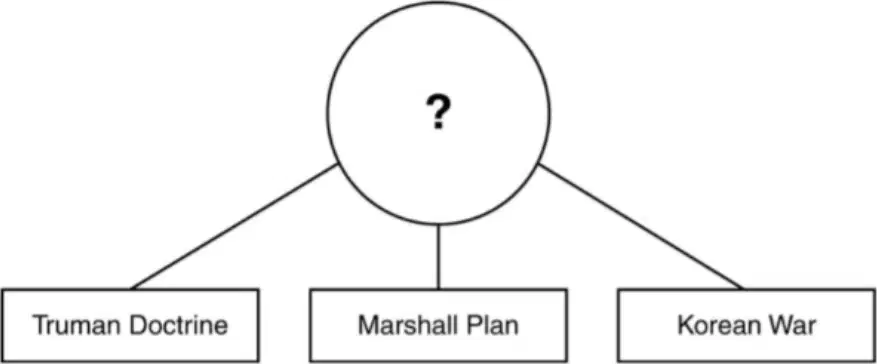
Which U.S. foreign policy term BEST completes this diagram?
Appeasement
Containment
Imperialism
Isolationism
Which of the following events set off the Korean War?
The United States invaded Korea
Chinese-controlled South Korea invaded North Korea
the Japanese invaded South Korea during World War II
Soviet-controlled North Korea invaded South Korea
Which action taken by President Harry S. Truman represents an attempt to respond to civil rights concerns and to set an example of equality for the nation to follow?
Outlawing segregation in public transportation
Integrating the military
Desegregating schools
Outlawing segregation in private businesses
Select the THREE options that were a direct effect of the G.I. Bill after World War II.
provided aid to Europe to rebuild
more small businesses started by veterans
increased enrollment in college and universities
an acceptance of African American veterans returning home
expansion of suburban home construction
At what point did US Senator Joseph McCarthy begin to lose support for what was ultimately deemed a 'witch hunt' to uncover communists in the United States?
when he spoke out in defense of friends who were accused of being communists
when he demanded popular Hollywood figures name individuals they suspected of being communists
when he called for charges of treason to be brought against those suspected of being communists
when he began to accuse high-ranking military officials of being communists
It is widely believed that when President Eisenhower signed a bill to create a national interstate highway system in 1956, he did it for what primary purpose?
To force southern states receiving federal funds to end segregation.
To allow people in suburban areas to enter into big cities more quickly.
So manufactured goods could be shipped from the east coast more quickly.
To provide the means to transport military aid more quickly in the event of a national military crisis.
How did the launch of Sputnik change education in the United States of America?
American education began to focus more on English and writing education as the Soviet Union proved they were better at science.
Soviet advances in science provoked American investments in science education as American educators realized the United States had fallen behind the Soviet Union.
The Soviet Union used their technology to spy on the American efforts to improve education in order to stay one step ahead of the United States in the Space Race and Cold War.
The United States brought scientists in from the Soviet Union to train American scientists.

The historical event described in this passage is known by which of the following names?
Iran Contra Affair
Gulf of Tonkin
Cuban Missile Crisis
Bay of Pigs

During which historical event was this presidential address given?
the Gulf of Tonkin incident
the Cuban Missile Crisis
the Berlin Blockade
the orbit of Sputnik I
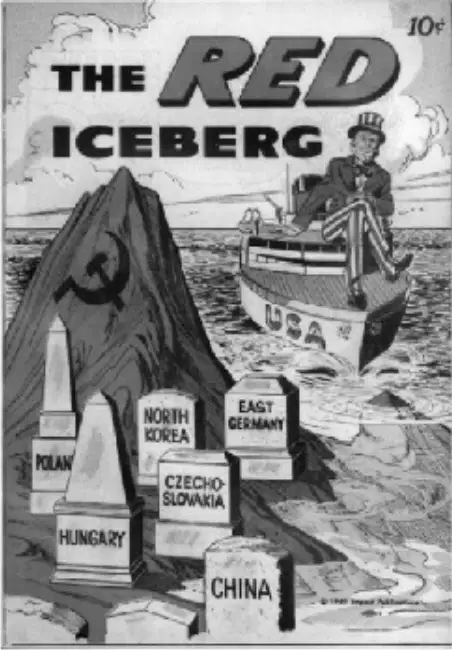
This comic book cover was published in 1960. For which U.S. anxiety does this comic book cover provide the BEST evidence?
concern about Soviet superiority during the space race
worry about the Communist infiltration of the U.S. government
alarm about the prospect of nuclear destruction
fear of the worldwide expansion of Communism
This sentence is part of the Tonkin Gulf Resolution, passed by Congress in 1964.
"Congress approves and supports the determination of the President, as Commander in Chief, to take all necessary measures to repel any armed attack against the forces of the United States and to prevent any further aggression."
What was an important consequence of this Congressional action?
It expanded the power of the presidency.
It sparked violent demonstrations against the war.
It called for civilian control of the military.
It gave Congress the ability to increase or reduce funding for the war.
Use the list to answer the question. - war on poverty - improved medical treatment for the poor - affirmative action plans for employers - civil rights laws
All of these were part of what vision for America?
Roosevelt’s New Deal
the Truman Doctrine
the Harlem Renaissance
Johnson’s Great Society
Which TWO laws, passed following President John F. Kennedy's assassination, helped to further Kennedy's goal of creating a more equal and just American society?
the Voting Rights Act
the Food and Agricultural Act
the Civil Rights Act
the Fair Labor Standards Act
the National Labor Relations Act
Which of the following made it unlawful to discriminate in the workplace?
Plessy v. Ferguson
24th Amendment
Civil Rights Act of 1964
Dred Scott v. Sandford
Which statement BEST describes the relationship between Plessy v. Ferguson and Brown v. Board of Education?
The Brown decision overturned the Plessy decision.
Both cases addressed the need for due process of the law.
Both cases dealt with the rights of minors in school.
The Brown case agreed with the Plessy case.
This excerpt is taken from a speech President Lyndon B. Johnson gave to Congress in March, 1965.
"There is no issue of states’ rights or national rights. There is only the struggle for human rights. . . . We cannot, we must not, refuse to protect the right of every American to vote in every election that he may desire to participate in."
Which sentence explains why Johnson believed a Voting Rights Act was needed?
Congress had passed laws that effectively limited voting to white citizens.
The Constitution had no provisions protecting the right to vote.
States had created obstacles to prevent African Americans from voting.
Voter turnout was declining because citizens had lost interest in elections.
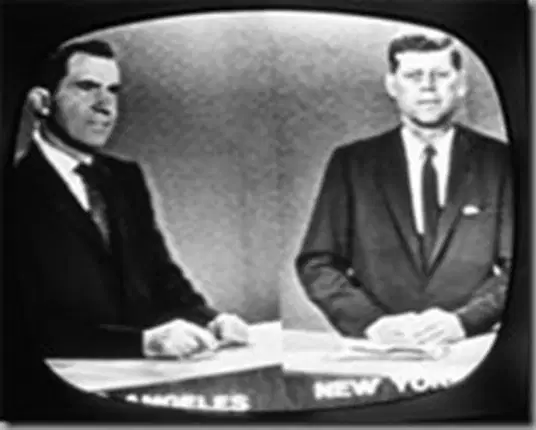
How does the image above reflect the political evolution in the 1960's?
The politics of the 1960's had not changed much from previous generations.
Americans were willing to elect the first Catholic president.
The political system in America was accepting more diverse candidates from different backgrounds.
The impact of television can be seen in the outcome of the 1960 presidential election.
What role did television play in advancing the Civil Rights Movement of the 1960s?
Television allowed leaders like Martin Luther King, Jr. to become famous.
Television did not play a significant role in the Civil Rights movement.
Television coverage of Civil Rights demonstrations fueled opposition to the movement.
Television showed the reality of struggles faced by African-Americans and put pressure on politicians to pass civil rights legislation.
What role did the television play during "Bloody Sunday"?
Americans were able to see that the protestors became aggressive and burned buildings. This caused Americans to not support black voting rights.
Americans saw the assassination of MLK Jr televised on TV during the march and called for an end to the Civil rights Movement.
Marchers were attacked by local and state police to stop the march. The televised scenes of violence brought about strong national support for black voting rights.
The Black Panthers joined the march. Americans saw their tactics of violence on TV and supported violence as the best method for gaining Civil Rights.
What new technology helped people in other regions of the country understand the struggle of African Americans in the segregated South during the mid-twentieth century?
the internet
radio
social media
television
Dear Mr. Barr, . . .
This letter does not express all that is in my heart, Mr. Barr. But if it says nothing else it says that we do not hate you or rejoice to dee your industry destroyed; we hate the agribusiness system [agricultural corporations] that seeks to keep us enslaved and we shall overcome and change it not b retaliation or bloodshed but by determined nonviolent struggle carried on by those masses of farm workers who intend to be free and human.
Sincerely yours,
Cesar Chavez
Which action did Cesar Chavez take that is most consistent with the theme of this excerpt?
He called for stricter enforcement of immigration laws.
He promoted the takeover of large corporations by farmworkers all across America.
He organized a farmworkers union.
He asked Congress to pass legislation for low-income housing.
Which of the following BEST illustrates the immediate reaction of the American public to the assassination of Martin Luther King Jr. in 1968?
The civil rights movement quickly disintegrated as despair and fear of violent retaliation to social protest began to outweigh hope.
Politicians from both major parties came together to pass civil rights legislation ending segregation and outlawing workplace discrimination.
The nation entered an extended period of mourning, ultimately coming together and resolving to end social injustice through peaceful means.
Riots broke out throughout the country, representing the most widespread example of social unrest in the country since the Civil War.
This excerpt is part of Martin Luther King, Jr.'s “I Have a Dream Speech” delivered during the March on Washington on August 28, 1963. It would be fatal for the nation to overlook the urgency of the moment. This sweltering summer of the Negro’s legitimate discontent will not pass until there is an invigorating autumn of freedom and equality. Nineteen sixty-three is not an end, but a beginning. Those who hope that the Negro needed to blow off steam and will now be content will have a rude awakening if the nation returns to business as usual. There will be neither rest nor tranquility in America until the Negro is granted his citizenship rights.
What situation was Dr. King describing?
opposition voiced by Lyndon Johnson to congressional action on civil rights
concern about the impact of Brown v. Board of Education
disorder after the repeal of the Civil Rights Act
major demonstrations against inequality in Birmingham, Alabama
Which civil rights leader delivered the famous I Have a Dream speech?
Malcolm X
Mahatma Gandhi
Rosa Parks
Martin Luther King, Jr.
In 1963, Martin Luther King, Jr. wrote his Letter from a Birmingham Jail. What did he advocate in this letter?
Civil disobedience by pushing for the use of peaceful, non-violent protest against unfair laws.
Persuade protestors that the movement was over and continue following the laws of states and the federal government.
Persuade protestors to take direct, violent action to push for Civil Rights.
Convince the Federal Government of the need to reform the prison system.
What is the significance of Cesar Chavez and what political tactics did he use?
Worked for higher wages for migrant workers through the use of nonviolent protest.
Worked for equal pay for women through the use of violent direct action.
Worked for African American voting rights through the use of voter registration drives.
Worked for environmental regulation through the use of petitioning Congress.
How did the Tet Offensive influence American perception of the Vietnam War?
The Tet Offensive proved to the American public that the war was justified and effective.
The Tet Offensive convinced many that the United States needed withdraw troops from Vietnam.
The Tet Offensive convinced the American public that the war was winnable.
The Tet Offensive was a complete failure by the Vietcong and North Vietnamese Army. The United States was able to use this battle to improve public relations.
How did the 1979 Iranian Revolution affect relations between Iran and the United States?
As the United States had supported the deposed Shah of Iran, the revolution led to a significant break in US-Iranian relations.
As the United States publicly opposed the deposed Shah of Iran, the revolution led to the strengthening of US-Iranian relations.
As the United States had supported the Islamic fundamentalists responsible, the revolution led to a significant break in US-Iranian relations.
As the United States publicly opposed the Islamic fundamentalists responsible, the revolution led to the strengthening of US-Iranian relations.
President Carter is most noted for which of the following?
Iran-Contra Scandal
War Powers Act
Pardon of Nixon
Iranian Hostage Crisis
Which of the following is the best example of a newspaper headline from the years of the Jimmy Carter Administration?
Carter Puts the 1st Man in Space!
The Hostage Crisis is Over!
After 5 Weeks, Our Boys are Coming Home From Iraq!
Carter Brings Peace in the Middle East!
Which of the following most accurately describes the War Powers Act of 1973?
Requires the President to notify Congress within 48 hours of committing armed forces to military action.
Requires Congress to get permission from the President before spending money on the military.
Requires the President to hold a cabinet meeting before committing any troops to a foreign conflict.
Requires Congress to issue a declaration of war before any level of military action can be taken.
Which statement BEST describes the difference between Jimmy Carter and Ronald Reagan in the White House?
Carter never took action, while Reagan always did.
Carter always took decisive action, while Reagan preferred to talk.
Neither Carter nor Reagan could do anything about the Iran Hostage Crisis, but Reagan took more of the blame for what happened in the 444-day ordeal.
Carter was unable to end the Iran hostage Crisis, and Reagan was able to use the end of the crisis to demonstrate that it was "morning in America again."
Which agency was created by the national government to set limits on pollutions?
Industrial Waste Commission
Environmental Protection Agency
Civilian Conservation Corps
Clean Air Act
Which of the following is a major contribution to the Environmental Movement?
Richard Nixon's Watergate Scandal
Upton Sinclair's The Jungle
Teddy Roosevelt's Yellowstone Park
Rachel Carson's Silent Spring
Which of the following scenarios would a NOW member protest against?
An African American is denied the right to vote because he cannot pass a literacy test.
A migrant Mexican worker is paid below minimum wage and forced to work long hours.
A women is paid less than a man who is employed in the same job as her.
A company is caught dumping chemical waste into the river system.
What happened to President Richard Nixon as a result of the Watergate scandal?
He was impeached and received a full pardon from President Gerald Ford.
He resigned from office and received a full pardon from President Gerald Ford.
He resigned from office and was sentenced to prison in a subsequent criminal trial.
He was impeached and was sentenced to prison in the Senate's impeachment trial.
Which presidential election has been the only one to have ever been decided by the Supreme Court?
1996- Bob Dole v. Bill Clinton
2000- George W. Bush v. Al Gore
2004- George W. Bush v. John Kerry
2008- John McCain v. Barrack Obama
What did the US government claim was true in order to justify its 2003 invasion of Iraq? Select the TWO answers that apply.
Saddam Hussein was about to launch another attack on Kuwait.
Saddam Hussein had stockpiles of weapons of mass destruction.
Saddam Hussein was a dictator who had massacred large numbers of Iraqi Shia.
It was the duty of the United States to liberate the oppressed and establish a democracy.
Iraq supported al-Qaeda and was involved in the September 11, 2001 attacks on the United States.
Which TWO of the following charges did Congress bring against President Clinton in his impeachment?
perjury
abuse of power
obstruction of justice
gross negligence
bribery
Which of the following is the most accurate argument for the listed president being considered the GREATEST MODERN PRESIDENT?
Watergate was a high point for Richard Nixon's administration, proved Nixon wanted to bring an end to the Vietnam War.
Gerald Ford was praised for his pardon of Richard Nixon.
George H W Bush, the US military crushed Iraq in the Persian Gulf War in 5 weeks, then took Baghdad and captured Saddam Hussein.
George W Bush kept the country together following the 9/11 attacks, took the war to Afghanistan to capture Bin Laden.
Which of the following are true of the Watergate Scandal?
President Nixon denied involvement with the crime.
The Democratic National Committee Headquarters was broken into.
The president was impeached.
The president resigned from office.
Which of the following are true of the Watergate Scandal?
President Nixon denied involvement with the crime.
The Democratic National Committee Headquarters was broken into.
The president was impeached.
The president resigned from office.
Which of the following are true of the Watergate Scandal?
President Nixon denied involvement with the crime.
The Democratic National Committee Headquarters was broken into.
The president was impeached.
The president resigned from office.

This image was taken days after 9/11/2001, most likely indicated the coming of
Healthcare Reform
The War on Terror (War on Afghanistan)
Bill Clinton's Impeachment
The Iran-Contra Scandal
Which of the following presidents was impeached?
Richard Nixon
George W. Bush
Jimmy Carter
Bill Clinton
When did President George H W Bush call for a large scale invasion of Iraq?
After Saddam Hussein's Iraq invaded Kuwait.
After Saddam Hussein was proven to have WMD's weapons of mass destruction)
After Al Qaeda's attack of the Twin Towers on 9/11.
After two US destroyers stationed in the Gulf of Tonkin radioed they had been fired upon.
Which BEST describes the 1980's economic policy called Reaganomics?
Expand business opportunities, expand social programs.
Reduce taxes, reduce government spending, deregulate business.
Eliminate foreign aid, raise taxes on corporations.
Reduce social programs, raise taxes on business, expand Medicare.
Under the Bill Clinton administration, which of the following is TRUE in reference to the national budget?
The national debt was dropped to zero.
The deficit increased all 8 years as a result of tax cuts and public welfare cuts.
A surplus was created due to tax cuts and reduced government spending.
The deficit decreased all 8 years as a result of tax increases and public welfare increases.
What was the purpose of the proposed Strategic Defense Initiative (SDI), often referred to as Star Wars.?
To allow US to shoot down enemy intercontinental ballistic missiles from space with lasers.
To retaliate against the USSR for the Cuban Missile Crisis.
To scare the Soviet Union into ending their glasnost policy.
To use satellite technology to have surveillance over the Berlin Wall.
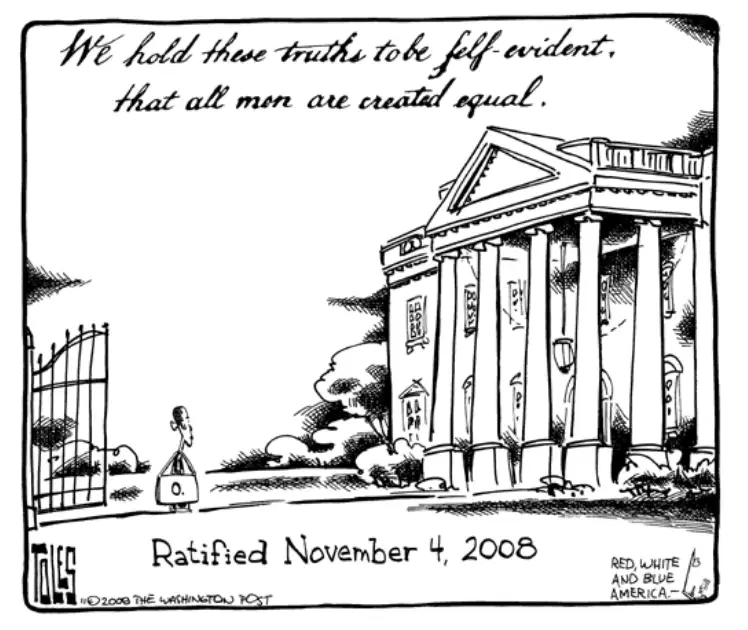
This cartoon is in reference to which historical event that occurred in November, 2008?
The end of the Iraq War
The election of Barack Obama
The renovation and re-opening of the White House
The re-election of George W. Bush
The following event is connected to which president?
Increasing the number of US advisors in Vietnam to about 16,000.
Kennedy
Johnson
Nixon
Ford
The following event is connected to which president?
Saigon, the capital of South Vietnam, fell to the North Vietnamese even as US troops were still leaving.
Kennedy
Johnson
Nixon
Ford
The following event is connected to which president?
After the Gulf of Tonkin Resolution the selective service or draft was reinstated to send roughly half a million young American men to Vietnam.
Kennedy
Johnson
Nixon
Ford
The following event is connected to which president?
Advocated for a policy of "Vietnamization" that would replace US troops with South Vietnamese troops, also renewed bombing raids against North Vietnam, and the neighboring countries of Cambodia and Laos.
Kennedy
Johnson
Nixon
Ford

