
 Worksheets
Microeconomics Exam 2
Total questions: 121
Worksheet time: 1hrs 1mins
What is the main belief of neoclassical economics regarding decision-making?
Decisions are based on systematic errors.
Decisions are irrational.
Decisions are random.
Decisions are rational.
What does behavioral economics aim to explain?
The rationality of human decisions.
The systematic errors in human decisions.
The randomness in economic theories.
The principles of neoclassical economics.
According to Neoclassical Economics, how are people's preferences described?
Unstable and frequently changing
Stable and not affected by context
Influenced by others
Varying with each situation
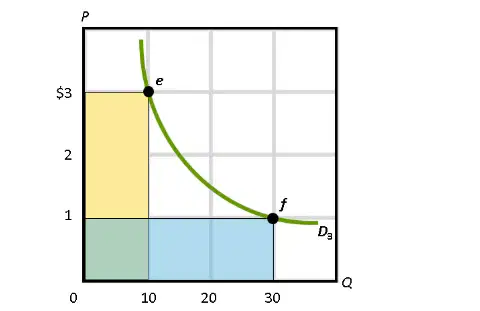
What does this graph represents
Elasticity Demand
Unit Elasticity Demand
InElasticity Demand
Unit InElasticity Demand
What is the assumption of Neoclassical Economics about people's nature?
People are altruistic and community-oriented
People are indifferent to their own interests
People are almost entirely selfish and self-interested
People are motivated by a mix of selfish and altruistic factors
In Neoclassical Economics, how are people characterized in terms of their calculating abilities?
People are reluctant and inaccurate calculating machines
People are eager and accurate calculating machines
People are not interested in calculations
People are capable but often make errors in calculations
What is the focus of Behavioral Economics?
Analyzing the financial systems of different countries
Focusing on the mental process behind decisions
Studying the effects of market regulations
Predicting stock market trends
What is the aim of Behavioral Economics in terms of decision making?
Decreasing the speed of decision making
Improving outcomes by improving decision making
Making decisions more complex
Reducing the number of choices in decision making
According to Neoclassical Economics, how are people's preferences described?
People's preferences are unstable and often inconsistent.
People's preferences are completely stable and unaffected by context.
People's preferences are dependent on context (framing effects).
People's preferences change regularly due to systematic errors.
In Behavioral Economics, what is said about people's ability to make mental calculations?
People are eager and accurate calculators.
People are bad at math and avoid difficult computations if possible.
People's calculation abilities are unaffected by context.
People make no errors in their calculations.
How does Behavioral Economics view human rationality in decision-making?
People are fundamentally rational and adjust their choices to achieve their goals.
People are irrational and make many errors that reduce their chances of achieving their goals.
People are rational and never make systematic errors.
People's rationality is consistent and context does not affect their decision-making.
According to Neoclassical Economics, how do people view future options and possibilities compared to current ones?
People place insufficient weight on future events and outcomes.
People are just as good at assessing future options as current options.
People often disregard future options entirely.
People consider future options to be less reliable than current options.
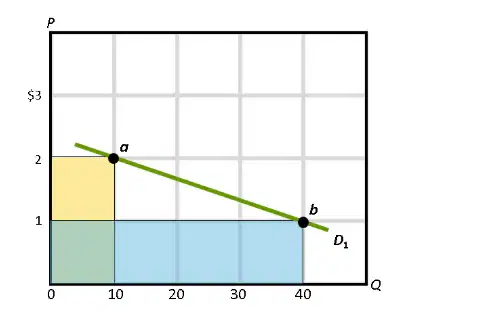
What does this graph represent
Unit Elasticity Demand
Inelasticity Demand
Elasticity Demand
Unit Inelasticity Demand
According to Behavioral Economics, how do people generally behave in terms of fairness?
People do not care about fairness and only treat others well if doing so will get them something they want.
Many people care deeply about fairness and will often give to others even when doing so will yield no personal benefits.
Fairness is not a significant factor in economic decisions.
People always act fairly if it benefits their self-interest.
What are heuristics primarily considered as?
Complex algorithms
Energy savers
Mathematical formulas
Psychological theories
What does "guesstimating ranks with recognition heuristics" imply?
Making precise calculations
Using a step-by-step approach
Making an educated guess based on familiarity
Applying a scientific method
What does the phrase "the implications of hardwired heuristics" suggest?
Heuristics that are difficult to understand
Heuristics that are innate or built-in
Heuristics that require external tools
Heuristics that are learned over time
Which of the following is considered a cognitive bias where people tend to favor information that confirms their preconceptions or hypotheses?
Overconfidence effect
Hindsight bias
Confirmation bias
Availability heuristic
What cognitive bias refers to the tendency to overestimate one's own abilities?
Self-Serving bias
Planning fallacy
Framing effects
Overconfidence effect
Which cognitive bias involves people attributing their successes to internal factors while blaming failures on external factors?
Availability heuristic
Self-Serving bias
Framing effects
Confirmation bias
What is the term for the cognitive bias that occurs when people mistakenly believe that past events were more predictable than they actually were after the events have occurred?
Planning fallacy
Overconfidence effect
Hindsight bias
Framing effects
Which cognitive bias is characterized by the tendency for people to rely too heavily on the first piece of information they encounter?
Framing effects
Confirmation bias
Availability heuristic
Self-Serving bias
What cognitive bias describes the error where people overestimate the likelihood of events with greater "availability" in memory?
Hindsight bias
Confirmation bias
Overconfidence effect
Availability heuristic
Which cognitive bias refers to the tendency to underestimate the time, costs, and risks of future actions and overestimate the benefits?
Framing effects
Planning fallacy
Hindsight bias
Self-Serving bias
According to Prospect Theory, how do people judge good and bad things?
In absolute terms, as fixed values
In relative terms, as gains and losses to their status quo
Based on the advice of experts only
Solely on the potential financial impact
What do people experience according to Prospect Theory?
Constant marginal utility for both gains and losses
Diminishing marginal utility for gains and increasing marginal utility for losses
Diminishing marginal utility for gains and diminishing marginal disutility for losses
Increasing marginal utility for gains and constant marginal disutility for losses
What is loss aversion in the context of Prospect Theory?
The preference to avoid losses rather than acquiring equivalent gains
The tendency to feel losses less intensely than gains
The indifference between losses and gains of the same amount
The tendency to prioritize gains over losses regardless of magnitude
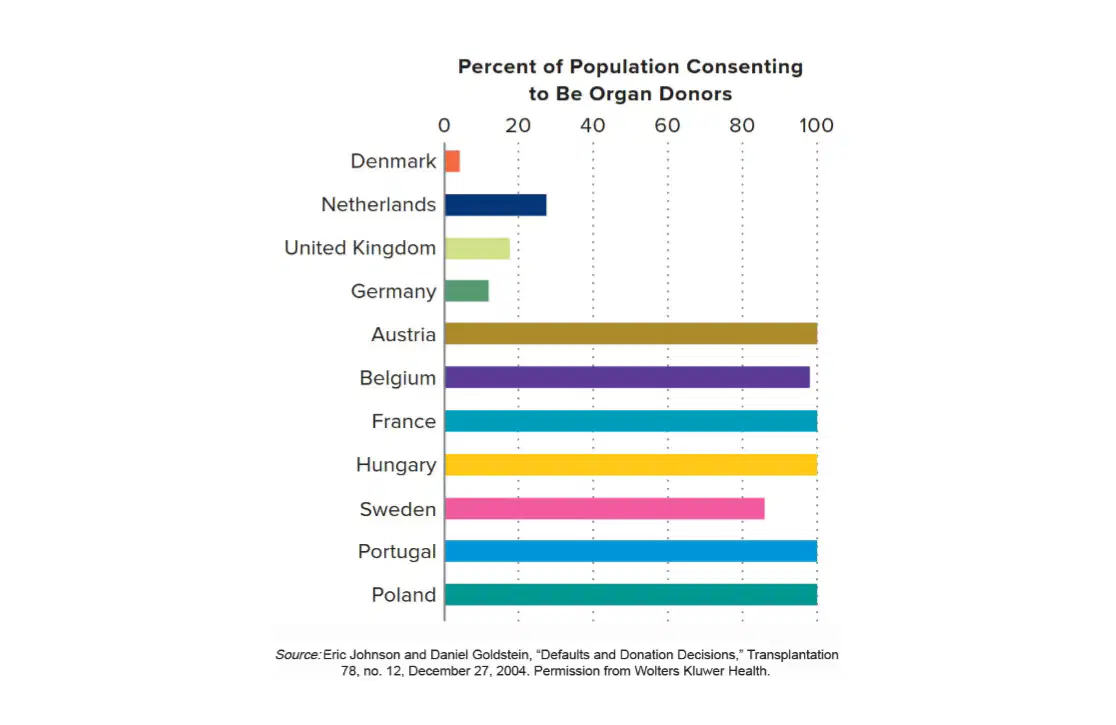
According to the bar graph, which country has the highest percent of population consenting to be organ donors?
Portugal
HUngary
France
Sweden
Austria
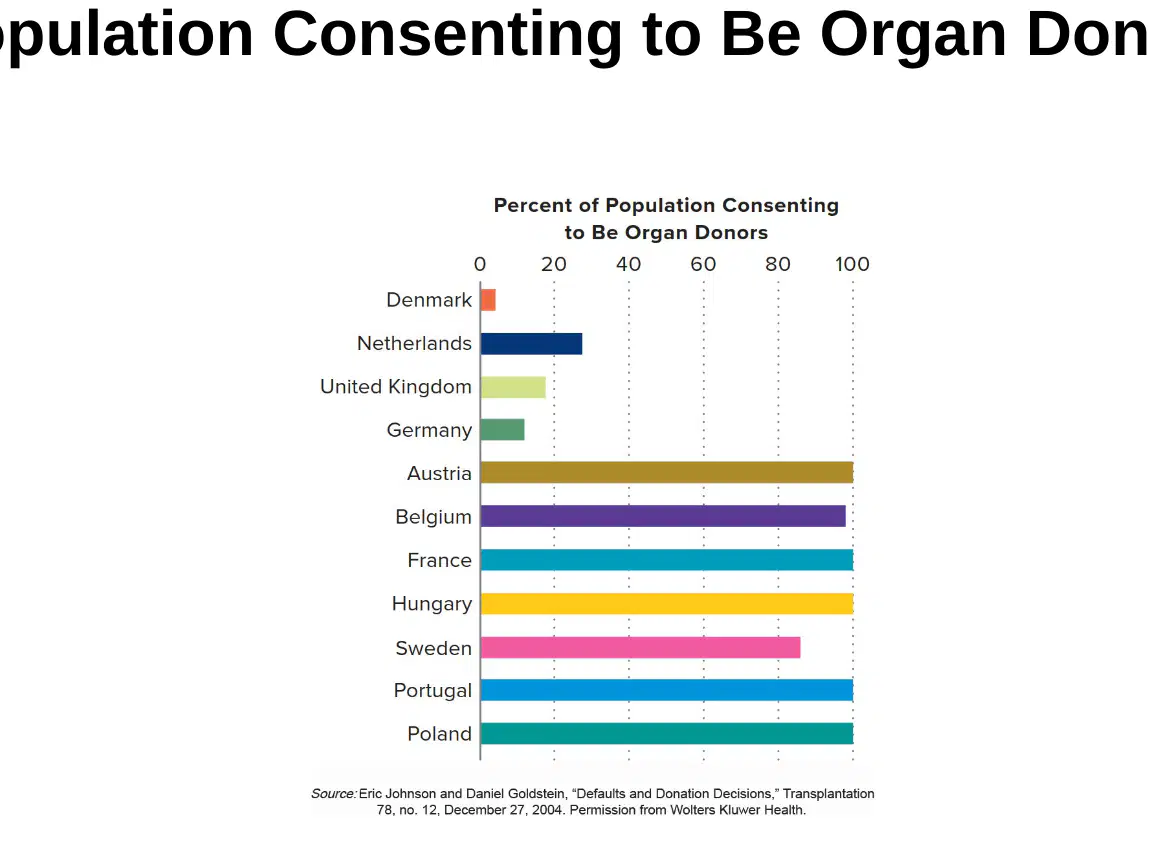
Which of the following countries has the lowest percent of population consenting to be organ donors as per the bar graph?
Denmark
Netherlands
United Kingdom
Poland
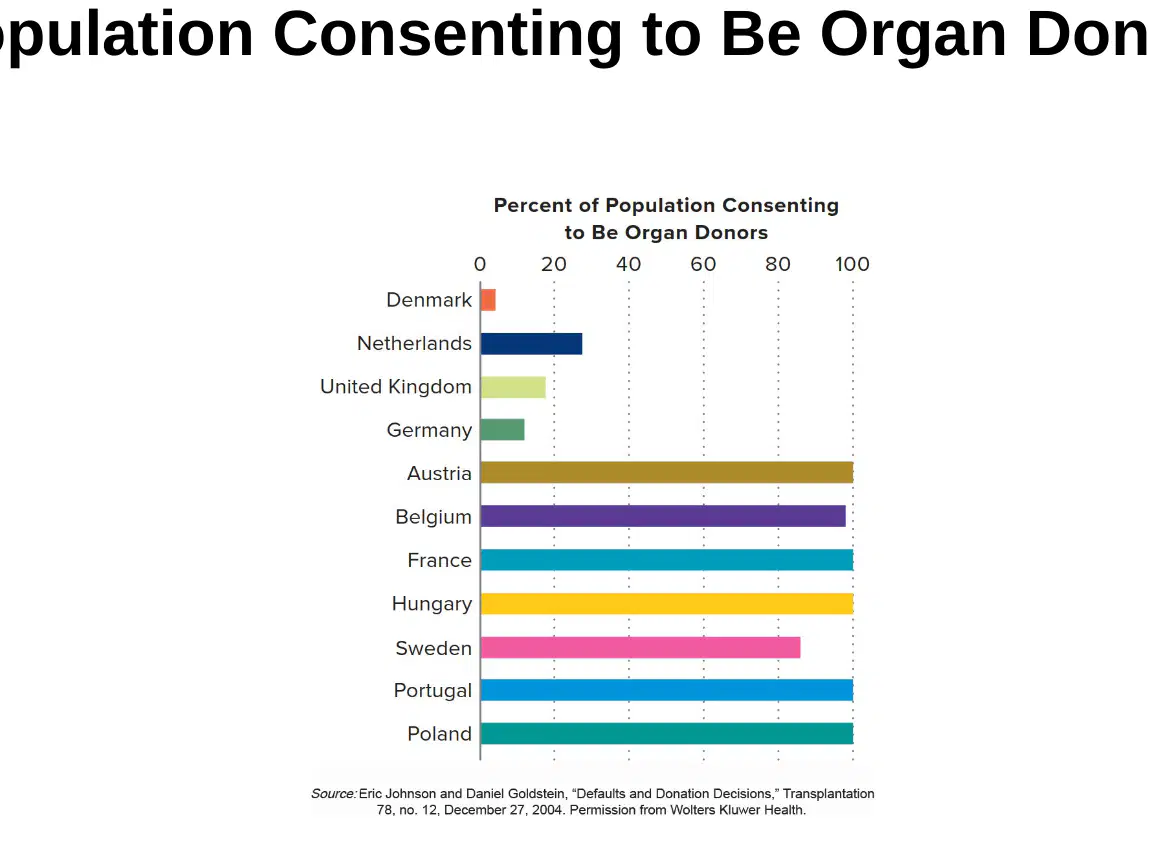
Based on the bar graph, which country's percent of population consenting to be organ donors is closest to 30%?
United Kingdom
Belgium
Portugal
France
What does the Law of Diminishing Marginal Utility describe?
The increase in utility from consuming additional units of a good or service
The decrease in utility from consuming additional units of a good or service
The constant utility obtained from each additional unit of a good or service
The initial utility obtained from the first unit of a good or service
What economic concept does the Law of Diminishing Marginal Utility help to explain?
The upward sloping supply curve
The downward sloping demand curve
The equilibrium price in a market
The elasticity of a product
What is utility according to the given terminology?
The usefulness of a product
The satisfaction one gets from consuming a good or service
A measure of how much one can use a product
A quantitative measure of product features
How is utility described in the document?
-Non Subjective
-Not the same as usefulness
-Difficult to quantify
-Subjective
-Not the same as usefulness
-Easy to quantify
-Subjective
-Not the same as usefulness
-Difficult to quantify
-Subjective
-the same as usefulness
-Difficult to quantify
What does the term "util" refer to in economics?
A type of utility
A unit of currency
One unit of satisfaction or pleasure
A measure of quantity
What is total utility?
The change in satisfaction from consuming one more unit of a good
The satisfaction obtained from the first unit of a good
The total amount of satisfaction
The price of a good in utility terms
What does marginal utility represent?
The total utility divided by the quantity of goods consumed
The extra satisfaction from an additional unit of the good
The initial satisfaction from the first unit of the good
The average utility of a good
How is marginal utility (MU) calculated?
MU = Total Utility / Quantity (TU/Q)
MU = Change in Total Utility / Change in Quantity (ΔTU/ΔQ)
MU = Total Utility * Quantity (TU*Q)
MU = Total Utility - Quantity (TU-Q)
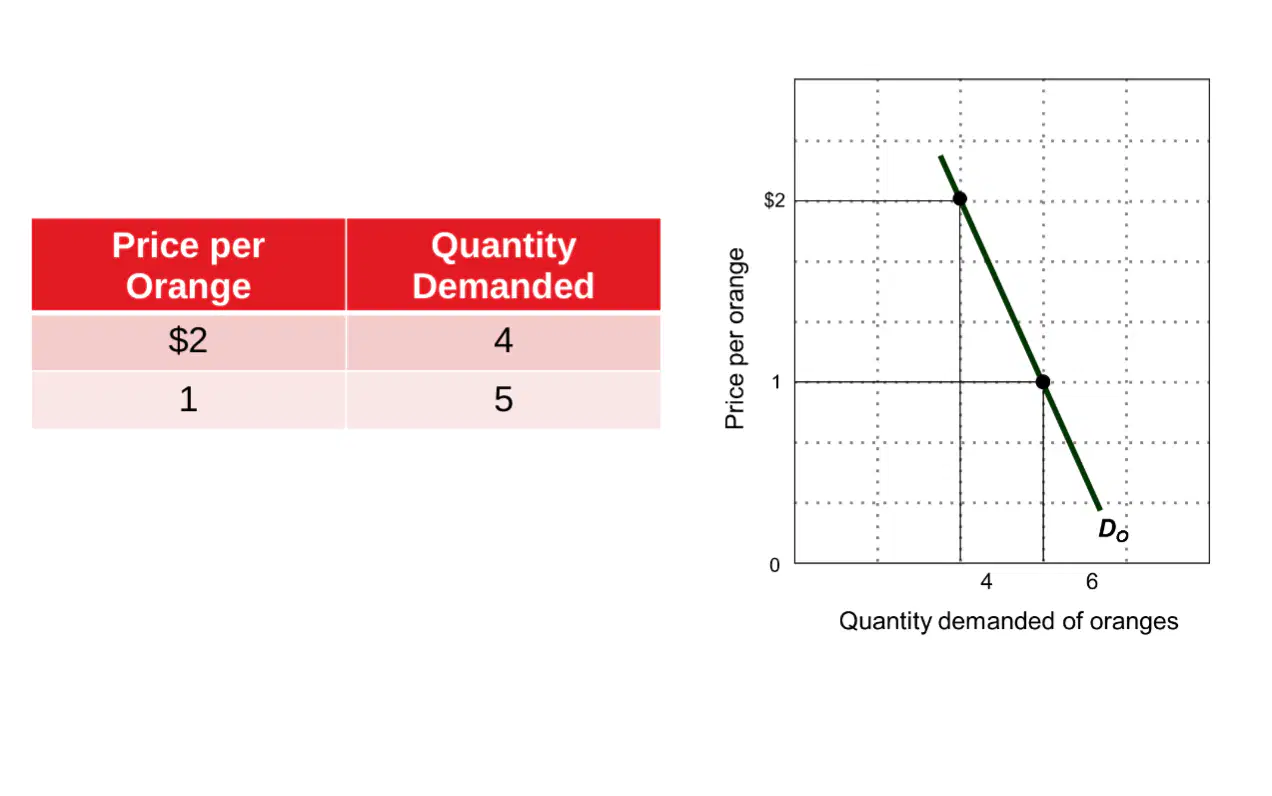
What does the demand curve in the diagram generally show?
The relationship between the quantity of oranges demanded and the price per orange
The relationship between the quantity of oranges supplied and the price per orange
The relationship between the quantity of oranges demanded and the quantity of oranges supplied
The relationship between the price per orange and the cost of production for oranges
What does the income effect refer to in the context of a price change?
The impact a price change has on a consumer's ability to purchase goods
The impact a price change has on a consumer's real income
The impact a price change has on the overall economy
The impact a price change has on a producer's revenue
What is the substitution effect?
The impact a price change has on a product's quality
The impact a price change has on a product's demand
The impact a price change has on a product's relative expensiveness
The impact a price change has on a product's supply
What does a criminal attempt to maximize according to the text?
Marginal benefit
Total utility
Marginal cost
Unlawful activity
What do most people find too high to engage in criminal behavior?
The marginal benefit
The total utility
The marginal cost
The societal impact
How does society attempt to reduce crime according to the text?
By reducing the total utility
By increasing the marginal benefit
By imposing additional costs such as fines and imprisonment
By decreasing the marginal cost
What is the potential effect of increasing the cost of crime?
Increase in total utility
Increase in marginal benefit
Reduction in crime
Increase in unlawful activity
What does price elasticity of demand measure?
The government's response to price changes.
Measures buyers' responsiveness to price changes.
The change in supply due to price changes.
The producer's response to price changes.
What characterizes elastic demand?
Insensitive to price changes.
No change in quantity demanded.
Sensitive to price changes.
Small change in quantity demanded.
What happens to the quantity demanded when there is elastic demand and the price changes?
No change in quantity demanded.
Small change in quantity demanded.
Large change in quantity demanded.
Quantity demanded becomes zero.
What is a characteristic of inelastic demand?
Large change in quantity demanded.
Sensitive to price changes.
Insensitive to price changes.
Quantity demanded increases exponentially.
How does the quantity demanded change when there is inelastic demand and the price changes?
Large change in quantity demanded.
Quantity demanded becomes zero.
No change in quantity demanded.
Small change in quantity demanded.
Price Elasticity of Demand Formula Include what
Use percentages:
Unit free measure.
Compare elasticities across products.
Eliminate the minus sign:
Easier to compare elasticities
Use percentages:
Compare elasticities across products.
Eliminate the minus sign:
Easier to compare elasticities
Does Not use percentages:
Unit free measure.
Compare elasticities across products.
Uses the minus sign:
Easier to compare elasticities
Use percentages:
Unit free measure.
Compare elasticities across products.
Eliminate the minus sign:
Easier to compare inelasticities
Why are percentages used in the Price Elasticity of Demand Formula?
To ensure the formula is mathematically correct.
To make the formula more complex.
To provide a unit free measure and compare elasticities across products.
To increase the accuracy of the demand prediction.
What is the purpose of eliminating the minus sign in the Price Elasticity of Demand Formula?
To simplify the calculation process.
To make it easier to compare elasticities.
To reduce the number of steps in the formula.
To align with accounting principles.
If the elasticity of demand (Ed) is greater than 1, how is the demand classified?
Inelastic
Unit elastic
Perfectly inelastic
Elastic
What does it mean when the elasticity of demand (Ed) is equal to 0?
Demand is elastic
Demand is unit elastic
Demand is perfectly inelastic
Demand is perfectly elastic
When the elasticity of demand (Ed) is less than 1, what is the demand considered to be?
Elastic
Unit elastic
Inelastic
Perfectly elastic
What does an elasticity of demand (Ed) equal to infinity (∞) signify?
Demand is inelastic
Demand is unit elastic
Demand is perfectly inelastic
Demand is perfectly elastic
What does a perfectly inelastic demand curve look like on a graph?
A. A horizontal line
B. A vertical line
C. A downward-sloping line
D. An upward-sloping line
What is the elasticity of demand (Ed) for a perfectly inelastic demand?
A. Ed > 1
B. Ed = 1
C. Ed = 0
D. Ed < 0
What does a perfectly elastic demand curve look like on a graph?
A downward-sloping line from left to right
A horizontal line
An upward-sloping line from left to right
A vertical line
In the context of elasticity of demand, what does an elasticity coefficient of infinity (∞) represent?
Perfectly inelastic demand
Unitary elastic demand
Perfectly elastic demand
Relatively elastic demand
What is the formula for Total Revenue?
Total Revenue = Demand x Quantity
Total Revenue = Price x Quantity
Total Revenue = Price + Quantity
Total Revenue = Price / Quantity
In the case of inelastic demand, how do price (P) and total revenue (TR) move?
In the same direction
In opposite directions
Price remains constant while TR moves
TR remains constant while P moves
When demand is elastic, how do price (P) and total revenue (TR) move?
In the same direction
In opposite directions
Price remains constant while TR moves
TR remains constant while P moves
What happens to total revenue when the price is lowered and demand is elastic according to the Total Revenue Test with Elastic Demand?
Total revenue decreases because the blue gain is less than the yellow loss.
Total revenue increases because the blue gain exceeds the yellow loss.
Total revenue remains unchanged because the blue gain equals the yellow loss.
There is no change in total revenue as demand is inelastic.
What happens to total revenue when the price is lowered and demand is inelastic?
Total revenue increases because the blue gain exceeds the yellow loss.
Total revenue decreases because the yellow loss exceeds the blue gain.
Total revenue remains unchanged despite the change in price.
Total revenue is not affected by price changes when demand is inelastic.
What happens to total revenue when price is lowered and demand is unit elastic according to the Total Revenue Test with Unit-Elastic Demand?
Total revenue decreases.
Total revenue increases.
Total revenue remains unchanged.
There is not enough information to determine the change in total revenue.
What does the Total Revenue Test do
approximates price elasticity of demand by measuring the change in total revenue from a change in the price of a service
approximates price elasticity of demand by measuring the change in total revenue from a change in the price of a product or service
approximates price of inelasticity of demand by measuring the change in total revenue from a change in the price of a product or service
approximates price elasticity of demand by measuring the change in total revenue from a change in the price of a product
Referring to the Total Revenue Test Example, what is the total revenue when the quantity of tickets demanded per week is 5,000?
$8,000
$14,000
$18,000
$20,000
What is the Total Revenue test formula
Total Revenue = Price × COGS
Total Revenue = Price per × Quantity
Total Revenue = Price × Quantity
Total Revenue = Sales - Cost
What is the shape of the total-revenue curve when demand is inelastic according to the Total Revenue Test Example?
Upward sloping
Downward sloping
Horizontal line
Vertical line
What happens to total revenue when the price of a product with elastic demand is increased?
Total revenue increases
Total revenue decreases
Total revenue is unchanged
There is not enough information to determine the impact on total revenue
If the absolute value of the elasticity coefficient (Ed) is less than 1, how is the demand classified?
Elastic
Unit-elastic
Inelastic
Perfectly elastic
When the price of a product with unitary elastic demand decreases, what is the impact on total revenue?
Total revenue increases
Total revenue decreases
Total revenue is unchanged
Total revenue fluctuates unpredictably
What describes the change in quantity demanded when the demand is relatively inelastic and the price changes?
Quantity demanded changes by a larger percentage than does price
Quantity demanded changes by the same percentage as does price
Quantity demanded changes by a smaller percentage than does price
Quantity demanded does not change at all
What happens to the demand for a product when there are more substitutes available?
Demand becomes more inelastic
Demand remains unchanged
Demand becomes more elastic
Demand cannot be determined
How does the proportion of income spent on a product affect its demand elasticity?
Lower proportion of income, demand is more elastic
Higher proportion of income, demand is more inelastic
Higher proportion of income, demand is more elastic
Proportion of income does not affect demand elasticity
Compared to necessities, how is the demand for luxury goods described?
The demand for luxury goods is more inelastic.
The demand for luxury goods is less elastic.
The demand for luxury goods is more elastic.
The demand for luxury goods is unaffected by elasticity.
What is the effect on total revenue when there is inelastic demand for large crop yields?
Total revenue increases
Total revenue decreases
Total revenue remains unchanged
There is no effect on total revenue
What is an economic cost?
The profit gained from an investment.
The payment that must be made to obtain and retain the services of a resource.
The total amount of money a company has.
The loss incurred from a business transaction.
What are explicit costs?
Costs that cannot be easily quantified.
Costs associated with non-monetary factors.
Monetary outlay: the amount of money that you have to spend in order to buy something or start a project
Costs that include a normal profit.
What are implicit costs?
Monetary outlay.
Opportunity cost of using self-owned resources and normal profit
The cost of using self-owned resources and normal profit
Opportunity cost of using self-owned resources and unusual profit
What is the formula for calculating accounting profit?
Revenue - Implicit Costs
Revenue - Economic Costs
Revenue - Explicit Costs
Revenue - Explicit Costs - Implicit Costs
How is economic profit different from accounting profit?
Economic profit includes implicit costs while accounting profit does not.
Economic profit includes explicit costs while accounting profit does not.
Economic profit is calculated before taxes while accounting profit is calculated after taxes.
There is no difference; both terms mean the same thing.
Which of the following represents the correct formula for economic profit?
Economic profit = Revenue - Economic Costs
Economic profit = Revenue - Explicit Costs - Implicit Costs
Economic profit = Accounting Profit - Implicit Costs
Economic profit = Revenue - Implicit Costs
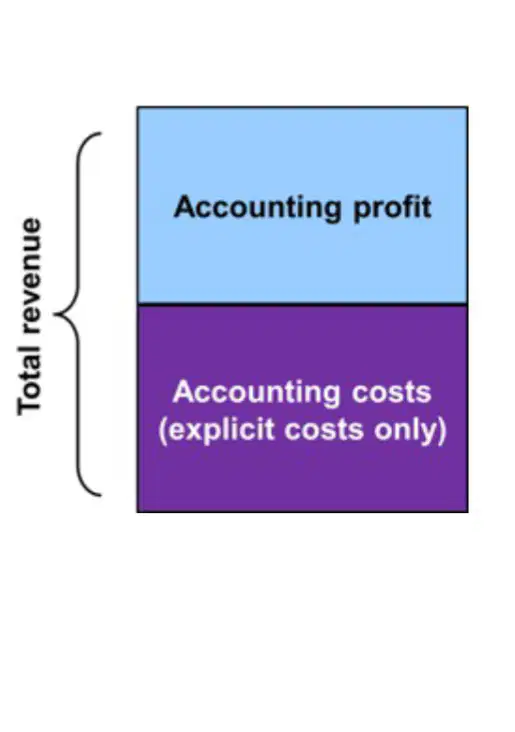
According to the diagram, accounting profit is calculated by subtracting which type of costs from total revenue?
Implicit costs only
Explicit costs only
Both explicit and implicit costs
Economic costs
What characterizes the short run in economic terms?
All inputs are variable.
Firms can enter and exit the industry.
Some variable inputs and fixed plant.
Fixed number of firms and variable plant size.
What characterizes the long run in economic terms?
Only some inputs are variable.
Firms cannot adjust plant size and All inputs are fixed.
Firms can adjust plant size as well as enter and exit industry and All inputs are variable.
Firms have a fixed plant size and All inputs are variable..
What is the formula for calculating Marginal Product (MP)?
Total Product ÷ Change in Labor Input
Change in Total Product ÷ Change in Labor Input
Total Product ÷ Units of Labor
Change in Total Product × Change in Labor Input
How is Average Product (AP) calculated?
Change in Total Product ÷ Units of Labor
Total Product × Units of Labor
Total Product ÷ Change in Labor Input
Total Product ÷ Units of Labor
What does the Law of Diminishing Returns state about resources and technology?
Resources and technology both vary.
Resources vary and technology is fixed.
Resources are fixed and technology varies.
Both resources and technology are fixed.
According to the Law of Diminishing Returns, what happens when variable resources are added to fixed resources?
Marginal product increases indefinitely.
Marginal product remains constant.
Marginal product will fall at some point.
Total product will fall immediately.
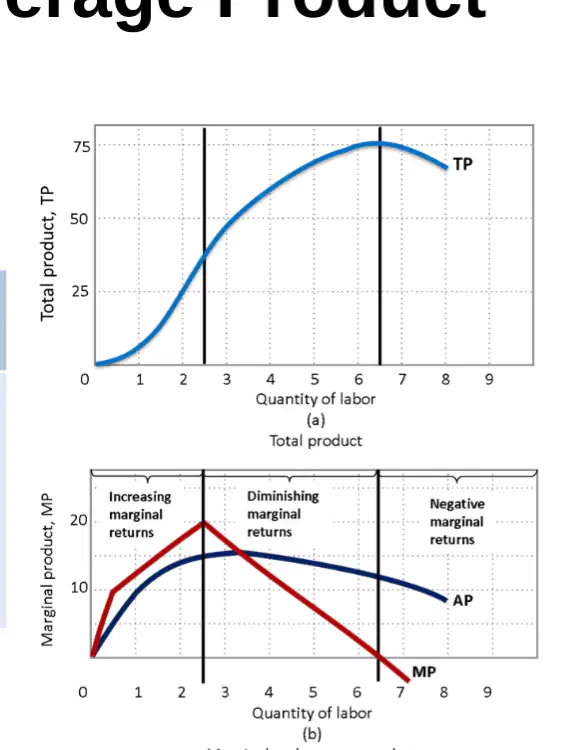
Based on the graph (b), during which stage does the average product (AP) start to decline?
When the quantity of labor is between 0 and 3
When the quantity of labor is between 3 and 5
When the quantity of labor is between 5 and 7
After the quantity of labor exceeds 7
Short-Run Production Costs
Fixed costs (TFC): Costs that do not vary with
output.
Variable costs (TVC): Costs that do not vary with
output.
Total cost (TC):
• TC = TFC + TVC.
Fixed costs (TFC): Costs that do not vary with
output.
Variable costs (TVC): Costs that do vary with
output.
Total cost (TC):
• TC = TFC + TVC.
Fixed costs (TVC): Costs that do not vary with
output.
Variable costs (TFC): Costs that do vary with
output.
Total cost (TC):
• TC = TFC + TVC.
Fixed costs (TFC): Costs that do vary with
output.
Variable costs (TVC): Costs that do not vary with
output.
Total cost (TC):
• TC = TFC + TVC.
What does AFC stand for in the context of per-unit costs?
Average Fixed Cost
Average Financial Cost
Annual Fixed Cost
Average Flexible Cost
How is Average Variable Cost (AVC) calculated?
AVC = TVC/Q
AVC = TFC/Q
AVC = TC/Q
AVC = MC/Q
What is the formula for calculating Average Total Cost (ATC)?
ATC = TC/Q
ATC = TFC/Q
ATC = TVC/Q
ATC = MC/Q
What does the symbol Δ represent in the Marginal Cost (MC) formula?
Total
Division
Change
Summation
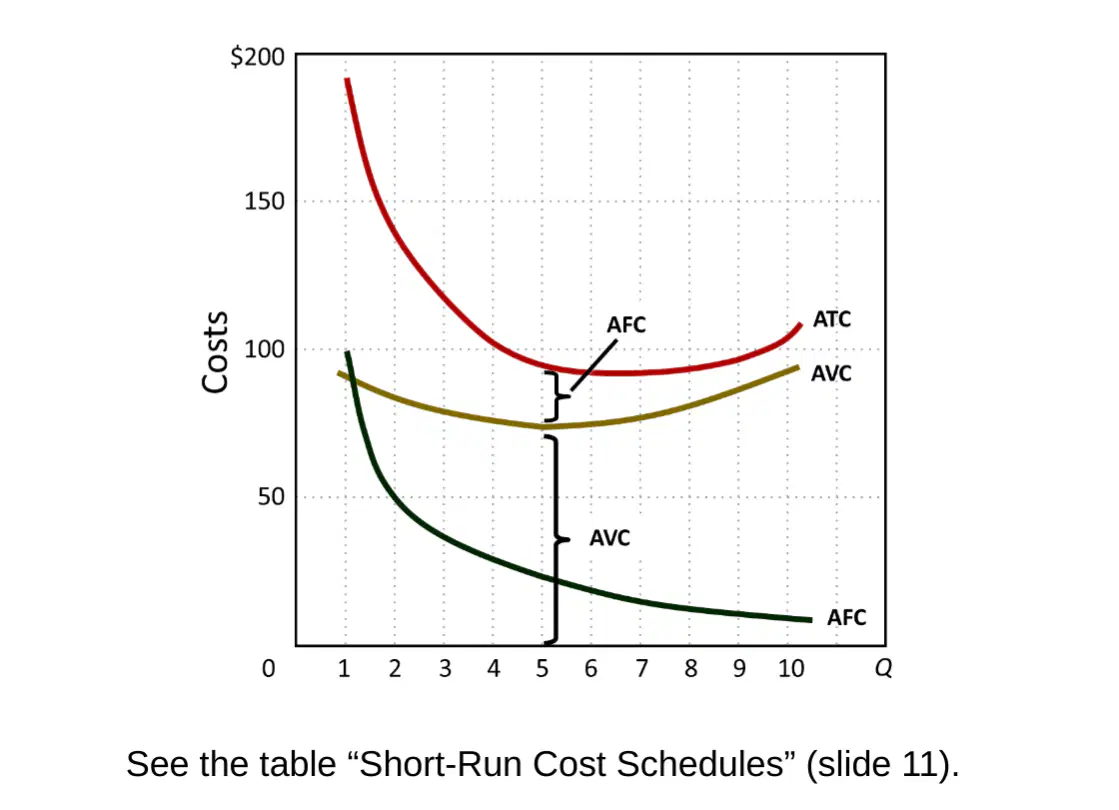
Which curve typically represents the Average Fixed Cost (AFC) in the short-run average cost curves diagram?
The curve that starts high and declines as Q increases, never touching the x-axis.
The curve that starts low and increases as Q increases.
The curve that starts at a medium level and declines as Q increases, eventually touching the x-axis.
The curve that remains constant as Q increases.
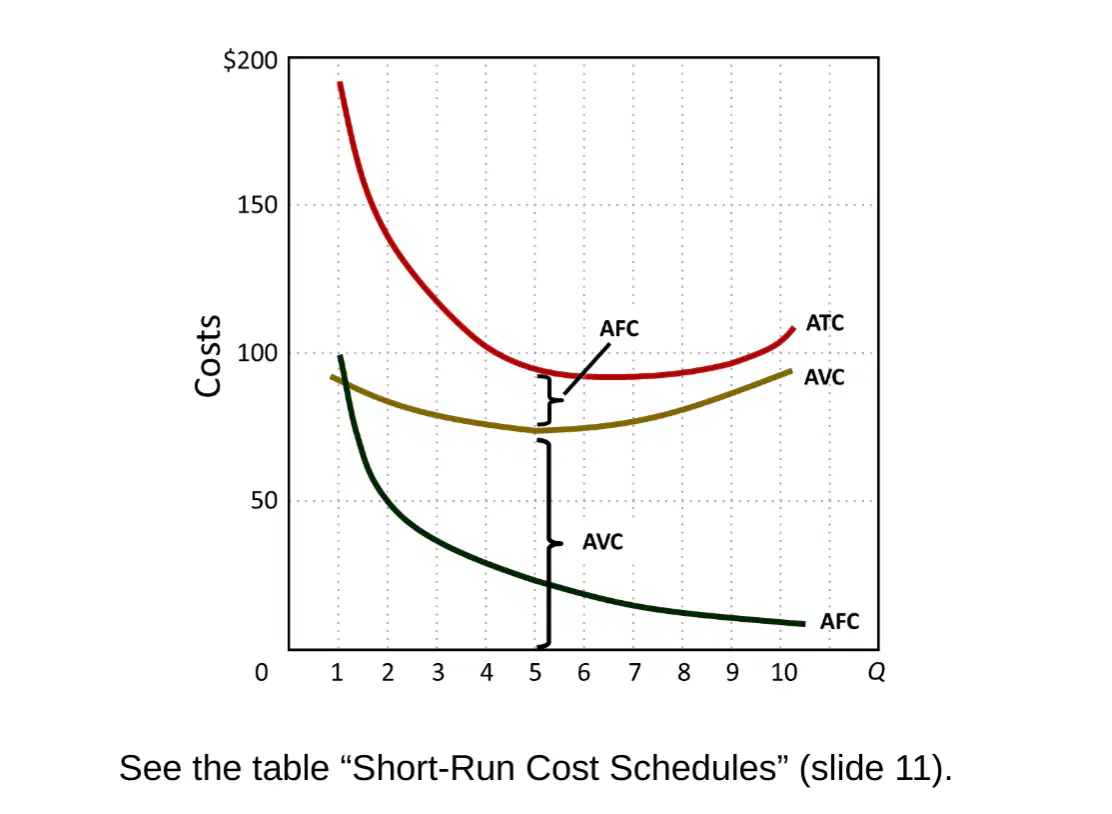
As the quantity produced (Q) increases, what happens to the Average Variable Cost (AVC) according to the diagram?
It decreases continuously.
It first decreases, reaches a minimum point, and then starts to increase.
It remains constant regardless of Q.
It increases continuously.
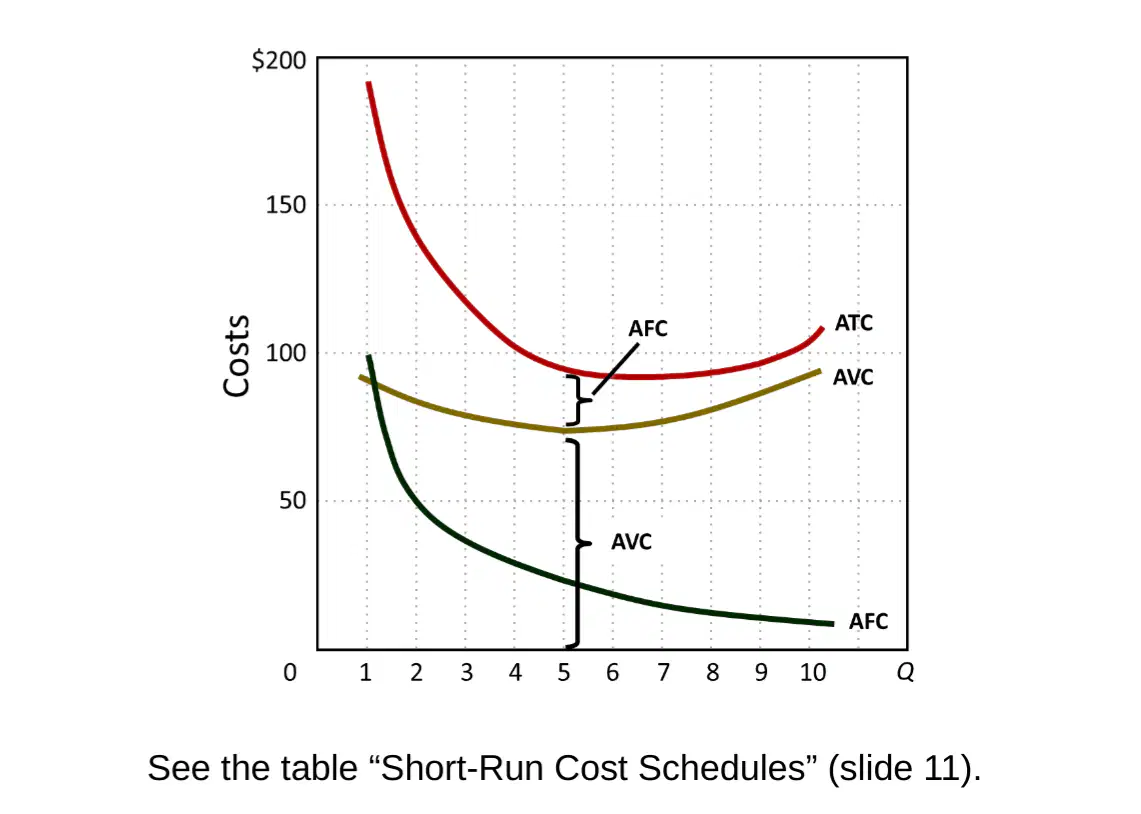
Which curve represents the Average Total Cost (ATC) in the diagram?
The curve that is always above the other two curves.
The curve that is always below the other two curves.
The curve that intersects with the other two curves.
The curve that remains constant as Q increases.
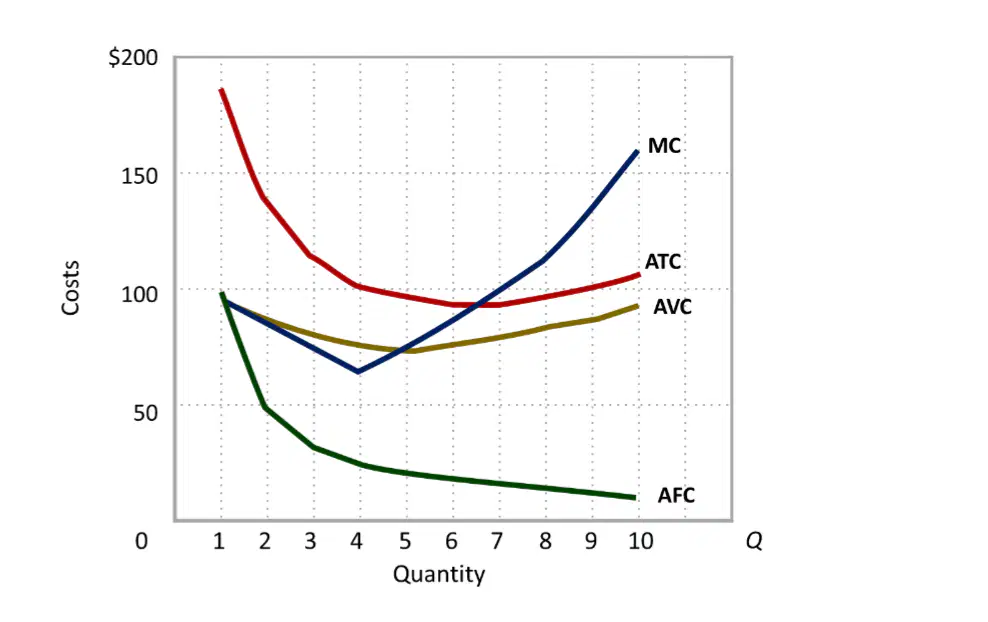
What does the MC curve in the diagram represent?
Average Total Cost
Average Variable Cost
Marginal Cost
Average Fixed Cost
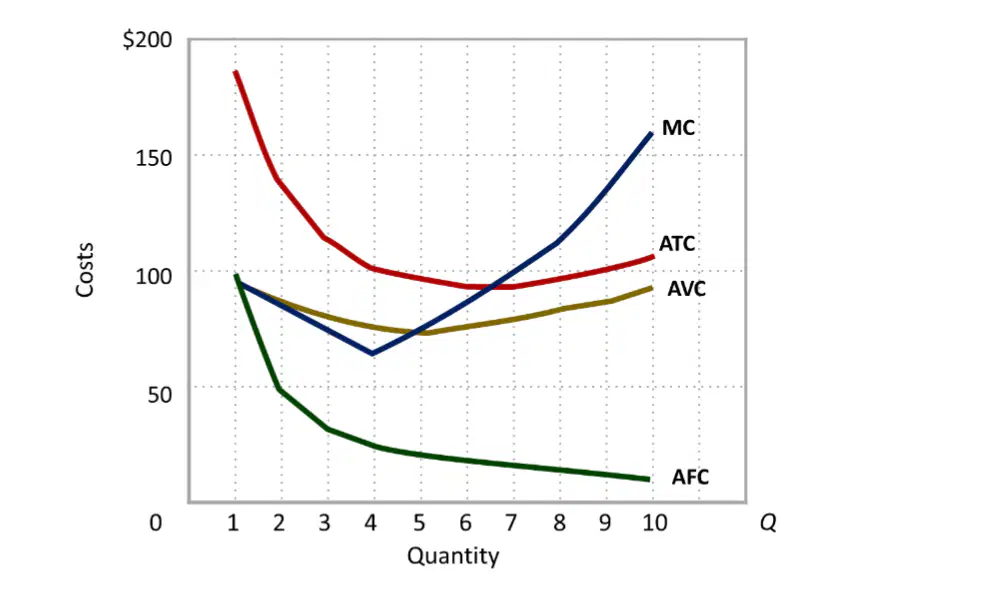
Based on the diagram, which cost curve always declines as quantity increases?
MC
ATC
AVC
AFC
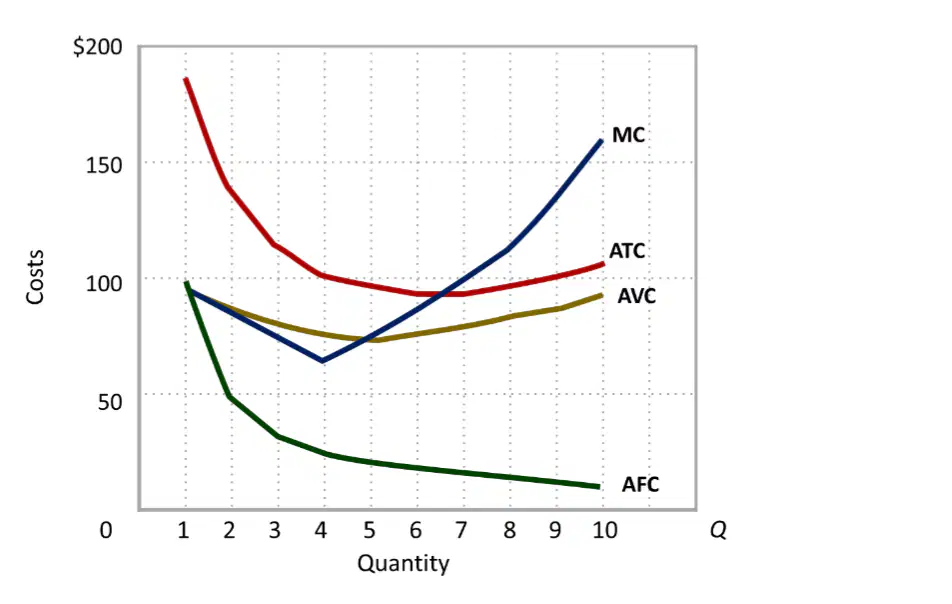
At what point does the MC curve intersect the ATC and AVC curves according to the diagram?
At the highest point of the ATC and AVC curves
At the lowest point of the ATC and AVC curves
At the midpoint of the ATC and AVC curves
The MC curve does not intersect the ATC and AVC curves
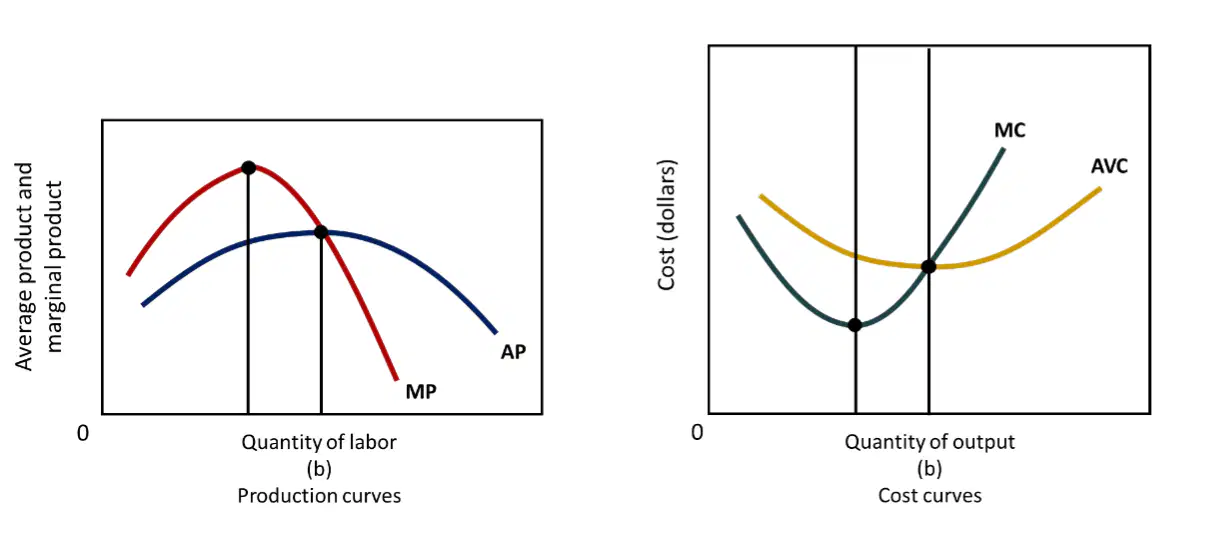
What does the acronym 'MC' stand for in the cost curves diagram?
Marginal Cost
Market Capital
Maximum Capacity
Monetary Compensation
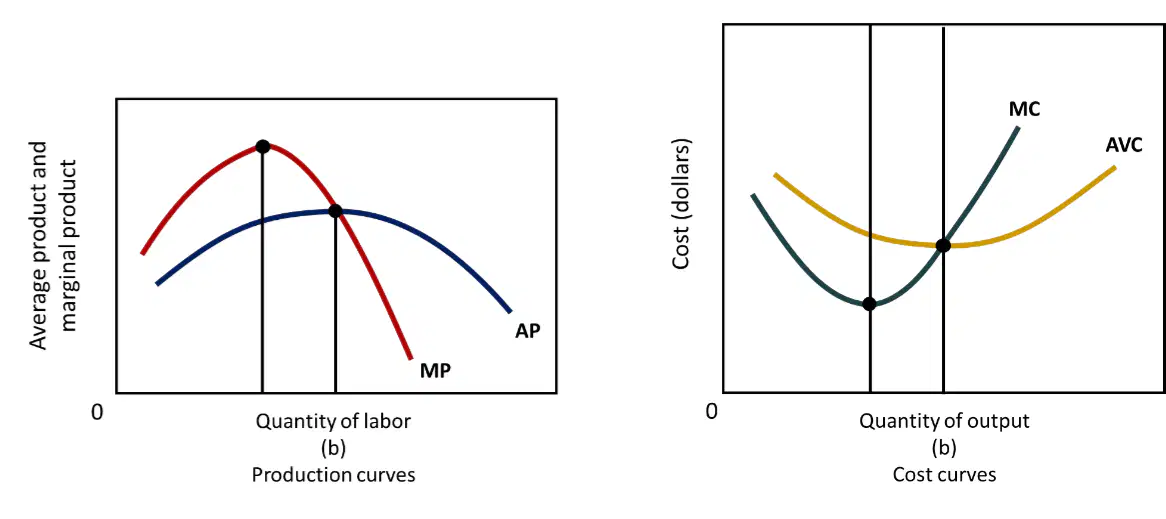
What does the acronym 'AVC' stand for in the cost curves diagram?
Average Variable Cost
Annual Value Change
Asset Valuation Coefficient
Average Venture Capital
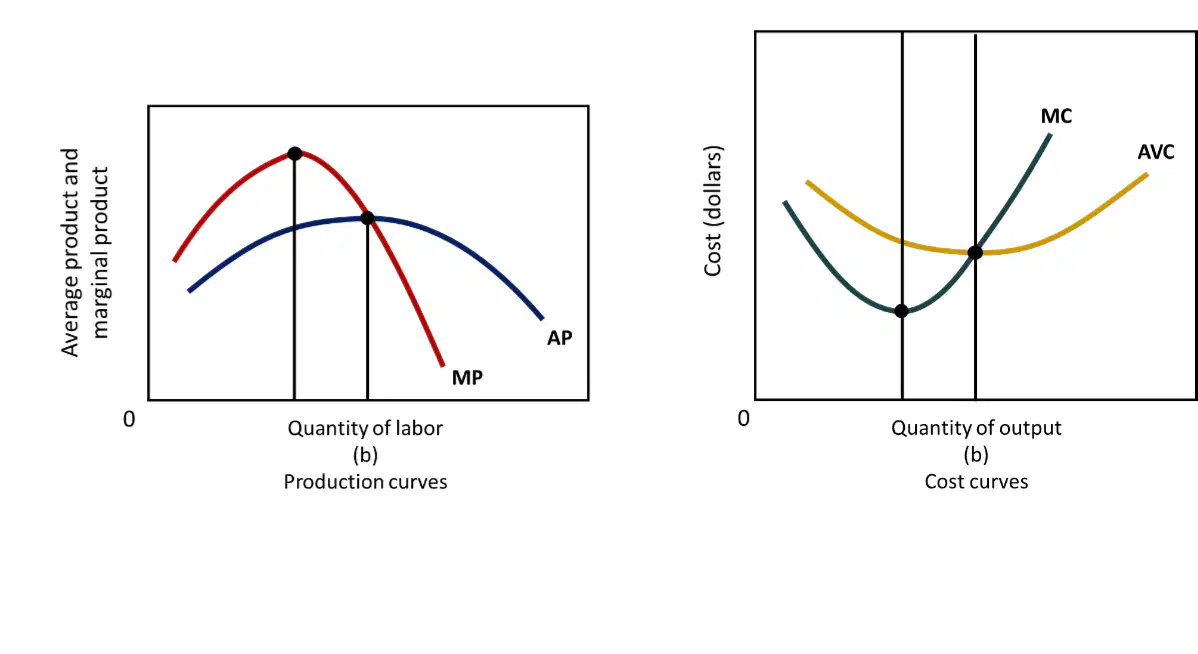
What does the acronym 'MP' stand for in the production curves diagram?
Marginal Product
Market Potential
Maximum Performance
Monetary Policy
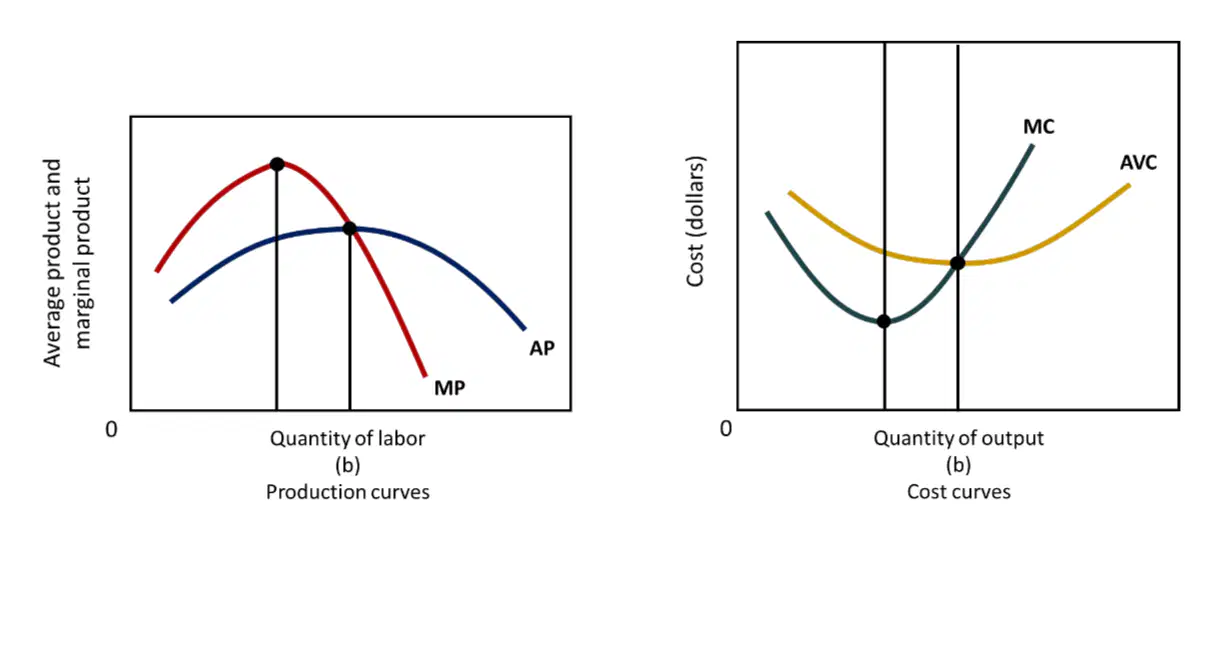
What does the acronym 'AP' stand for in the production curves diagram?
Average Product
Annual Profit
Asset Procurement
Aggregate Planning
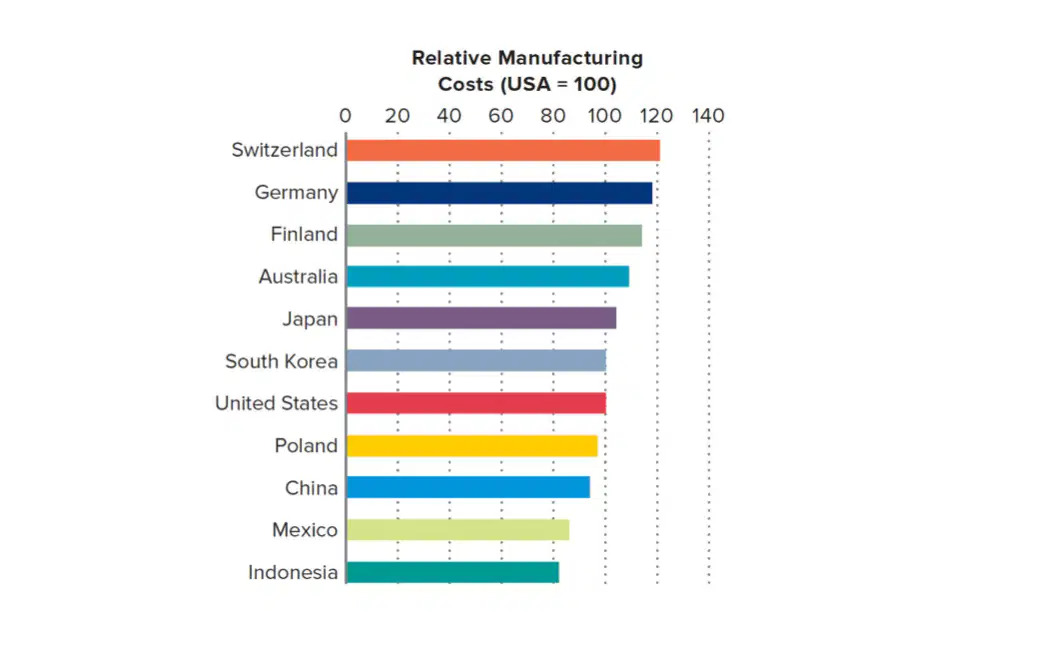
According to the graph, which country had the highest relative manufacturing costs in 2018?
Switzerland
Germany
United States
China
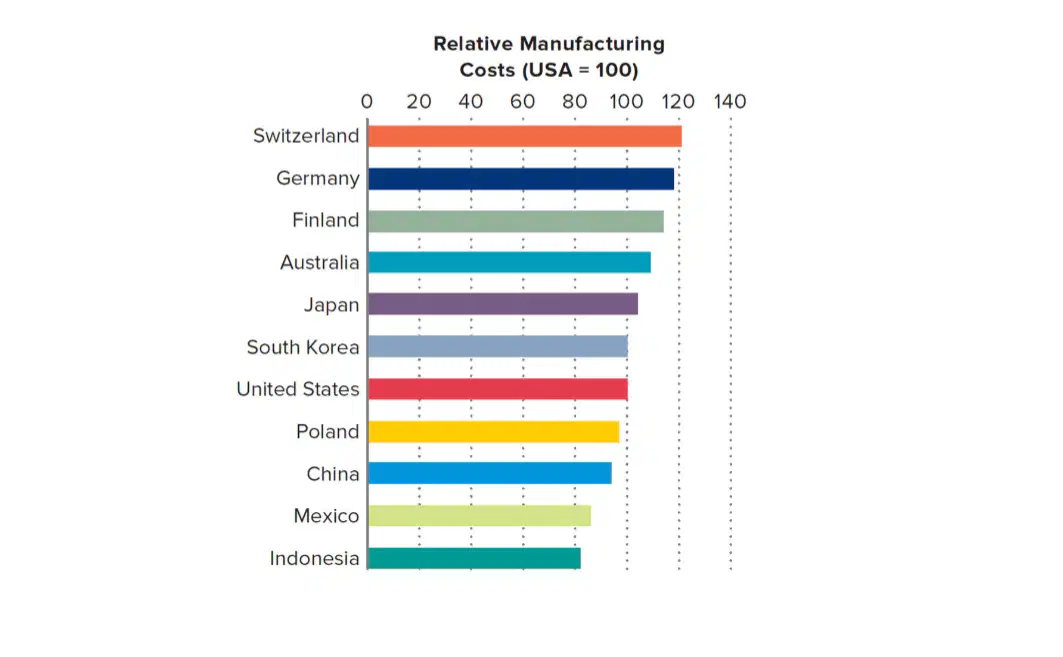
Which country is used as the baseline (100) for comparing relative manufacturing costs in the graph?
Switzerland
Germany
United States
Japan
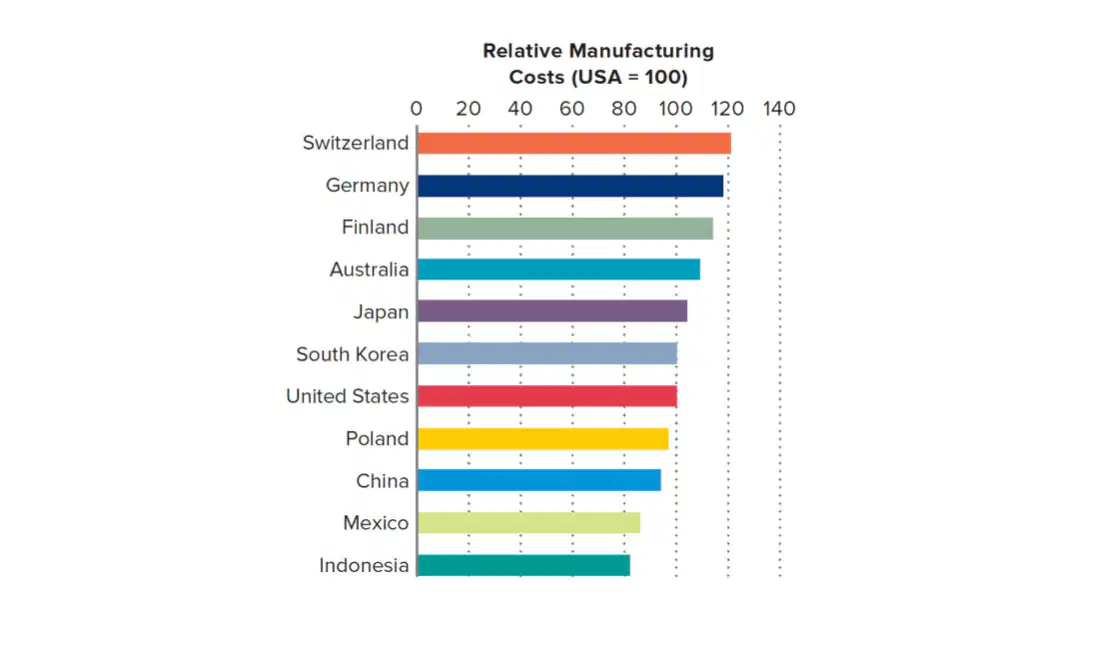
As per the graph, which of the following countries had lower relative manufacturing costs than the United States in 2018?
Japan
Finland
Mexico
South Korea
What can the firm change in the long run regarding production costs?
Only labor costs
Only raw material costs
All input amounts, including plant size
Only fixed costs
Are costs fixed or variable in the long run?
All costs are fixed
All costs are variable
Only labor costs are variable
Only capital costs are variable
What does Long-run ATC consider in terms of costs?
Marginal costs
Total fixed costs
Average total costs
Total variable costs
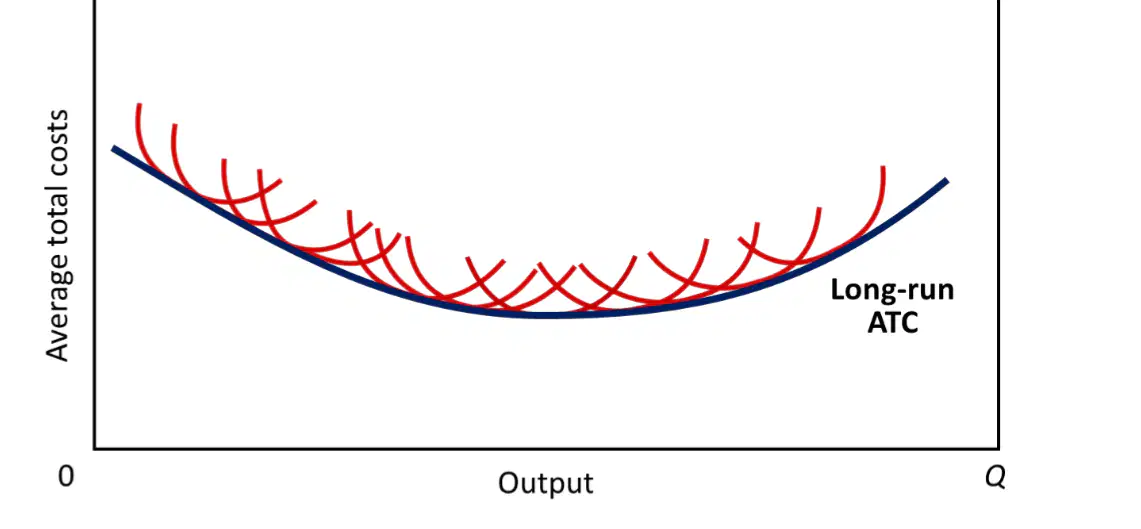
What does this graph represent
Marginal Cost Curve
Long-Run Cost Curve
Short-Run Cost Curve
Average Cost Curve
Short-Run Production Relationships
Total product (TP)
Marginal product (MP) =
Change in Total Product ÷ Change in Labor
Input
Average product (AP) =
Total Product ÷ Units of Labor
Total product (TP)
Marginal product (MP) =
Total Product ÷ Change in Labor
Input
Average product (AP) =
Total Product ÷ Units of Labor
Total product (TP)
Marginal product (MP) =
Total Product ÷ Labor
Input
Average product (AP) =
Total Product ÷ Units of Labor
Total product (TP)
Marginal product (MP) =
Change Total Product ÷ Change in Labor
Input
Average product (AP) =
Product ÷ Units of Labor
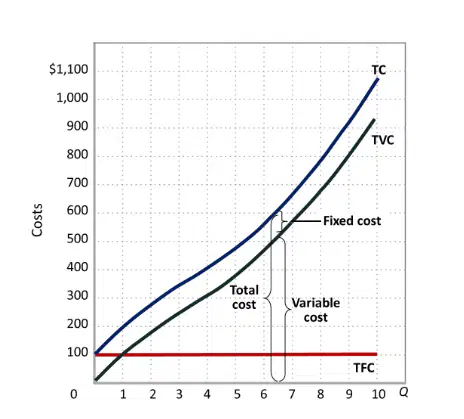
What does this graph represents
Short-Run Cost Curves
Long-Run Cost Curves
Average Cost Curves
Increasing Cost Curves
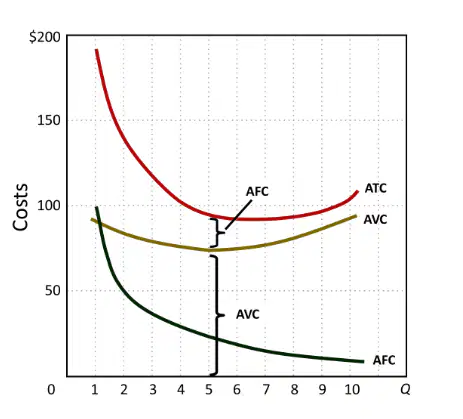
What does this graph represent
Long-Run Cost Curves
Short-Run Cost Curves
Average Cost Curves
Scattered-Run Cost Curves
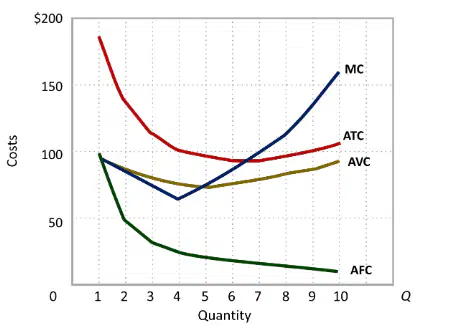
What does this graph represent
Average Cost
Short-Run Cost
Long-Run Cost
Marginal Cost

Finish the formulas
AFC = TFC/Q
AVC = TC/Q
ATC = TVC/Q
MC = ΔTC/ΔQ
AFC = TVC/Q
AVC = TFC/Q
ATC = TC/Q
MC = ΔTC/ΔQ
AFC = TFC/Q
AVC = TVC/Q
ATC = TC/Q
MC = ΔTC/ΔQ
AFC = TC/Q
AVC = TVC/Q
ATC = TFC/Q
MC = ΔTC/ΔQ
What is Production cost
Cost are incurred by a business when it manufactures a product and a service
Cost are incurred by a business when it provides a service
Cost are incurred by a business when it manufactures a product
Cost are incurred by a business when it manufactures a product or provides a service

