
 Worksheets
POF - Mock Exam
Total questions: 118
Worksheet time: 1hrs 5mins
What percentage of the atmosphere is Nitrogen
21%
100%
78%
1%
What is ISA sea level density?
1225 kg/m³
1.225 kg/m²
1.225 kg/m³
0.1225 kg/m²
What happens to air pressure with a gain in altitude?
Increases
No change
Decreases
Gains more energy
Select all values that are ISA values at sea level
15°C
1013.25 hPa
1.225 kg/m³
1013.25 Inches of Mercury
At approximately 18,000 - 20,000' what will the pressure be compared to sea level
The same as sea level pressure
75% of sea level pressure
25% of sea level pressure
Half of sea level pressure
Select all below that effect density altitude
Pressure
Speed
Weight
Humidity
Temperature
What attributes does a vector have?
Magnitude
Direction
Magnitude and Direction
Magnitude and Time
Which if these is NOT a SI unit?
Metre (m)
Kilogram (kg)
Watt (W)
Kelvin (K)
Knot (kn)
What is Newtons Second Law?
F = na
The external force acting on a body is proportional to the product of it’s mass and the acceleration produced by the force
The external force acting on a body is inversely proportional to the product of it’s mass and the acceleration produced by the force
Every object continues in its state of rest or of uniform motion in a straight line, unless acted upon by an external force
What is newtons Third Law?
For every action, there is an equal reaction felt 90° clockwise
For every action, there is an equal reaction felt 90° anticlockwise
The external force acting on a body is proportional to the product of it’s mass and the acceleration produced by the force
For every action, there is an equal and opposite reaction
Where does weight act through?
Centre of Pressure
Centre of Acceleration
Centre of Gravity
Centre of Weight
The upward movement of air at the LEADING edge is known as:
The total reaction
Upwash
Downwash
Leftwash
At the zero lift angle:
Negative lift is produced
A small amount of lift is produced
The aircraft will stall
No net lift is produced
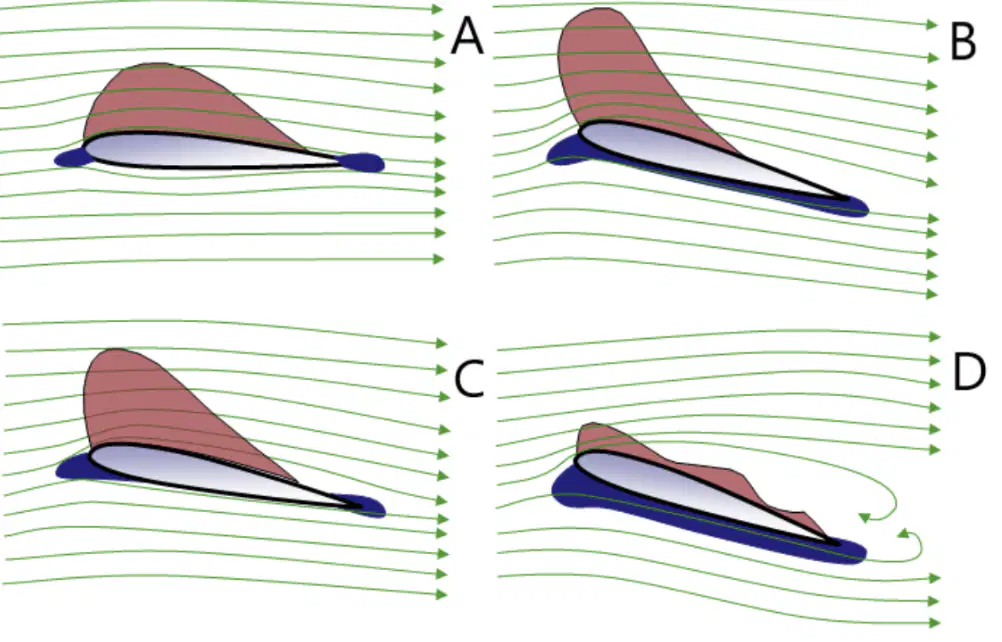
Which of the these pressure envelopes represents an aerofoil at the critical angle (16°)
A
B
C
D
Lift is:
The component of the total reaction acting inline with the RAF
The component of drag caused by friciton
The component of the total reaction acting inline with the RAF in the direction of motion
The component of the total reaction acting 90° to the RAF through the CoP
Which attributes would be considered an ideal aerofoil?
Select all that apply
High Max CL
Low Minimum Cd
Low Lift/Drag ratio
Large and stable movement of CoP
Sufficient Depth
What is aspect ratio?
Ratio of aircraft length to wingspan
Ratio of depth to length of an aerofoil
Ratio of main wingspan to tail plane span
Ratio of wingspan to chord of a wing
A rough surface condition will cause:
The separation and transition point to move rearwards
The separation point to move forwards but the transition point to move rearwards
The separation point and transition point to move forwards
CL to increase
Select all answers that make up the lift formula
CL
CD
½pV²
½pV
S

Which point on the graph would indicate CL max?
A
B
C
D
Total drag is made up of:
Zero lift drag - Lift dependent drag
Zero lift drag - Total drag
Lift dependent drag + Zero lift drag
Zero lift drag / Lift Dependent drag
Select all the options that will increase induced drag
Low Aspect ratio
Increased passengers
Increased weight
Increased AoA
The transition point is:
The point where the air within the boundary layer stops accelerating and becomes turbulent
The point where the air within the boundary layer become turbulent and starts accelerating
The point when the airflow detaches from the wings surface and becomes turbulent
The point with the airflow within the boundary layer becomes laminar and detaches from the wings surface
Induced drag is:
Proportional to V²
Proportional to V
Inversely proportional to V²
Inversely proportional to V
Washout:
Is the reduction of the angle of incidence at the wingroot. This reduces induced drag
Is the reduction of the angle of incidence at the wingtip. This increases induced drag
Is the reduction of the angle of incidence at the wingroot. This increases induced drag
Is the reduction of the angle of incidence at the wingtip. This reduces induced drag
What is the approximate depth of the turbulent boundary layer?
2mm
2m
20mm
20cm
Some methods to reduce induce drag are? (Select all that apply)
Tip tanks
WInglets
Wing fence
Washout
Windscreens
Skin friction drag is caused by
Sheer stress between successive layer of air
The mixing between converging airflows at the junction of various aircraft surfaces
The pressure differential between the forward are rear facing surfaces
Wingtip vortices
What type of drag does streamlining reduce?
Induced
Form
Skin friction
Interference
What is the ideal fineness ratio?
1:4
14
4:1
1 part length to 4 parts depth
Select all the factors that effect form drag
Surface Condition
Size
AoA
Speed
Zero lift drag (parasite drag) is:
Proportional to V
Inversely proportional to V
Proportional to V²
Inversely proportional to V²
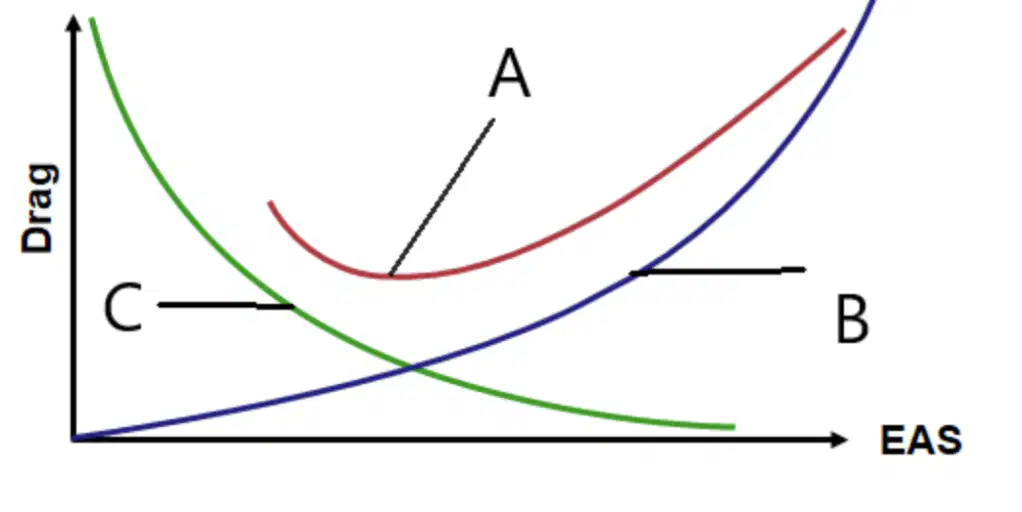
Which of the marked curves represents parasite drag (Zero lift)?
A
B
C
When the induced drag curve and parasite drag curve meet:
Minimum drag
Maximum L/D ratio
Best Glide Speed
Minimum induced drag
Minimum parasite drag
Slats are only used at:
High speeds
Low AoA
High AoA
Low speeds
The basic purpose of lift augmentation devices is:
To provide an increase in lift at high airspeeds
To provide an increase in lift at low airspeeds
To improve the lift to drag ratio
To decrease the amount to lift produces
How does lowering trailing edge flaps effect the CoP?
The CoP with move rearwards and towards the wingtips
The CoP will move rearwards and towards the wingroot
The CoP will move forwards and towards the wingroot
The CoP will not move until the final stage of flap is lowered. It will then move rearward and inward
With regards the the slots created my some leading and trailing edge devices select the correct statement:
Slots allow the spanwise flow another path from the lower surface to the upper surface reducing induced drag
Slots allow airflow to flow through them to the upper surface decreasing lift by decreasing the static pressure on the lower surface
Slots allow air to flow through them re-energizing the upper boundary layer delaying separation and increasing lift
Slots allow air to flow through them re-energizing the upper boundary layer promoting separation and increasing lift
The lift and weight forces form a couple:
True. A nose down couple
False
True. A nose up couple
Whats a couple
What is the purpose of the tail plane
Balance the passengers incase one is much heavier
Balance residual rolling moments
Balance residual pitching moments
Hold the elevator on
Select all the correct statements regarding gear:
Raising and lowering the gear will cause a nose up moment
Raising and lowering the gear will cause a nose down moment
Raising the gear will cause a nose up moment
Raising the gear will cause a nose down moment
Lowering the gear will cause a nose down moment
To maintain S&L flight, if the speed increases:
The AoA must be increased
S&L cannot be maintained if speed is increased
The AoA must be decreased
Flaps must be lowered
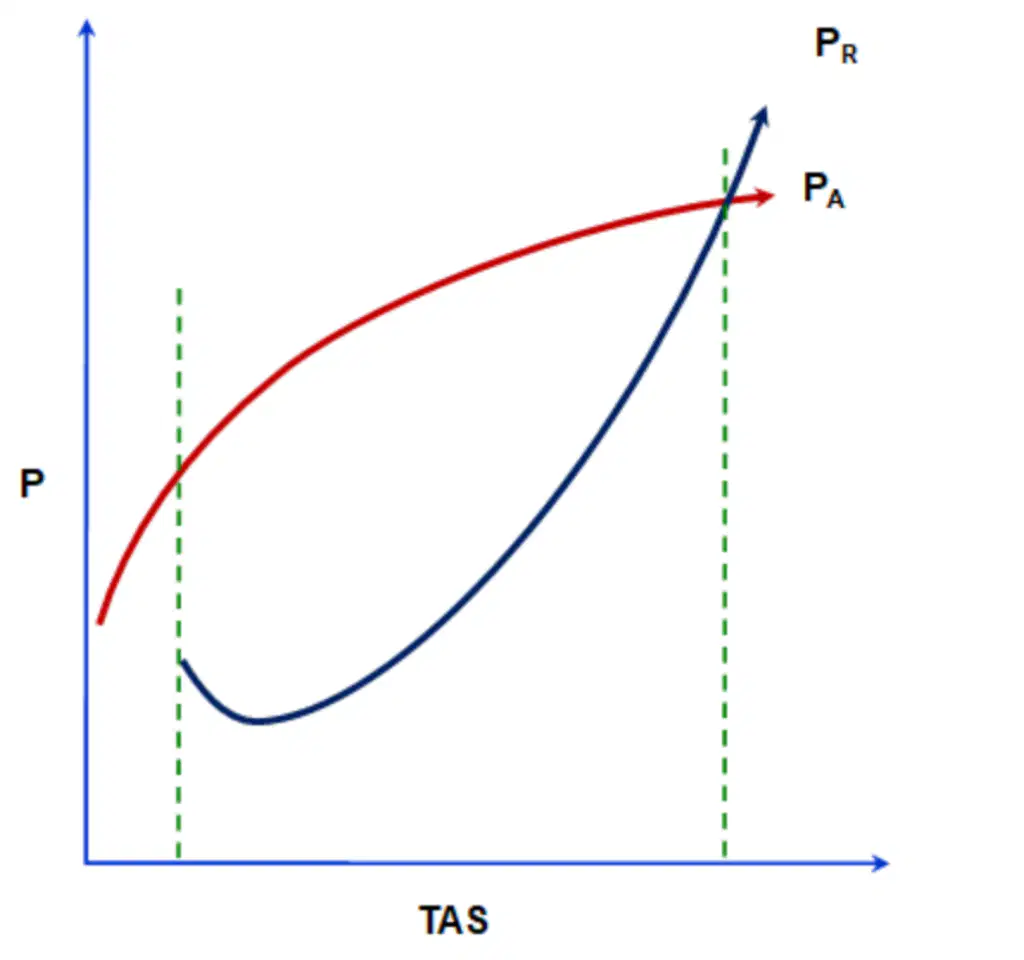
Considering this power available vs power required graph:
An increase in altitude would cause the Pr curve to move down. The Pa curve would move up.
An increase in altitude would have no effect
An increase in altitude will cause the Pr curve to move up and the Pa curve to move up
An increase in altitude will cause the Pr curve to move up and the Pa curve to move down
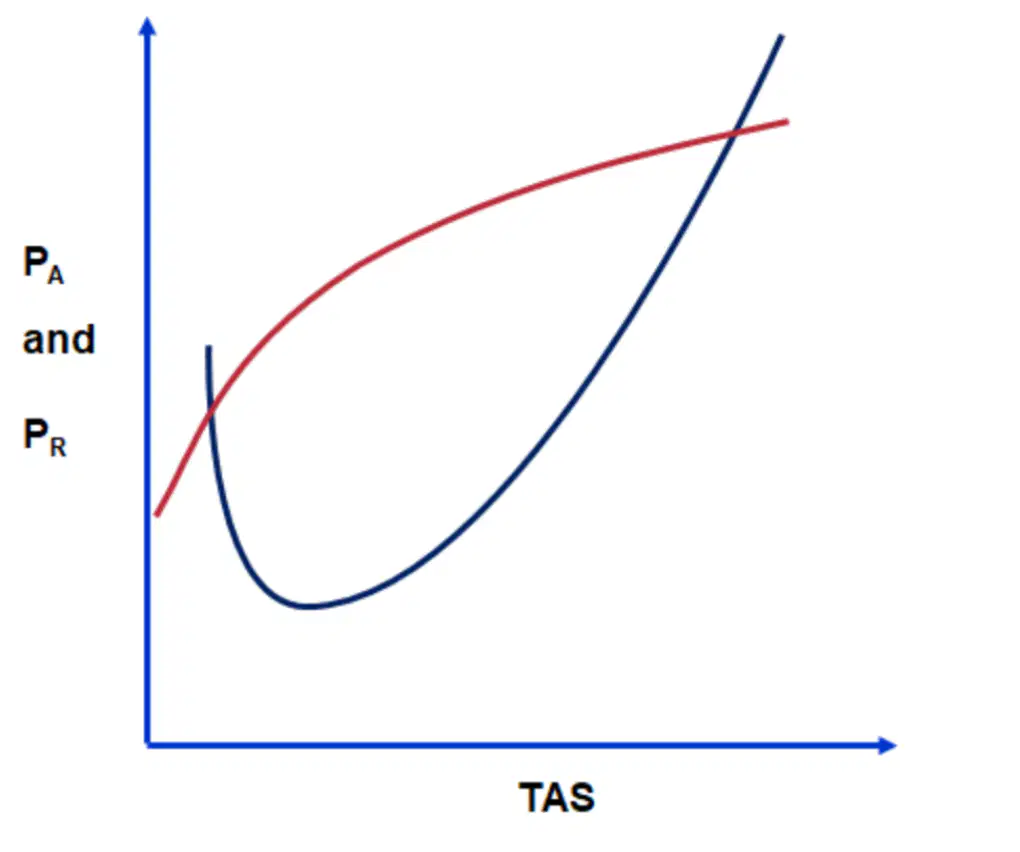
Consider the above graph. Where does the minimum speed for straight and level flight occur
At the greatest distance between the Pa and Pr curves
At 25% of the Pr curve
Cannot be found on this graph
When the Pa and Pr curves meet at the lower TAS
The power required versus TAS curve moves ________ as altitude is increased (aside from supercharging/turbo charging)
down and to the left
down and to the right
up and to the left
up and to the right
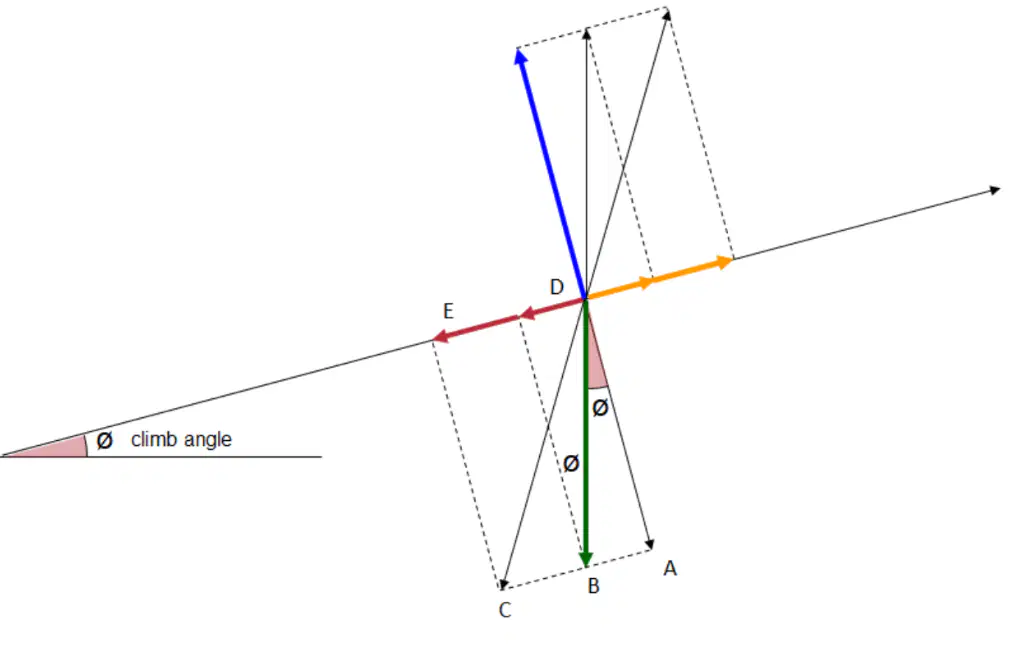
Identify D and E for this aircraft in a steady climb
Forward component of weight
Rearward component of weight
Drag
Lift
Weight
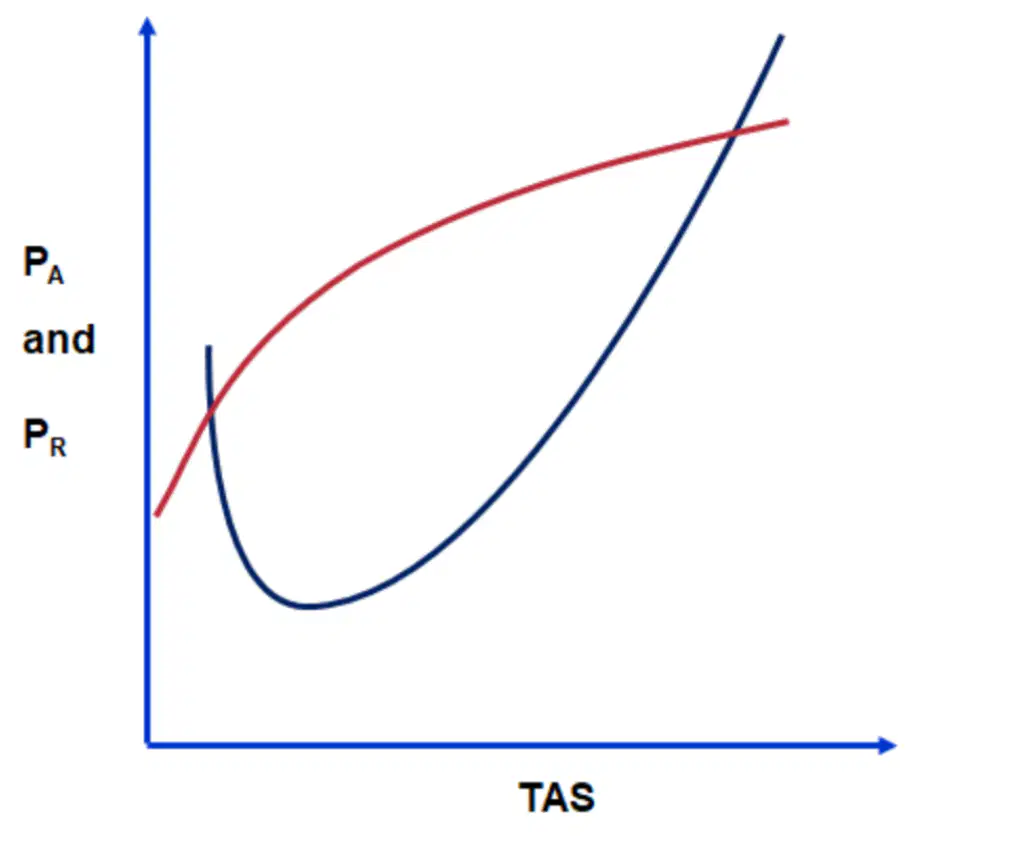
Where on the above curve would you find the maximum rate of climb?
hen the Pa and Pr curves meet
At the speed for minimum level flight
The biggest gap between Pa and Pr
The smallest gap between Pa and Pr
Define Vy
Greatest gain in height over a given distance
Greatest gain in height for a given speed
Greatest gain in height over a given amount of time
Greatest gain in height for a given amount of fuel
Define Vx
Greatest gain in height over a given horizontal distance
Greatest gain in height over a given amount of time
Greatest gain in height for a given amount of fuel
Greatest gain in height for a given vertical distance
Define absolute ceiling
The altitude where minimum power is required to maintain S&L
The altitude where 50% power is required to maintain S&L
The altitude where 75% power is required to maintain S&L
The altitude where full power will be required to maintain S&L
Define service ceiling
The altitude where full power is required to maintain S&L
The altitude where an aircraft can maintain a climb rate of 100fpm. This will be higher than an aircraft's service ceiling
The altitude where an aircraft can maintain a climb rate of 100fpm. This will be lower than an aircraft's absolute ceiling
The altitude where an aircraft can maintain a climb rate of 100fpm. This will be the same level as an aircraft's absolute ceiling
Select all the factors that will decrease climb performance:
2 stages of flap
Increased altitude
Gear down
Increased weight
Increased temperature
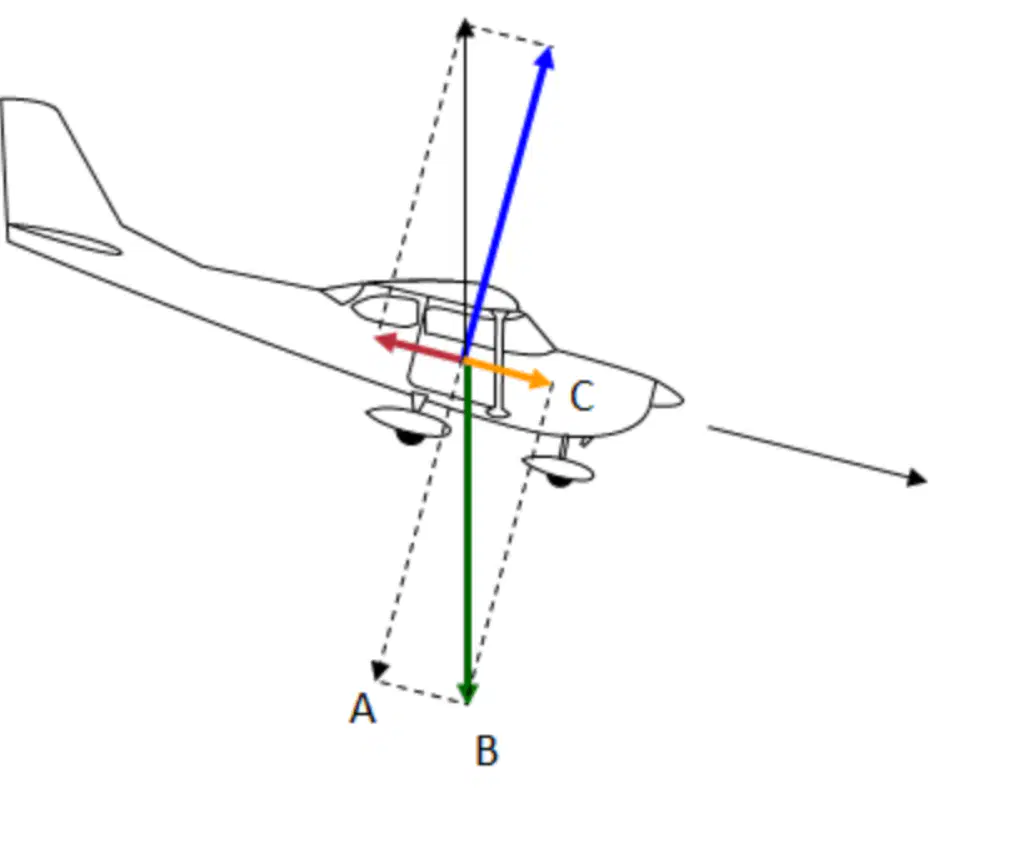
Identify A, B and C for this aircraft in a glide
Lift
Thrust
Weight
Weight 1
Forward component of weight

Identify A, B and C for this aircraft in a glide
Rearward component of weight
Lift
Drag
Resultant 1
Total reaction
An aircraft is in a glide at its best lift/drag ratio. The pilot decides to increase speed to try and glide to a paddock further away. Select the correct statement:
The pilot is more likely to glide to the new paddock because the lift/drag ratio has been increased
The pilot will get to the paddock faster
The pilot is less likely to glide to the new paddock as the aircraft has moved away from the best lift/drag ratio
The pilot is less likely to make the paddock but the lift/drag ratio has improved
Two aircraft of the same type are gliding. Aircraft 'A' is lighter than aircraft 'B'. Select the correct statement:
Aircraft 'A' will glide a greater distance than aircraft 'B'
Aircraft 'B' will glide a greater distance than aircraft 'A'
Both aircraft 'A' and 'B' will glide the same distance but aircraft 'B' will have a steeper glide angle
Both aircraft 'A' and 'B' will glide the same distance but aircraft 'B' will be gliding at a higher airspeed to maintain best lift/drag ratio
A powered on descent will (assume a constant airspeed):
Be steeper as the power is pulling the aircraft down
Be shallower as the pilot will have to raise the nose to maintain airspeed
A descent is no effected by power only by the amount of drag acting on the aircraft eg. flap setting
Will require an increase in flap to balance out thrust
In a powered on descent what balances drag? (Select all that apply)
Lift
Weight
Thrust
Weight 1
Forward component of weight
At the stall angle the separation point:
Moves forwards
Moves rearwards
Remains stationary
Will move to the stagnation point
Describe basic stall speed
VS1 - The stall speed with no power and no flap
VS0 - The stall speed with no power and no flap
VS1 - The stall speed with no power and full flap
VS0 - The stall speed with full power and no flap
The only way to remedy a stall is:
Lower AoA (nose down)
Adding power
Adding correct rudder
Being a good pilot and not stalling
An increase in aircraft weight will do what to the stall speed?
Increase stall speed due to the reduced requirement for lift
Increase stall speed due to the CoP moving past the CoG
Increase stall speed due to the increased requirement for lift
Reduce stall speed because the aircraft has more potential energy
I am flying in my plane with a stall speed of 50kts, however I decide to have so fun and show my passengers what 2G (max rate) would feel like. What is my new stall speed?
50
60
70
100
Which instrument give a reliable indication of spin direction?
Airspeed indicator
Altimeter
Artificial horizon
Turn coordinator
Select those that make up the standard recovery from a spin
Power - Full
Ailerons - Central
Rudder - Opposite direction of spin
Elevator - ease forward to break stall once rotation has stopped
Power - Close
The turning force acting on the aircraft is called:
Centrifugal Force
Centripetal Drag
Centrifugal Drag
Centripetal Force
Load factor is:
An increase in weight
An increase in apparent speed
An increase in apparent weight
A decrease in apparent weight
Load factor in a turn can be found using:
1/Cos AoB²
1/Cos AoB
1/Sin AoB²
1/Sin AoB
I am in a steep turn, what is the load factor experienced?
1
1.4
2
2.4
To make a maximum rate/minimum radius turn the aircraft should be flown at:
AoA for CLmax and at VS1
AoA for CLmax and at normal cruise speed
AoA for CLmin and VS1
AoA for CLmax and at Va
What angle of bank do I need to hold to get a rate one turn if my airspeed indicator shows 117kt, my ground speed shows 134kt and I have a tailwind from the South East?
18º
11º
3º
5º
For a given AoB an aircraft in a descending turn will:
Select all the apply
Have a decreased rate of descent
Have an increased rate of descent
Over bank because the outer wing is traveling faster
Under back because the inner wing has a higher AoA
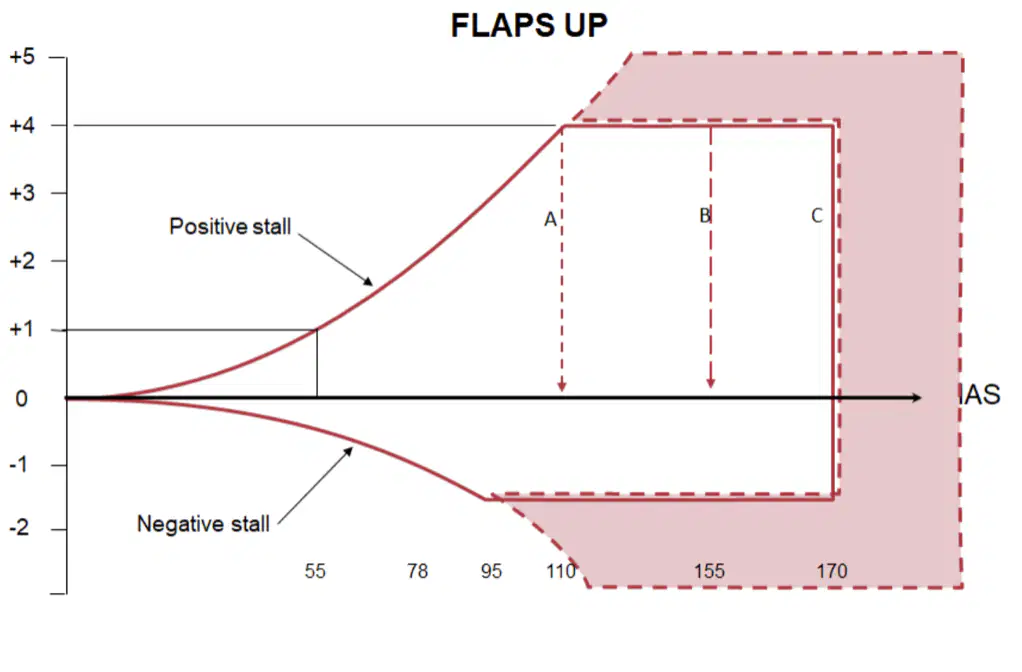
What does the line labeled 'C' represent?
Va
Vne
Vs1
Vn
Blade angle is:
Angle between the chord line and the plane of rotation
Angle between the blade back and the plane of rotation
Angle between the chord line and RAF
Angle between the RAF and the blade back
The angle between the RAF and the plane of rotation is known as:
AoA
Blade angle
Helix angle
Angle of incidence
The most useful thrust is produced at approximately:
50% to blade radius
25% blade radius
75% blade radius
The entire blade radius assuming the propeller is twisted to maintain best AoA
In an aircraft with a CSU what is the correct technique to increase power?
Pitch/Rich/Power
Power/Pitch/Rich
Rich/Pitch/Power
Power/Rich/Pitch
If you put your CSU aircraft into a climb without adjusting the throttle, what will happen?
The CSU will fine the blade
The CSU will coarsen the blade
The CSU will alert the pilot
Nothing will happen unless you change it
What will happen to the propeller pitch in an aircraft fitted with a CSU if the pilot increases the manifold pressure?
The propeller pitch will fine in order to absorb more power
The propeller pitch will coarsen in order to absorb less power
The propeller pitch will fine in order to absorb less power
The propeller pitch will coarsen in order to absorb more power
Aerodynamic twisting moment will always act to fine the blade:
True
False
The asymmetric blade effect is caused by:
The up going blade traveling a greater distance
Asymmetric blade effect is only a factor on multi-engine aircraft
The down going blade traveling a greater distance
The tips of the blade traveling faster than the speed of sound
With the propeller feathered:
Maximum drag is produced and no net torque is produced
Minimum drag is produced and no net torque is produced
Is the pitch setting for best cruise speed
Will increase the drag and reduce glide range
When operating in the pitch range for reverse thrust the propeller torque:
Is acting in the same direction as for windmilling flight
Is acting in the opposite direction as normal flight
Is acting to oppose engine torque
Is acting 90° to the plane of rotation
What are the primary flight controls? (Select all that apply)
Rudder
Aileron
Flaps
Elevator
To roll the aircraft left how will the ailerons be deflected?
Left aileron will move down and the right aileron will move down
Left aileron will move up and the right aileron will move up
Left aileron will move down and the right aileron will move up
Left aileron will move up and the right aileron will move down
How do you increase slipstream?
Fly faster
Fly slower
Higher power setting
Lower power setting
Trim tabs:
Relieve control pressures. If back stick pressure is required, move the trim wheel forwards
Relieve control pressure. If forward stick pressure is required, move the trim wheel backwards
Increase control pressure. If forward stick pressure is required, move the trim wheel forwards
Relieve control pressures. If forward stick pressure is required, move the trim wheel forwards
What is the purpose of mass balancing?
Eliminate flutter by moving the CoG of a control closer to the hinge line
Eliminate flutter by moving the CoG of a control further from the hinge line
Eliminate flutter by moving the CoG of a control further from the hinge line
Increase flutter by moving the CoG of a control closer to the hinge line
Flutter is caused by?
CoG to far rearwards
CoG to far forwards
CoP to far rearwards
CoP to far forwards
What is the difference between a balance tab and an anti-balance tab?
Select all that apply
Balance tabs move in the same direction and anti-balance tabs move in the opposite direction of the main control surface
Anti-balance tabs reduce control pressures where as balance tabs increase control pressures
Balance tabs move in the opposite direction and anti-balance tabs move in the same direction of the main control surface
Anti-balance tabs increase control pressures where as balance tabs reduce control pressures
Define flying for endurance:
Flying for the greatest amount of time for the most fuel used
Flying for the greatest distance in the shortest amount of time
Flying for the greatest distance in the longest amount of time
Flying for the greatest amount of time for the least fuel used
The best conditions for maximum SAR are:
Lowest weight
Flying at minimum drag speed
Increased altitude (Only effects best IAS)
Decreased altitude (Only effects best IAS)
Select two types of stability
Weight stability
Static stability
Dynamic stability
Elevator stability
Static stability refers to:
The intermediate reaction of a disturbed object
The subsequent reaction of a disturbed object
The initial reaction of a disturbed object
The last reaction of a disturbed object
Which aircraft axis does lateral stability refer to?
Lateral
Normal
Lateral stability only refers to helicopters
Longitudinal
Select the conditions required for dutch roll:
Strong lateral stability
Strong directional stability
Weak lateral stability
Weak directional stability
Strong longitudinal stability
Good cross wind landing technique:
Involves crabbing to counter drift caused by wind
Involves lowering the windward wing to counter drift caused by wind
Involves decreasing approach speed to lower the effect of the cross wind
Involves using both the crab method and the wing down method to achieve the best result
Which is more stable on the ground?
Tricycle type
Tailwheel type
The critical engine:
Is the engine with the longest moment arm between the engine and CoG
Will be the left engine if the propeller rotates anti-clockwise
Is the engine with the shortest moment arm between the engine and CoG
Will be the right engine if the propeller rotates clockwise
The yawing moment is caused by:
Increased drag on the live engine
Incorrect rudder usage
Increased weight on the side of the failed engine
The thrust line will become offset from the CoG
A quick way to remember how to identify the failed engine is:
Dead leg working engine
Working leg working engine
Working leg dead engine
Lazy leg working engine
Vmca is
The minimum control speed airborne. Based on full rudder and no more than 10° AoB
The minimum control speed airborne. Based on half rudder and no more than 10° AoB
The minimum control speed airborne. Based on half rudder and no more than 5° AoB
The minimum control speed airborne. Based on full rudder and no more than 5° AoB
Select all the methods of maintaining a constant heading under asymmetric flight:
Using only rudder
Using only bank
Using only pitch
Using rudder and bank
TODA is:
TORA - Clearway
TORA + Clearway
The length of runway suitable for the landing run of an aircraft
The clearway available
Climb gradient is the:
Ratio of height gained over a horizontal distance
Ratio of height gained in a given time
Ratio of height gained over a vertical distance
Ratio of height gained over any trees or other obstacles obstructing the take off path
A runway has 1000m TORA under part 135 how much can you plan to use?
1000m
850ft
500m
850m
If completing a P-Chart for runway 020 and the reported wind is 200°/5 knots what must you use for the P-Chart
10 knots of headwind
5 knots of tailwind
10 knots of tailwind
7.5 knots of tailwind
The screen height for large and commuter aircraft may be:
35m
50m
50ft
35ft
Select all the options that will effect takeoff performance
Density Altitude
Tailwind
Headwind
Slope
Weight
LDR means:
The horizontal distance where the aeroplane can be brought to a complete stop with maximum breaking
The length of runway that is declared by the airfield operator as available and suitable for the ground run of an aeroplane
Longest Distance Required
The horizontal distance where the aeroplane can be brought to a complete stop with maximum breaking. Measured from 50' above the threshold
Using the 152 PChart.
I am taking off out of an aerodrome which I calculated to have a pressure altitude of 1000ft, it comes with a 0.5 downslope 506m paved runway. I grabbed the ATIS and it told me it is 16ºC and I could calculate the total headwind to be 10kts.
Under New Zealand law, what is the take off distance required and can we legally depart from this runway?
422m, no
422m, yes
500m, no
500m, yes

Using the graph in the question.
The ensure the required legal clearance over terrain we must continue our flight at 4000ft. The OAT states it is 2ºC at the 4000ft. What is the maximum weight the aircraft can be in order to maintain a 1% climb gradient if one engine fails.
4010lbs
4010kgs
3820lbs
3770kgs
If your propeller is windmilling what happens to the ATM and CTM forces?
Select all that apply
ATM will act to fine the blade
ATM will act to coarsen the blade
CTM will act to fine the blade
CTM will act to coarsen the blade

Use the data in the image to help answer the question.
You used a tabulated PChart you calculated your landing distance to be 1490ft. What is your new landing distance if the grass runway you are landing on has no slope?
(give your answer in metres)
1758m
454m
518m
536m
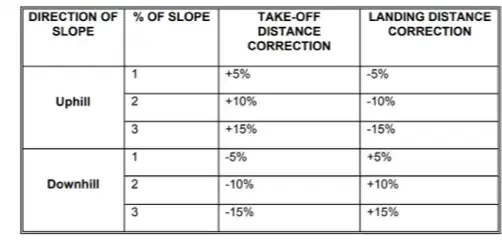
Use the table provided to assist you in answering the question.
You have calculated a landing distance of 311m, but you have to correct for the 0.36D slope of the runway. What will be your new landing distance?
327m
295m
317m
305m
What do Eddies and Swirls over the surface of an aerofoil indicate?
Turbulent Layer
Seperation point
No air is touching the surface of the aerofoil
Approaching stall

Using the table provided.
What is the ground roll required to takeoff on the grass runway at a given aerodrome when our take off weight is 1670ft, pressure altitude was calculated to be 4000 ft and a temperature of 23ºC the wind blowing has given us a total headwind component of 18kts.
1127 ft
1296 ft
1166 ft
1127 m

What is the 'X' representing in the image?
Torque
Thrust
Lift
AoA

