
 Worksheets
MDA Level 3 Quiz
Total questions: 33
Worksheet time: 19mins
A relaxing and welcoming environment is necessary:
to ensure optimum client comfort
to ensure the therapist is comfortable
to fulfil health and safety requirements
to fulfil insurance requirements
If a mole is present on the skin in the area being treated, the therapist should:
refuse to treat the client
seek GP approval
work around the mole
work over the mole
Which of the following may prevent microdermabrasion treatment?
Recent botox (over 6 weeks)
Recent chemical peel (over 6 weeks)
Steroid medication
Telangiectasia
A microdermabrasion treatment can:
decrease cellular function
increase muscle tension
reduce fine lines
stimulate melanin production
The protective barrier layer of the skin take approximately:
one day to restore after a microdermabrasion treatment
two days to restore after a microdermabrasion treatment
three days to restore after a microdermabrasion treatment
four days to restore after a microdermabrasion treatment
The purpose of COSHH is to:
control first aid at work
control hazardous substances
control infectious diseases
control the correct handling stock
The type of insurance that protects against the consequences of death or injury to a third party while on the premises is called:
public liability insurance
product liability insurance
employer’s liability insurance
professional indemnity insurance
Future treatment recommendations for a client who experiences skin sensitivity following microdermabrasion may be to:
apply make-up afterwards and leave longer between appointments
reduce the vacuum pressure and shorten the treatment time
change to a chemical peel and apply soothing products
cancel further treatments and advise them that they are unsuitable
Immediately following a treatment, it is advisable to:
apply an exfoliating mask
apply healing products
have a facial massage
have a hot shower
Exposure to UV should be avoided following a treatment for up to:
1 week
4 days
2 weeks
4 weeks
The skin's protective acid mantle is comprised of:
collagen and elastin
fibroblasts and keratin
melanin and erythrocytes
sebum and sweat
Which of the following should be done immediately after a microdermabrasion treatment?
Apply healing products
Apply an exfoliating mask
Have a facial massage
Take a hot shower
A pink, purplish birthmark, often found on the face is called:
chloasma
lentigo
naevus
vitiligo
Acne vulgaris is caused by:
a bacterial infection
a congenital infection
a fungal infection
a viral infection
An oily skin may suffer from:
broken capillaries
reduced pigmentation
sallow colouring
hydrated areas
Signs of congested skin may include
blemishes and uneven skin
fine lines and wrinkles
pale skin with flakiness
smooth skin with small pores
Skin that reacts easily to products is defined as:
combination
dry
normal
sensitive
The growth cycle of the skin through the epidermal layers takes approximately:
14 days
28 days
42 days
56 days
Keratinocytes are produced in the:
stratum corneum
stratum germinativum
stratum lucidum
stratum spinosum
The natural ageing process of the skin results in:
improved blood circulation
increased sebaceous activity
reduced sweat production
tightened muscle tone
Which of the following may have a detrimental effect on the skin?
Drinking water
Good sleep patterns
Regular exercise
Taking medication
A client who has worked outdoors for many years may experience:
excessive oily skin
improved skin repair
increased collagen production
premature ageing skin
One effect of a microdermabrasion treatment is to:
decrease cellular function
improve skin texture
enhance melanin production
improve muscle tension
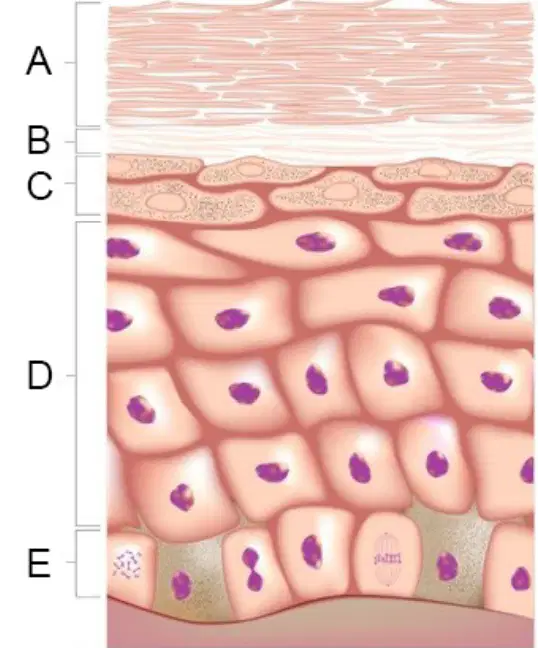
What layer of the Epidermis is labelled B?
(a)
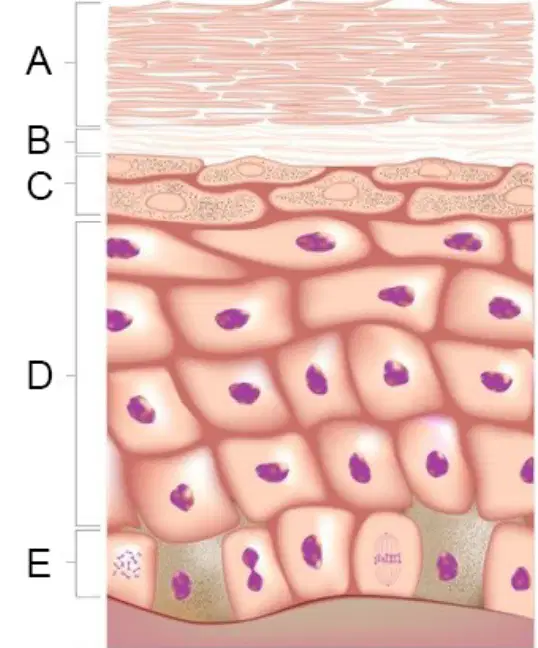
What layer of the Epidermis is labelled, D?
(a)
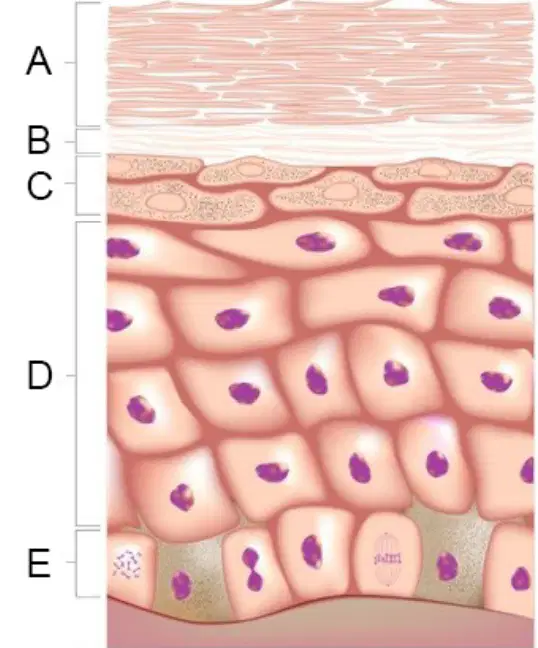
What layer of the Epidermis is labelled, A?
(a)
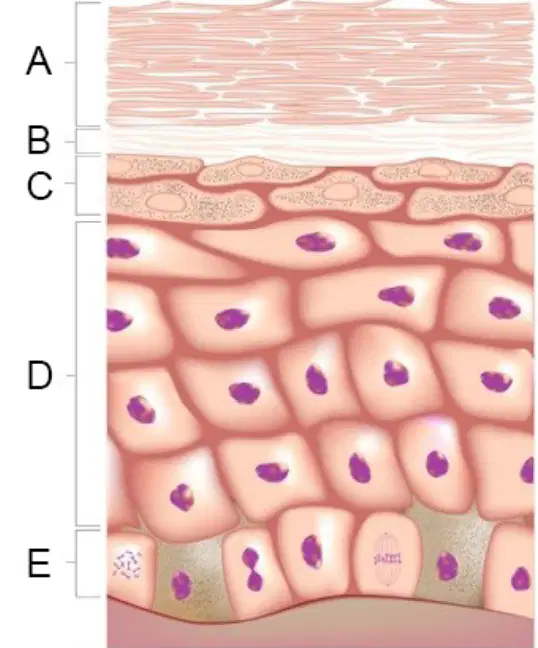
What layer of the Epidermis is labelled, E?
(a)
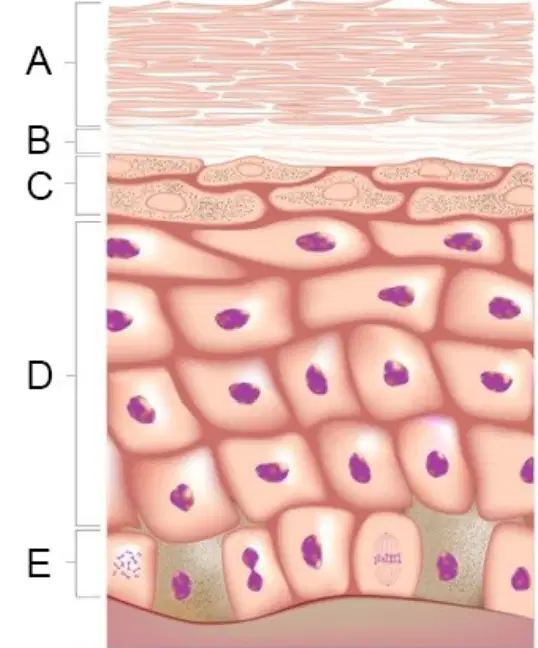
What layer of the epidermis is labelled, C?
(a)
Which of the following is located in the hypodermis?
Adipose tissue
Lymph supply
Dermal papilla
Sweat gland
Which of the following are protein fibres found in the reticular layer?
Eccrine and apocrine
Fibroblasts and macrophages
Melanin and mast cells
Collagen and elastin
The receptors in the skin that transmit stimuli are called:
adipocytes
arrector pili muscles
sensory nerve endings
sebaceous glands
Which of the following is a congenital skin disorder?
Albinism
Eczema
Impetigo
Warts
Which of the following is a fungal skin disease?
Pediculosis
Herpes zoster
Folliculitis
Tinea corporis

