
 Worksheets
Chapter 8 Learning Material Quiz
Total questions: 81
Worksheet time: 41mins
What is the main topic of Chapter 8 in the learning material?
Traffic signals and their meanings
Sharing The Roadway
Vehicle maintenance and repair
Driving in adverse weather conditions
Which section of Chapter 8 discusses the interaction between drivers and motorcyclists?
8.1 Sharing the Roadway with Motorcyclists
8.2 Motorcyclist Actions Can Affect You
8.3 Bicycles, Mopeds, and Motor Scooters
8.4 Pedestrians and Special Vehicles
What is the focus of Section 8.5 in Chapter 8?
Sharing the Road with Trucks
Motorcyclist Actions Can Affect You
Bicycles, Mopeds, and Motor Scooters
Pedestrians and Special Vehicles
Why do motorcyclists have the same privileges within the Highway Transportation System (HTS) as drivers of other vehicles?
Because they follow a different set of rules.
Because they pay more taxes.
Because they have equal responsibility for following and creating practices.
Because motorcycles are larger and more visible.
What is the main reason motorcycles are more difficult to see on the road?
They usually drive faster than other vehicles.
They are smaller and can be obscured by other vehicles.
They have quieter engines.
They have less colorful paint.
What should a driver of a larger vehicle do to protect motorcyclists on the road?
Ignore the motorcyclists as they have their own way of staying safe.
Use the IPDE Process to anticipate and address potential conflicts.
Only pay attention to other larger vehicles.
Assume motorcyclists will always give way.
When should you look for motorcyclists?
Only during the daytime.
When planning to turn across one or more lanes of traffic.
Only when motorcyclists are signaling.
Only in clear weather conditions.
What is the Identify step in the IPDE Process crucial for when it comes to motorcycles?
It helps in identifying only larger vehicles.
It is crucial for predicting the weather conditions.
It is crucial because motorcycles are more difficult to see.
It helps in identifying the color of the motorcycle.
When making a left turn at night, why should you be especially watchful for oncoming motorcycles?
Motorcycles are usually faster than cars.
The single headlight of a motorcycle can be confused with a larger vehicle that has only one working headlight.
Motorcycles often do not use headlights.
Motorcycles are less likely to follow traffic rules.
What should drivers of larger vehicles do to avoid turning right directly in front of a motorcyclist?
Speed up before making the turn.
Check their rear zones frequently.
Always let the motorcyclist turn first.
Turn off their vehicle's headlights.
When approaching an intersection and there is oncoming traffic, what should you expect if you see a motorcyclist turning left?
The motorcyclist will turn right instead.
The motorcyclist will wait for you to pass.
The motorcyclist may turn directly in front of you.
The motorcyclist will signal for you to turn first.
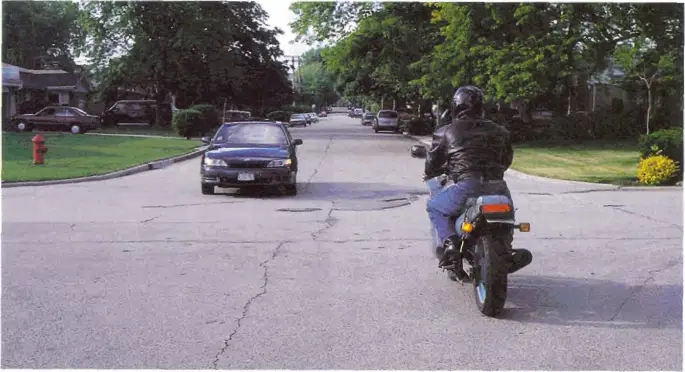
As a driver, how could you have avoided a possible conflict with the motorcyclist shown in the image?
By honking to alert the motorcyclist.
By accelerating past the motorcyclist quickly.
By letting the motorcyclist start the turn first.
By turning off your vehicle's headlights.
Why should you always check the blind spots in your left- and right-rear zones before turning or changing lanes?
To adjust your seat and mirrors
To check for vehicles that are speeding
To ensure there are no motorcycles or small vehicles in your blind spot
To signal to other drivers your intention to turn
What is the main reason to check your rear view mirror frequently when a motorcyclist is tailgating you?
To determine the speed of the motorcyclist
To avoid sudden braking and allow the motorcyclist to stop in time
To signal the motorcyclist to stop tailgating
To check if the motorcyclist is wearing a helmet
What should you do when you see an oncoming motorcyclist during the daytime?
Turn off your headlights
Speed up to pass the motorcyclist quickly
Stay on your side of the roadway until the motorcyclist has passed
Flash your headlights to alert the motorcyclist
What is the recommended action if a motorcyclist is passing your vehicle on the right or left?
Speed up to prevent them from passing
Honk to alert them of your presence
Check your rearview mirrors and blind spots frequently
Ignore them as they have the right to pass
When passing a motorcyclist, what is the first step you should take as part of the passing maneuver?
Speed up and pass the motorcyclist quickly.
Signal, check your rearview mirror, signal again, check your right blind-spot area, and then pass.
Honk to alert the motorcyclist of your intention to pass.
Immediately steer into the lane of the motorcyclist to pass.
Why is it important to avoid conflicts with motorcyclists when driving a larger vehicle?
Because motorcyclists are usually faster and more agile.
Because a larger vehicle has more blind spots.
Because a motorcyclist is fully exposed to dangers that could cause injury or death.
Because it is easier to see and avoid motorcyclists.
What should drivers be aware of due to some motorcyclists lacking experience and skill?
Motorcyclists always follow traffic rules.
Motorcyclists can predict and control errors due to inexperience and lack of skill.
Motorcyclists may make errors due to inexperience and lack of skill.
Motorcyclists do not need practice to develop sound judgment and good control.
What attitude should drivers develop towards motorcyclists and other less protected road users?
Indifference to their safety.
An attitude of helping others who are less protected.
A competitive attitude to show superiority on the road.
An attitude of ignoring the presence of motorcyclists.
Why should you increase your following distance when behind a motorcyclist?
Motorcyclists do not require as much space as other vehicles.
Motorcyclists can stop more quickly than other vehicles.
Motorcyclists' balance and stability depend on a small area of tires gripping the road, which can be affected by various road conditions.
Motorcyclists typically travel faster than other vehicles.
What should you do to make a motorcyclist aware of your presence when following them?
Honk continuously to ensure they know you are there.
Flash your headlights repeatedly.
Keep extra space in your front zone and do not assume the cyclist is aware of your presence.
Overtake the motorcyclist to avoid any confusion.
Which of the following can reduce traction and make motorcycle control more uncertain?
Dry and clean asphalt.
Freshly paved roads.
Water, sand, oil, wet leaves, potholes, or loose gravel.
Warm and sunny weather conditions.
What factors make it difficult for a motorcyclist to hear your vehicle?
The color of your vehicle.
Traffic and wind noises, along with the protective helmets they wear.
The type of music you are playing in your car.
The brightness of your headlights.
What is the primary responsibility of motorcyclists for protecting themselves and others on the road?
To use protective equipment and avoid conflict
To follow the speed limits strictly
To ensure their motorcycle is the fastest on the road
To perform stunts and impress other road users
Why must a motorcyclist operate separate brakes for front and rear wheels?
Because it's easier to use only one brake
To make the motorcycle go faster
To provide most of the braking power for stopping
Because it's a legal requirement in all states
What can happen if both foot and hand brakes are applied too hard on a motorcycle?
It can increase the motorcycle's speed
It can improve the motorcycle's handling
It can lock the brakes and cause loss of control
It can automatically signal for help
What is the benefit of taking a certified training course for motorcyclists?
It allows them to ride without a helmet
It helps reduce their risks on the road
It enables them to ride in restricted areas
It is required for motorcycle purchase
Why should motorcyclists increase their following distance?
To reduce the risk of collisions and prevent cyclists from being hit by pebbles or dirt
To improve fuel efficiency
To follow traffic regulations
To allow for better visibility
What is one of the reasons a motorcycle might have difficulty remaining upright while in motion?
The motorcycle's design is flawed
The roadway is wet or covered with oil drippings
The motorcycle's tires are new
The cyclist is inexperienced
Which of the following is NOT listed as a piece of protective equipment for motorcyclists?
Helmet
Eye-protection
Full-length pants and jacket made of durable material
Lightweight jacket
What can a puddle on the road potentially hide that poses a risk to motorcyclists?
A speed bump
A pothole
A traffic signal
Road signs
According to the text, why are helmets required by law in some states for motorcyclists?
To protect against wind and debris
To improve motorcycle handling
To prevent neck and head injuries in a collision
To make motorcyclists more visible to other drivers
Why is traction reduced for motorcyclists when it rains?
The motorcycle becomes heavier.
The rain mixes with dirt and oil on the roadway.
The windshield wipers stop working.
The road becomes less visible.
What should motorcyclists do when riding on or crossing painted lines on a wet roadway?
Speed up to cross the lines quickly.
Use extra caution.
Follow other vehicles closely.
Turn on their windshield wipers.
How can motorcyclists gain extra traction on wet roads?
By riding in the middle of the lane.
By avoiding all painted lines.
By riding in another vehicle's wheel track.
By increasing their speed.
What additional challenges do motorcyclists face when carrying a passenger?
The motorcycle uses more fuel.
The motorcycle makes more noise.
There is a difference in acceleration, braking, and turning.
The headlights become less effective.
What should other vehicle drivers remember when near motorcyclists?
To always use the horn when passing.
To always be ready to yield to cyclists.
To maintain higher speeds.
To ignore the motorcyclists.
When riding in groups, how should motorcyclists position themselves in traffic?
Side by side in one lane
In an offset position
In multiple lanes
Directly behind one another without any offset
What is the purpose of riding in lane position 2?
To make it harder for other drivers to see the motorcyclist
To encourage other drivers to use the same lane
To add a degree of safety to the passing maneuver
To increase the chance that the cyclist will be forced off the roadway
Why should motorcyclists not ride between lanes of moving vehicles?
It is the safest position in traffic
It is recommended for better visibility
It is dangerous and often illegal
It allows for quicker travel times
What additional precautions can motorcyclists take when riding at night to be more visible?
Ride faster than during the day
Use reflective tape on helmets and clothing and have reflectors on the motorcycle
Turn off the motorcycle's tail light
Ride in lane position 1 only
What should bicyclists wear for protection according to the safe-riding practices mentioned in the text?
Dark-colored clothing
A helmet
A seatbelt
Earphones
What is one of the responsibilities of bicyclists to avoid conflicts with other roadway users?
To wear earphones while riding
To obey all signs, signals, and laws
To keep bicycles in poor operating condition
To ride without lights and reflectors
What should a driver of a larger vehicle do to protect bicyclists?
Give bicyclists less space when possible
Honk continuously when passing bicyclists
Give bicyclists extra space whenever possible
Ignore the possible path the bicyclist might take
What is the purpose of the IPDE Process when encountering bicyclists?
To increase the speed of travel
To reduce the space for bicyclists
To build a special awareness of bicyclists and where they might be
To encourage bicyclists to swerve into your path
Why should bicycles allow a greater stopping distance under wet or slippery road conditions?
Hand-operated brakes work better when the bicycle wheels are wet.
It is easier to control the bicycle in these conditions.
Bicycles do not operate effectively when the bicycle wheels are wet.
Wet conditions make it easier to see bicycles on the road.
When passing a bicyclist, how much space should you leave between your vehicle and the bicyclist at a minimum?
At least one-fourth lane
At least one-half lane
One full lane
Two full lanes
What should you do to help identify a bicyclist when driving at night?
Use low-beam headlights
Use high-beam headlights
Turn off all headlights
Flash your headlights repeatedly
What is the origin of the name "moped"?
It comes from "motor-driven bicycle and pedal-driven."
It is derived from "motorized pedal vehicle."
It is an acronym for "motorized operation pedal."
It stands for "motor-powered development."
What should you do to prevent conflicts with bicyclists when opening the street-side door of your vehicle?
Open the door quickly to minimize time in the bicyclist's path.
Look for bicyclists before opening the door.
Honk the horn before opening the door.
Open the door halfway and wait for bicyclists to pass.
What is a moped similar to in terms of its operation?
A car
A motorcycle
A bicycle
A skateboard
What do most states require from moped and motor scooter operators?
A special parking permit
A commercial driver's license
An operator’s license
No documentation
Why are mopeds not typically allowed on certain high-speed roadways?
Because they are too large
Because they can carry too many passengers
Because they do not accelerate to traffic speed as quickly as a motorcycle or other vehicle
Because they are too noisy
Which of the following is a guideline that moped and motor scooter drivers should follow?
Wear protective clothing
Only ride during daylight hours
Use the vehicle for long-distance travel
Avoid using the headlight at night
What should drivers of other larger vehicles do when driving near a moped or motor scooter?
Ignore the moped or motor scooter
Predict possible sudden actions from drivers of mopeds and motor scooters
Encourage mopeds and motor scooters to speed up
Only focus on the road ahead and not the moped or motor scooter
What is the purpose of reflective tape on a motor scooter rider's clothing?
To make the rider more fashionable
To make the rider more visible to other drivers at night
To keep the rider warm
To indicate the rider's rank or experience level
Why should drivers use extra caution around pedestrians?
Pedestrians always have the right of way.
Pedestrians are the most vulnerable highway users.
Pedestrians can easily see and avoid vehicles.
Pedestrians are usually aware of traffic laws and signals.
What should you do when driving out of an alley or driveway?
Speed up to merge with traffic quickly.
Honk continuously to alert pedestrians.
Be especially alert for pedestrians and be prepared to stop.
Assume pedestrians will yield to you.
What is the IPDE Process mentioned in the text?
A method to communicate with pedestrians.
A process to increase driving speed.
A technique for vehicle maintenance.
A process to identify and react to driving hazards.
According to the text, what should a driver expect when approaching alleys and driveways?
Pedestrians and bicyclists may suddenly appear.
Traffic lights will indicate when to stop.
Vehicles will always yield to you.
There will be signs to indicate pedestrian crossings.
What action should a driver take first when exiting an alley?
Accelerate to join the traffic flow.
Stop before the sidewalk and look both ways for pedestrians and bicyclists.
Turn on the vehicle's emergency lights.
Wave at pedestrians to indicate they should move.
According to the text, why should drivers be extra alert in business districts?
Because there are more traffic signals
Because there are fewer pedestrians
Because there is often a high volume of traffic and many pedestrians
Because pedestrians have the right-of-way only at crosswalks
What should drivers do when it is raining to avoid a conflict with pedestrians?
Ignore the traffic signals
Drive faster to get out of the rain
Be extra alert and take more time to identify pedestrians
Assume pedestrians will yield the right-of-way
What is the driver's responsibility when children are playing in the street?
To join in the play
To honk to warn them
To make the utmost effort to prevent conflict
To ignore them and continue driving
What should joggers expect when using a sidewalk or jogging path?
To be ignored by traffic
To always have the right-of-way
To be seen by drivers in traffic lanes
To yield to moving traffic
What is recommended for a pedestrian to do at night to be more visible?
Carry a light
Wear black clothing
Walk into traffic lanes
Step off the curb without looking
What should pedestrians avoid doing when stepping off the curb, according to the "DID YOU KNOW?" section?
Looking both ways
Walking into the side of a moving vehicle they do not see
Waiting for the traffic signal
Walking in a crosswalk
Why should drivers exercise special care whenever pedestrians are around in parking lots?
Pedestrians can damage vehicles easily.
Parking lots are high-risk areas for drivers, riders, and pedestrians.
Vehicles are traveling at high speeds in parking lots.
Parking lots are designed only for vehicles.
What should you do to reduce your risk when driving in parking lots?
Increase your speed to leave the parking lot quickly.
Ignore the routes for traffic flow.
Drive diagonally across parking lot lines.
Obey parking-lot speed limits and follow the routes for traffic flow.
What is a recommended action when backing out of a parking space if your vision is blocked?
Continually scan in all directions.
Tap the horn before you back out.
Speed up to minimize the time spent backing out.
Assume there is no traffic and proceed.
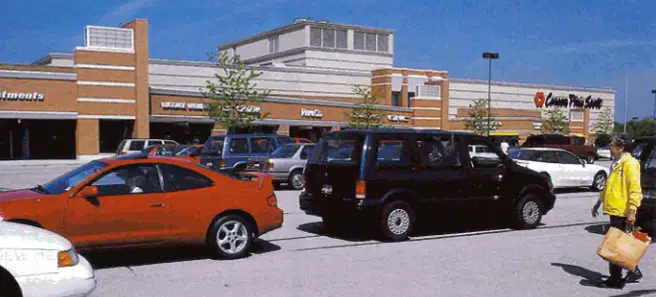
What should you be alert for when leaving a parking space, according to the image caption?
Nearby shopping carts.
The color of the parking lines.
Other vehicles that may be moving.
The weather conditions.
What type of vehicle is mainly used for pleasure and travel, and includes motor homes, travel trailers, pickup trucks, and sports utility vehicles?
Recreational vehicles
School buses
Snow plows
Farm machinery
What should you do when you encounter a school bus with flashing red lights and a stop sign that swings out from the side of the bus?
Proceed with caution
Pass the bus if no children are crossing
Stop and do not proceed until the lights stop flashing and the bus begins to move
Honk to alert the bus driver
When passing large vehicles like those carrying a "Wide Load" sign, what should you do to ensure safety?
Allow these larger vehicles extra space in traffic and increase your following distance
Increase your speed to pass quickly
Decrease your following distance
Ignore the sign as it does not pertain to passenger vehicles
What is the usual action of local buses when stopping to discharge or pick up passengers?
They pull in toward the curb out of the lane of traffic
They stop in the middle of the lane of traffic
They require traffic from both directions to stop
They activate flashing yellow lights only
When you see an emergency vehicle with sirens and flashing lights, what should you do?
Continue driving at the same speed
Pull over to the right as far as possible and stop if it is safe to do so
Speed up to get out of the way quickly
Only pull over if the emergency vehicle is traveling in the same direction as you
What is the reason for giving buses extra space when they are stopped?
To allow other drivers to overtake you
To prevent traffic congestion
To ensure no pedestrian is blocked from view and might enter your path
To make it easier for the bus to resume driving
What should you do if you are in heavy traffic and an emergency vehicle is approaching?
Keep driving in your lane and let the emergency vehicle find its way
Move in the direction other drivers are moving and leave as much space as possible
Stop your vehicle immediately, regardless of your position
Honk to alert other drivers about the emergency vehicle
How should you communicate with pedestrians hurrying to catch a bus to make them aware of your presence?
Use hand signals
Use horn and eye contact
Flash your headlights
Shout out the window
What should you do to give yourself more time to respond when driving near pedestrians?
Increase your speed
Reduce speed and cover the brake
Ignore the pedestrians
Turn off your vehicle's lights

