
 Worksheets
5.08 Motion and forces Physics Quiz
Total questions: 51
Worksheet time: 26mins
By the end of the session, learners should be able to describe:
The types of energy
The types of motion
The types of materials
The types of machines
What should learners be able to calculate related to forces by the end of the session?
Speed and velocity
Work and energy
Force and pressure
Mass and weight
What concept involving force should learners be able to define?
The velocity of a force
The moment of a force and torque
The acceleration due to a force
The potential energy of a force
Which of the following is NOT a type of motion described in the learning material?
Linear
Rotary
Pendulum
Oscillating
What does each type of motion use to make a movement in a set pattern?
An applied force (input)
A complex machine
A simple calculation
A chemical reaction
What type of motion involves movement in a straight line?
Rotary motion
Oscillating motion
Linear motion
Vibrational motion
Which of the following is an example of rotary motion?
A train moving along a straight track
A pendulum swinging back and forth
A fan rotating around its central axis
A ball rolling down a hill
What type of motion involves a repeated up and down or back-and-forth movement, such as that of a piston?
Rotational motion
Oscillating motion
Reciprocating motion
Linear motion
Which type of motion is characterized by a curved backwards and forwards movement that swings on an axis or pivot point, like a swing or a clock pendulum?
Reciprocating motion
Linear motion
Rotational motion
Oscillating motion
What is a force?
The energy exerted by an object.
A push or pull exerted by one object on another.
The velocity of an object.
The distance covered by an object.
How is force generally recognised?
By its color and texture.
By its effect on a body.
By its weight.
By its temperature.
What is the SI unit of force?
Kilogram (kg)
Meter (m)
Newton (N)
Second (s)
What does 1 newton of force equate to?
The force that gives a mass of 1 kg an acceleration of 10 m s^-2
The force that gives a mass of 1 kg an acceleration of 1 m s^-2
The force that gives a mass of 2 kg an acceleration of 1 m s^-2
The force that gives a mass of 1 kg a velocity of 1 m s^-1
What type of quantity is force?
Scalar
Vector
Algebraic
Numeric
What is the formula for weight force?
F = ma
F = mg
W = mg
W = ma
What is the approximate value of the acceleration due to gravity, g?
9.81 m s^-1
9.81 m s^-2
10 m s^-1
10 m s^-2
What is an applied force called in engineering terms?
Reaction
Action
Friction
Tension
What is the opposing force to an applied force known as?
Action
Friction
Tension
Reaction
How many defining characteristics does a force have according to the document?
2
3
4
5
Which of the following is NOT a defining characteristic of a force?
Magnitude (size)
Direction
Point of application
Color
What does the size of the arrow represent in the diagrams illustrating force characteristics?
Direction of the force
Point of application of the force
Magnitude (size) of the force
Reaction to the force
According to the diagrams, how is the direction of a force represented?
By the size of the arrow
By the color of the arrow
By the orientation of the arrow
By the number of arrows
What does the point where the arrow touches the beam represent in the force diagrams?
Magnitude of the force
Direction of the force
Point of application of the force
Reaction of the force
What is the formula for calculating pressure?
P = A / F
P = F / A
P = F + A
P = F - A
If the pressure (P) and the area (A) are known, how can you calculate the force (F)?
F = P / A
F = P + A
F = P - A
F = P * A
What is the unit of pressure in the given formula?
Newton (N)
Pascal (Pa)
Joule (J)
Meter squared (m²)
What does the symbol 'A' represent in the formula for pressure?
Acceleration
Area
Amplitude
Angular momentum
In the context of the given material, what is the unit for force?
Pascal (Pa)
Meter squared (m²)
Newton (N)
Kilogram (kg)
What is the formula to calculate pressure (P) in Pascals (Pa)?
P = F × A
P = A / F
P = F / A
P = F + A
If a force of 400 N is applied to an area of 200 mm², what is the pressure in Pascals (Pa)?
2 × 10⁶ Pa
2 × 10⁵ Pa
20 Pa
200 Pa
How many Pascals are equivalent to 1 bar?
1 × 10⁵ Pa
1 × 10⁻⁵ Pa
1 × 10⁶ Pa
1 × 10⁻⁶ Pa
Using the given example, what is the pressure in bar when a force of 400 N is applied to an area of 200 mm²?
2 bar
20 bar
200 bar
2000 bar
What is the formula to calculate the force produced by a hydraulic cylinder?
F = m × a
F = P × A
F = P + A
F = P / A
If a hydraulic pump produces a pressure of 260,000 Pa, and the area of the cylinder is 1.59 × 10^-3 m², what force will the cylinder produce?
414 N
260 N
159 N
260,000 N
How do you calculate the area of a cylinder with a bore diameter of 45 mm?
A = π × radius
A = π × diameter
A = π × (radius)^2
A = π × (diameter)^2
What is the area of a cylinder with a bore diameter of 45 mm, given that the radius is half of the diameter?
A = 1.59 × 10^-2 m²
A = 1.59 × 10^-3 m²
A = 1.59 × 10^-4 m²
A = 1.59 m²
What is the pressure on the ground under each foot of the industrial machinery if each foot has an area of 900 mm² and the force pushing down on each foot is 12,500 N?
13.9 MPa
12.5 MPa
14.5 MPa
15.0 MPa
What is the formula to calculate force in a hydraulic system?
Force = distance × time
Force = mass × acceleration
Force = pressure × area
Force = volume × pressure
If the pressure in a hydraulic system is 1.2 MPa and the piston area is 0.0014 m², what is the force produced by the piston?
1 680 N
1 200 N
1 400 N
1 600 N
What does a moment measure in the context of physics?
The weight of an object
The tendency of a force to rotate a body
The speed of an object in motion
The distance an object travels
How is a moment calculated?
By dividing the load by the distance from the fulcrum
By adding the load to the distance from the fulcrum
By multiplying the load (newtons) by the distance from the fulcrum (metres)
By subtracting the distance from the fulcrum from the load
What is the unit of a moment?
Kilogram metre (kg m)
Newton (N)
Newton metre (N m)
Metre per second squared (m/s²)
How are moments identified?
Positive or negative
Heavy or light
Clockwise or anticlockwise
Static or dynamic
For a lever to balance, what must be true about the moments?
The sum of the anticlockwise moments must be greater than the clockwise moments
The sum of the clockwise moments must be greater than the anticlockwise moments
The sum of the anticlockwise moments must be equal to the sum of the clockwise moments
The sum of the moments must be zero
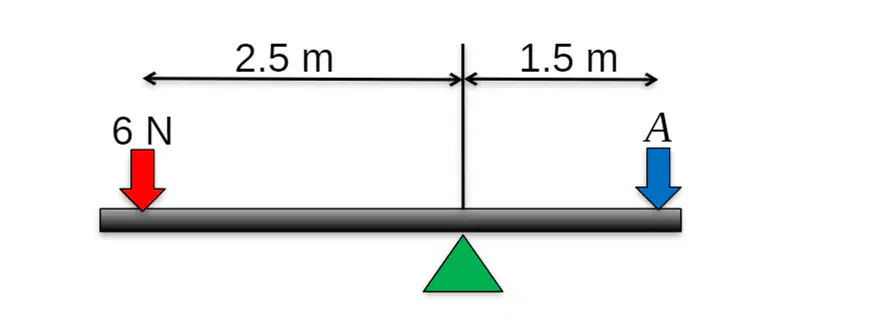
What value of force A is required to balance the lever shown in the diagram?
10 N
4 N
9 N
15 N
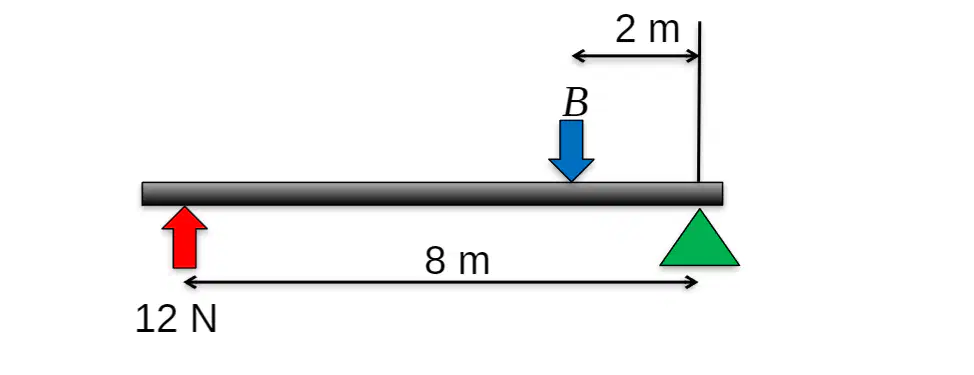
What is the moment of the 12 N force applied at a distance of 8 m from the pivot in the lever system shown?
48 N m
96 N m
24 N m
64 N m
If the moment of force B is required to balance the lever shown in the diagram, what is the magnitude of force B?
24 N
48 N
96 N
12 N
What is torque?
A force that causes linear motion
A type of energy
A moment that causes rotation about an axis
A measure of electrical resistance
Which common tool is associated with the application of torque?
Screwdriver
Hammer
Spanner
Pliers
How is the torque being applied by the spanner to the nut calculated?
By adding the forces applied by the hands
By multiplying the force by the distance from the axis and summing the moments
By dividing the force by the distance from the axis
By calculating the average force applied by both hands
Calculate the torque applied if hand A applies 20N of force at 0.3m from the axis and hand B applies 10N of force at 0.6m from the axis.
12 N m
6 N m
18 N m
15 N m

