
 Worksheets
Cell Theory and Cells Introduction - Review
Total questions: 25
Worksheet time: 46mins

The cell theory applies to all organisms, including the five shown. Which of the following statements describes how these organisms are an example of the cell theory?
The organisms have cells that lack a nucleus.
The organisms are made of one or more cells.
The cells of the organisms undergo photosynthesis.
The cells of the organisms are identical to each other.
Plants have cells but animals do not.
They are both made of one or more cells.
They both come from the same kind of cell.
They both come from a non-living organism.
Which statement was NOT included in cell theory?
All living things are composed of cells.
Living cells come only from other living cells.
Each cell contains a cell membrane, cytoplasm, nucleus, mitochondria, and endoplasmic reticulum.
Cells are the smallest structure of living things that can perform the functions necessary for life.
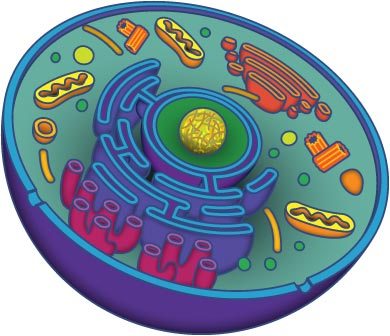
Which of the following does not have a nucleus?
prokaryotes
eukaryotes
prokaryotes and eukaryotes
Which of the following needs energy?
prokaryotes
eukaryotes
prokaryotes and eukaryotes
Which of the following has organelles?
prokaryotes
eukaryotes
prokaryotes and eukaryotes
Which of the following has DNA?
prokaryotes
eukaryotes
prokaryotes and eukaryotes
Bacteria are an example of __________.
prokaryotes
eukaryotes
Which of the following does have a nucleus?
prokaryotes
eukaryotes
prokaryotes and eukaryotes
Which of the following are living cells?
prokaryotes
eukaryotes
prokaryotes and eukaryotes
Which organelle captures the energy from sunlight and converts it to chemical energy, and in which cells could it be found?
The Golgi apparatus, which can be found in lung cells of animals
Lysosomes, which can be found in all cells of grasses
Ribosomes, which can be found in muscle cells of humans
Chloroplasts, which can be found in leaf cells of trees

A student is labeling the model of a cell. Which type of cell is this?
Animal Cell
Plant Cell

An animal cell has the following except a/an...
Nucleus
Lysosome
Cell Wall
Endoplasmic reticulum
Which is the best description of a cell wall's function?
keeps the organelles inside of the cell
holds the cell up and keeps a square shape so the cell can stack on top of each other
responsible for directing the activities of a cell
is responsible for turning carbon dioxide and water into sugars and oxygen
What is the best description of a chloroplasts function?
holds the cell up and keeps a square shape so the cell can stack on top of each other
regulates what comes in and out of the cell
helps to keep the cell's organelles in place
contains chlorophyll, which is molecule that allows the cell to use light energy to turn water and carbon dioxide into sugars and oxygen
Choose the statement below that is TRUE.
Plant and animal cells both have cell walls so the cell can maintain its shape.
Animal cells do not have chloroplasts because animals do not require the use of photosynthesis to produce their food.
Plant cells do not have a nucleus because plants are not living organisms like animals are.
Animal cells do not have cytoplasm because an animal cell's organelles are free to move around as they please.

All plant and animal cells contain chromosomes with DNA.
True
False

