
 Worksheets
Exam 2 Bio 153 Review
Total questions: 185
Worksheet time: 3hrs 50mins
What are the two domains into which prokaryotic diversity falls?
Eukarya and Archaea
Bacteria and Eukarya
Bacteria and Archaea
Bacteria and Protista
What percentage of prokaryotic forms of life are unknown and undescribed?
10-20%
90-99%
50-60%
75-85%
Prokaryotes are known to colonize environments that are too extreme for which type of organisms?
Archaea
Viruses
Eukarya
Bacteria
Prokaryotes have diverse capabilities in which of the following areas?
Reproductive and developmental capabilities
Metabolic and physiological capabilities
Cognitive and behavioral capabilities
Structural and mechanical capabilities
What is the structure of the chromosome in prokaryotes?
Single linear double-stranded DNA
Single circular double-stranded DNA
Multiple circular double-stranded DNA
Multiple linear double-stranded DNA
Are prokaryotic cells capable of forming biofilms?
Yes, and they can include complex communities of different species
No, they cannot form biofilms
Yes, but only with identical species
No, biofilms are exclusive to eukaryotic cells
What is a unique feature of genetic exchange in prokaryotes?
It occurs through mitosis
It is a form of reproduction
It allows for genetic recombination through horizontal gene transfer
It happens only during meiosis
Which of the following is a characteristic of prokaryotic cells?
They have membrane-bounded organelles.
Their plasma membrane cannot be infolded.
They have simple flagella that are different from eukaryotic flagella.
They lack metabolic diversity.
Prokaryotes can use a variety of sources for energy. Which of the following is NOT mentioned as a source of energy for prokaryotes in the text?
Different electron donors and acceptors
A variety of carbon sources
Light for photosynthesis
Nuclear fission
In which of the following areas do bacteria and archaea differ?
Ribosome function
Plasma membranes
Mitochondrial function
Chloroplast structure
Which of the following is NOT a key area where bacteria and archaea differ?
Cell walls
DNA replication
Gene expression
Protein synthesis
What is one of the key areas where bacteria and archaea differ?
Cytoplasmic content
Cell walls
Nucleus structure
Endoplasmic reticulum presence
How do the membranes of archaea differ from those of bacteria and eukaryotes?
Archaeal membranes have the same structure as bacterial and eukaryotic membranes.
Archaeal membranes have different lipid structures and bonds within the molecule.
Archaeal membranes are made entirely of hydrocarbons.
Archaeal membranes do not have any lipids.
What adaptation allows some archaea to withstand high temperatures?
Having a bilayer membrane.
Having a monolayer membrane.
Having no membrane at all.
Having a triple-layer membrane.
What is a distinctive feature of bacterial cell walls?
Bacteria cell walls lack peptidoglycan.
Bacteria cell walls have peptidoglycan.
Bacteria cell walls are similar to eukaryotes.
Bacteria cell walls are made of cellulose.
Which of the following statements is true regarding archaeal DNA replication?
Archaeal DNA replication is more similar to that of bacteria.
Archaeal DNA replication is less similar to that of eukaryotes.
Archaeal DNA replication is more similar to that of eukaryotes.
Archaeal DNA replication does not have a single replication origin.
How does gene expression in archaea compare to eukaryotes?
Archaeal transcription and translation are less similar to those of eukaryotes.
Archaeal transcription and translation are more similar to those of bacteria.
Archaeal transcription and translation are more similar to those of eukaryotes.
Archaeal transcription and translation are not similar to any other domain of life.
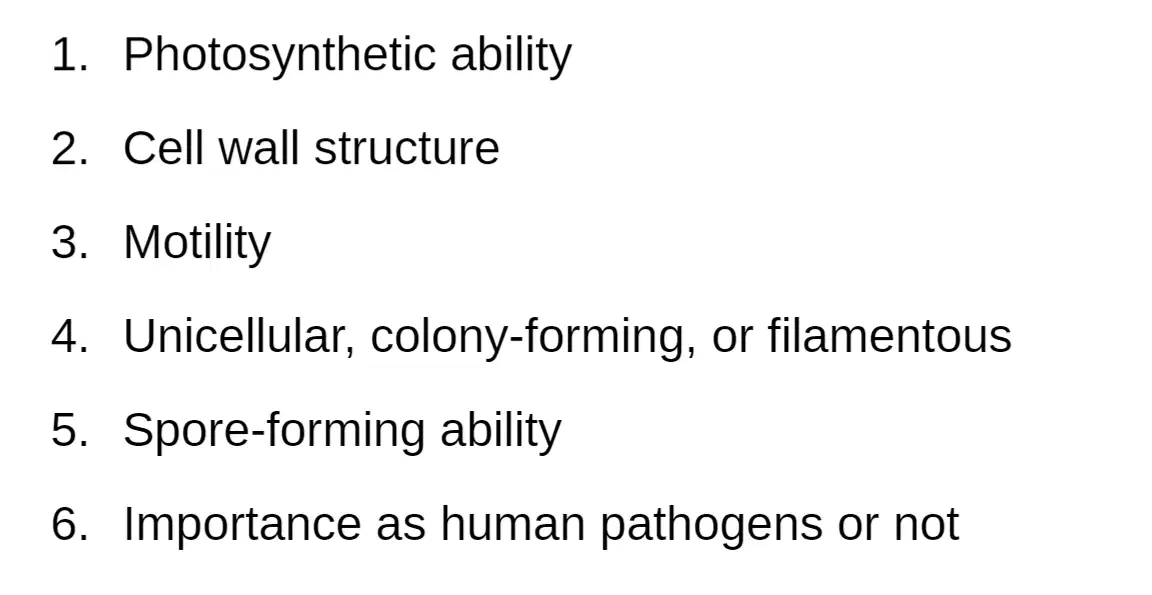
Which characteristic was NOT one of the early classification characteristics for prokaryotes according to the image?
Ability to produce spores
Ability to move
Nucleus presence
Photosynthetic ability
According to the early classification characteristics, which of the following was considered when classifying prokaryotes?
Their multicellular structure
Their cell wall structure
Their eukaryotic features
Their ability to reproduce sexually
Which type of RNA is especially focused on during gene and RNA sequencing for molecular classification?
mRNA
tRNA
rRNA
snRNA
What is the most comprehensive method of molecular classification listed in the document?
Amino acid sequencing
Nucleic acid hybridization
Gene and RNA sequencing
Whole-genome sequencing
What is the basis for proposing several prokaryotic groupings?
Genetic similarities
Molecular data
Physical characteristics
Metabolic types
What does large scale sequencing of random samples indicate about bacteria?
All bacteria have been cultured
Most bacteria are well studied
A vast majority of bacteria have never been cultured or studied in detail
Bacteria are easy to culture
What type of environments do Euryarchaeota typically inhabit?
Mild, temperate environments
Extreme environments, such as those with high salinity or temperature
Aquatic environments with stable conditions
Urban environments with high pollution levels
Which group within the domain Archaea is known for being mostly anaerobic and includes methanogens and halophiles?
Crenarchaeota
Eukaryota
Euryarchaeota
Bacteria
Compared to Euryarchaeota, Crenarchaeota are more extreme in their tolerance to what conditions?
Cold temperatures
Heat and cold temperatures
Heat temperatures
Humid conditions
Which of the following diseases is caused by spirochetes?
Common cold
Syphilis and Lyme disease
Tuberculosis
Influenza
Thermophiles are described as:
Monophyletic and photosynthetic.
Not monophyletic and chemoheterotrophs.
Not monophyletic and chemoautotrophs.
Monophyletic and parasites.
What are the characteristics of Proteobacteria in the Domain Bacteria?
Gram-positive, photoautotrophs, release oxygen
Gram-negative, metabolically diverse, aerobic and anaerobic
Gram-positive, metabolically limited, anaerobic only
Gram-negative, photoheterotrophs, consume oxygen
Which of the following bacteria is NOT an example of Proteobacteria?
E. coli
Salmonella
Vibrio cholerae
Cyanobacteria
What is the significance of most bacteria within the Proteobacteria group?
They are primarily involved in disease causation.
They are used in bioremediation and nitrogen fixing.
They are not significant in medical or agricultural contexts.
They are used in industrial food production.
What is the role of Cyanobacteria in photosynthesis?
They consume oxygen and release carbon dioxide.
They are not involved in photosynthesis.
They release oxygen as a byproduct of photosynthesis.
They fix nitrogen but do not participate in photosynthesis.
What is the composition of peptidoglycan?
Nucleic acids cross-linked with amino acids
Polysaccharides cross-linked with polypeptides
Fatty acids cross-linked with glycerol
Proteins cross-linked with lipids
Which organisms have a molecule similar to peptidoglycan?
Plants
Fungi
Archaea
Animals
What is the purpose of the Gram stain process?
To identify the type of bacterial cell wall
To determine the size of bacteria
To count the number of bacteria
To observe the motility of bacteria
What is a characteristic of most pathogenic bacteria in terms of Gram staining?
They are mostly Gram-positive
They are mostly Gram-negative
They do not respond to Gram staining
They change colors multiple times during staining
Why are Gram negative bacteria often resistant to antibiotics?
They have a thick layer of peptidoglycan
They lack a plasma membrane
They have a second outer membrane with lipopolysaccharide
They can be easily killed with penicillin
What is the S-layer in prokaryotic cells?
A flexible protein layer found in all bacteria
A rigid protein layer found in some bacteria and archaea
A gelatinous layer found in some bacteria
A slime layer that is highly organized
Where is the S-layer located in prokaryotic cells?
Inside the peptidoglycan layer
Within the cytoplasm
Outside of peptidoglycan or outer membrane layers in gram-negative and gram-positive bacteria
Directly attached to the cell's DNA
What is one of the functions of the S-layer in prokaryotic cells?
Replication
Adhesion
Photosynthesis
Protein synthesis
What is the capsule in prokaryotic cells?
A rigid layer that provides structural support
A slime layer that is highly organized
A gelatinous layer found in some bacteria
A protein layer that aids in cell division
What are the functions of the capsule in prokaryotic cells?
Aids in attachment and protects from the immune system
Provides energy through photosynthesis
Involved in the replication of DNA
Acts as a storage for nutrients
How does the slime layer of prokaryotic cells compare to the capsule?
The slime layer is more rigid and organized than the capsule
The slime layer is looser and less organized than the capsule
The slime layer is found inside the cell, while the capsule is outside
The slime layer aids in photosynthesis, unlike the capsule
What is the structure of bacterial flagella?
Short, hairlike structures
Long, flexible, helical structures
Slender, rigid, helical structures
Composed of multiple protein fibers
What is the function of bacterial flagella?
Attachment and conjugation
DNA replication
Locomotion, spinning like a propeller
Nutrient absorption
What do endospores develop around their genome and some of the cytoplasm when exposed to?
Nutrient-rich environments
Environmental stress
Low temperature conditions
High oxygen levels
Endospores are highly resistant to what type of environmental stress?
Chemical exposure
Heat
Radiation
High pressure
What can endospores do when environmental conditions improve?
Multiply rapidly
Germinate and return to normal cell division
Become dormant
Die off
Which diseases are caused by bacteria that can form endospores?
Influenza, pneumonia, and tuberculosis
Tetanus, botulism, and anthrax
HIV, hepatitis, and malaria
Measles, mumps, and rubella
What components make up a virus?
RNA or DNA surrounded by a lipid envelope
RNA or DNA enclosed within a protein shell
Both RNA and DNA within a carbohydrate coat
A combination of proteins, a lipid bilayer, and RNA
What occurs once the virus enters the host cell?
it starts synthesizing proteins
it undergoes replication
it integrates into the host's genetic material
it activates its infectious phase
What is the composition of the outer layer of a virus?
proteins
sugars
fats
minerals
Why are viruses often not considered living entities by biologists?
they need a host cell to replicate
they do not perform metabolic activities
they lack cellular structure
all of the mentioned reasons
none of the mentioned reasons
What happens in the lytic cycle?
the spacecraft shaped virus attaches to the host cell then leaves
the spacecraft virus kills the host cell
the spacecraft shaped virus attaches to the host cells and as it leaves it kills the host cell
the spacecraft virus attaches to the host cell injects DNA as the virus leaves it kills the host cell
What is the name of the protein shell that encases the genetic material of a virus?
membrane
capsule
capsid
lipid layer
Viral DNA that is incorporated into a host cell's chromosome is called a
provirus
plasmid
party animal
prophage
What does the term 'obligate intracellular parasite' mean?
does not need a host to survive
needs a host to survive
Which feature is shared by both viruses and bacteria?
Ability to reproduce independently
Presence of a cellular structure
Containment of nucleic acids as genetic material
Capability for photosynthesis
Which of the following viruses utilize single-stranded RNA as a template for synthesizing DNA?
temperate phages
oncoviruses
lysogenic viruses
retroviruses
prions

What type of virus infects bacterial cells?
Retrovirus
Bacteriophage
Adenovirus
Herpesvirus

What part of the phage is the tail fibers?
What are prions?
Infectious RNA molecules
Initial amino acids in proteins of eukaryotes
Proteins around which DNA is coiled
Proteins that have misfolded

What role do the spikes on a virus's surface play?
They assist in the virus's reproduction
They enable the virus to attach to and enter host cells
They are involved in the virus's nutrient absorption
They protect the virus from the host's immune system
What is a defining feature of the lytic cycle in the context of viral replication?
The host's DNA is replaced with viral DNA.
Viral DNA merges with the host's genome and lies dormant.
Viruses replicate without causing immediate harm to the host cell.
It results in the destruction of the host cell due to the release of new viruses.
What is the term for the process where there is a major change in the influenza virus due to the reassortment of genes from two different strains, leading to a new subtype?
Antigenic drift
Antigenic shift
Genetic recombination
Phenotypic modulation
What was the nature of the earliest organisms on Earth in terms of their cellular structure and oxygen requirements?
eukaryotic and aerobic
eukaryotic and anaerobic
prokaryotic and aerobic
prokaryotic and anaerobic
Which gas is believed to have been missing from the primordial Earth's atmosphere, considering the environmental conditions of that era?
Nitrogen (N2)
Hydrogen (H2)
Oxygen (O2)
Ammonia (NH3)
Argon (Ar)
What was the primary purpose of the 1953 Miller-Urey experiment, and why is its outcome considered significant in the study of the origins of life?
It aimed to demonstrate the role of water in the formation of life, which remains a controversial theory.
It sought to prove that organic molecules could be synthesized from inorganic substances through natural processes.
The experiment was designed to show the impact of solar radiation on the evolution of life forms on Earth.
Its goal was to test the viability of amino acids surviving in the harsh conditions of early Earth.

Considering the theory of endosymbiosis, why would early eukaryotic cells containing organelles similar to mitochondria be considered evolutionarily advantageous?
They could replicate faster than other cells
They could utilize energy more efficiently
They had a larger size
They could resist viruses more effectively
These scientists proved that organic molecules formed from inorganic molecules present in the Earth’s early atmosphere when given energy from lightening.
Lennon and McCartney
Einstein and Newton
Watson and Crick
Miller and Urey
Which of the following organelles are believed to have originated from prokaryotic cells being absorbed by ancestral eukaryotic cells?
Endoplasmic Reticulum and Golgi Apparatus
Mitochondria and Chloroplasts
Nucleus and Ribosomes
Lysosomes and Peroxisomes
What was formed in the Miller-Urey experiments?
amino acids
proteins
living cells
DNA
Organic molecules can form spontaneously from inorganic materials
True
False
What are the gases found in primitive air?
Hydrogen
Methane
Water
C02
Oxygen
Methane
Chlorine
Methane
Silicon
Oxygen
Water
Oxugen
CO2
Methane

Which era is known for the earliest known records of many major groups of animals and plants?
Precambrian
Cambrian
Devonian
Carboniferous
During what Era do we currently live?
Cenozoic
Mesozoic
Paleozoic
Precambrian

violent and chaotic with constant meteor and asteroid bombardment; toxic and noxious atmosphere; no life
transform
Early Earth
seafloor spreading
cyanobacteria

dome shaped rock made from cyanobacteria; some of the oldest fossils in the world
stromatolites
zircon
iron banded formations
convection current

Identify the ancient photosynthetic organisms believed to be among the earliest forms of life on Earth.
archaea
cyanobacteria
diatoms
red algae
A theory stating that the Earth's surface is broken into plates that move (transform, convergent, divergent boundaries)
Early Earth
iron banded formations
convection currents
Plate Tectonics
These are the longest units of geologic time.
eons
era
period
epoch
During the Paleozoic Era, the continents were together in a super-continent known as ________.
Pangaea
Gondwana
Pangaea Ultima
Anteurasiafricalia
The Earth is _____________________ years old.
4.6 million
4.6 billion
4.6 trillion
4.6 zillion
The three earliest eons make up 90% of geologic time, known as Precambrian. Which of the following is the correct sequence of these eons from OLDEST TO YOUNGEST?
Hadean, Proterozoic, Archean
Archean, Proterozoic, Hadean
Hadean, Archean, Proterozoic
Proterozoic, Hadean, Archean
Named after the Greek underworld "Hades" due to the extreme conditions that characterized this eon.
Hadean
Archean
Proterozoic
Phanerozoic
During which eon did Earth experience a cooling phase, allowing single-celled prokaryotic life forms to flourish?
Hadean
Archean
Proterozoic
Phanerozoic
The fossil record shows that multicellular organisms first appeared during this eon.
Hadean
Archean
Proterozoic
Phanerozoic
There are no fossils from this eon
Hadean
Archean
Proterozoic
Phanerozoic
Apart from offering protection to a virus, what is another function of the virus's protein coat?
Interact with the host cell's membrane
Inject genetic material into the host cell
Synthesize proteins inside the host cell
Eliminate the host cell's nucleus

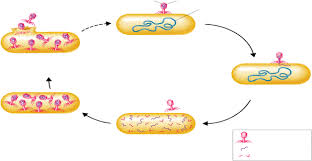

Identify structure Z.
Capsid
Membrane Envelope
Viral Genome (RNA/DNA)
Glycoproteins
The scientific name for the "spikes" on a virus
Capsid
Membrane Envelope
Viral Genome (RNA/DNA)
Glycoproteins
Derived (Stolen) from the membranes of the host cell
Capsid
Membrane Envelope
Viral Genome (RNA/DNA)
Glycoproteins
Also known as a "protein coat"
Capsid
Membrane Envelope
Viral Genome (RNA/DNA)
Glycoproteins


Naked RNA with no protein coat – sometimes found in plants
Virion
immature virus
viroid
host
How is influenza an example of a zoonotic disease?
a disease that can pass from species to species
a disease that stays in one species
a disease that is a
dead end disease
If a virus only passes its genetic material to the cell without making copies of itself this means the virus is _____________.
active
latent
sleeping
A prion is:
misfolded tissue
a misfolded protein
misfolded nervous tissue
misfolded cells
Which four help classify a virus?
Shape (morphology)
Size
Type of genetic Material
type of host (what it takes over)
Gram positivity
Which of the following is a recognized shape of viral capsids?
spherical
icosahedral
cuboidal
hexagonal
Antigenic shifts can lead to the development of novel viruses that cause pandemics.
True
False
In viruses, protein spikes on the outer surface are responsible for _________.
attachment
replication
protein synthesis
translation
Viruses can be a variety of shapes. Identify the various names of viral shapes.
Icosahedral
Helical
Coccus
Complex
Bacillus
How does an amoeba move?
It uses cilia.
It uses a flagellum.
It uses pseudopods.
It cannot move.
Which organelle functions to remove excess water in many protists?
micronucleus
contractile vacuole
food vacuole
oral groove
The long, whip-like structure which helps some protists move is called the ______________.
cilia
flagellum
tail
pseudopod


Which organelles found in algae are the sites of photosynthesis?
eyespots
mitochondria
chloroplasts
contractile vacuoles

These have a macronucleus and micronucleus.
zooflagellates (Giardia)
sporozoans (Plasmodium)
ciliates (Paramecium)
sarcodines (Amoeba)
What is the insect vector for malaria?
Anopheles mosquito
Tsetse fly
kissing bug
Domestic feline
Sponges (phylum: Porifera) are animals that possess feeding cells called collar cells. These cells have a central flagellum surrounded by a collar of microvilli. The collar filters organic matter out of the water column. Which protists share a most recent common ancestor with the poriferans?
Ciliates
Rhodophytes
Choanoflagellates
Radiolarians
The Irish potato famine in the 1840's was caused in large part by a proliferation of a(n)
Oomycete
Dinoflagellate
Chlorophyte
Paramecia
Which feature unites paramecia, malarial parasites, and dinoflagellates into a single group?
The use of cilia
Parasitic life style
Type of Ribosomes
Possession of Alveoli
A patient presents in an ER with severe stomach cramps and diarrhea. She was recently swimming in unclean water. Which protist would be the most likely cause of her symptoms?
Giardia
Plasmodium
Trypanosome
What would be strong evidence to suggest a protist is phagotrophic?
What would be strong evidence to suggest a protist is phototrophic?
Presence of chloroplasts
Which are features of mitochondria that reflect their endosymbiotic origin?
Have their own Circular DNA
Genes translated by ribosomes similar to bacterial ribosomes.
They replicate via meiosis, just like bacteria.
If a researcher wants to create a phylogeny showing relationships of different groups of algae, which type of DNA would be best to compare, and why?
Chloroplast DNA, because it will reflect algal relationships better than nuclear DNA.
Ribosomal DNA, because it is unique to algae.
Mitochondrial DNA, because only chloroplasts are from endosymbiosis.
Nuclear DNA, because chloroplast DNA will reflect primary and secondary endosymbiosis
A biologist uses a time machine to collect living material from two different time periods. Sample A is 3 billion years old, and sample B is 1.5 billion years old. How would these samples differ?
Prokaryotic organisms would be abundant in sample A but absent from sample B.
Eukaryotic organisms would be present in both samples but much more common in sample B.
Prokaryotic organisms would only occur in sample B.
Eukaryotic organisms would be absent from sample A.
The (a) are a group within the Euglenozoa that have a unique, single mitochondrion with minicircles and maxicircles of DNA linked in chains.
The members of (a) include dinoflagellates, apicomplexans, and ciliates.
All apicomplexans are nonmotile, spore forming, and live as (a) in animals.
The common characteristic of Alveolata is
A common characteristic of choanoflagellates is
presence of a funnel-shaped, contractile collar.
The marine multicellular protists including the larger brown algae belong to the
dinoflagellates
choanoflagellates
stramenopiles
foraminifera
Organisms that are characterized by being unicellular, photosynthetic, and having double shells made of silica are known as
The tropical diseases such as African sleeping sickness, Chagas disease, and leishmaniasis are caused by
foraminifera
sporozoans
oomycetes
trypanosomes
All (a) have two very different types of nuclei within their cells, small micronuclei and larger macronuclei.
Protists are classified into a single kingdom because of which of the following features?
They are monophyletic.
They are unicellular.
They are eukaryotes, but not fungi, plants, or animals.
Which of the following is true about Euglena?
They belong to the same phylum as Paramecium.
They do not have flagella.
They lack chloroplasts.
They can be both autotrophs and heterotrophs.
The White Cliffs of Dover, a famous landmark in England, is made of limestone, which is really a collection of the pore-studded shells (tests) of
diatoms
foraminifera
spirochetes
Trypanosomiasis is spread by
Vacuoles for ingesting food and regulating their water balance are characteristic of
sporozoans.
trypanosomes
ciliates
Conjugating ciliates exchange a pair of haploid micronuclei that undergo mitosis as a diploid micronucleus, while the macronucleus in each
Fuses with each other
Divides
Disentegrates
Gets expelled
The malarial parasite, Plasmodium, is a member of the group
Euglenozoa
Stramenopiles
Alveolata
Diplomonads
In addition to the true amoebas (Rhizopoda), another group with pseudopods are the
Euglenozoa
Stramenopila
Radiolarians
Diplomonads
Some photosynthetic euglenids can also ingest dissolved or particulate food. Which one of the following terms would best describe such a protist?
Which of the following are not shapes of bacteria
Cube
Spiral
Sphere
Rod
A bacterium reproduces asexually by dividing to form two new bacterial cells. What is the name of the process by which bacteria reproduce?
meiosis
budding
binary fission
Prokaryotes that like to live in extreme environments
Eubacteria
Archaea
Bacteriophage
Structure on bacteria used to stick to other bacteria or other surfaces.
cilia
flagellum
Pili
Which cycle kills the host cell immediately?
Lytic
Lysogenic
When viral DNA integrates with host cell DNA, this is called a:
capsid
bacteriophage
retrovirus
provirus
A virus that hides within the host cell for up to years is going through the _______ cycle.
Lytic
Lysogenic

Identify the shape and arrangement of this bacterium.
single bacillus
single spirrillium
strepto bacillius
strepto coccus

Identify the shape and arrangement of this bacterium.
singel bacillus
diplo bacillius
strepto bacillius
strepto coccus

Identify the shape and arrangement of this bacteria.
diplo coccus
strepto coccus
staphlo coccus
coccus tetrad
Thick peptidoglycan in cell wall
Gram positive bacteria
Gram negative bacteria
Thin peptidoglycan in cell wall
Gram positive bacteria
Gram negative bacteria
Stained pink
Gram positive bacteria
Gram negative bacteria
Stains purple
Gram positive bacteria
Gram negative bacteria
What makes up cell wall of some prokaryotes?
Cellulose
Chitin
Peptidoglycan
I am single celled. I am prokaryotic. I have a cell wall that's not made of peptidoglycan. I also live in very extreme conditions. Which domain do I belong in?
Bacteria
Archea
Eukarya
Archaea can be classified as Extremophiles because of their ability to live in extreme environments. What is an example of an Extremophile?
Halophiles
Thermophiles
Methanogens
All the Following are Extremeophiles
What is transformation?
The use of viruses to transform or genetically
engineer cells.
The measure of how well cells are transformed in a new phenotype.
The insertion of a foreign plasmid into a bacterial cell which results in new acquired traits.
Genetic engineering or transformation of mammalian cells.
Which image is a plasmid?


When bacteria is able to take up DNA, it is considered
permeable
semi-permeable
competent
curated
A small, rounded, thick-walled resting cell inside a bacterial cell
Endospore
Cellular Respiration
Pasteurization
Flagellum
A process by which bacteria reproduce sexually
conjugation
binary fission
endospore
decomposers

What is the name of the bacteria shape in the image?
Bacilli
Cocci
Spirilla

What is the name of the bacteria shape in the image?
Bacilli
Cocci
Spirilla

What is the name of the bacteria shape in the image?
Bacilli
Cocci
Spirilla
Archaebacteria (Select all that apply)
Live in extremely harsh environments
are the most common type of bacteria
are ancient bacteria
Viral DNA that is incorporated into a host cell's chromosome is called a
provirus
plasmid
party animal
prophage

