
Font size
 Worksheets
The Great Depression and the New Deal
Total questions: 87
Worksheet time: 44mins
What happened to banks and businesses after the stock market crashed?
They experienced unprecedented growth
They remained largely unaffected
Banks and businesses failed
They received large government subsidies
What caused the suffering of the Great Depression?
Rapid economic expansion
Widespread joblessness and poverty
Technological advancements
International peace and cooperation
How did President Hoover respond to the Great Depression?
By immediately implementing government aid programs
By relying on cooperation and voluntary action
By resigning from office
By declaring a national holiday
What event in 1929 revealed weaknesses in the American economy and helped trigger a spreading economic crisis?
The election of Herbert Hoover
The start of World War II
The stock market crash of 1929
The end of the Roaring Twenties
What is the gross national product?
The total value of a nation's exports
The total value of all goods and services produced in a nation
The total amount of money a nation owes
The total income of a nation's government
Who was the Republican president elected in 1928?
Calvin Coolidge
Franklin D. Roosevelt
Herbert Hoover
Harry S. Truman
What does buying on margin mean?
Purchasing stocks with the intention of selling them at a margin of profit
Buying stocks with loans from stockbrokers
Buying a small portion of a company's stocks
Investing in the stock market without any risk
What was the date of Black Tuesday, the worst day of the stock market crash?
October 24, 1929
October 29, 1929
November 2, 1929
December 25, 1929
Which group of people did not prosper during the 1920s?
Stockbrokers
Farmers and certain other workers
Business owners
Bankers
What percentage of people did not earn enough to have a good standard of living in 1929?
50%
60%
70%
80%
What caused spending to drop sharply at the end of the 1920s?
The introduction of new goods
People had used up their credit
The stock market crash
Increase in product prices
Why was buying on margin considered very risky?
It guaranteed a return on investment
It involved borrowing money to buy stocks
It was supported by the Federal Reserve System
It reduced the value of stocks
What event is known as Black Tuesday?
The day the stock market crashed
The day new goods were introduced
The day banks loaned out more money
The day spending on products increased
What was the Great Depression?
A natural disaster that affected the United States
The most severe economic downturn in the history of the United States
A war that caused economic suffering
A government policy that led to economic decline
What does the term "foreclosure" mean?
The process of investing in the stock market
A lender taking over ownership of a property from an owner who has not made loan payments
The act of traveling by train in search of a job
A period of below average rainfall
What was a "Hooverville" during the Great Depression?
A type of economic policy
A new industrial development
A shantytown where homeless people lived
A term used to describe a prosperous city
By 1933, how much savings had been lost in the United States due to the Great Depression?
$140 million
$140 billion
$140 thousand
$140
Compared to 1929, how did food prices change by 1933?
They doubled
They remained the same
They were about half of what they had been
They increased by 25%
By 1935, how many farms had gone bankrupt or been foreclosed?
750,000 farms
75,000 farms
7,500 farms
750 farms
What were Hoovervilles?
Shelters made by people who lost their homes during the Great Depression.
Cities that were economically prosperous during the Great Depression.
Programs initiated by President Hoover to combat unemployment.
Areas known for their resistance to the economic downturn.
How did nature make the Great Depression worse?
By causing a severe drought in the Great Plains region.
By providing abundant rainfall and crops.
By preventing any form of natural disaster.
By increasing the national product.
By what percentage did the gross national product drop by 1933?
25%
40%
10%
60%
What was the Dust Bowl?
A period of severe dust storms that damaged the ecology and agriculture of the US and Canadian prairies.
A bowl used during the Great Depression for food sharing.
A term used to describe the stock market crash of 1929.
A government program to help farmers during the Great Depression.
Who were the Okies?
People from Oklahoma who moved to California during the Great Depression.
A group of politicians who tried to help during the Great Depression.
The name given to the wealthy individuals who profited during the Great Depression.
The farmers who managed to keep their farms during the Dust Bowl.
What term did Herbert Hoover use to describe the voluntary partnership between business associations and government?
Cooperative state
Associative state
Reconstruction state
Hoover state
What was the Hoover Dam primarily funded by?
Private business
The Government
Reconstruction Finance Corporation
Cooperative funds
What is a cooperative?
A government program that provided money to banks
An organization owned and controlled by its members
A law that placed tariffs on many imported goods
Hoover's term for voluntary partnership
What was the main idea of Herbert Hoover's philosophy of government?
The government should control all aspects of business.
The government should play as small a role as possible in business affairs.
The government should provide direct financial support to individuals.
The government should build all major infrastructure projects.
How did cooperatives help farmers according to Hoover's response to the Great Depression?
By providing government jobs to all farmers
By allowing farmers to sell their crops directly to the government
By enabling farmers to buy materials at lower prices and sell their crops in ways that would raise prices for them all
By imposing tariffs on imported goods to protect farmers
Which act, passed in 1930, placed tariffs on many imported goods?
Hoover Dam Act
Cooperative Act
Smoot-Hawley Tariff Act
Reconstruction Finance Act
What actions made the Great Depression worse?
Increasing government spending on public projects
Businesses cutting wages and jobs
The establishment of the Reconstruction Finance Corporation
The Federal Home Loan Bank supporting home ownership
What was the Smoot-Hawley Tariff Act supposed to do?
Reduce international trade severely
Encourage Americans to buy foreign goods
Raise taxes on imports
Reduce foreclosures
What caused Hoover to lose support?
His efforts to reduce the budget deficit
The passage of the Smoot-Hawley Tariff Act
Passing a large tax increase in 1932
Establishing the Reconstruction Finance Corporation
What year were the two major plans of the New Deal established?
1929 and 1931
1933 and 1935
1941 and 1943
1930 and 1932
Which of the following was a result of the New Deal?
It ended the Great Depression completely.
It introduced temporary government programs.
It established many new government programs.
It was unpopular from the start.
From whom did Roosevelt face opposition on the New Deal?
Only from the political right
Only from the political left
Only from the Supreme Court
From both political right and left, and the Supreme Court
What is one lasting impact of the New Deal mentioned in the summary?
It temporarily changed the relationship between people and government.
It introduced programs such as Social Security that are still with us.
It was fully accepted and no longer controversial.
It was limited in its success and quickly forgotten.
Why might the New Deal still be considered controversial today?
Because it was too successful and ended all economic problems.
Because it only introduced temporary changes.
Because it is still debated due to its lasting impact and changes in government.
Because it faced no political opposition at the time.
In which year did Franklin Delano Roosevelt become president during the Great Depression and lead the country through World War II?
1932
1929
1945
1939
What name was given to the government-funded construction projects mentioned in the text?
New Deal
Fireside chats
Public works
Subsidy
What were the Roosevelt radio talks called that sounded like he was sitting next to your fireplace?
Fireside chats
New Deal
Subsidy
Hundred Days
What was Eleanor Roosevelt's role during FDR's presidency?
An influential senator
A critic of the New Deal
The wife of FDR, who established a more active role for First Ladies
A radio broadcaster
Which FDR program was aimed at ending the Great Depression?
Fireside chats
Public works
New Deal
Subsidy
Which senator said that FDR was too close to banks and corporations?
Huey P. Long
Father Charles Coughlin
Dr. Francis Townsend
Eleanor Roosevelt
Which critic claimed that the New Deal did not do enough for older Americans?
Huey P. Long
Father Charles Coughlin
Dr. Francis Townsend
Eleanor Roosevelt
What social issue did Eleanor Roosevelt address as part of her political work?
The fight against poverty
The campaign to stop the lynching of African Americans
The reform of the banking system
The creation of jobs
What were Roosevelt's first months in office called?
The Great Days
The Hundred Days
The New Beginning
The Banking Days
Which act made banks report to the government?
The Securities and Exchange Act
The National Industrial Recovery Act
The Agricultural Adjustment Act
The Emergency Banking Act
What was the purpose of the Civilian Conservation Corps created by FDR?
To oversee the stock markets
To pay people to work on conservation projects
To give farmers a subsidy
To set wages and production levels
What did the Agricultural Adjustment Act give to farmers?
A payment to grow more crops
A payment to grow fewer crops
A payment after retirement
A payment to oversee the stock markets
Which organization thought the New Deal was anti-business and had gone too far?
The Supreme Court
The American Liberty League
The Civilian Conservation Corps
The Securities and Exchange Commission
What was the Supreme Court's decision regarding many New Deal programs?
They were constitutional and balanced power
They were unconstitutional and changed the balance of power
They were effective and needed no changes
They were underfunded and incomplete
What was the main goal of the Social Security program introduced during the Second New Deal?
To provide a guaranteed income to older Americans
To fund the construction of roads and bridges
To establish labor laws and practices
To support the banking industry
Which of the following was a key part of the Second New Deal that employed millions of people?
The Wagner Act
The Social Security Act
The Works Progress Administration
The Committee for Industrial Organization
What was the economic condition called when the government spends more than it takes in?
Surplus
Equilibrium
Deficit
Inflation
Who was John Maynard Keynes?
The head of the United Mine Workers
A British economist who supported deficit spending to help the economy
The president who initiated the New Deal
The founder of the Committee for Industrial Organization
What was the purpose of the Wagner Act, also known as the National Labor Relations Act?
To provide income for Americans age 65 or older
To establish the Social Security program
To outlaw many anti-labor practices
To create jobs through public works projects
What kind of unions formed the organization called the CIO?
Skilled workers' unions
Unskilled workers' unions
Agricultural workers' unions
Government workers' unions
What had FDR accomplished by the 1936 election?
He had ended the Great Depression
He had increased unemployment
He had halved unemployment and incomes were up
He had started a war
Why do you think FDR's proposal to reorganize the courts caused so much argument?
Because it would reduce the number of courts
Because it would increase the number of Supreme Court justices
Because it would decrease the power of the president
Because it would make the courts less efficient
What was the new kind of strike launched by the United Auto Workers, part of the CIO, called?
Walk-out strike
Sit-down strike
Stand-up strike
Lock-out strike
Who argued that deficit spending could help the economy?
Franklin D. Roosevelt
John L. Lewis
John Maynard Keynes
The Republican Party
What happened to the economy in the summer of 1938?
It worsened significantly
It began to decline
It began to improve
It remained the same
Who was the first woman to head an executive department, serving as FDR's Secretary of Labor?
Mary McLeod Bethune
Dorothea Lange
Frances Perkins
Eleanor Roosevelt
What group of black government officials met as a group, advised FDR, and was led by Mary McLeod Bethune?
The Black Cabinet
The Executive Department
The National Youth Administration
The Southern Democrats
What was the main idea of the New Deal's impact as stated in the text?
It primarily focused on economic reforms.
It had a deep impact on American culture during the 1930s.
It was unsuccessful in changing racial discrimination.
It was led by Mary McLeod Bethune.
Which director of Negro Affairs in the National Youth Administration challenged racial discrimination during the New Deal programs?
Frances Perkins
Dorothea Lange
Eleanor Roosevelt
Mary McLeod Bethune
What problems did women workers face during the Great Depression and New Deal?
They were paid less than men.
They were not allowed to work in executive departments.
They were not affected by the Great Depression.
They were given more jobs than men.
Did the New Deal programs fight racial discrimination?
Yes, they completely eliminated racial discrimination.
No, Roosevelt thought it would make enemies of southern Democrats.
Yes, but only in the Southern states.
No, because the New Deal was focused solely on economic recovery.
What novel did Steinbeck write that was about a family of Okies leaving the Dust Bowl for California?
The Great Escape
The Dusty Road
The Grapes of Wrath
The California Dream
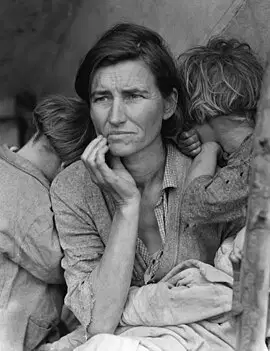
What did Dorothea Lange's most famous work include pictures of?
The urban elite
The rural poor
Famous celebrities
Industrial landscapes
What was the average cost of a movie ticket in the 1930s?
5 cents
25 cents
10 cents
50 cents
Which radio broadcast in 1938 was so realistic that some listeners thought Martians were attacking Earth?
The Great Martian Invasion
The War of the Worlds
The Alien Broadcast
The Mars Attack
What new kind of music became popular in the 1930s and was known for being highly orchestrated?
Blues
Swing
Rock
Classical
What was the main idea expressed about The New Deal in the text?
It was a complete failure with no lasting impact.
It had mixed success in rescuing the economy and changed Americans' relationship with their government.
It was solely responsible for ending the Great Depression.
It had no significant impact on American policies or economy.
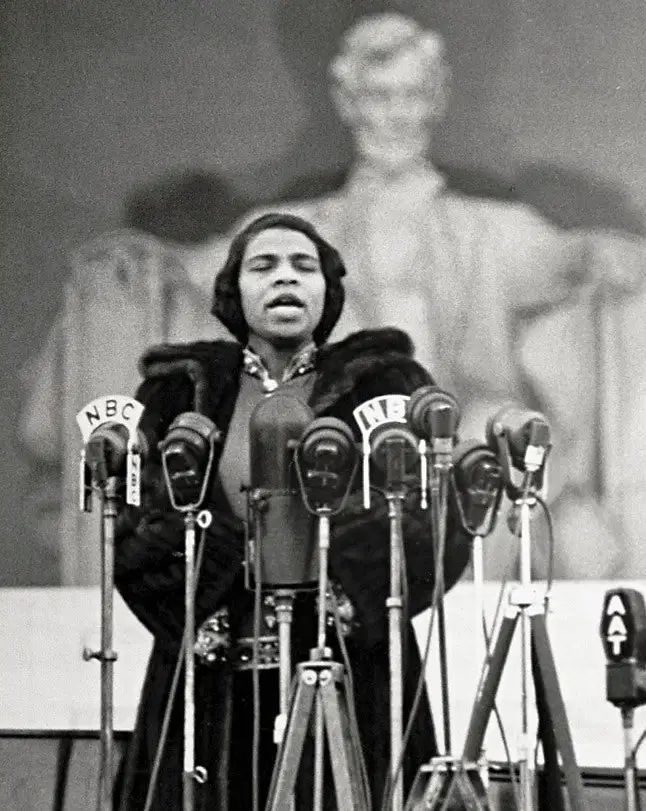
Who was Marian Anderson?
A politician involved in The New Deal.
A famous black singer who encountered racial discrimination.
The person who created the minimum wage law.
An incumbent during the time of The New Deal.
What is the definition of 'minimum wage' according to the text?
The highest salary an employer can pay a worker.
The average salary a worker receives in a particular industry.
The lowest wage an employer can legally pay a worker.
A fixed wage set by the government for all workers.
What does the term 'incumbent' mean?
A person who is currently unemployed.
The person currently holding a position.
A new candidate running for office.
A former official who has left office.
What did FDR promise the nation with The New Deal?
War and conflict resolution.
"Relief, recovery, and reform."
Immediate employment for all.
A new constitution.
What two opposing opinions do historians hold about The New Deal?
It was either too expensive or too cheap.
It was either too long or too short.
It either undermined business or saved the economy.
It was either completely successful or a total failure.
What two New Deal reforms do we still rely on today?
The Social Security Act and Public Works Administration.
The Federal Deposit Insurance Corporation and the Securities and Exchange Commission.
The National Recovery Administration and Civilian Conservation Corps.
The Agricultural Adjustment Act and Tennessee Valley Authority.
How did the New Deal change the relationship between businesses and government?
It made businesses more independent from the government.
It created a relationship based on the belief that government had a role in helping both businesses and individuals gain economic security.
It reduced the government's role in economic matters.
It established a one-time financial support for businesses.
Why were work-relief jobs not as good as regular jobs?
They were considered illegal.
They clashed with state programs.
They were temporary and did not pay well.
They required higher qualifications.
What was one of the limitations of the New Deal?
It provided jobs for all jobless people.
It did not allow racial discrimination.
It resulted in different amounts of relief in different states.
It established a permanent economic structure.
What action did FDR take that was considered daring regarding racial discrimination?
He passed a law that ended all racial discrimination.
He appointed minority groups to office, despite not pushing for racial justice.
He allowed a famous African American singer to perform at the White House.
He created a special relief program for minority groups.
What was the outcome of the 1938 congressional elections?
FDR's candidates won and the New Deal continued.
The incumbent candidates lost to new challengers.
The incumbent candidates won and the New Deal policies were reinforced.
The New Deal was ended immediately after the elections.
By what year was the New Deal considered to be over?
1935
1937
1938
1940

