
 Worksheets
Big Bang Scientists Quiz
Total questions: 25
Worksheet time: 13mins
According to Isaac Newton, how does light travel?
In curved paths
In straight lines
Only in a vacuum
In a wave pattern
Which Scientist described the first principles of chemistry that supported the theory of a fundamental unit of matter, the atom?
Thomson
Rutherford
Bohr
Dalton
Who discovered that atoms are made of particles with charge with his cathode-ray tube experiment?
Dalton
Rutherford
Bohr
Thomson
Which Scientist described the structure of atoms as having a massive nucleus and mostly empty space with his gold foil experiment?
Dalton
Thomson
Bohr
Rutherford
Who described the mathematics of electron energy by describing the energy levels that electrons can move to as a planetary model of the atom?
Dalton
Thomson
Rutherford
Bohr
Which scientist described electromagnetic phenomena and built the first electric motor?
Faraday
Einstein
Maxwell
None of the above
Which Scientist described the electromagnetic phenomena using differential calculus?
Faraday
Einstein
Maxwell
None of the above
What did Heisenberg and Schrodinger describe using the ideas about the probabilistic wave nature of matter?
The classical nature of light
The quantum nature of electrons
The structure of atomic nuclei
The principles of thermodynamics
How did Henrietta Swan Leavitt's discovery of the relationship between Cepheid variable luminosity and distance aid astronomers?
It helped them understand the life cycle of stars.
It provided them with the first "standard candle" to measure the distance to distant stars clusters.
It allowed them to predict when a star would go supernova.
It enabled them to identify new planets outside our solar system.
What was Annie Jump Cannon known for in the field of astronomy?
Discovering the planet Neptune
Developing the theory of relativity
Cataloging work that aided in stellar classification
Inventing the telescope
What was Cecilia Payne-Gaposchkin able to accurately relate in her work?
The spectral classes of stars to their size
The spectral classes of stars to their actual temperatures
The spectral classes of stars to their distance from Earth
The spectral classes of stars to their age
By what factor did Cecilia Payne-Gaposchkin find helium and particularly hydrogen to be more abundant in stars?
About one thousand
About one hundred thousand
About one million
About ten million
What did Hubble study in 1929 to determine the radial velocities of distant galaxies?
The brightness of galaxies
The size of galaxies
The redshift of spectral bands
The blue shift of spectral bands
What did Hubble discover about dim galaxies compared to bright ones?
Dim galaxies were closer than bright galaxies
Dim galaxies were redshifted further than bright galaxies
Dim galaxies were moving faster than bright galaxies
Dim galaxies were not redshifted at all
According to the concept of Red-Shift, what can be inferred about distant galaxies?
They are moving towards us
They are not moving
They are moving away from us
They are moving in a circular orbit around us
What did Georges Lemaître theorize about the recession of nearby galaxies?
It was caused by gravitational pull from black holes.
It was a result of a static universe.
It could be explained by an expanding universe.
It was an optical illusion.
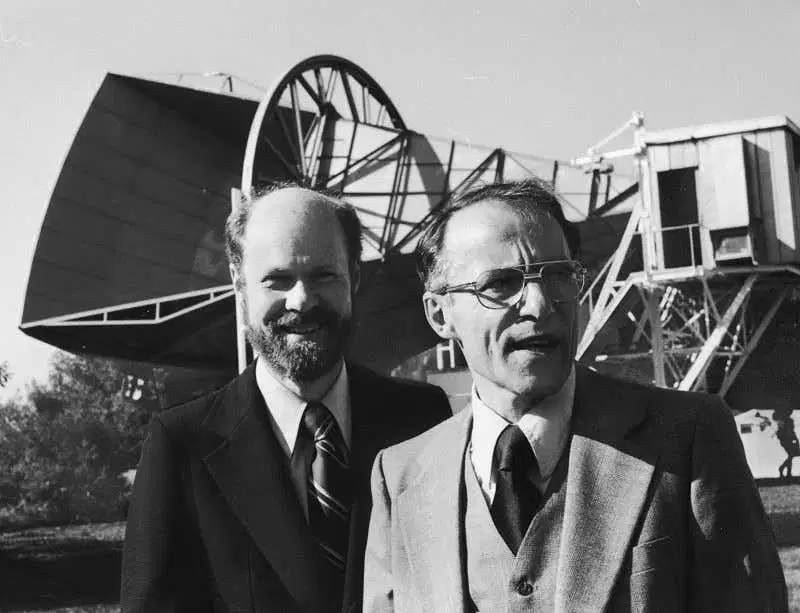
Which pair of scientists received the Nobel Prize for their discovery of cosmic background radiation?
Gamow and Alpher
Wilson and Penzias
Einstein and Lemaitre
Smith and Wesson
_____________, predicted that, starting from an infinitely dense and heated beginning of matter, which caused the great explosion, an enormous number of photons must have been released through the cosmos.
Ralph Alpher and Robert Herman
Georges Lemaitre
George Gamow
Fred Hoyle, Hermann Bondi and Thomas Gold
_____________ calculated the loss of heat of the light emitted by the explosion, since the Big Bang to our days; they estimated the CMB temperature.
Ralph Alpher and Robert Herman
Georges Lemaitre
George Gamow
Fred Hoyle, Hermann Bondi and Thomas Gold
In 2006, these two scientists won the Nobel Prize for mapping the cosmic microwave background over a broad spectral range.
Ralph Alpher and Robert Herman
Georges Lemaitre and George Gamow
John Mather and George Smoot
Hermann Bondi and Thomas Gold
Which space satellite created the most precise measurement of the CMB today?
COBE
KOBE
Planck
WIlkinson Anisotropy Probe
Which is NOT a piece of evident that support big bang cosmology?
CMB
Relative abundance of Isotopic ratios
Galactic evolutionary data
The Physical Limits and Constants to the universe
According to big bang cosmology, how do galaxies evolve?
Irregular to spiral to ellipse to lenticular
Blue to green to Red
Dwarf to main sequence to giant
None of the above
What is the Lambda Cold Dark Matter Model of the universe?
It is the current model that best fits observational evidence and theoretical prediction
It the theory that explains why the big bang happened
It is the best estimation of the universe's size
It explains why Type 1a supernovas can be seen billions of light years away
What is Hubble Tension?
A discrepancy between the measured Hubble constant from different reference points
The energy stored in the Hubble space Telescope
Hubble's stressful relationship with his wife
The Universal tension all things feel when being observed

