
 Worksheets
EKG Ch. 7-8 Test
Total questions: 37
Worksheet time: 19mins
Name
Class
Date
1.
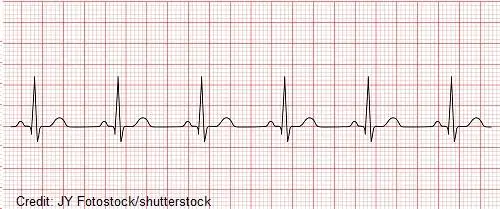
The rhythm this figure is:
a)
sinus tachycardia.
b)
sinus rhythm.
c)
sinus bradycardia.
d)
sinus arrhythmia.
2.
Which of the following is TRUE about sinus rhythm?
a)
It is regular.
b)
It has an irregularly irregular pattern of QRS complexes.
c)
It has multiple shapes of P waves.
d)
It has wide QRS complexes without preceding P waves.
3.
Sinus arrhythmia is
a)
a regular rhythm.
b)
an irregular rhythm.
c)
a rhythm that originates in the atria.
d)
a rhythm that originates in the AV junction.
4.
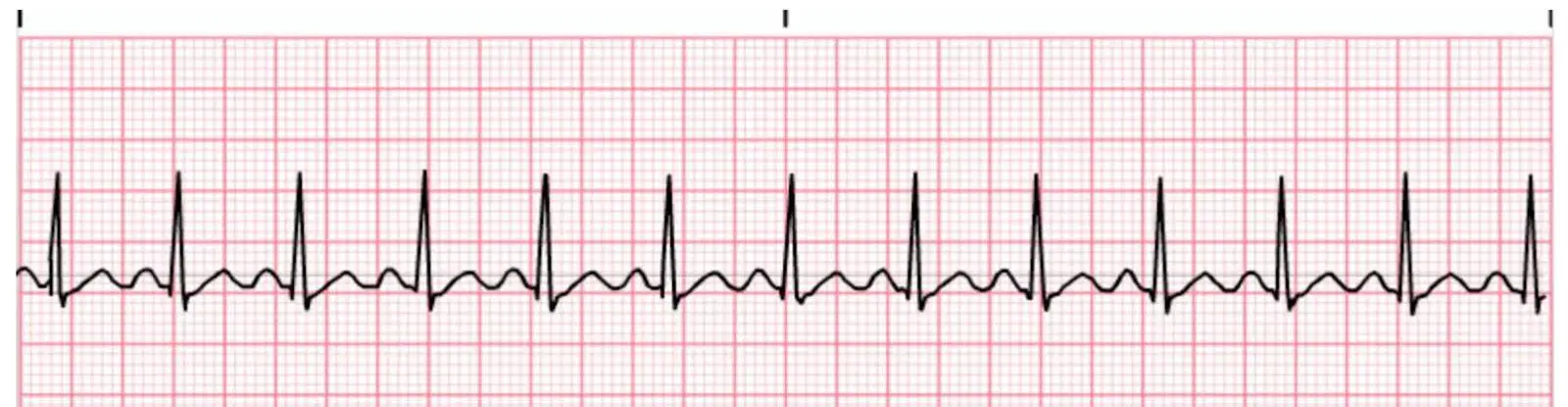
The heart rate in this figure is closest to
a)
170
b)
150
c)
140
d)
100
5.
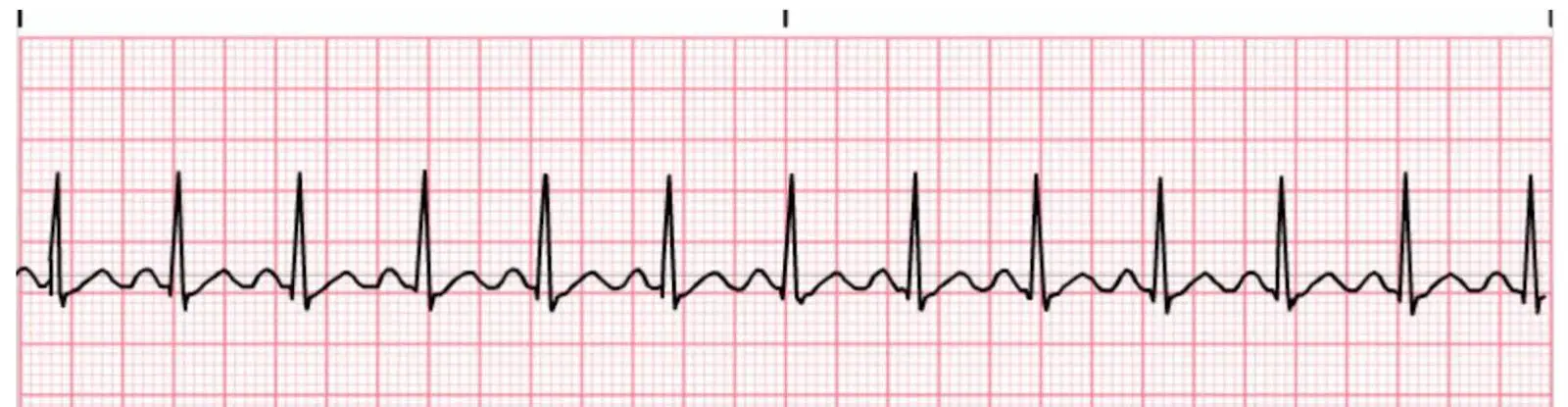
The rhythm in this figure is
a)
sinus rhythm.
b)
sinus bradycardia.
c)
sinus rhythm with sinus arrest.
d)
sinus tachycardia.
6.
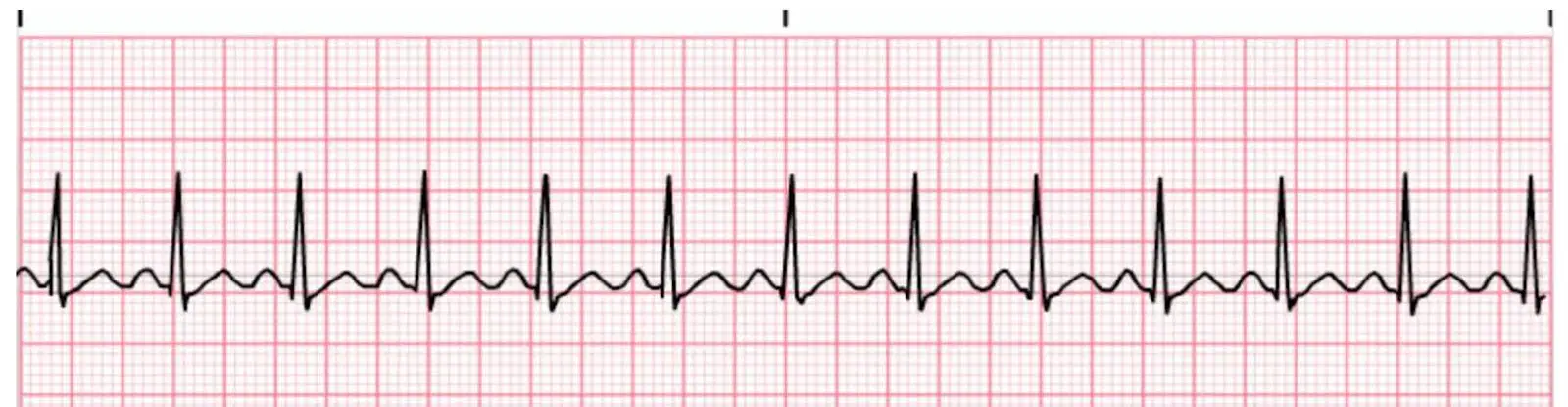
PR interval in this figure is closest to
a)
0.16 seconds.
b)
0.28 seconds.
c)
0.04 seconds.
d)
0.40 seconds.
7.
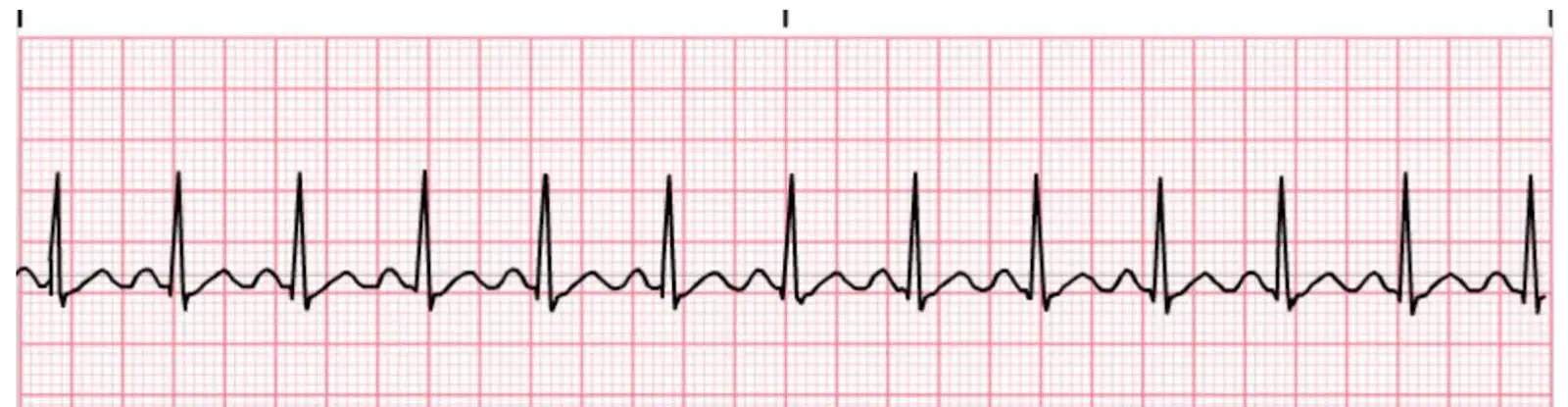
QRS interval in this figure is closest to
a)
0.42 seconds.
b)
0.08 seconds.
c)
0.28 seconds.
d)
0.30 seconds.
8.
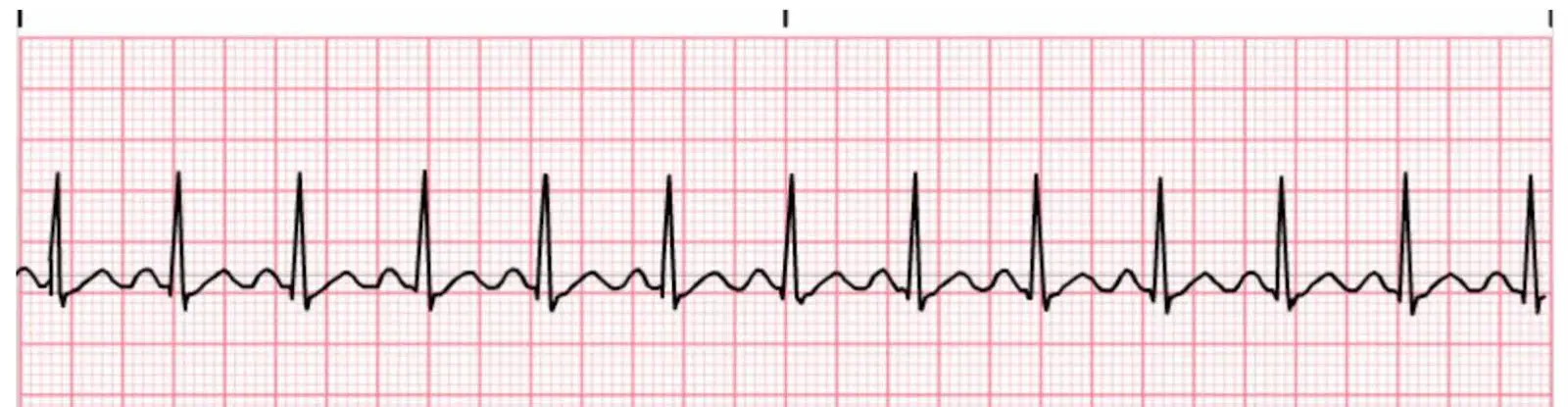
The T wave in this figure is
a)
inverted.
b)
upright.
c)
indicative of sinus control of the ventricles.
d)
indicative of ventricular depolarization.
9.
Sinus rhythms all have
a)
uniform shape P waves preceding the QRS complexes.
b)
multiple shapes of P waves preceding the QRS complexes.
c)
a wavy baseline without P waves or QRS complexes.
d)
inverted P waves in Lead II.
10.
In sinus block
a)
the pause is a multiple of the R-R intervals.
b)
there are P waves inside the pause.
c)
all R-R intervals are constant.
d)
the heart rate varies from 100 to 160.
11.
Treatment for sinus tachycardia associated with a high fever would be to
a)
give atropine.
b)
start CPR.
c)
give acetaminophen or ibuprofen to get the temperature down.
d)
give beta-blockers.
12.
Which of the following sinus rhythms would be expected with stimulation of the sympathetic nervous system?
a)
Sinus rhythm rate 68
b)
Sinus bradycardia rate 45
c)
Sinus arrhythmia rate 45—73
d)
Sinus tachycardia rate 125
13.
A pause that occurs when the sinus node's impulse is not conducted out of the sinus node itself is
a)
sinus arrest.
b)
sinus arrhythmia.
c)
sinus bradycardia.
d)
sinus block.
14.
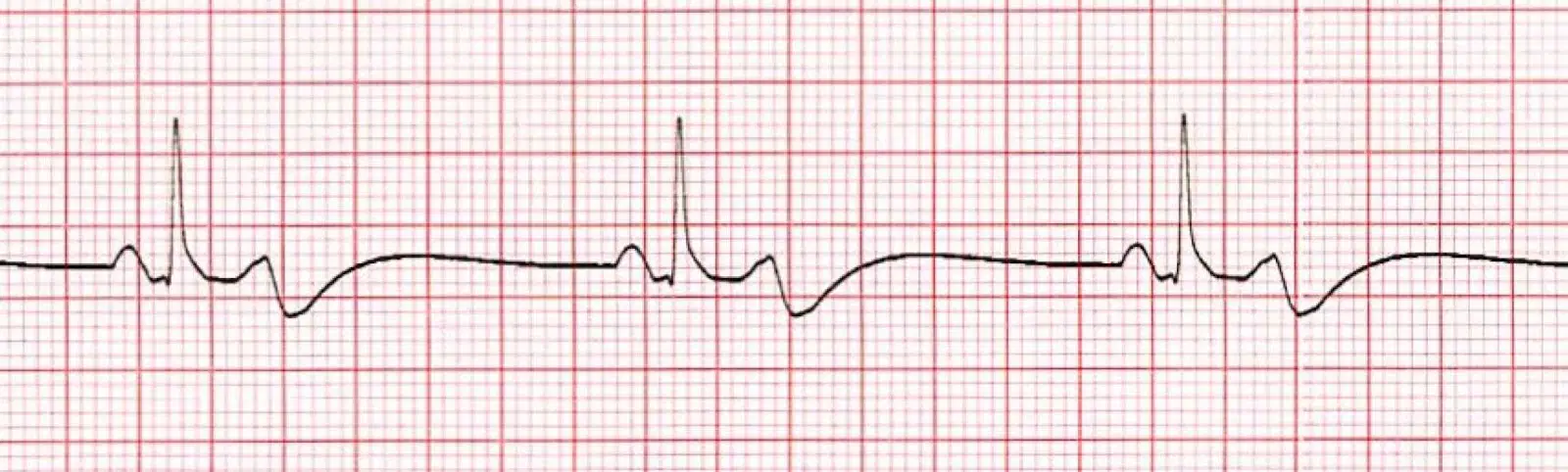
In this figure the rhythm shown is
a)
sinus rhythm.
b)
sinus bradycardia.
c)
sinus tachycardia.
d)
sinus block.
15.
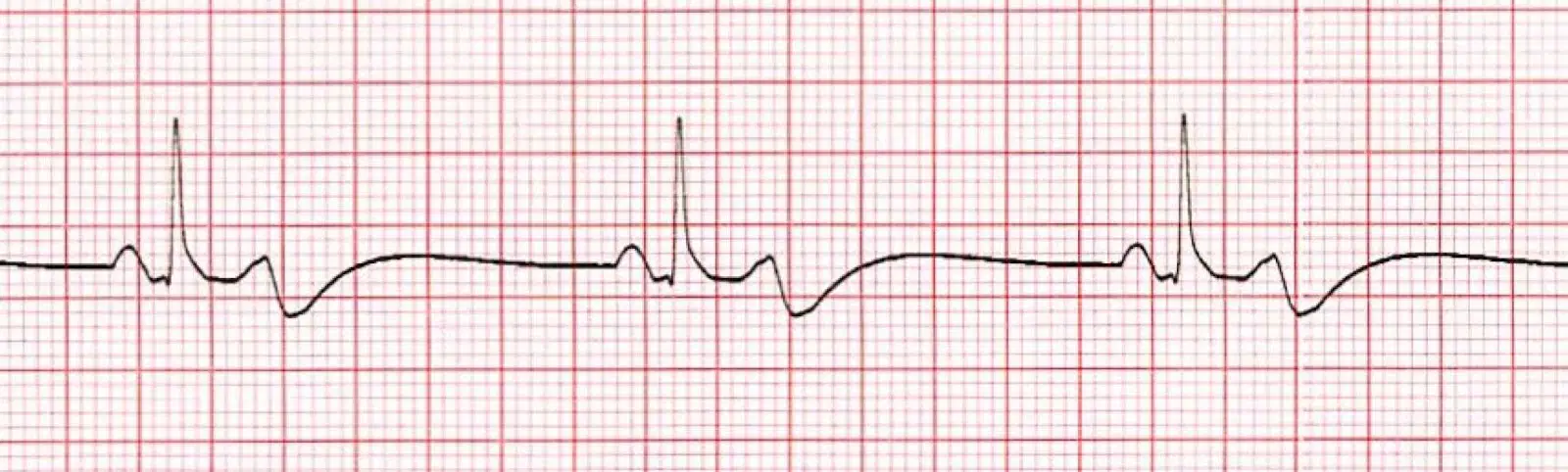
In this figure, the heart rate is closest to
a)
100.
b)
40.
c)
75.
d)
55.
16.
Atropine is a medication that would be appropriate for symptomatic
a)
sinus tachycardia.
b)
sinus bradycardia.
c)
sinus rhythm.
d)
none of the above.
17.
Thyrotoxicosis is a condition associated with which rhythm?
a)
Sinus block
b)
Sinus arrest
c)
Sinus tachycardia
d)
Sinus bradycardia
18.
In which rhythm is an escape beat sometimes seen?
a)
Sinus rhythm
b)
Sinus bradycardia
c)
Sinus arrhythmia
d)
Sinus arrest
19.
Sinus arrhythmia has a pattern that often corresponds with the
a)
PR intervals.
b)
breathing pattern.
c)
P-P intervals.
d)
patient's age.
20.
Atrial fibrillation has
a)
P waves of multiple shapes.
b)
P waves with uniform shape.
c)
no P waves at all.
d)
sawtooth-shaped waves between the QRS complexes.
21.
The most common cause of an unexplained pause is a(n)
a)
nonconducted PAC.
b)
sinus arrest.
c)
sinus block.
d)
atrial tachycardia.
22.
A PAC is a
a)
premature beat from the sinus node.
b)
late beat from the atria.
c)
premature beat from the ventricle.
d)
premature beat from the atrium.
23.
Atrial tachycardia is characterized by
a)
abnormal P waves preceding the regular QRS complexes.
b)
sawtooth waves between the QRS complexes.
c)
undulating, fibrillatory baseline between the irregular QRS complexes.
d)
a heart rate of 250—350.
24.
Atrial flutter has an atrial rate
a)
between 60 and 100.
b)
greater than 100.
c)
between 40 and 60.
d)
between 250 and 350.
25.
Wandering atrial pacemaker has at least three different shapes of
a)
T waves.
b)
QRS complexes.
c)
P waves.
d)
U waves.
26.
A regular rhythm with narrow QRS complexes, indistinguishable P waves, and a heart rate of 155 would be consistent with
a)
atrial fibrillation.
b)
supraventricular tachycardia.
c)
sinus bradycardia.
d)
ventricular tachycardia.
27.
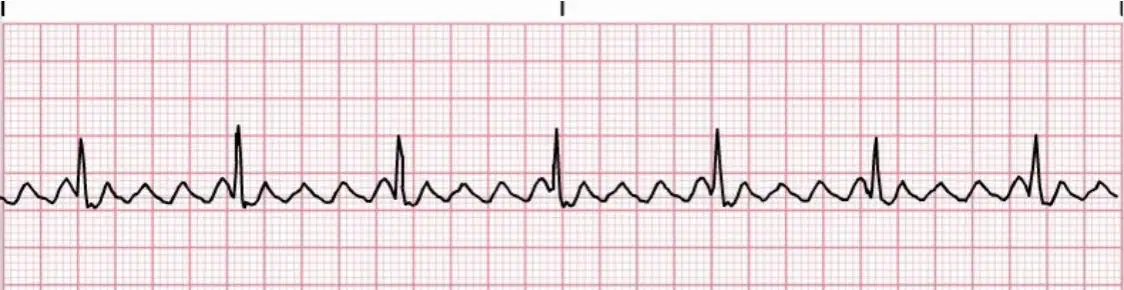
In this figure, the rhythm is
a)
sinus rhythm.
b)
atrial fibrillation.
c)
atrial flutter.
d)
SVT.
28.
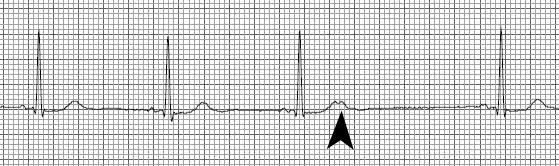
The rhythm in this figure is
a)
sinus rhythm with a sinus arrest and a junctional escape beat.
b)
sinus arrhythmia.
c)
sinus rhythm with a nonconducted PAC.
d)
wandering atrial pacemaker.
29.
Blood clots collecting in the atria are a possible complication of what rhythm?
a)
Atrial tachycardia
b)
PACs
c)
Sinus tachycardia
d)
Atrial fibrillation
30.
Paroxysmal means
a)
starting and stopping suddenly.
b)
life-threatening.
c)
premature.
d)
prolonged.
31.
Atrial flutter is characterized by what kind of atrial waves?
a)
Zigzag or sawtooth-shaped waves between the QRS complexes
b)
P waves of uniform shape
c)
No atrial waves at all
d)
Tall, pointy P waves following the QRS complexes
32.
Frequent PACs can be a sign of impending
a)
heart failure.
b)
sinus arrest.
c)
respiratory failure.
d)
cardiac arrest.
33.
Which statement is TRUE regarding P waves in atrial flutter?
a)
There are no P waves; flutter waves are present instead.
b)
The P waves are all tall and pointy.
c)
P waves change shape constantly.
d)
P waves have an atrial rate of about 100.
34.
Atrial fibrillation is
a)
regular.
b)
irregular.
c)
regular but interrupted by premature beats.
d)
regular but interrupted by pauses.
35.
Atrial fibrillation can cause a drop in cardiac output because it causes
a)
a loss of the atrial kick.
b)
the ventricles to contract more forcefully.
c)
the AV valves to remain open too long.
d)
the sinus node to fire more often.
36.
Atrial flutter is almost always seen in patients with
a)
thyrotoxicosis.
b)
acute heart attacks.
c)
heart disease.
d)
cardiac arrest.
37.
Atrial fibrillation causes the atria to
a)
contract forcefully.
b)
expel the blood backwards.
c)
wiggle instead of contract.
d)
depolarize as a unit.
100 %

