
 Worksheets
Atomic Structure and Arrangement- 1-1 Scale Review
Total questions: 26
Worksheet time: 13mins
Name
Class
Date
1.
Most of an atom's mass is found in its __________.
a)
electron cloud
b)
protons
c)
nucleus
d)
electrons
2.
Which state of matter have molecules widely spaced a part and move around randomly at high speeds?
a)
Solid
b)
Liquid
c)
Gas
3.
What is made up of only one type of atom?
a)
Element
b)
Fusion
c)
Compound
4.
Particle motion in frozen ice (H₂O) is __________ than particle motion in liquid water (H₂O).
a)
faster
b)
more massive
c)
less massive
d)
slower
5.
Molecules in a solid state of matter have a definite shape and volume.
a)
True
b)
False
6.

Which model represents a COMPOUND?
a)
A
b)
B
7.

Which of the substances in the table below IS NOT an element?
a)
Helium
b)
Carbon
c)
Oxygen
d)
Water
8.
The center of an atom is known as a(n) __________.
a)
electron
b)
nucleus
c)
proton
d)
neutron
9.
A(n) __________ is a subatomic particle with a POSITIVE charge.
a)
atom
b)
neutron
c)
proton
d)
electron.
10.
A(n) __________ is the basic building block for all matter.
a)
nucleus
b)
solid
c)
electron
d)
atom
11.
In an atom, where are the ELECTRONS located?
a)
at the bottom of the nucleus
b)
in the electron cloud
c)
inside the nucleus
d)
in the energy cloud
12.

How many ATOMS are shown?
a)
3
b)
1
c)
2
d)
6
13.

How many MOLECULES are shown?
a)
1
b)
2
c)
7
d)
6
14.
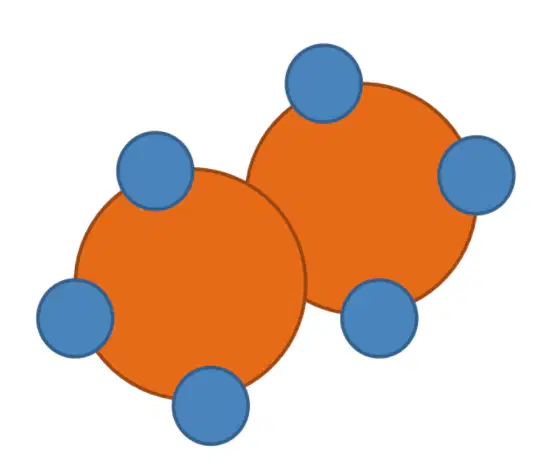
How many COMPOUNDS are shown?
a)
1
b)
2
c)
4
d)
8
15.

How many ELEMENTS are shown?
a)
1
b)
2
c)
3
d)
6
16.
Atoms in a GAS state of matter are ______________.
a)
colliding with each other and moving around
b)
vibrating in place and tightly packed together in a rigid formation
c)
spaced far apart, moving fast/high speeds and colliding less often
d)
not moving at all
17.
Which two subatomic particles are found in the NUCLEUS of an atom?
a)
protons and electrons
b)
protons and neutrons
c)
neutrons and electrons
d)
positive and negative atoms
18.
H₂O (water) is a(n) ____________ because when 2 Hydrogen atoms (gas) and 1 Oxygen atom (gas) are combined they form a new substance.
a)
atom
b)
nucleus
c)
proton
d)
compound
19.
Which subatomic particle is found OUTSIDE OF the NUCLEUS of an atom and has a negative charge?
a)
proton
b)
electron
c)
neutron
d)
nucleus
20.
Which subatomic particle has a NEUTRAL charge?
a)
neutron
b)
electron
c)
compound
d)
proton
21.
What are the three subatomic particles?
a)
atoms, molecules, compounds
b)
solids, liquids, gases
c)
atoms, molecules, elements
d)
protons, neutrons, electrons
22.
Every object in the universe is composed of various combinations of atoms that create the different _____________ we see every day.
a)
atoms
b)
elements
c)
compounds
d)
nucleus
23.
CO and CO₂ are the same compound.
a)
True
b)
False
24.
How many NEUTRONS are in Sulfur (S)?
Atomic Number- 16
Atomic Mass- 32.066
Use: A=P=E M-A=N
(Don't forget to round the atomic mass!)
a)
14
b)
16
c)
18
d)
20
25.

The Periodic Table is organized with ____________ as horizontal rows.
a)
Periods
b)
Groups
c)
Teams
d)
Clubs
26.

The Periodic Table is organized with ____________ as vertical columns.
a)
Periods
b)
Groups
c)
Teams
d)
Clubs
100 %

