
 Worksheets
CCNA 4
Total questions: 110
Worksheet time: 1hrs 1mins
Which WLC interface provides out-of-band management in the Cisco Unified Wireless Network Architecture?
AP-Manager
service port
dynamic
virtual
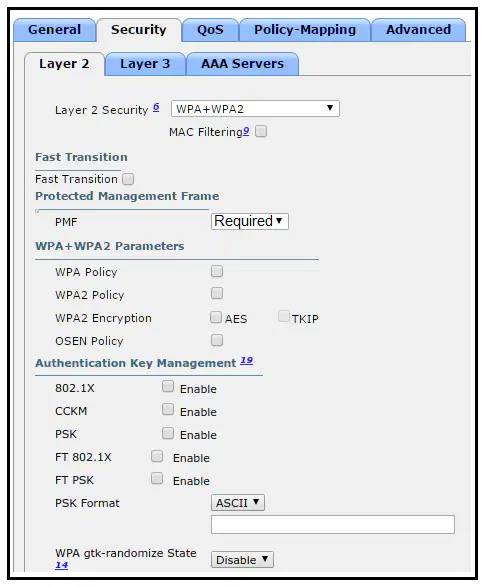
Refer to the exhibit. The network engineer is configuring a new WLAN and is told to use a setup password for authentication instead of the RADIUS
servers.
Which additional set of tasks must the engineer perform to complete the configuration?
Disable PMF Enable PSK Enable 802.1x
Select WPA Policy Enable CCKM Enable PSK
Select WPA Policy Select WPA2 Policy Enable FT PSK
Select WPA2 Policy Disable PMF Enable PSK
Which mode must be set for Aps to communicate to a Wireless LAN Controller using the Control and Provisioning of Wireless Access Points
(CAPWAP) protocol?
route
bridge
lightweight
autonomous
Which switch technology establishes a network connection immediately when it is plugged in?
PortFast
BPDU guard
UplinkFast
BackboneFast
Which command on a port enters the forwarding state immediately when a PC is connected to it?
switch(config)#spanning-tree portfast default
switch(config)#spanning-tree portfast bpduguard default
switch(config-if)#spanning-tree portfast trunk
switch(config-if)#no spanning-tree portfast
If a switch port receives a new frame while it is actively transmitting a previous frame, how does it process the frames?
The new frame is delivered first, the previous frame is dropped, and a retransmission request is sent
The previous frame is delivered, the new frame is dropped, and a retransmission request is sent
The new frame is placed in a queue for transmission after the previous frame
The two frames are processed and delivered at the same time
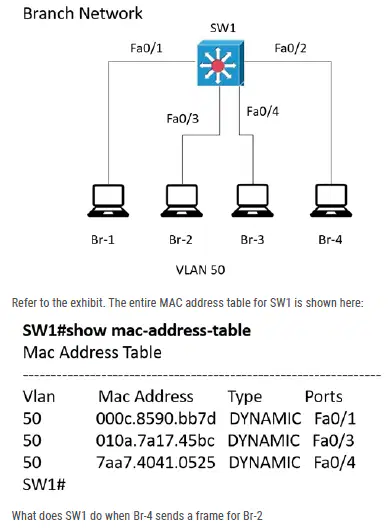
Refer to the exhibit. The entire MAC address table for SW1 is shown here:
What does SW1 do when Br-4 sends a frame for Br-2
It performs a lookup in the MAC address table for Br-4 and discards toe frame due to a missing entry
It floods the frame out or all ports except on the port where Br-2 is connected
It Inserts the source MAC address and port into the forwarding table and forwards the frame to Br-2.
It maps the Layer 2 MAC address for Fa0/3 to the Layer 3 IP address and towards the frame.
Which statement about Link Aggregation when implemented on a Cisco Wireless LAN Controller is true?
To pass client traffic two or more ports must be configured
The EtherChannel must be configured in ג€mode active €
When enabled, the WLC bandwidth drops to 500 Mbps
One functional physical port is needed to pass client traffic
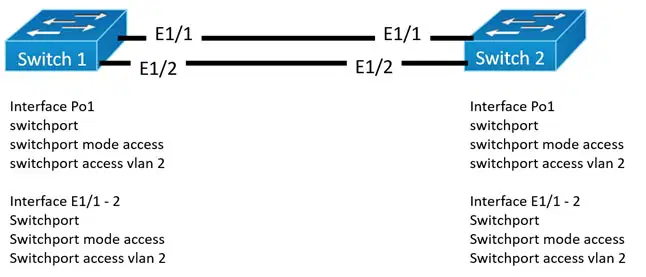
Refer to the exhibit. An engineer is configuring an EtherChannel using LACP between Switches 1 and 2.
Which configuration must be applied so that only Switch 1 sends LACP initiation packets?


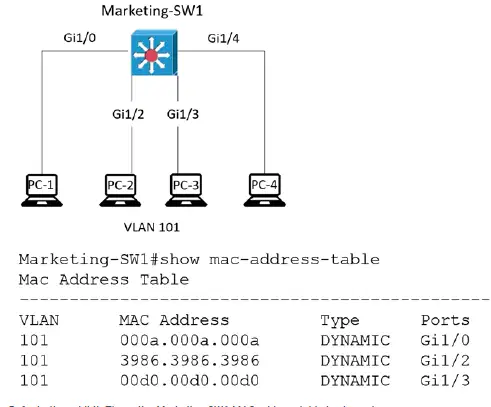
Refer to the exhibit. The entire Marketing-SW1 MAC address table is shown here:
What does the switch do when PC-4 sends a frame to PC-1?
It performs a lookup in the MAC address table and discards the frame due to a missing entry.
It maps the Layer 2 MAC address to the Layer 3 IP address and forwards the frame.
It inserts the source MAC address and port into the table and forwards the frame to PC-1.
It floods the frame out of all ports except on the port where PC-1 is connected.

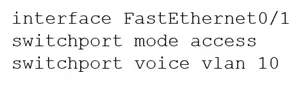
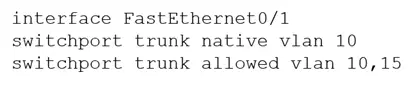
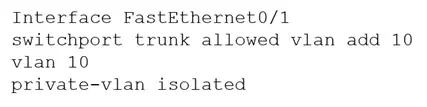
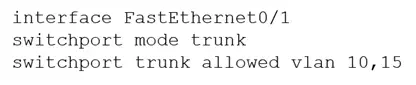
Refer to the exhibit. All VLANs are present in the VLAN database. Which command sequence must be applied to complete the configuration?
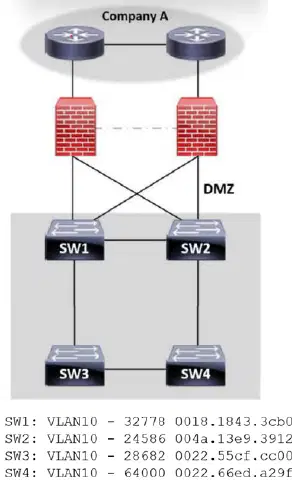
Refer to the exhibit. Which switch becomes the root of a spanning tree for VLAN 10 if the primary switch fails and all links are of equal speed?
1
2
3
4
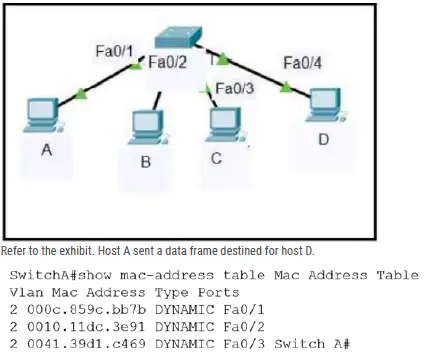
Refer to the exhibit. Host A sent a data frame destined for host D.What does the switch do when it receives the frame from host A?
It floods the frame out of all ports except port Fa0/1
It experiences a broadcast storm
It shuts down the port Fa0/1 and places it in err-disable mode
It drops the frame from the switch CAM table
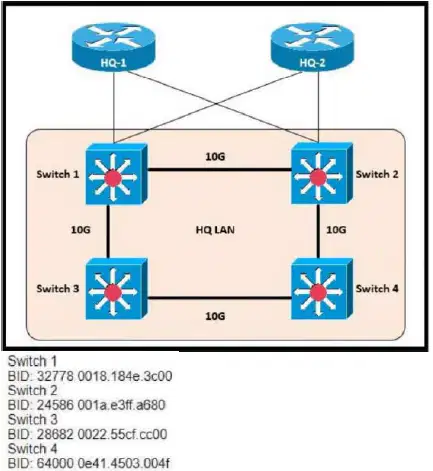
Refer to the exhibit. Which switch becomes the root of the spanning tree?
1
2
3
4
Which channel-group mode must be configured when multiple distribution interfaces connected to a WLC are bundled?
Channel-group mode passive.
Channel-group mode on.
Channel-group mode desirable
Channel-group mode active.
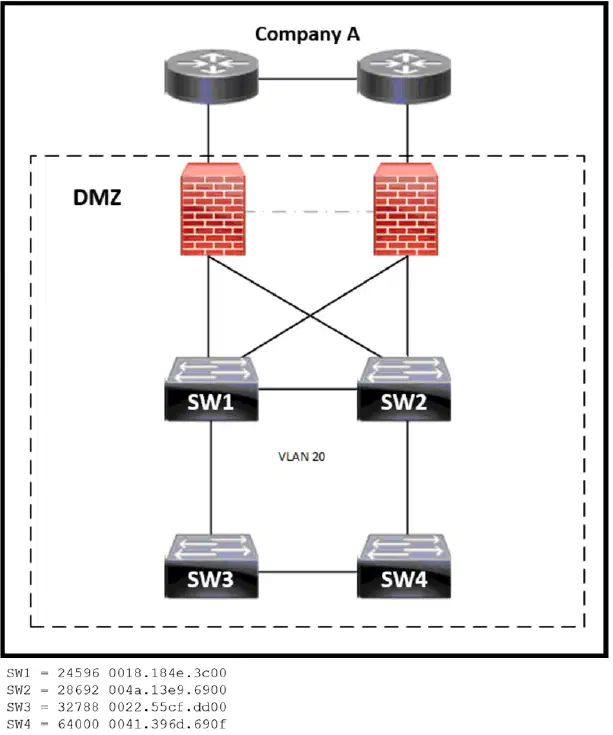
Refer to the exhibit. Which switch become the root of a spanning tree for VLAN 20 if all links are of equal speed?
1
2
3
4
Which Layer 2 switch function encapsulates packets for different VLANs so that the packets transverse the same port and maintain traffic
separation between the
VLANs?
VLAN marking
VLAN numbering
VLAN DSCP
VLAN tagging
Which value is the unique identifier that an access point uses to establish and maintain wireless connectivity to wireless network devices?
VLAN ID
SSID
RFID
WLAN ID
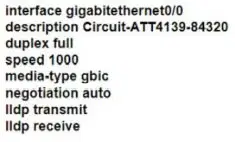
An engineer must configure neighbor discovery between the company router and an ISP. What is the next step to complete the configuration if the ISP uses a third-party router?
Enable LLDP globally.
Disable CDP on gi0/0.
Enable LLDP TLVs on the ISP router.
Disable auto-negotiation.
What is a function of MAC learning on a switch?
MAC address learning is disabled by default on all VLANs.
Frames received for a destination MAC address not listed in the address table are dropped
The MAC address table is used to populate the ARP table.
A static MAC address is manually added to the MAC table.
What does a switch do when it receives a frame whose destination MAC address is missing from the MAC address table?
It changes the checksum of the frame to a value that indicates an invalid frame.
It updates the CAM table with the destination MAC address of the frame.
It appends the table with a static entry for the MAC and shuts down the port.
It floods the frame unchanged across all remaining ports in the incoming VLAN.
By default, how long will the switch continue to know a workstation MAC address after the workstation stops sending traffic?
200 seconds
300 seconds
600 seconds
900 seconds
A project objective is to minimize the association time to the different access points as mobile devices move around the office. The ideal solution
must cover numerous devices and device types, including laptops, mobile phones, tablets and wireless printers. What must be configured?
802.11v BSS Max Idle Service
802.11v Disassociation Imminent
802.11ax BSS configure
802.11k neighbor List Dual Band
Which two protocols are used by an administrator for authentication and configuration on access points? (Choose two.)
802.1Q
RADIUS
Kerberos
TACACS+
802.1x
A WLC sends alarms about a rogue AP, and the network administrator verifies that the alarms are caused by a legitimate autonomous AP. How
must the alarms be stopped for the MAC address of the AP?
Remove the AP from WLC management
Place the AP into manual containment.
Manually remove the AP from Pending state.
Set the AP Class Type to Friendly.
What is one reason to implement LAG on a Cisco WLC?
to increase security and encrypt management frames
to enable connected switch ports to failover and use different VLANs
to provide link redundancy and load balancing
to allow for stateful and link-state failover
When an access point is seeking to join wireless LAN controller, which message is sent to the AP-Manager interface?
Discovery response
DHCP request
DHCP discover
Discovery request
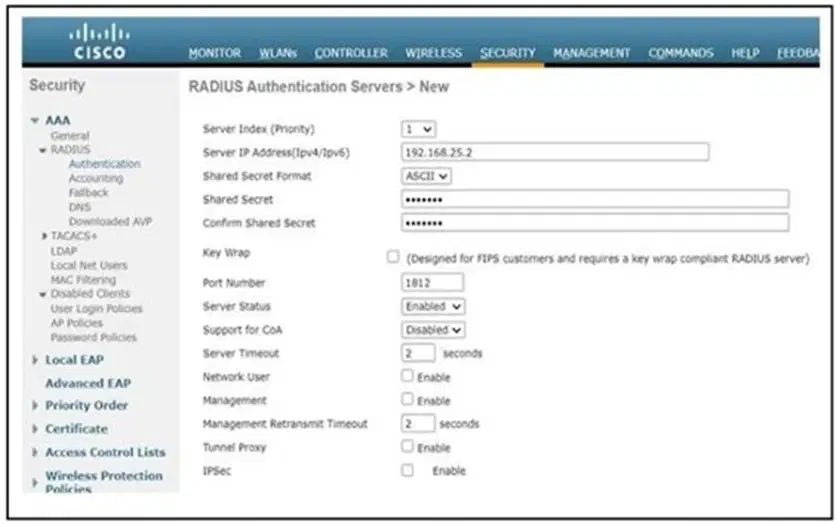
Refer to the exhibit. A network engineer configures the Cisco WLC to authenticate local wireless clients against a RADIUS server. Which task must
be performed to complete the process?
Change the Support for CoA to Enabled
Select Enable next to Management
Select Enable next to Network User
Change the Server Status to Disabled
After installing a new Cisco ISE server which task must the engineer perform on the Cisco WLC to connect wireless clients on a specific VLAN
based on their credentials?
Disable the LAG Mode on Next Reboot.
Enable the Event Driven RRM.
Enable the Allow AAA Override.
Enable the Authorize MIC APs against auth-list or AAA
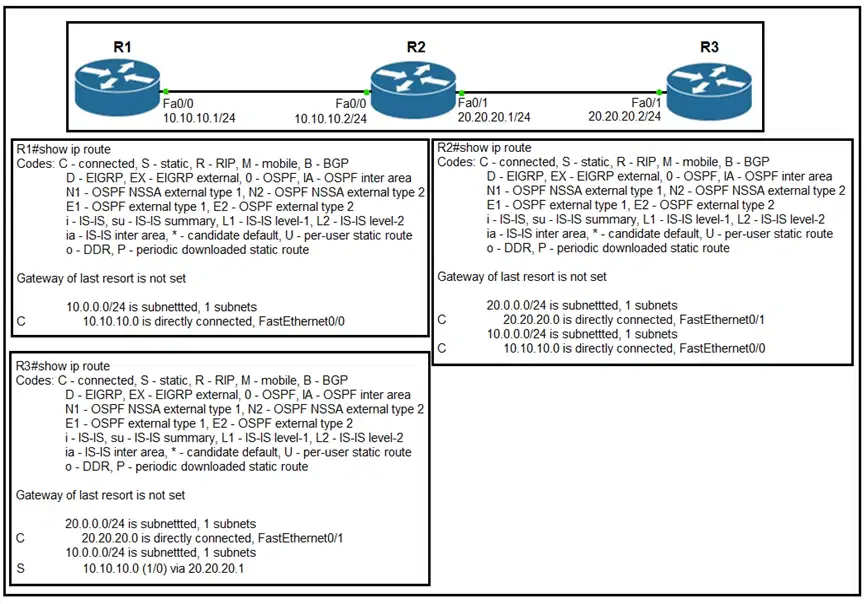
Refer to the exhibit. Router R1 Fa0/0 cannot ping router R3 Fa0/1. Which action must be taken in router R1 to help resolve the configuration issue?
set the default gateway as 20.20.20.2
configure a static route with Fa0/1 as the egress interface to reach the 20.20.2.0/24 network
configure a static route with 10.10.10.2 as the next hop to reach the 20.20.20.0/24 network
set the default network as 20.20.20.0/24
By default, how does EIGRP determine the metric of a route for the routing table?
It uses the bandwidth and delay values of the path to calculate the route metric.
It uses a default metric of 10 for all routes that are learned by the router.
It counts the number of hops between the receiving and destination routers and uses that value as the metric.
It uses a reference bandwidth and the actual bandwidth of the connected link to calculate the route metric.
Router R1 must send all traffic without a matching routing-table entry to 192.168.1.1. Which configuration accomplishes this task?
R1#config t R1(config)#ip routing R1(config)#ip route default-route 192.168.1.1
R1#config t R1(config)#ip routing R1(config)#ip route 192.168.1.1 0.0.0.0 0.0.0.0
R1#config t R1(config)#ip routing R1(config)#ip route 0.0.0.0 0.0.0.0 192.168.1.1
R1#config t R1(config)#ip routing R1(config)#ip default-gateway 192.168.1.1
A packet is destined for 10.10.1.22. Which static route does the router choose to forward the packet?
ip route 10.10.1.0 255.255.255.240 10.10.255.1
ip route 10.10.1.20 255.255.255.252 10.10.255.1
ip route 10.10.1.16 255.255.255.252 10.10.255.1
ip route 10.10.1.20 255.255.255.254 10.10.255.1
What are two reasons for an engineer to configure a floating static route? (Choose two.)
to enable fallback static routing when the dynamic routing protocol fails
to route traffic differently based on the source IP of the packet
to automatically route traffic on a secondary path when the primary path goes down
to support load balancing via static routing
to control the return path of traffic that is sent from the router
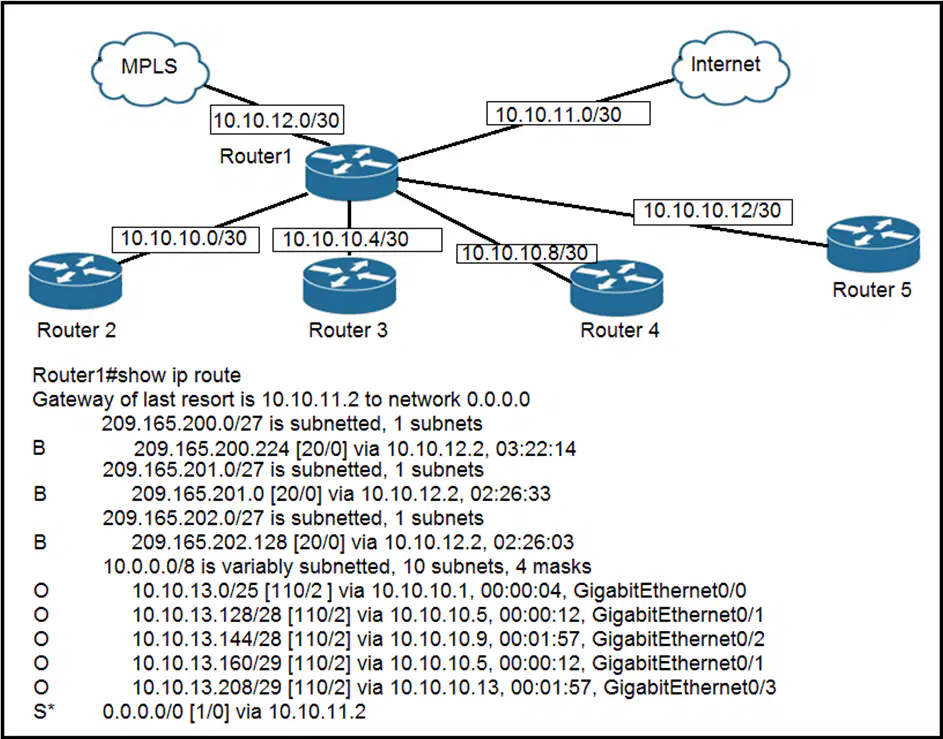
Refer to the exhibit. To which device does Router1 send packets that are destined to host 10.10.13.165?
2
3
4
5
R1 has learned route 10.10.10.0/24 via numerous routing protocols. Which route is installed?
route with the next hop that has the highest IP
route with the lowest cost
route with the lowest administrative distance
route with the shortest prefix length
Which two minimum parameters must be configured on an active interface to enable OSPFV2 to operate? (Choose two.)
OSPF process ID
OSPF MD5 authentication key
OSPF stub flag
IPv6 address
OSPF area
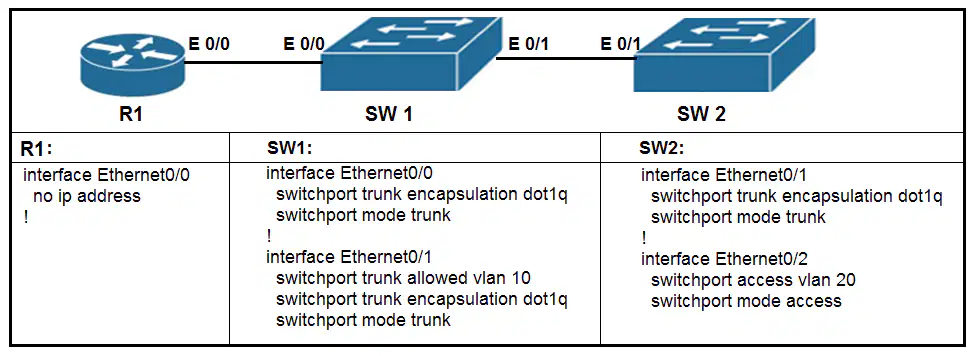
Refer to the exhibit. What commands are needed to add a sub-interface to Ethernet0/0 on R1 to allow for VLAN 20, with IP address 10.20.20.1/24?
R1(config)#interface ethernet0/0 R1(config-if)#encapsulation dot1q 20 R1(config-if)#ip address 10.20.20.1 255.255.255.0
R1(config)#interface ethernet0/0.20 R1(config-if)#encapsulation dot1q 20 R1(config-if)#ip address 10.20.20.1 255.255.255.0
R1(config)#interface ethernet0/0.20 R1(config-if)#ip address 10.20.20.1 255.255.255.0
R1(config)#interface ethernet0/0 R1(config-if)#ip address 10.20.20.1 255.255.255.0

Refer to the exhibit. The loopback1 interface of the Atlanta router must reach the loopback3 interface of the Washington router. Which two static
host routes must be configured on the New York router? (Choose two.)
ipv6 route 2000::3/128 s0/0/0
ipv6 route 2000::1/128 s0/0/1
ipv6 route 2000::1/128 2012::1
ipv6 route 2000::1/128 2012::2
ipv6 route 2000::3/128 2023::3
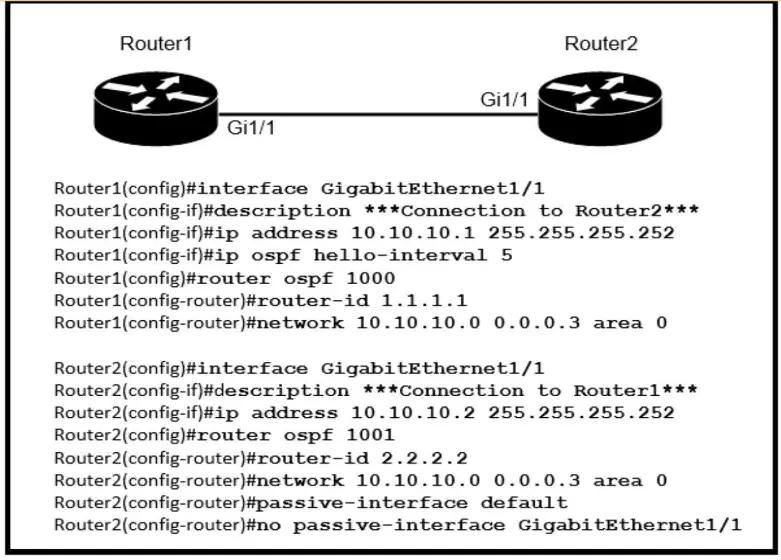
Refer to the exhibit. After the configuration is applied, the two routers fail to establish an OSPF neighbor relationship. What is the reason for the
problem?
The OSPF process IDs are mismatched
The network statement on Router1 is misconfigured
Router2 is using the default hello timer
The OSPF router IDs are mismatched
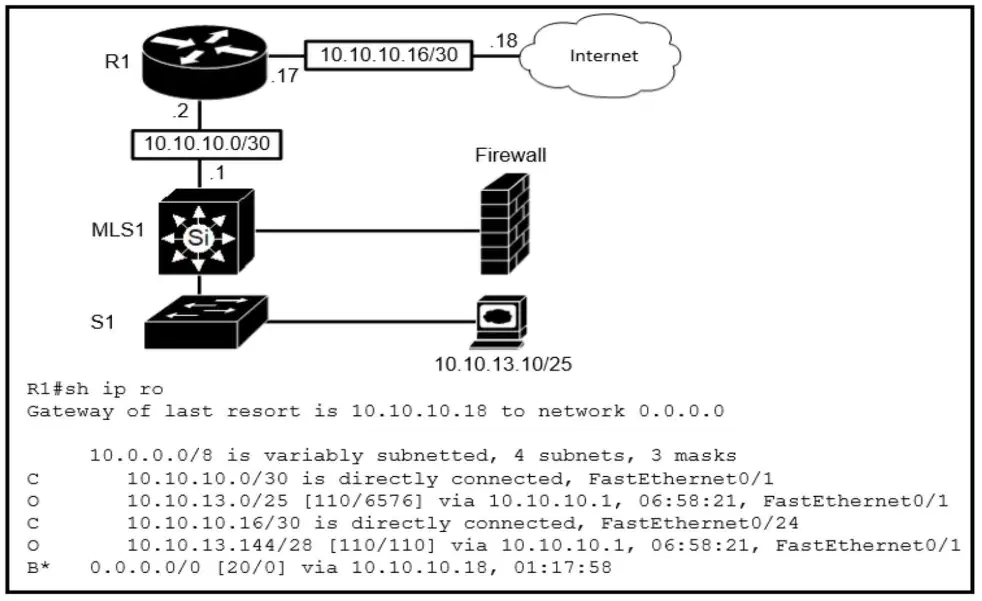
Refer to the exhibit. Which route type is configured to reach the Internet?
floating static route
host route
network route
default route
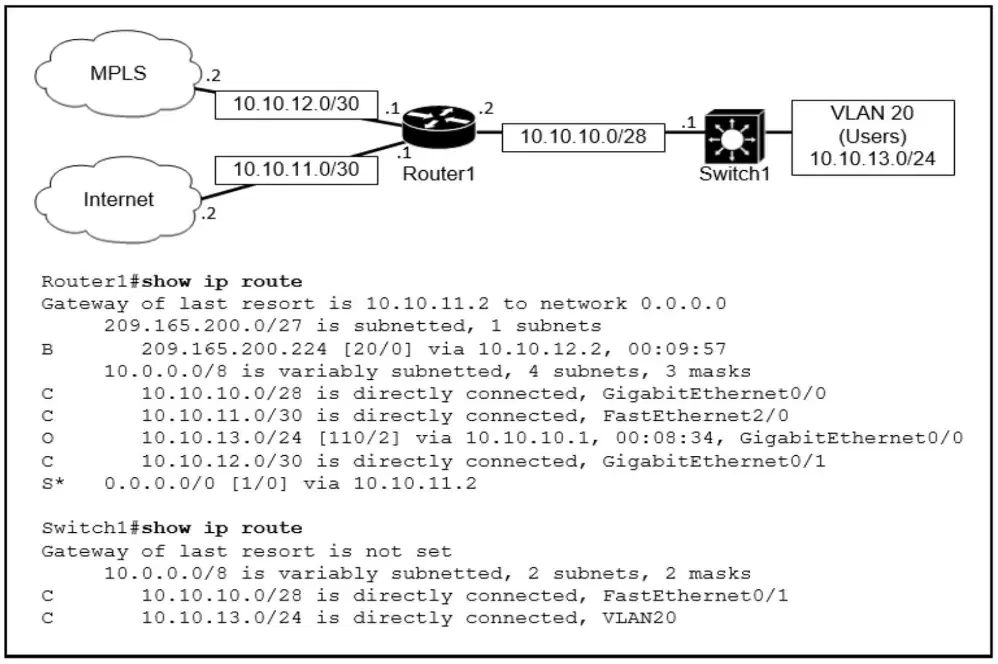
Refer to the exhibit. Which path is used by the router for Internet traffic?
209.165.200.0/27
0.0.0.0/0
10.10.13.0/24
10.10.10.0/28
A user configured OSPF and advertised the Gigabit Ethernet interface in OSPF. By default, to which type of OSPF network does this interface
belong?
point-to-multipoint
point-to-point
broadcast
nonbroadcast

Refer to the exhibit. If OSPF is running on this network, how does Router2 handle traffic from Site B to 10.10.13.128/25 at Site A?
It sends packets out of interface Fa0/1 only.
It sends packets out of interface Fa0/2 only.
It load-balances traffic out of Fa0/1 and Fa0/2.
It cannot send packets to 10.10.13.128/25.
How does HSRP provide first hop redundancy?
It load-balances Layer 2 traffic along the path by flooding traffic out all interfaces configured with the same VLAN.
It uses a shared virtual MAC and a virtual IP address to a group of routers that serve as the default gateway for hosts on a LAN.
It forwards multiple packets to the same destination over different routed links in the data path.
It load-balances traffic by assigning the same metric value to more than one route to the same destination in the IP routing table.

Refer to the exhibit. Which action establishes the OSPF neighbor relationship without forming an adjacency?
modify hello interval
modify process ID
modify priority
modify network type
Which command must you enter to guarantee that an HSRP router with higher priority becomes the HSRP primary router after it is reloaded?
standby 10 preempt
standby 10 version 1
standby 10 priority 150
standby 10 version 2
Which command should you enter to verify the priority of a router in an HSRP group?
show hsrp
show sessions
show interfaces
show standby
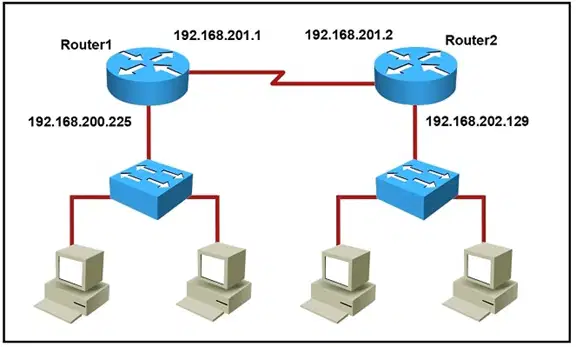
Refer to the exhibit. Which command would you use to configure a static route on Router1 to network 192.168.202.0/24 with a nondefault
administrative distance?
router1(config)#ip route 192.168.202.0 255.255.255.0 192.168.201.2 1
router1(config)#ip route 192.168.202.0 255.255.255.0 192.168.201.2 5
router1(config)#ip route 1 192.168.201.1 255.255.255.0 192.168.201.2
router1(config)#ip route 5 192.168.202.0 255.255.255.0 192.168.201.2
Which of the following dynamic routing protocols are Distance Vector routing protocols?
ISIS
EIGRP
OSPF
RIP
BGP
You have configured a router with an OSPF router ID, but its IP address still reflects the physical interface.
Which action can you take to correct the problem in the least disruptive way?
Reload the OSPF process
Specify a loopback address
Reboot the router
Save the router configuration
Which command should you enter to view the error log in an EIGRP for IPv6 environment?
show ipv6 eigrp neighbors
show ipv6 eigrp topology
show ipv6 eigrp traffic
show ipv6 eigrp events
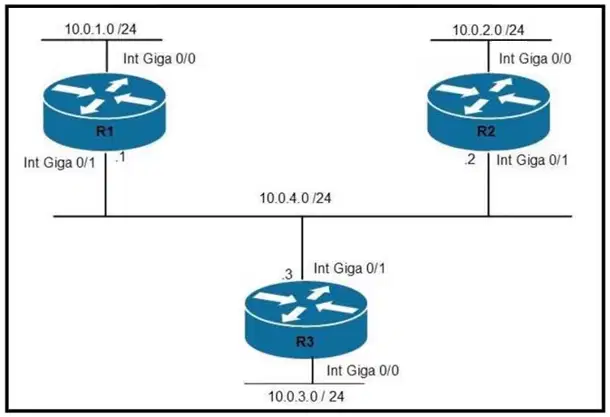
Refer to the exhibit. Router R1 must be configured to reach the 10.0.3.0/24 network from the 10.0.1.0/24 segment. Which command must be used
to configure the route?
route add 10.0.3.0 0.255.255.255 10.0.4.2
ip route 10.0.3.0 0.255.255.255 10.0.4.2
route add 10.0.3.0 mask 255.255.255.0 10.0.4.3
ip route 10.0.3.0 255.255.255.0 10.0.4.3
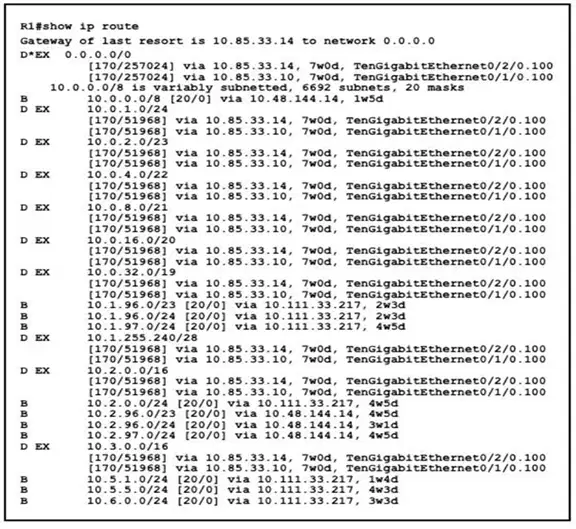
Refer to the exhibit. Which two statements about the network environment of router R1 must be true? (Choose two.)
The EIGRP administrative distance was manually changed from 90 to 170.
There are 20 different network masks within the 10.0.0.0/8 network.
Ten routes are equally load-balanced between Te0/1/0.100 and Te0/2/0.100.
The 10.0.0.0/8 network was learned via external EIGRP.
A static default route to 10.85.33.14 was defined.
Which two statements about exterior routing protocols are true? (Choose two.)
They determine the optimal within an autonomous system.
They determine the optimal path between autonomous systems.
BGP is the current standard exterior routing protocol.
Most modern networking supports both EGP and BGP for external routing.
Most modern network routers support both EGP and EIGRP for external routing.
You have two paths for the 10.10.10.0 network - one that has a feasible distance of 3072 and the other of 6144.
What do you need to do to load balance your EIGRP routes?
Change the maximum paths to 2
Change the configuration so they both have the same feasible distance
Change the variance for the path that has a feasible distance of 3072 to 2
Change the IP addresses so both paths have the same source IP address
Which two circumstances can prevent two routers from establishing an OSPF neighbor adjacency? (Choose two.)
mismatched autonomous system numbers
an ACL blocking traffic from multicast address 224.0.0.10
mismatched process IDs
mismatched hello timers and dead timers
use of the same router ID on both devices
Which three describe the reasons large OSPF networks use a hierarchical design? (Choose three.)
to speed up convergence
to reduce routing overhead
to lower costs by replacing routers with distribution layer switches
to decrease latency by increasing bandwidth
to confine network instability to single areas of the network
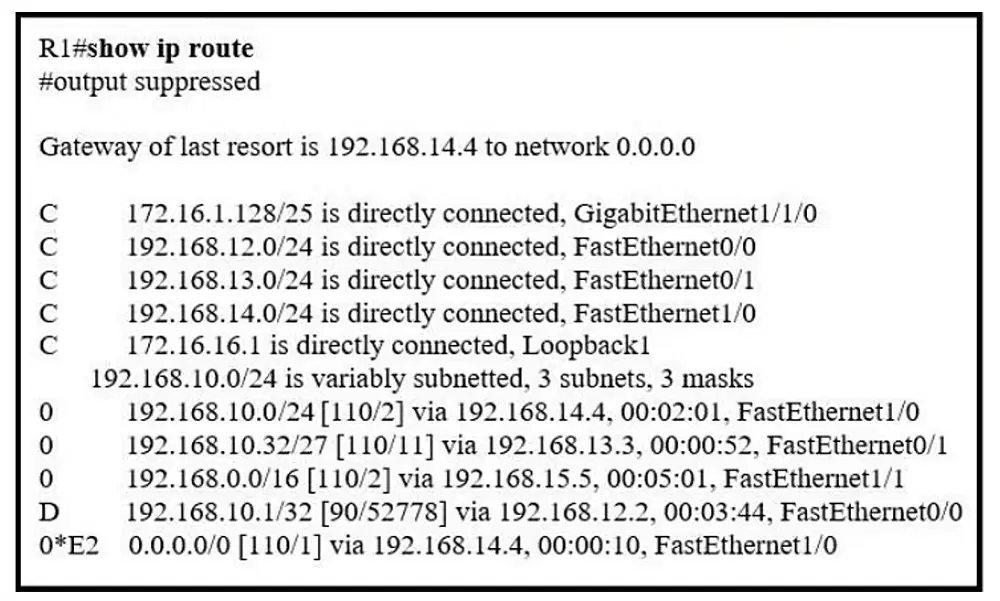
Refer to the exhibit. If R1 receives a packet destined to 172.16.1.1, to which IP address does it send the packet?
192.168.14.4
192.168.12.2
192.168.13.3
192.168.15.5
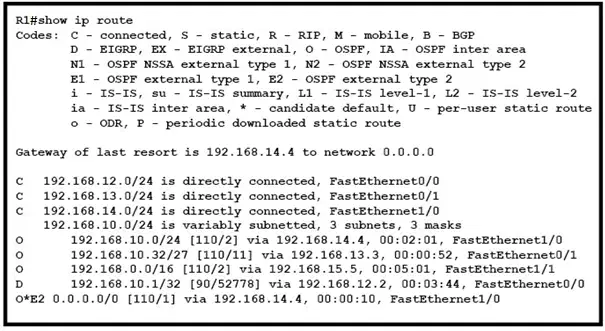
Refer to the exhibit. On R1 which routing protocol is in use on the route to 192.168.10.1?
RIP
OSPF
IGRP
EIGRP
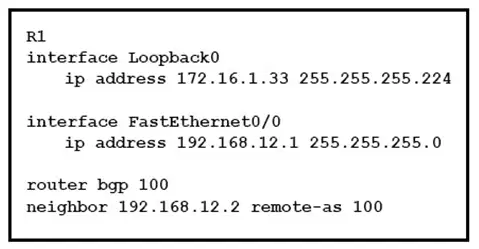
Refer to the exhibit. Which Command do you enter so that R1 advertises the loopback0 interface to the BGP Peers?
Network 172.16.1.32 mask 255.255.255.224
Network 172.16.1.0 0.0.0.255
Network 172.16.1.32 255.255.255.224
Network 172.16.1.33 mask 255.255.255.224
Network 172.16.1.32 mask 0.0.0.31
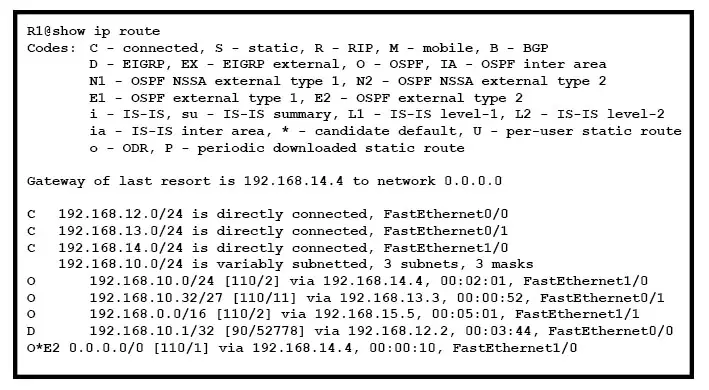
Refer to exhibit. What Administrative distance has route to 192.168.10.1?
1
90
110
120
Which value is used to determine the active router in an HSRP default configuration?
Router loopback address
Router IP address
Router priority
Router tracking number
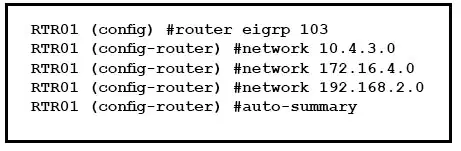
Refer to the exhibit. If RTR01 is configured as shown, which three addresses will be received by other routers that are running EIGRP on the
network? (Choose three.)
192.168.2.0
10.4.3.0
10.0.0.0
172.16.0.0
192.168.0.0
Which configuration command can you apply to a HSRP router so that its local interface becomes active if all other routers in the group fail?
no additional config is required
standby 1 track ethernet
standby 1 preempt
standby 1 priority 250
Which two statements about eBGP neighbor relationships are true? (Choose two.)
The two devices must reside in different autonomous systems
Neighbors must be specifically declared in the configuration of each device
They can be created dynamically after the network statement is configured
The two devices must reside in the same autonomous system
The two devices must have matching timer settings
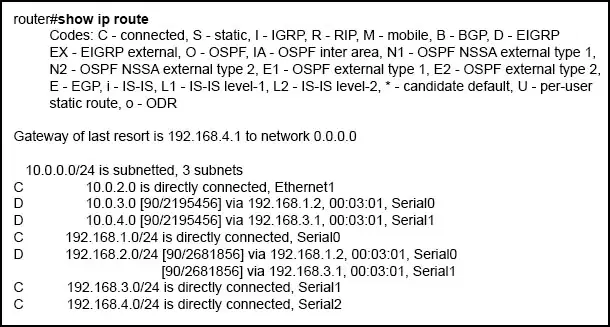
Refer to the exhibit. How will the router handle a packet destined for 192.0.2.156?
The router will forward the packet via either Serial0 or Serial1.
The router will return the packet to its source.
The router will forward the packet via Serial2.
The router will drop the packet.
Which statements describe the routing protocol OSPF? (Choose three.)
It supports VLSM.
It is used to route between autonomous systems.
It confines network instability to one area of the network.
It increases routing overhead on the network.
It allows extensive control of routing updates.

Refer to the exhibit. After you apply the given configurations to R1 and R2 you notice that OSPFv3 fails to start.
The area numbers on R1 and R2 are mismatched
The IPv6 network addresses on R1 and R2 are mismatched
The autonomous system numbers on R1 and R2 are mismatched
The router ids on R1 and R2 are mismatched
Which command is used to display the collection of OSPF link states?
show ip ospf link-state
show ip ospf lsa database
show ip ospf neighbors
show ip ospf database

Refer to the exhibit. A network associate has configured OSPF with the command:
City(config-router)# network 192.168.12.64 0.0.0.63 area 0
After completing the configuration, the associate discovers that not all the interfaces are participating in OSPF. Which three of the interfaces
shown in the exhibit will participate in OSPF according to this configuration statement? (Choose three.)
FastEthernet0 /0
FastEthernet0 /1
Serial0/0
Serial0/1.102
Serial0/1.103
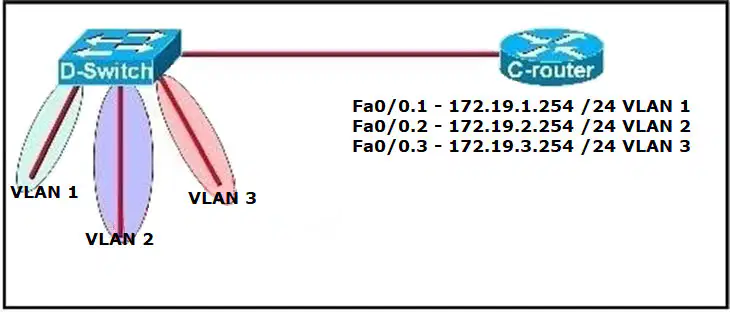
Refer to the exhibit. C-router is to be used as a "router-on-a-stick" to route between the VLANs. All the interfaces have been properly configured
and IP routing is operational. The hosts in the VLANs have been configured with the appropriate default gateway. What is true about this
configuration?
These commands need to be added to the configuration: C-router(config)# router eigrp 123 C-router(config-router)# network 172.19.0.0
These commands need to be added to the configuration: C-router(config)# router ospf 1 C-router(config-router)# network 172.19.0.0
0.0.3.255 area 0
These commands need to be added to the configuration: C-router(config)# router rip C-router(config-router)# network 172.19.0.0
No further routing configuration is required.

Refer to the exhibit. Which address and mask combination represents a summary of the routes learned by EIGRP?
192.168.25.0 255.255.255.240
192.168.25.0 255.255.255.252
192.168.25.16 255.255.255.240
192.168.25.16 255.255.255.252
192.168.25.28 255.255.255.240

Refer to the exhibit. Given the output for this command, if the router ID has not been manually set, what router ID will OSPF use for this router?
10.1.1.2
10.154.154.1
172.16.5.1
192.168.5.3
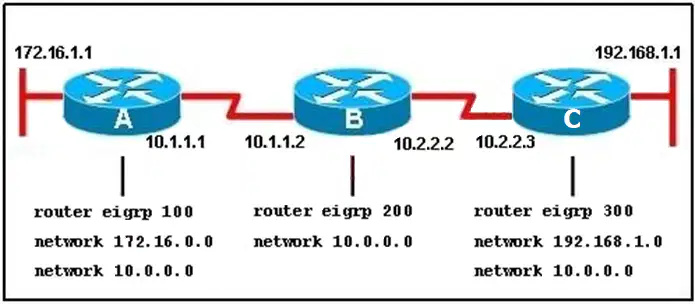
Refer to the exhibit. When running EIGRP, what is required for RouterA to exchange routing updates with RouterC?
AS numbers must be changed to match on all the routers
Loopback interfaces must be configured so a DR is elected
The no auto-summary command is needed on Router A and Router C
Router B needs to have two network statements, one for each connected network

A network administrator is troubleshooting the OSPF configuration of routers R1 and R2. The routers cannot establish an adjacency relationship
on their common
Ethernet link.The graphic shows the output of the show ip ospf interface e0 command for routers R1 and R2. Based on the information in the graphic, what is
the cause of this problem?
The OSPF area is not configured properly
The priority on R1 should be set higher.
The cost on R1 should be set higher.
The hello and dead timers are not configured properly.
A backup designated router needs to be added to the network.
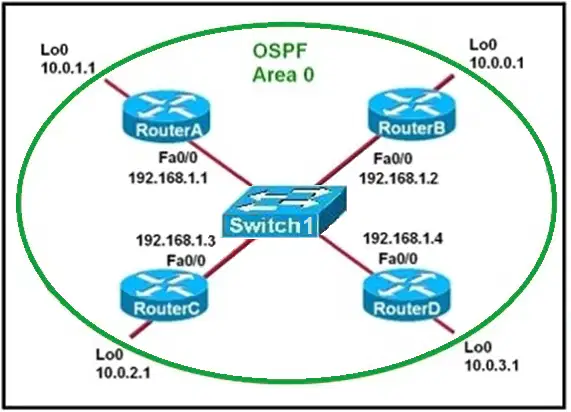
Refer to the exhibit. Which two statements are true about the loopback address that is configured on RouterB? (Choose two.)
It ensures that data will be forwarded by RouterB.
It provides stability for the OSPF process on RouterB.
It specifies that the router ID for RouterB should be 10.0.0.1.
It decreases the metric for routes that are advertised from RouterB.
It indicates that RouterB should be elected the DR for the LAN.
If all OSPF routers in a single area are configured with the same priority value, what value does a router use for the OSPF router ID in the absence
of a loopback interface?
the IP address of the first Fast Ethernet interface
the IP address of the console management interface
the highest IP address among its active interfaces
the lowest IP address among its active interfaces
the priority value until a loopback interface is configured
The OSPF Hello protocol performs which of the following tasks? (Choose two.)
It provides dynamic neighbor discovery.
It detects unreachable neighbors in 90 second intervals.
It maintains neighbor relationships
It negotiates correctness parameters between neighboring interfaces.
It uses timers to elect the router with the fastest links as the designated router.
What are two requirements for an HSRP group? (Choose two.)
exactly one active router
one or more standby routers
one or more backup virtual routers
exactly one standby active router
exactly one backup virtual router
Which two pieces of information can you learn by viewing the routing table? (Choose two.)
whether an ACL was applied inbound or outbound to an interface
the EIGRP or BGP autonomous system
whether the administrative distance was manually or dynamically configured
which neighbor adjacencies are established
the length of time that a route has been known

Refer to the exhibit. Which route type does the routing protocol Code D represent in the output?
statically assigned route
route learned through EIGRP
724 route of a locally configured IP
internal BGP route
An engineer must configure an OSPF neighbor relationship between router R1 and R3. The authentication configuration has been configured and
the connecting interfaces are in the same 192.168.1.0/30 subnet. What are the next two steps to complete the configuration? (Choose two.)
configure the interfaces as OSPF active on both sides
configure both interfaces with the same area ID
configure the hello and dead timers to match on both sides
configure the same process ID for the router OSPF process
configure the same router ID on both routing processes

Refer to the exhibit. A packet is being sent across router R1 to host 172.16.0.14. What is the destination route for the packet?
209.165.200.250 via Serial0/0/0
209.165.200.254 via Serial0/0/0
209.165.200.254 via Serial0/0/1
209.165.200.246 via Serial0/1/0
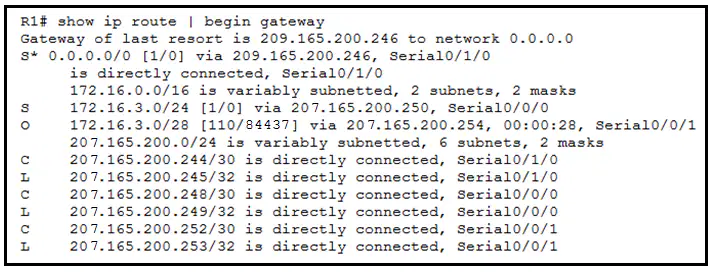
Refer to the exhibit. A packet is being sent across router R1 to host 172.16.3.14. To which destination does the router send the packet?
207.165.200.246 via Serial0/1/0
207.165.200.254 via Serial0/0/0
207.165.200.250 via Serial0/0/0
207.165.200.254 via Serial0/0/1

Refer to the exhibit. Router R2 is configured with multiple routes to reach network 10.1.1.0/24 from router R1. Which path is chosen by router R2
to reach the destination network 10.1.1.0/24?
static
EIGRP
eBGP
OSPF

Refer to the exhibit. What is the next hop address for traffic that is destined to host 10.0.1.5?
Loopback 0
10.0.1.4
10.0.1.3
10.0.1.50
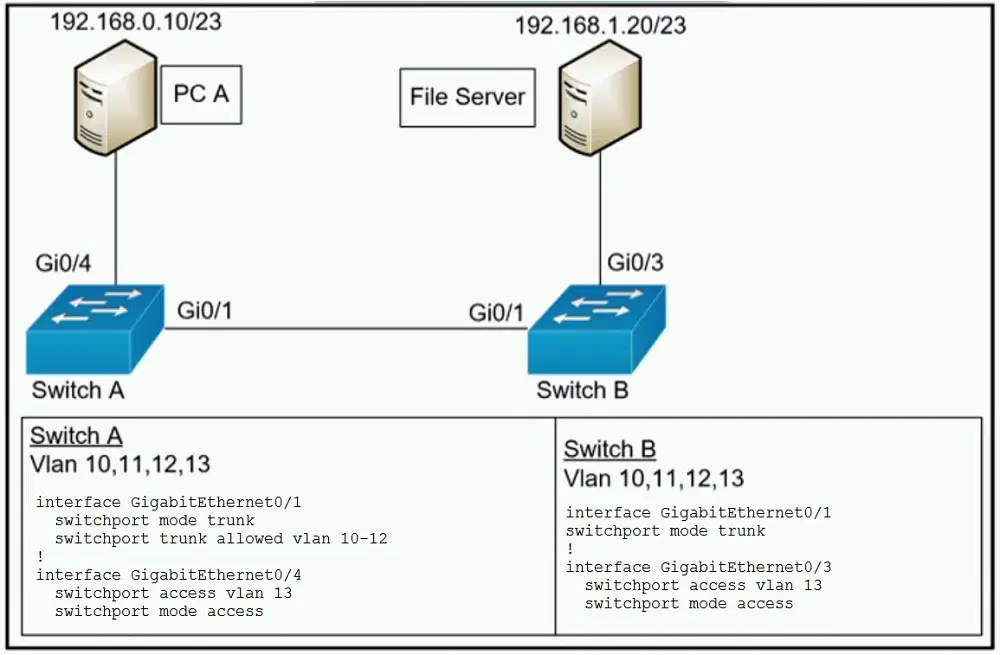
Refer to the exhibit. A network administrator assumes a task to complete the connectivity between PC A and the File Server. Switch A and Switch
B have been partially configured with VLANs 10, 11, 12, and 13. What is the next step in the configuration?
Add PC A to VLAN 10 and the File Server to VLAN 11 for VLAN segmentation
Add VLAN 13 to the trunk links on Switch A and Switch B for VLAN propagation
Add a router on a stick between Switch A and Switch B allowing for Inter-VLAN routing
Add PC A to the same subnet as the File Server allowing for intra-VLAN communication
R1 has learned route 192.168.12.0/24 via IS-IS, OSPF, RIP, and Internal EIGRP. Under normal operating conditions, which routing protocol is
installed in the routing table?
IS-IS
Internal EIGRP
RIP
OSPF
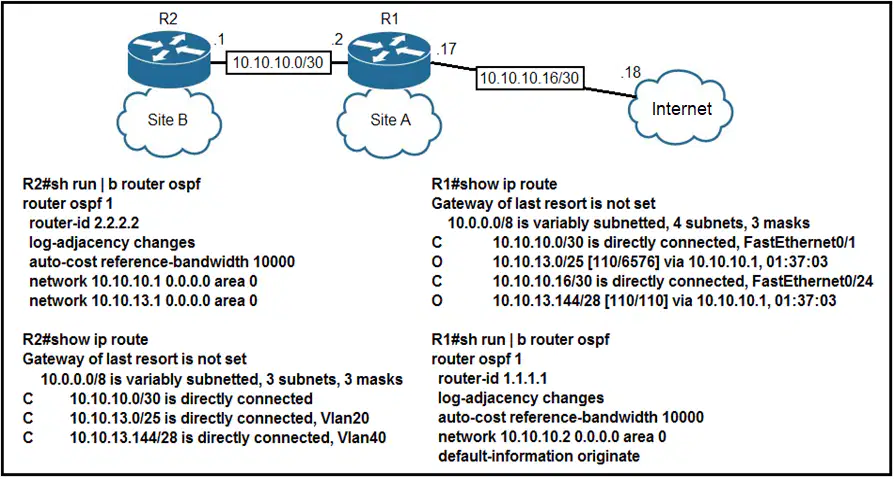
Refer to the exhibit. The default-information originate command is configured under the R1 OSPF configuration. After testing, workstations on
VLAN 20 at Site
B cannot reach a DNS server on the Internet.
Which action corrects the configuration issue?
Add the default-information originate command on R2.
Add the always keyword to the default-information originate command on R1.
Configure the ip route 0.0.0.0 0.0.0.0 10.10.10.18 command on R1.
Configure the ip route 0.0.0.0 0.0.0.0 10.10.10.2 command on R2.
Which MAC address is recognized as a VRRP virtual address?
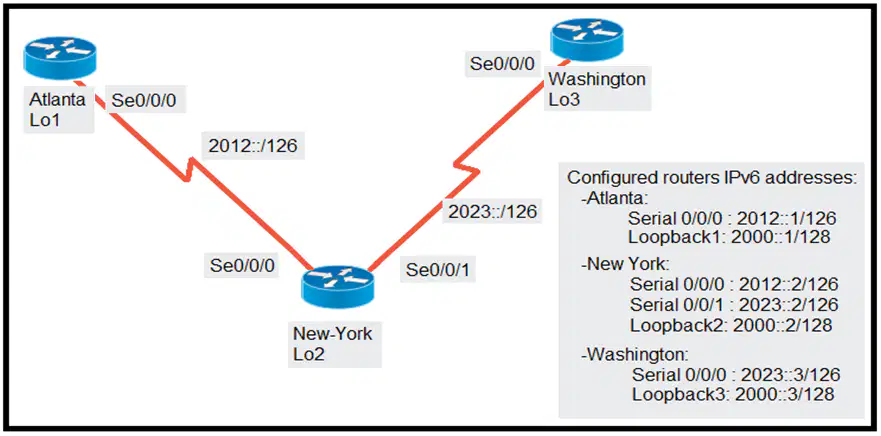
Refer to the exhibit. The New York router is configured with static routes pointing to the Atlanta and Washington sites.
Which two tasks must be performed so that the Se0/0/0 interfaces on the Atlanta and Washington routers reach one another? (Choose two.)
Configure the ipv6 route 2023::/126 2012::1 command on the Atlanta router.
Configure the ipv6 route 2012::/126 2023::2 command on the Washington router.
Configure the ipv6 route 2012::/126 2023::1 command on the Washington router
Configure the ipv6 route 2023::/126 2012::2 command on the Atlanta router.
Configure the ipv6 route 2012::/126 s0/0/0 command on the Atlanta router.
An engineer configured an OSPF neighbor as a designated router. Which state verifies the designated router is in the proper mode?
Init
2-way
Exchange
Full
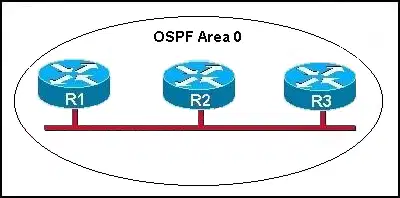
Refer to the graphic. R1 is unable to establish an OSPF neighbor relationship with R3. What are possible reasons for this problem? (Choose two.)
All of the routers need to be configured for backbone Area 1.
R1 and R2 are the DR and BDR, so OSPF will not establish neighbor adjacency with R3.
A static route has been configured from R1 to R3 and prevents the neighbor adjacency from being established.
The hello and dead interval timers are not set to the same values on R1 and R3.
R1 and R3 are configured in different areas.
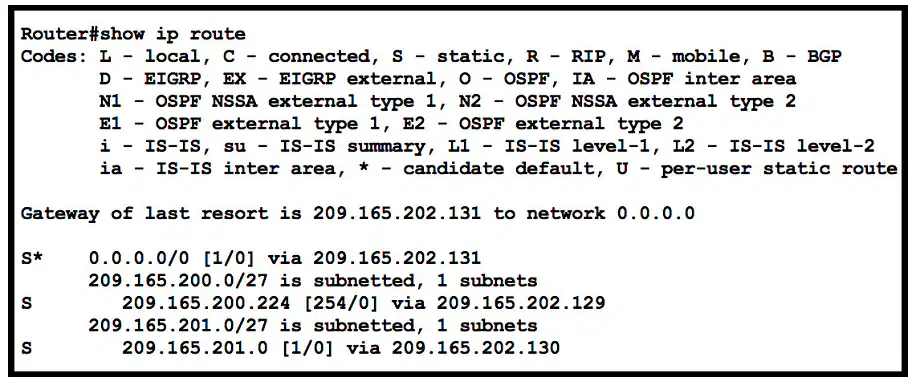
Refer to the exhibit. Which command configures a floating static route to provide a backup to the primary link?
ip route 209.165.200.224 255.255.255.224 209.165.202.129 254
ip route 209.165.201.0 255.255.255.224 209.165.202.130
ip route 0.0.0.0 0.0.0.0 209.165.200.224
ip route 0.0.0.0 0.0.0.0 209.165.202.131
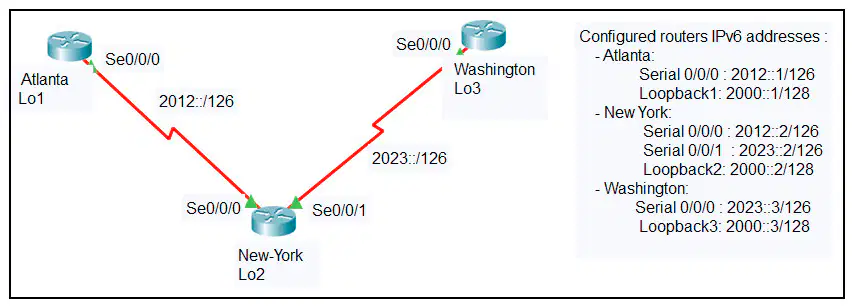
Refer to the exhibit. An engineer configured the New York router with static routes that point to the Atlanta and Washington sites. Which command
must be configured on the Atlanta and Washington routers so that both sites are able to reach the loopback2 interface on the New York router?
ipv6 route::/0 Serial 0/0/0
ipv6 route::/0 Serial 0/0/1
ipv6 route:0/0 Serial 0/0/0
ip route 0.0.0.0 0.0.0.0 Serial 0/0/0
ipv6 route::/0 2000::2
What is the effect when loopback interfaces and the configured router ID are absent during the OSPF Process configuration?
The lowest IP address is incremented by 1 and selected as the router ID.
The router ID 0.0.0.0 is selected and placed in the OSPF process.
No router ID is set, and the OSPF protocol does not run.
The highest up/up physical interface IP address is selected as the router ID.
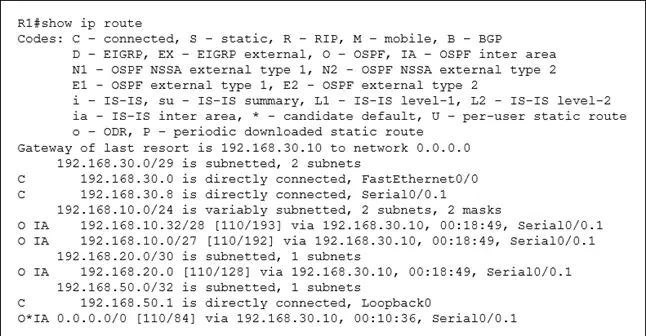
Refer to the exhibit. What is the metric of the route to the 192.168.10.33/28 subnet?
84
110
128
192
193

Refer to the exhibit. Traffic sourced from the loopback0 interface is trying to connect via ssh to the host at 10.0.1.15. What is the next hop to the
destination address?
192.168.0.7
192.168.0.4
192.168.0.40
192.168.3.5
When the active router in a VRRP group fails, which router assumes the role and forwards packets?
forwarding
standby
backup
listening
Which action does the router take as it forwards a packet through the network?
The router encapsulates the original packet and then includes a tag that identifies the source router MAC address and transmits it
transparently to the destination.
The router encapsulates the source and destination IP addresses with the sending router IP address as the source and the neighbor IP
address as the destination.
The router replaces the original source and destination MAC addresses with the sending router MAC address as the source and neighbor
MAC address as the destination.
The router replaces the source and destination labels with the sending router interface label as a source and the next hop router label as a
destination.

Refer to the exhibit. Which two prefixes are included in this routing table entry? (Choose two.)
192.168.1.17
192.168.1.61
192.168.1.64
192.168.1.127
192.168.1.254
Which virtual MAC address is used by VRRP group 1?
What is the purpose of using First Hop Redundancy Protocol on a specific subnet?
forwards multicast hello messages between routers
sends the default route to the hosts on a network
ensures a loop-free physical topology
filters traffic based on destination IP addressing

Refer to the exhibit. When router R1 is sending traffic to IP address 10.56.192.1, which interface or next hop address does it use to route the
packet?
10.56.0.1
0.0.0.0/0
Vlan57
10.56.128.19

Refer to the exhibit. Load-balanced traffic is coming in from the WAN destined to a host at 172.16.1.190. Which next-hop is used by the router to
forward the request?
192.168.7.4
192.168.7.7
192.168.7.35
192.168.7.40
What is a benefit of VRRP?
It provides the default gateway redundancy on a LAN using two or more routers.
It provides traffic load balancing to destinations that are more than two hops from the source.
It prevents loops in a Layer 2 LAN by forwarding all traffic to a root bridge, which then makes the final forwarding decision.
It allows neighbors to share routing table information between each other.
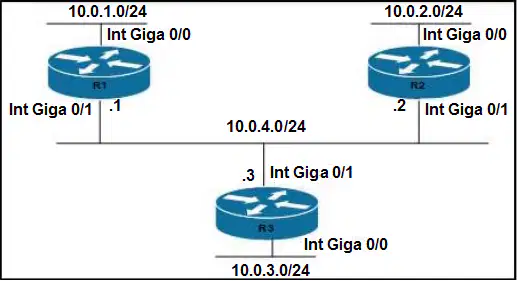
Refer to the exhibit. Routers R1 and R3 have the default configuration. The router R2 priority is set to 99. Which commands on R3 configure it as
the DR in the
10.0.4.0/24 network?
R3(config)#interface Gig0/0 R3(config-if)#ip ospf priority 100
R3(config)#interface Gig0/0 R3(config-if)#ip ospf priority 1
R3(config)#interface Gig0/1 R3(config-if)#ip ospf priority 0
R3(config)#interface Gig0/1 R3(config-if)#ip ospf priority 100
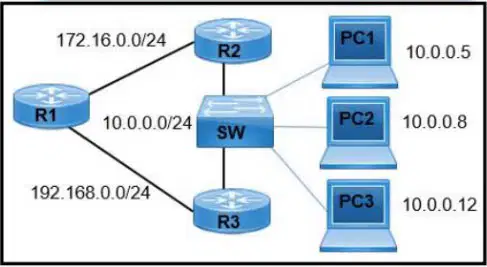
Refer to the exhibit. A network engineer must configure R1 so that it sends all packets destined to the 10.0.0.0/24 network to R3, and all packets
destined to PC1 to R2. Which configuration must the engineer implement?
R1(config)#ip route 10.0.0.0 255.255.255.0 172.16.0.2 R1(config)#ip route 10.0.0.5 255.255.255.255 192.168.0.2
R1(config)#ip route 10.0.0.0 255.255.0.0 172.16.0.2 R1(config)#ip route 10.0.0.5 255.255.255.255 192.168.0.2
R1(config)#ip route 10.0.0.0 255.255.255.0 192.168.0.2 R1(config)#ip route 10.0.0.5 255.255.255.255 172.16.0.2
R1(config)#ip route 10.0.0.0 255.255.0.0 192.168.0.2 R1(config)#ip route 10.0.0.5 255.255.255.0 172.16.0.2

Refer to the exhibit. All traffic enters the CPE router from interface Serial0/3 with an IP address of 192.168.50.1. Web traffic from the WAN is
destined for a LAN network where servers are load-balanced. An IP packet with a destination address of the HTTP virtual IP of 192.168.1.250
must be forwarded. Which routing table entry does the router use?
192.168.1.0/24 via 192.168.12.2
192.168.1.128/25 via 192.168.13.3
192.168.1.192/26 via 192.168.14.4
192.168.1.224/27 via 192.168.15.5

