
 Worksheets
TEST ON PRESSURE
Total questions: 53
Worksheet time: 46mins

Pressure in gases is a measure of:
the number of collisions per second of the particles with the side of the container.
the force of the collisions of the particles with the side of the container.
the amount of space taken up by the particles in the container.
None of the above

Pressure can be exerted by solids, liquids and gases.
TRUE
FALSE

A dam (not the wall) is an example of pressure in:
Solids
Liquids
Gases
Plasma

The pressure inside the balloon will:
Decrease
Increase
Remain the same
Not enough information to formulate an answer

The pressure of the gas in the balloon in the ice water will be:
Greater than that of the balloon in the boiling water.
Less than that of the balloon in the boiling water.
The same as that of the balloon in the boiling water.
Not enough information to answer the statement.

This is an example of the everyday application of pressure in:
Solids
Liquids
Gases
Plasma

The pressure inside the syringe will decrease if we move the plunger in:
Direction A
Direction B
We don't have to move the plunger as the pressure will change on its own.
None of the above answers.

We can increase the pressure of a gas by:
Adding more gas.
Reduce the volume of the container.
Increase the temperature of the gas.
None of the above answers.

Weather balloons travel to a great height gathering data before the balloon bursts. This is because the atmospheric pressure (layer of gas surrounding the earth):
Increases the higher you travel.
Decreases the higher you travel.
Remains the same.
Not enough information to answer the question.

The reason gases can be compressed is because:
The particles are very close together.
The particles are merely vibrating.
The particles are unable to move.
The particles are very far apart.
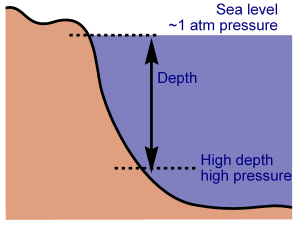
When you increase your depth under water, the water pressure on your body
increases
decreases
stays the same
How do you Calculate Pressure
Force(N)/Area(m2)
Force(kg)/Area(mi2)
Area(m2)/Force(N)
Why won't you sink in mud if you wear boots?
Because the surface area is larger creating less pressure.
Has air in it to keep you floating.
Because the mud won't want you.

Diagram shows the design of a dam. Why does the thickness of the dam increase with its depth?
The design of this structure is stronger.
Water pressure increases with depth.
The cost of construction is lower.
Water pressure acts uniformly in all directions.
What is pressure?
The amount of force exerted on a surface
The surface area of an object
The weight of an object
An object will float on water if it is
less dense than water.
more dense than water.
the same density as water.

1 Pa = 1N/m2

The earth is surrounded by the ......... up to a height of many miles
water
soil
air
atmosphere
The atmosphere consists of gases which has no weight
true
false
The SI unit of pressure is the (a)
1 pascal is equivalent to a force of ...................
1 Nm-2
1 Nm
1 Nm2
1 Nm-1
The atmospheric pressure changes according to locality and .......... .
places
times
weather
The atmospheric pressure at the plains is .......... that at the hilly regions .
lower than
equal to
higher than
Nose bleeding will occur at a place of ........... atmospheric pressure .
low
high
A pressure of (a) mm Hg is known as standard atmospheric pressure or 1 atmosphere (1 atm).
Two simple applications of atmospheric pressure in our daily life are (a) and syringe.
When bodies are immersed in a liquid there is loss in (a) .
The weight of liquid column depends on the base area of container .
true
false
The pressure on the bottom of an object is ........... the top.
equal to
less than
greater than
If you want to know the density of liquid, which instrument do you use?


A body will float in a fluid if the upward thrust acting on it equals its _____.
weight
mass
volume
____________ can be applied in checking the purity of metals.
Archimedes’ principle
Pascal’s law
Hooke’s law


Pressure depends on depth
1 Pa = 1N/m2

