
Font size
 Worksheets
Electrical Installation Level 1 Review Quiz
Total questions: 12
Worksheet time: 7mins
What is the correct definition of Ohm's Law?
Ohm's Law states voltage and current are indirectly related.
Ohm's Law states that the current through a conductor is inversely proportional to resistance of that conductor given by the equation I=V*R
Ohm's Law states that the current (I) through a conductor is directly proportional to the pd (V) across its ends given by the equation V=I*R
Which of these is NOT an electrical safety rules?
If you get hurt, get help only when the job is complete.
Frayed wires are dangerous and must be reported.
Always use the correct size fuse or breaker.
Do not block access to electrical panels.
Electrical hand tools must be properly (a)
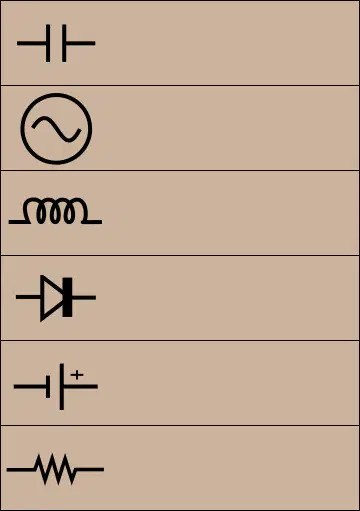
If you list the electrical symbols from 1 to 6, with one being the one at the top, which option correctly identifies the symbols?
1- capacitor
2- a.c power
3- single outlet
4- bell
5- single cell
6- fixed resistor
1- capacitor
2-a.c power
3 - coil
4- diode
5- single cell
6- fixed resistor
1- battery
2- bulb
3- transformer
4- ohmmeter
5- conductor
6- variable resistor
1- capacitor
2- bulb
3- coil
4- diode
5- single cell
6- fixed resistor
Label the parts of the atom.
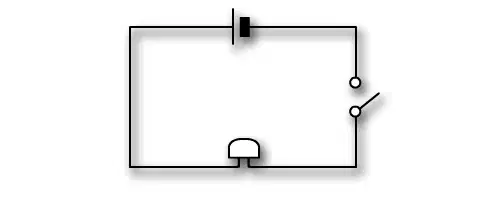
Which component is not present in the circuit in the picture?
bell
switch
battery/ cell
A voltage of 12 V is applied across a lamp of resistance 5Ω. Find the current flowing through the lamp.
what is the maximum voltage that can be applied to a 20 Ω resistor is the current flowing through the lamp cannot exceed 1.5 A.
define alternating current.
Explain what is meant by electrical power and state its formula.
The rate of at which work is done. The formula is P= V/I
the time it takes to get from one point to another. D= s*t
Current that flows through one direction only. D=I/f
The rate of doing work. The formula is P=V*I
Differentiate between e.m.f and potential difference.
states the units for the following electrical quantities: voltage, power and energy.
Volts (V) for voltage, Watts (W) for power, and kilo watt-hours (kWh) for energy.
Kilowatt-hours (kWh) for energy, Ohms (Ω) for voltage and Amps (A) for power.
Joules (J) for power, Mole (mol) for energy and Watts (W) for voltage.
Amps (A) for voltage, Watts (W) for power and Kilowatts- hours (kWh) for power.

