Wayground logo

Free Printable Worksheets

Font size

S
M
L
XL
Worksheets

Evolution Review

Total questions: 42

Worksheet time: 21mins
Name
Class
Date
1.
This scientist came up with the idea of natural selection.
a)
Jean Baptiste Lamarck
b)
Gregor Mendel
c)
Charles Darwin
d)
Thomas Malthus
2.
Inherited trait that helps an organism survive is a(n) __________.
a)
Fossil
b)
Adaptation
c)
Ancestor
d)
Natural selection
3.
Survival of the fittest or when favorable adaptations reproduce faster is called what?
a)
Evolution
b)
Adaptation
c)
Natural selection
d)
Fossilization
4.
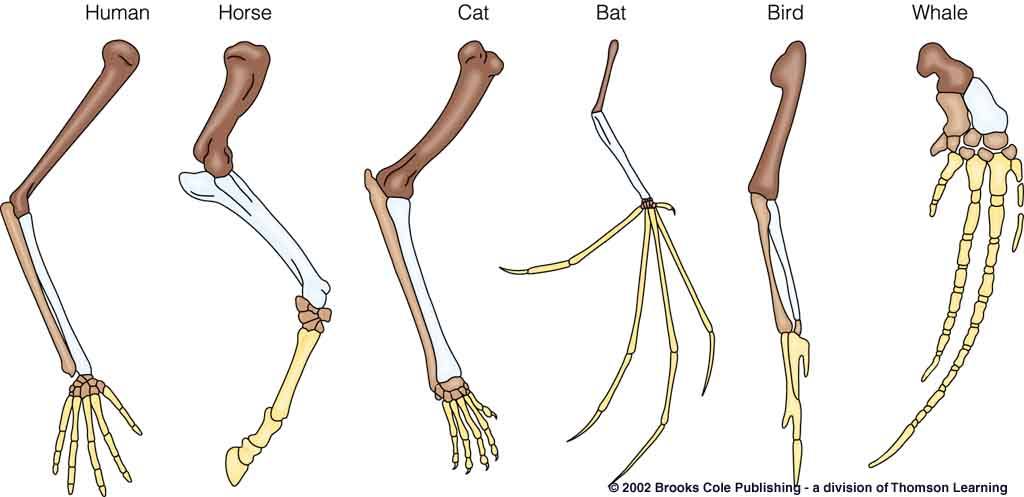
Structures with the same parts have different functions; suggests that organisms share a common ancestry
a)
vestigial structures
b)
homologous structures
c)
adaptive radiation
d)
fossil
5.
Which of the following is an example of a vestigial structure?
a)
the wings of a red-tailed hawk
b)
the hind limbs of a house cat
c)
the fins of sharks
d)
the tailbone of a human
6.
The diagram shows fossils in different rock layers. Which of these statements about the age of these fossils is most likely correct?
a)
Fossil A and C are the same age
b)
Fossil B is older than fossil C
c)
Fossils A is older than fossil B
d)
Fossil D is older than fossil C
7.

What do we call a change in a species over time?

a)

Adaptation

b)

Evolution

c)

Extinction

d)

Environmental influences

8.
Ostrich wings are examples of
a)
homologous structures
b)
vestigial structures
c)
adaptations
d)
traits
9.
Why do embryologist study embryos?
a)
to see if they are related
b)
to understand adaptations
c)
to determine the age
d)
to learn what parents are vestigial
10.
What is embryology?
a)
the age of organisms
b)
the oldest stage of development
c)
the life span of an organism
d)
the earliest growth stage of development
11.
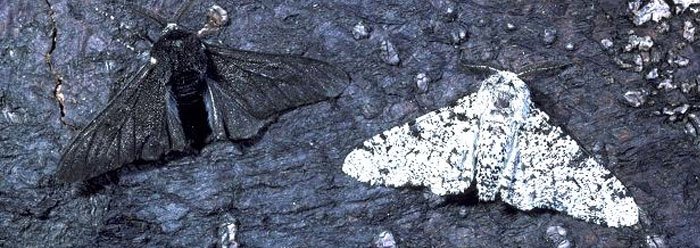
The environment around Manchester, England, changed during the Industrial Revolution.  How did this change affect peppered moths living in the area?
a)
Natural selection favored moths with dark wings because predators could not see them on the soot-colored trees.
b)
Natural selection favored moths with white wings that were easy for predators to see.
c)
Natural selection favored moths with white wings because predators could not see them on the soot-colored trees.
d)
Natural selection caused moths with white wings to become extinct.
12.
When an organism completely dies out, it is called.....
a)
Adaption
b)
Extinction
c)
Fossilization
d)
Mutation
13.
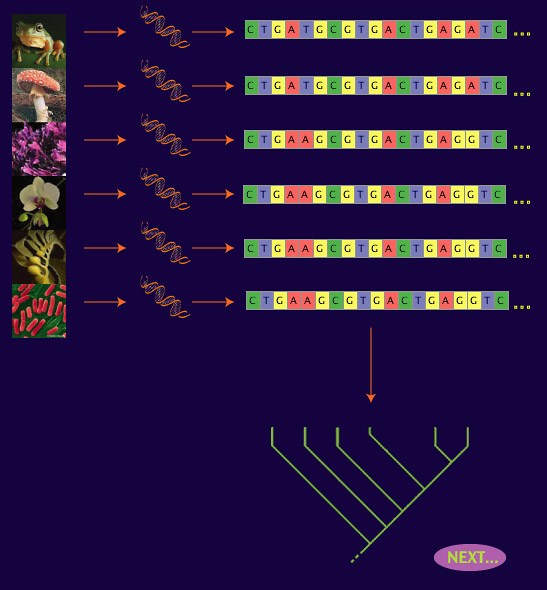
Two organisms that are closely related would have
a)
very similar DNA sequence
b)
exactly the same DNA sequences
c)
no proteins in common
d)
completely different DNA sequence
14.
Comparing human hemoglobin of chimpanzees, horses, kangaroos, and chickens, reveal that humans have the fewest amino acid differences with 
a)
Kangaroos
b)
Horses
c)
chickens
d)
chimpanzees
15.
All the individuals of a species that live in a particular area are called a
a)
variation
b)
population
c)
fossil
d)
group
16.
Which layer is oldest?
a)
A
b)
W
c)
G
d)
Z
17.
According to the law of superposition, which layer is the youngest?
a)
A
b)
B
c)
C
18.
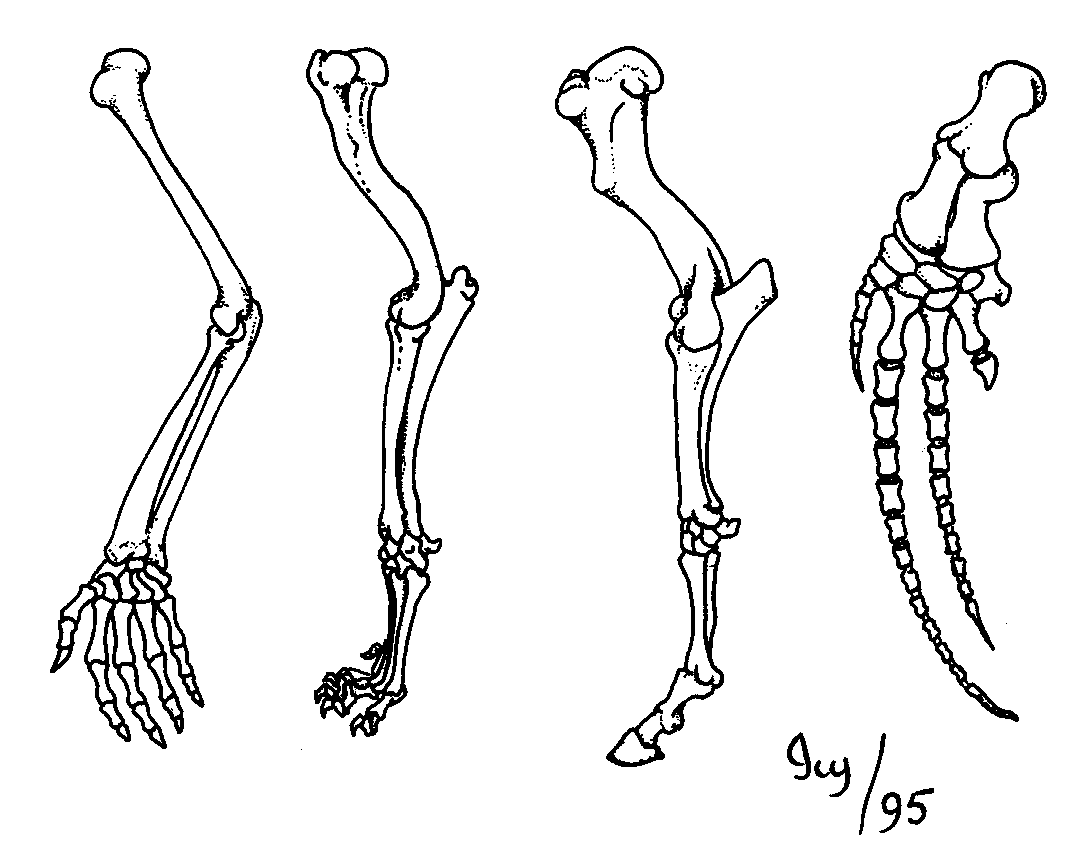
The structures shown are_________
a)
homologous
b)
heterologous
c)
analogous
d)
vestigial
19.
The disappearance of a species.
a)
Evolution
b)
Extinction
c)
Migration
d)
Mutation
20.
Why are advantageous traits more likely to be passed onto offspring?
a)
Because they are more likely to survive and reproduce.
b)
Because they come from dominant alleles.
c)
Because they come from recessive alleles.
d)
Because the trait is an acquired phenotype.
21.
The trees these moths used to live on were white, but have been covered in soot from coal factories. Which moth will be more successful in this environment?
a)
Dark moth
b)
Light moth
c)
Both will be equally successful
d)
Neither will be successful
22.
Which best describes mutations?
a)
Always helpful
b)
Always harmful
c)
Can be helpful or harmful
d)
Always neutral
23.
Study of embryos of various organisms to show a common ancestor because of similarities in development
a)
natural selection
b)
embryology
c)
speciation
d)
evolution
24.

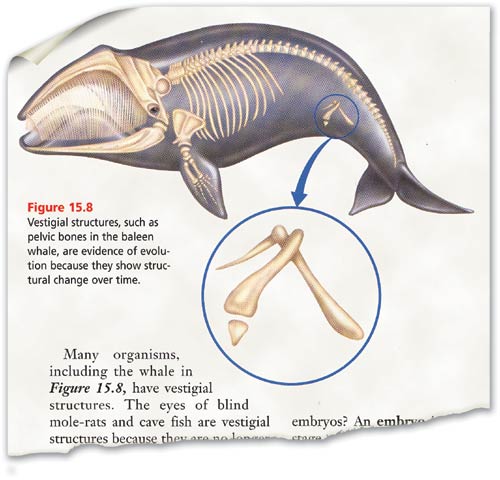
Whales are aquatic mammals that contain a pelvis (hip) bone. Even though it does not aid in its movement, the function must have been used by a common ancestor of the whale. Thus, the pelvis is referred to as a(n)

a)

vestigial structure

b)

analogous structure

c)

homologous structure

25.
The ability of an organism to survive and reproduce in its specific environment 
a)
diversity.
b)
evolution
c)
adaptation
d)
 fitness
26.
Genetic differences between organisms of the same species
a)
Variation
b)
Adaptation
c)
Behavior
d)
Environment
27.
The difference in the physical traits of an individual from those of other individuals in a group is called a(n)
a)
change
b)
adaption
c)
species
d)
variation
28.
An error in DNA copying that results in a new trait
a)
Homeostasis
b)
Mutation
c)
Natural Selection
d)
Selective Breeding
29.
The long and sharp beak of a woodpecker is an example of:
a)
Natural Selection
b)
Selective Breeding
30.

Where do adaptations come from?

a)

The individual organism decides to adapt

b)

Mutations that give an organism an advantage in its environment

c)

Genetic recombination during meiosis

d)

Both mutations and genetic recombination are sources of adaptation
31.
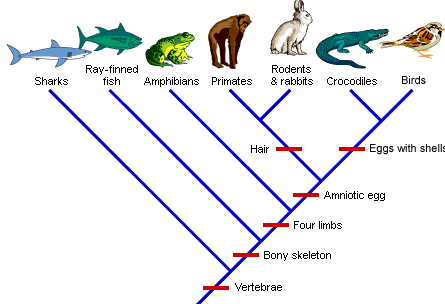
According to this cladogram, sharks are MOST closely related to which organism? 
a)
Amphibians
b)
Ray finned fish
c)
Crocodiles
d)
Birds
32.

Binomial nomenclature is a 2-name naming system based on

a)

Family genus

b)

Class order

c)

genus species

d)

Genus species

33.

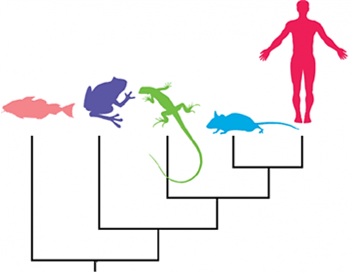
According to this phylogenetic tree, which creature is the least related out of all pictured?

a)

Fish

b)

Frog

c)

Salamander

d)

Human

34.

According to this image, which two domains of life are most related?

a)

Bacteria & Archaea

b)

Archaea & Eukarya

c)

Eukarya & Bacteria

35.

What do you call the traits shown on phylogenetic trees, such as "four limbs" or "vertebrae"?

a)

Derived characteristics

b)

Speedy Lambofeeties

c)

Branching elements

d)

Harmonious changes

36.

Which group of animals on this tree are most closely related to birds?

a)

Saurischian dinosaurs

b)

Ornithischian dinosaurs

c)

Crocodiles

d)

None of these are related to birds

37.

Where is the alligator and T. rex's common ancestor?

a)

Point A

b)

Point B

c)

Point C

d)

Point D

38.

Which trait(s) do conifers have?

a)

vascular tissue only

b)

vascular tissue and seeds

c)

vascular tissue, seeds and flowers

d)

seeds only

39.

Which trait should go where C is on the cladogram?

a)

eyes

b)

feet

c)

lips

d)

hat

40.

Genetic Diversity is increased through this process.

a)

Gene Flow

b)

Genetic Drift

41.

What is gene flow?

a)

The addition or removal of alleles in a population due to individuals entering or leaving one population for another

b)

A change in allele frequencies when a new population arises from only a few individuals

c)

A reduction in population caused by natural disasters, disease, hunting, etc.

d)

A change in the gene pool due to chance

42.

What is genetic drift?

a)

A population for which the gene frequencies do not change

b)

A change in allele frequencies due to selection

c)

The addition or removal of alleles in a population due to individuals entering or leaving one population for another

d)

A change in the gene pool due to chance