
 Worksheets
Structure 3 - Periodicity
Total questions: 20
Worksheet time: 18mins
What is the tendency of an atom to attract electrons towards itself in a bond?
atomic radius
ionization energy
shielding
Electronegativity
The higher the ionization energy...
the more attracted the valence electron is to the nucleus so it is harder to remove
the less attracted the valence electron is to the nucleus so it is easier to remove
the more attracted the valence electron is to another electron, so it is harder to remove
the more repelled a valence electron is to another electron, so it is easier to remove
Why does ionization energy decrease going down a group?
Adding more energy levels makes the valence electrons further from the nucleus so it is easier to remove
There are more valence electrons in the outer shell so the valence electrons is easier to remove
There are more protons in the nucleus so the valence electrons is easier to remove
There are less protons in the nucleus so the valence electrons is easier to remove
P, Cs, Co, Sr
Why doesn't having more protons increase the attraction down a group?
there are more valence electrons in the outermost energy level
actually, there aren't more protons in the nucleus down the group
as energy levels are added, non-valence electrons block the extra protons from attracting valence electrons
more neutrons block the extra protons
What happens to atomic radius across a period?
the atoms get bigger because the nucleus is bigger as more protons are added
the atoms get bigger because there are more valence electrons
the atoms get smaller because with more attraction to the extra protons, the electrons moves closer to the nucleus
the atoms get bigger because there are more energy levels
Element Z has more protons than element Y, but both have 4 energy levels. Which statement is true?
Y is smaller and would attract electrons more in a bond
Y is bigger and would attract electrons more in a bond
Z is smaller and would attract electrons more in a bond
Z is bigger and would attract electrons more in a bond
Nitrogen is a _ so it will _ electrons when forming an ion.
metal, lose
metal, gain
nonmetal, lose
nonmetal, gain
The energy required to remove one mole of electrons from 1 mole of gaseous atoms
What is the trend of atomic radius as you move down a group in the periodic table?
The atomic radius decreases because of increased nuclear charge
The atomic radius increases due to the addition of more energy levels
The atomic radius remains constant throughout the group
The atomic radius fluctuates unpredictably
Why does the electronegativity of elements generally increase across a period?
There are more valence electrons in the outer shell
Adding more energy levels makes the valence electrons further from the nucleus
There are more protons in the nucleus
There are less protons in the nucleus
Which of the following elements is most likely to gain electrons when forming an ion?
Lithium (Li)
Neon (Ne)
Fluorine (F)
Aluminum (Al)
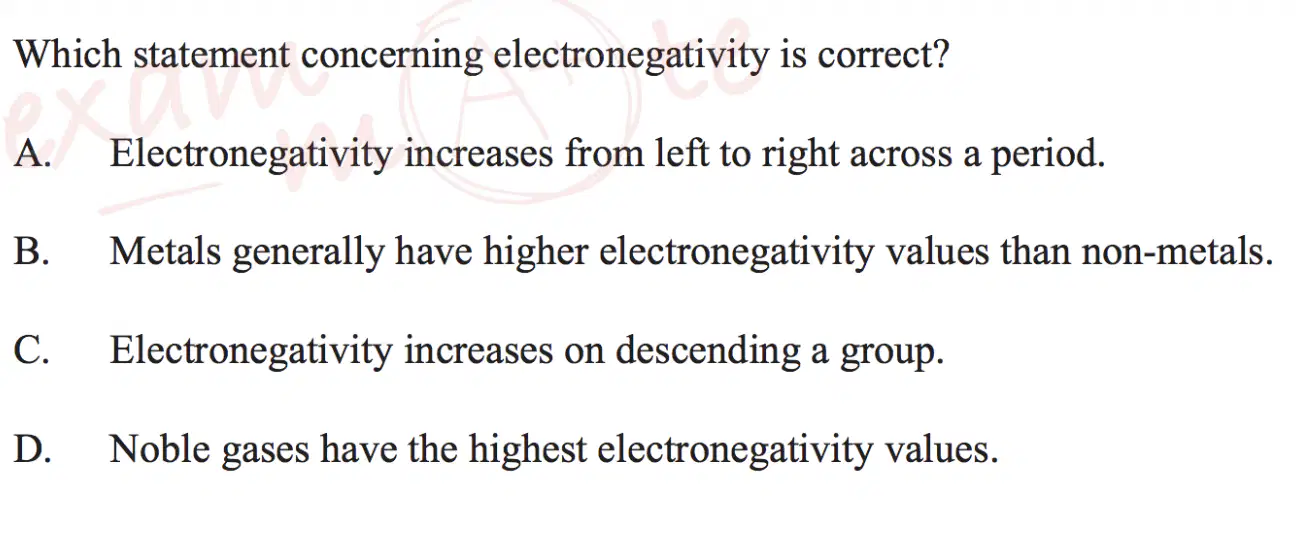
Which statement is correct?
A
B
C
D
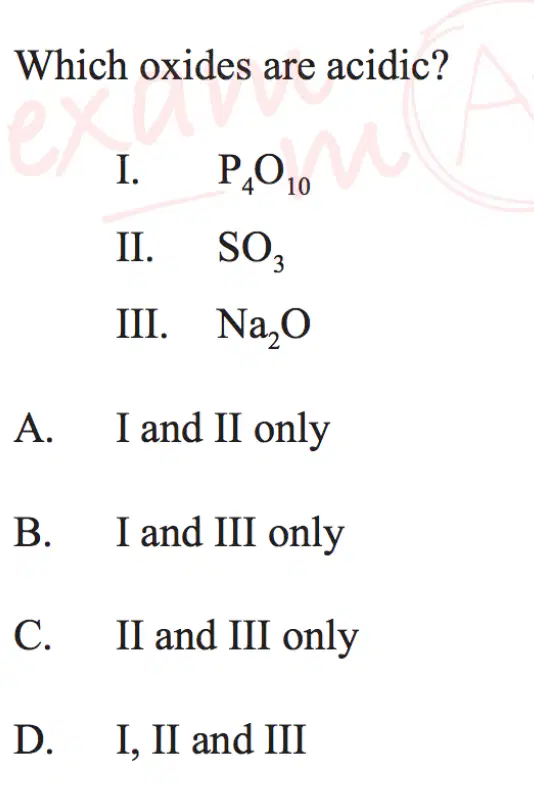
Which oxides are acidic?
A
B
C
D

Which combination is correct?
A
B
C
D
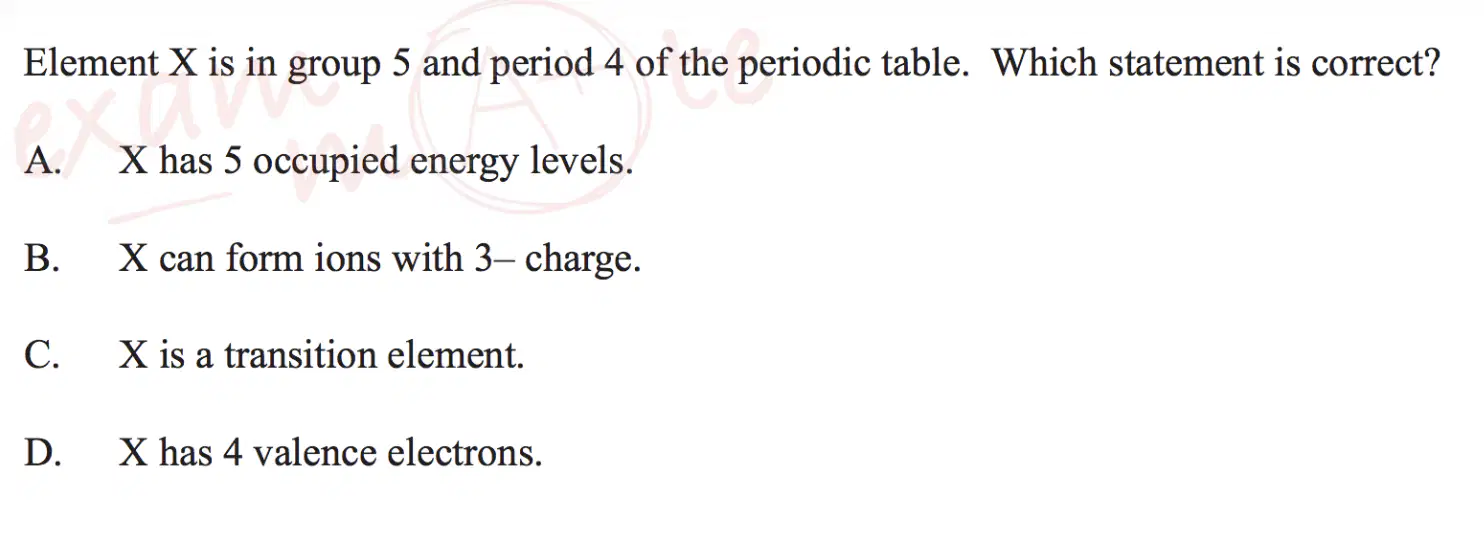
Which statement is correct?
A
B
C
D

Which gives the correct order?
A
B
C
D

