
 Worksheets
Savvas -Chapter 2: The American Revolution Test Review
Total questions: 42
Worksheet time: 42mins

Look at the graphic organizer. Then answer the question.
Which of the following was another reason that tensions grew between the colonists and Britain?
King George III told colonists they were not British citizens.
Britain and France were fighting over land in North America.
There was no colonial representation in Britain’s Parliament.
American Indians were fighting with the British in the Ohio River Valley.

Look at the picture. Then answer the question.
Which of the following effects of the Stamp Act does this image show?
Colonists protesting saying that it will ruin America.
Colonists boycotting printed materials to avoid paying the tax.
Colonists saying that Britain is ridiculous for taxing the colonies.
Colonists marching from New York to show their support of the Stamp Act.
Read each of the items that have to do with the causes and effects of Britain taxing the colonies.
Which item would be a cause?
Britain had to raise money to pay for war debts.
Colonists had to pay a tax on printed materials when they bought them.
Britain had to raise money to pay soldiers to protect the colonies.
Many colonists joined the Sons of Liberty or Daughters of Liberty.
Read each of the items that have to do with the causes and effects of Britain taxing the colonies.
Which items would be effects?
Choose ALL that apply
Britain had to raise money to pay for war debts.
Colonists had to pay a tax on printed materials when they bought them.
Many colonists protested.
Many colonists joined the Sons of Liberty or Daughters of Liberty.
The colonies were taxed without representation in Parliament.
Why did Britain think it had the right to tax the colonies?
British soldiers were protecting the colonies, and Britain needed money to pay them.
Britain hoped that by taxing the colonies it could benefit from American foreign trade.
Britain was more powerful than the colonies, and the colonies relied on Britain to survive.
Britain needed money to pay for wars with France so all British colonies were required to help.
Which of the following illustrates a form of protests against British taxation of the colonies?
Benjamin Franklin proposed the Albany Plan.
The Sons of Liberty formed as a secret group.
The Daughters of Liberty spun their own cloth.
Representatives met at the Stamp Act Congress.
Read each of the items that have to do with the causes and effects of the Boston Massacre.
Which item is are causes?
Click ALL that apply
A British soldier fires into a crowd after being hit with a stick.
Britain sends soldiers and warships to Boston.
Britain passes the Coercive Acts.
Britain passes the Tea Act.
Britain repeals the Townshend Acts but keeps the tax on tea.
Read each of the items that have to do with the causes and effects of the Boston Massacre.
Which item is are effects?
Click ALL that apply
A British soldier fires into a crowd after being hit with a stick.
Britain sends soldiers and warships to Boston.
Britain passes the Coercive Acts.
Britain passes the Tea Act.
Colonists form Committees of Correspondence.
Read the excerpt. Then answer the question.
"i. British Parliament has assumed power of legislation for the colonists without their consent.
ii. Parliament has raised illegal revenues.
iii. Tax collectors have been appointed by the Crown, a right reserved to the province.
iv. Tax collectors are entrusted with power too absolute and arbitrary. Private premises are exposed to search.
v. Fleets and Armies are quartered on the townsfolk in time of peace without their consent.
vi. Tax revenue has been used by King to pay provincial government officers, making them dependent on him, in violation of the charter."
—Boston Committee of Correspondence
Which of the following conclusions can you draw about Boston’s Committee of Correspondence?
It ordered the other colonies to form Committees of Correspondence.
It threatened the British government about its actions against the colonists.
It was unaware of the illegal acts that the British government had committed.
It pointed out the wrongdoings of the British government against the colonists.
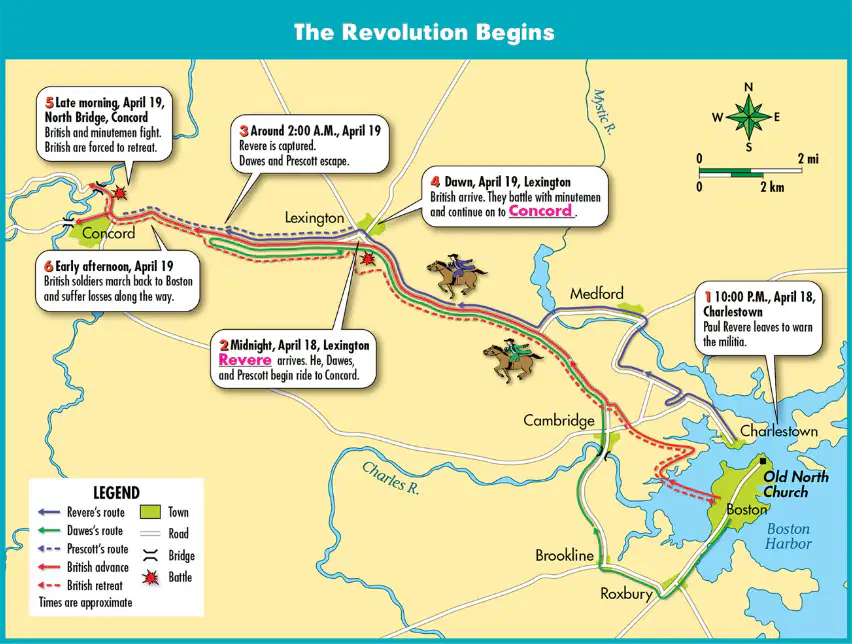
When did the British and minutemen go to battle at Concord?
dawn on April 19, 1775
midnight on April 18, 1775
late morning on April 19, 1775
early afternoon on April 19, 1775
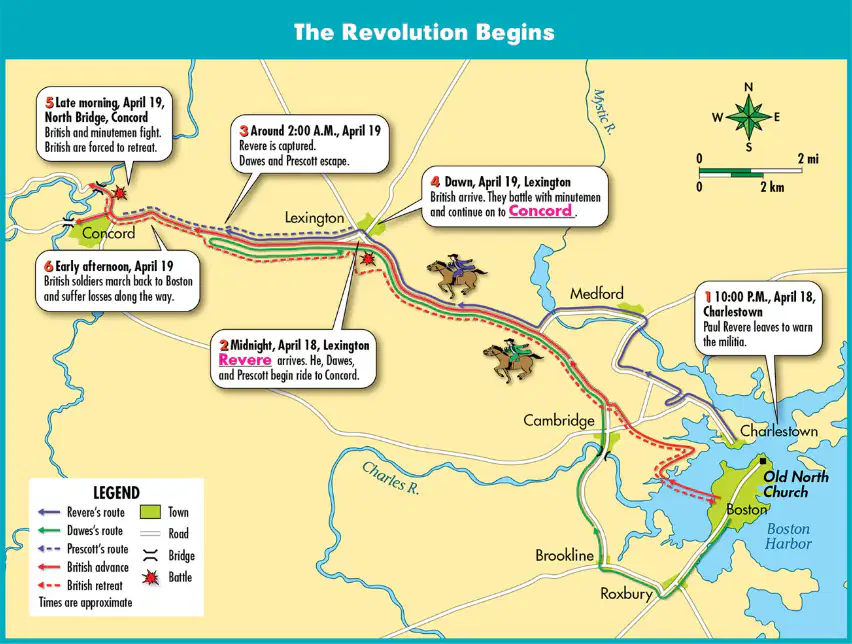
Based on the information in the map, what were the course and results of the conflict at Lexington and Concord?
The British fought all day on April 19 in Concord and Lexington before returning to Charlestown.
The British fought against minutemen in Lexington and then Concord before retreating to Boston.
The British fought against minutemen in Concord and then Lexington before retreating to Concord.
The British captured Paul Revere on April 19 before fighting at Lexington and Concord and returning to Boston.
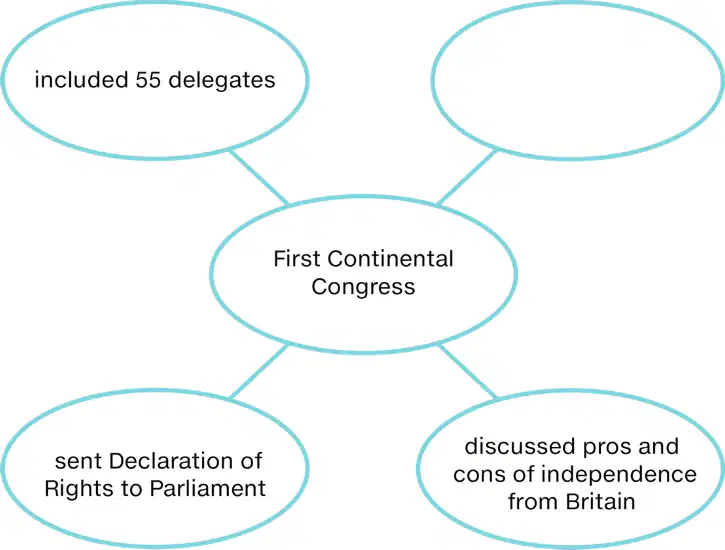
Look at the graphic organizer. Then answer the question.
Which of the following details completes the graphic organizer?
organizes the Continental army
drafts the Declaration of Independence
organizes in response to the Coercive Acts
chooses George Washington as commander-in-chief
Read the excerpts. Then answer the question. "Why is it that we hesitate? From Britain we can expect nothing but ruin. If she is admitted to the government of America again, this Continent will not be worth living in." —Thomas Paine "We have petitioned . . . our petitions have been slighted . . . and we have been spurned, with contempt, from the foot of the throne! . . . There is no longer any room for hope. If we wish to be free—. . . we must fight! I repeat it, sir, we must fight!" —Patrick Henry "Deny them this participation of freedom and you break that sole bond, which originally made, and must still preserve, the unity of the empire." —Edmund Burke Which of the following best expresses the message of all of these excerpts?
that the colonists must go to war now
that America is a terrible place to live in
that the British empire in North America is over
that Britain is at fault if the colonists fight for freedom
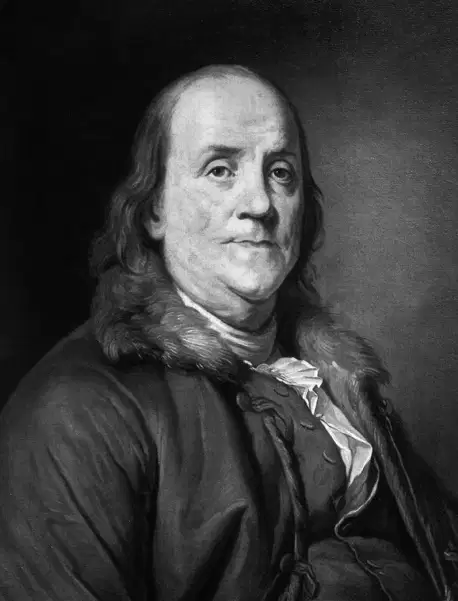
Look at the picture. Then answer the question.
If you were to use a library media center to identify this person, which of the following key words or phrases could you use?
President of the United States
soldier in the Continental army
writer of the United States Constitution
signer of the Declaration of Independence
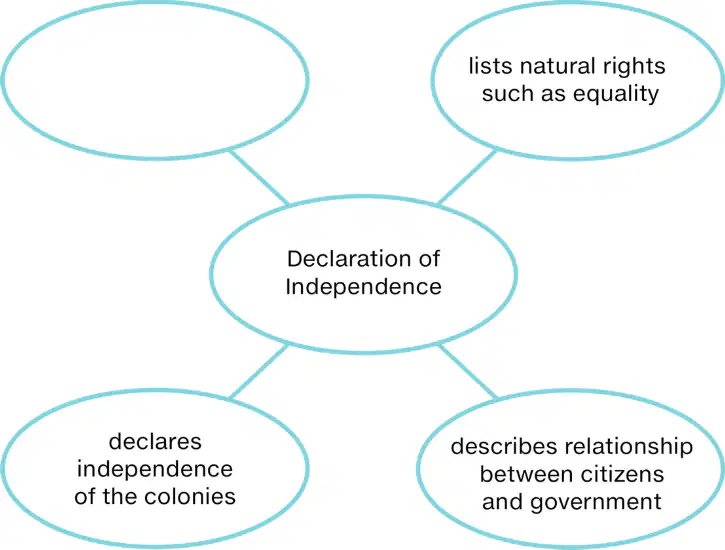
Look at the graphic organizer. Then answer the question.
Which of the following completes the graphic organizer?
describes the plan of government for the United States
introduces the Second Continental Congress and its members
lists the ways that the British king violated the rights of colonists
explains how Enlightenment ideas and thinkers influenced the colonists
Complete the sentence by writing the correct word from the word bank on the lines.
African Americans and women were groups that did not have their rights ________ after the United States became an independent country.
removed
recognized
understood
translated
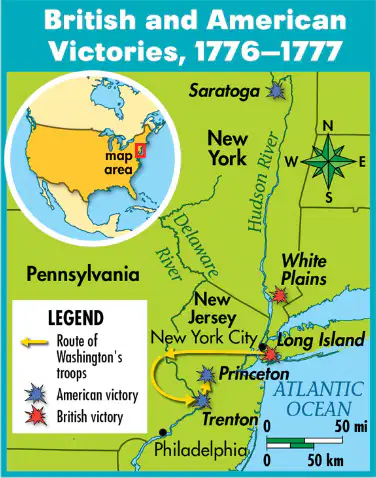
Read the map. Then answer the question.
In which directions did Washington and his troops march after the Battle of Long Island?
east, northeast
west, southeast
north, northwest
south, southwest
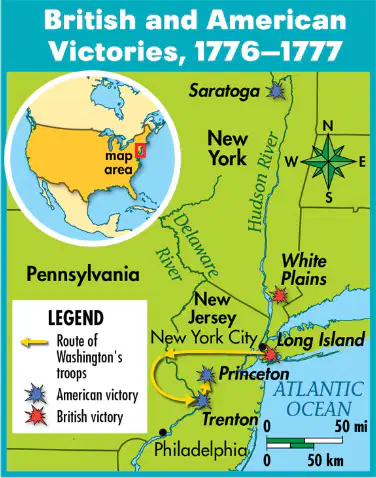
Read the map. Then answer the question.
Which of the following were battle victories in New York for the Continental army?
Saratoga
New York City
Saratoga and Long Island
Saratoga and White Plains
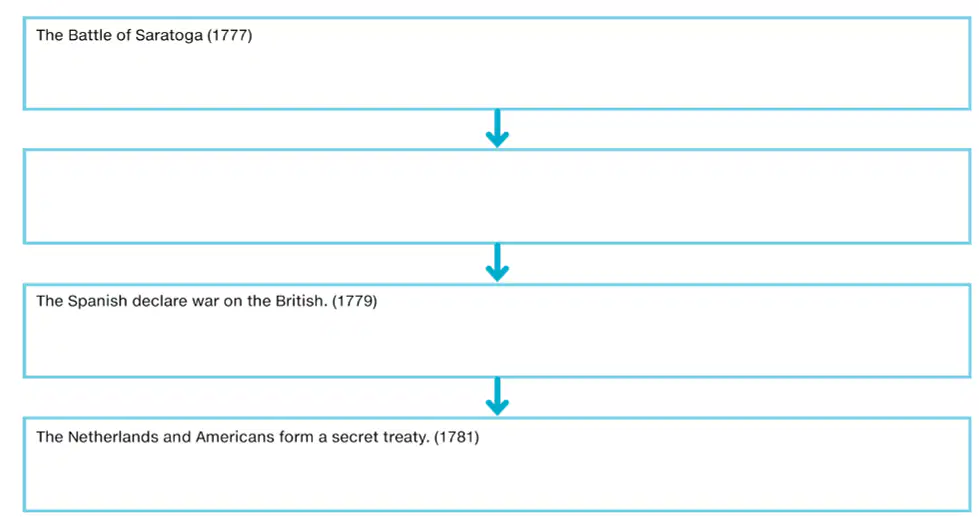
Look at the graphic organizer. Then answer the question.
Which of the following completes the graphic organizer?
The French join the Patriot cause.
The Russians send troops to America.
The Prussians help train Washington’s troops.
The Oneida and Tuscarora fight with the Patriots.
Read each of the actions that Spain or France took to support the Americans during the American Revolution.
Which actions were from Spain?
Its navy blocked the British from escaping at Yorktown.
Starting in 1776, it sent money and supplies
After the Battle of Saratoga, it sent money and supplies.
It attacked British forts in Louisiana territory.
It declared war on Britain over land in the west in 1779.
Read each of the actions that Spain or France took to support the Americans during the American Revolution.
Which actions were from France?
Its navy blocked the British from escaping at Yorktown.
Starting in 1776, it sent money and supplies
After the Battle of Saratoga, it sent money and supplies.
It attacked British forts in Louisiana territory.
It marched with General Washington from New York to Yorktown.

Look at the chart. Then answer the question.
Which disadvantages best complete the chart?
American: not enough soldiers or militias; British: weak navy
American: no European allies; British: not highly trained or skilled soldiers
American: not highly skilled soldiers; British: not enough soldiers or militias
American: lack of resources and supplies; British: lived far away from colonies
Read the excerpt. Then answer the question.
"You have now pointed out to you, Gentlemen, two Roads - one evidently leading to Peace, Happiness and a Restoration of the public Tranquility - the other inevitably conducting you to Anarchy, Misery, and all the Horrors of a Civil War. Your Wisdom, your Prudence, and your Regard for the true Interests of the People, will be best known when you have shown to which Road you give the Preference."
—William Franklin, son of Benjamin Franklin
What conclusion can you draw from this passage?
William Franklin was a Patriot.
William Franklin was a Loyalist.
William Franklin wanted to start a civil war.
William Franklin was a supporter of anarchy.
What was the main reason that enslaved African Americans fought in the Revolutionary War?
They had signed treaties with the British.
They were promised their freedom in return.
They preferred being British citizens.
They were promised western lands in return.
Which side did Native American groups choose during the Revolutionary War?
They sided with the British.
They sided with the Americans.
They remained neutral.
Some groups chose a side while others remained neutral.
The American victory at the Battle of Saratoga was a turning point in the Revolutionary War.
What does the term turning point mean in the sentence above?
a time when people try to reach an agreement
an event that causes an important change
a place where people gather to fight
an event in which people die
Which of these countries supported the American during the Revolutionary War?
France
Germany
Ireland
Mexico
Delegates in the ________ created the Continental army, wrote the Olive Branch Petition, and considered independence from Britain.
Committee of Five
Colonial Legislatures
First Continental Congress
Second Continental Congress
What role did the Enlightenment have on colonists such as Thomas Paine?
Enlightenment thinkers told Thomas Paine to unite against Great Britain.
Enlightenment thinkers wrote about basic human rights for all and liberty.
The Enlightenment persuaded the colonists to be patient and support Britain.
The Enlightenment spread to the colonies in an effort to draw them back to Europe.
Who created the first draft of the Declaration of Independence?
Samuel Adams
Thomas Paine
Thomas Jefferson
George Washington
Which American ideals are expressed in the Declaration of Independence?
unity and diversity
voting and security
freedom and equality
equal representation and rights
Why was the Declaration of Independence an important step in equal rights even though it recognized only some people’s rights?
The Declaration of Independence forced other groups in the colonies to fight for equal rights.
Britain failed to recognize the rights of the colonists and did not think of them as British citizens.
The Founders thought that mentioning the equal rights of some groups but not all was an improvement.
Britain could see that there was much diversity in the colonies and that many groups would be rebelling.
Which was an advantage that the colonists had over the British during the American Revolution?
The British did not know how to fight on unfamiliar land.
The colonists had more resources and knew the land better.
The colonists had more to fight for because they wanted their freedom.
The British lived far away from the colonies and did not have enough soldiers.
The ________ was a turning point in the war for the Continental army.
Battle of Saratoga
Battle of Yorktown
Battle of Bunker Hill
Battle of White Plains
Why were General George Washington’s tactics at the Battle of Trenton successful?
He withdrew his troops to set up a winter camp at Valley Forge.
He used the river to move his soldiers to Manhattan to avoid capture.
He enlisted the help of a Polish engineer to help build a fort in New York.
He used the element of surprise and took multiple victories in New Jersey.
The ________ supported the Continental army with financial aid, weapons, supplies, and troops during the American Revolution.
French
Spanish
Prussians
American Indians
Which of the following explains why some American Indians most likely fought on the side of the Continental army during the American Revolution?
They may have thought that if the Americans won they would be able to keep their lands.
The Americans made an agreement with them that said westward expansion would stop.
The Americans were a stronger fighting force, and they believed it would be a quick victory.
They had nothing to lose and had strained relations with the British since the French and Indian War.
How did George Washington raise morale of the Continental army at Valley Forge?
He had the soldiers build more shelters.
He got Baron Friedrich von Steuben to train the soldiers.
He gave the soldiers paid leave and sent them home to rest.
He reminded them that General Burgoyne was closing in for victory.
Which country was instrumental in helping the Continental army win the final major battle in the American Revolution?
Spain
France
Russia
Prussia
Which leaders in the Continental army were known for using quick attacks that were effective against the British?
Horatio Gates and Benedict Arnold
George Washington and Charles Lee
Francis Marian and Nathanael Greene
Marquis de Lafayette and Baron von Steuben
Why was the Battle at Yorktown successful?
It was a retreat that allowed time for reinforcements to arrive.
It was a land and sea operation that trapped the British army.
It was carried out in secret and enabled the Continental army to escape.
It was the last effort that the Continental army could make to win the war.
Which of the following is the best assessment of the Treaty of Paris?
It was comprehensive in that it announced that the United States was an independent nation and set its borders.
It was controversial because there were more American officials than British officials at the signing.
It was overdue because it was signed long after the Battle of Yorktown and took a long time to negotiate.
It was unfair to Britain because it took away British control of the colonies and made Britain give up its land in North America.

