wayground logo

Free Printable Worksheets

NEW

Font size

S
M
L
XL
Worksheets

cells

Total questions: 28

Worksheet time: 14mins

Name
Class
Date
1.
Which of the following is the smallest unit of life that can carry out all life functions?
a)
the mitochondria
b)
the vacuoles
c)
the nucleus
d)
the cell
2.
Which structures are found in every living cell?
a)
cell membrane and cytoplasm
b)
chloroplasts and mitochondria
c)
a cell wall and nucleus
d)
chloroplasts and cell wall
3.
Cells with a nucleus and membrane-bound organelles are called ____________________.
a)
prokaryotes
b)
eukaryotes
c)
bacteria
d)
protists
4.
Who was the first  person to see cells under the microscope and give them their name?
a)
Mattias Schleiden
b)
Robert Hooke
c)
Theordor Schwann
d)
Anton van Leeuwenhoek
5.

An organism that is made of a prokaryotic cell is called ....

a)

mold

b)

mushrooms

c)

plants

d)

bacteria

6.

Tiny membrane-bound structures inside a cell that function like organs of a body are called....

a)

cell wall

b)

cell membrane

c)

organelle

d)

organ

7.

Which of the following is a characteristic of both eukaryotic and prokaryotic cells?

a)

contains ribosomes

b)

contains a nucleus

c)

contains several membrane bound organelles
8.

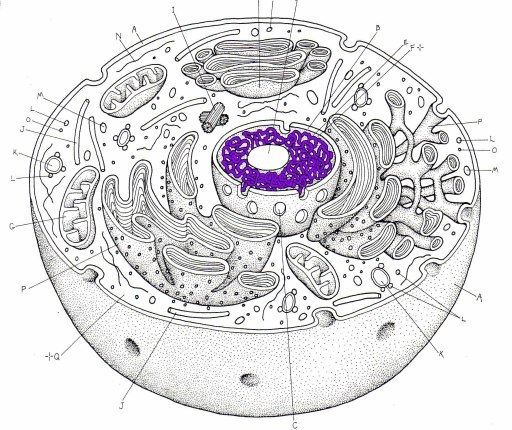
What type of cell is in the diagram?

a)

Prokaryote

b)

Eukaryote

9.

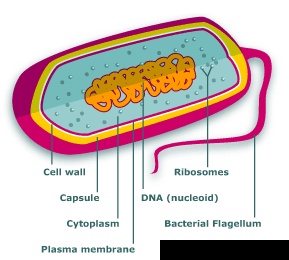
What kind of cell is in the diagram?

a)

Eukaryotic

b)

Prokaryotic

10.
The main difference between prokaryotic and eukaryotic cells? 
a)
Prokaryotic cells have a cell membrane but eukaryotic cells do not.
b)
Eukaryotic cells contain DNA in a nucleus while prokaryotic cells do not.
c)
Eukaryotic cells have flagella but prokaryotic cells do not.
d)
Prokaryotic cells contain membrane-bound ribosomes while eukaryotic cells do not. 
11.
What in the cell has the instructions to tell it what type of cell it needs to be?
a)
DNA / Genes
b)
Cytoplasm
c)
Cell Membrane
d)
Mitochrondria
12.

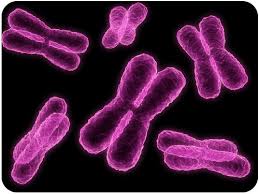
A normal human cell contains how many chromosomes?

a)

16

b)

26

c)

46

d)

14

13.

The the three main phases of cell division are, Interphase, Mitosis and

a)

cytoplasm

b)

cytokineses

c)

Cell Division

d)

Cell phones

14.

This part of the cells controls what moves in and out

a)

cell wall

b)

cell membrane

c)

Cytoplasm

d)

organelles

15.
Robert Hooke, Anton van Leeuwenhoek, Theodor Schwann, Rudolf Virchow, and Matthias Schliden were all responsible for what theory?
a)
The Theory of Gravity
b)
The Theory of Relativity
c)
The Cell Theory
d)
The Theory of Continental Drift
16.
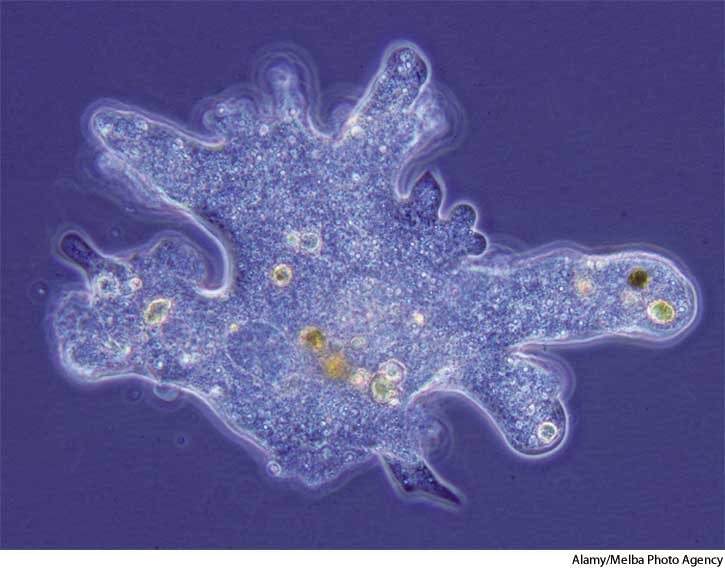
An Amoeba is a unicellular, animal-like protist that lives in ponds and streams. According to cell theory, where did this cell come from?
a)
another pre-existing amoeba cell.
b)
energy from sun that allowed the protist to reproduce.
c)
a multicellular organism.
d)
the nonliving environment.
17.
What tool do you use to view the cells?
a)
metric ruler
b)
centrifuge
c)
microscope
d)
telescope
18.
All cells are produced ____________.
a)
From pre-existing and deceased cells
b)
from other pre-existing cells
c)
Cells can come from anywhere, as long as there is the sun.
19.
In order to sustain life, all cells must...
a)
digest nutrients and water
b)
excrete waste and fluids
c)
must be able to maintain a homeostasis environment (aka cellular respiration and regulation)
d)
All of the above
20.
Which type(s) of cells have genetic material that is contained in a nucleus?
a)
bacteria
b)
only animal cells
c)
protists
d)
both plant and animal cells
21.
The diagram below represents a cell. Which organelle is the site where amino acids are synthesized into proteins? 
a)
1
b)
2
c)
3
d)
4
22.
Which of these best completes this concept map? 
a)
an animal cell
b)
a prokaryotic cell
c)
a virus
d)
a plant cell
23.
 Cells can be classified into two different categories: prokaryotic and eukaryotic. Which of the following information is needed in order to determine if an organism is prokaryotic?
a)
The organism’s color and mass.
b)
The organism’s internal structures.
c)
. If the organism is unicellular or multicellular
d)
The methods the organism uses to feed and move.
24.
Look at the cell membrane model below: What is the name of the macromolecule that makes up the majority of the cell membrane?
a)
nucleotide
b)
lipid
c)
carbohydrate
d)
protein
25.
 A specific type of cell is being studied by a scientist. She notices the cell contains a nucleus, lysosomes, a cell membrane and cell wall. What is the correct classification of this cell?
a)
 A prokaryotic animal cell
b)
 A prokaryotic plant cell
c)
 A eukaryotic animal cell
d)
A eukaryotic plant cell
26.

What is one way in which all living things on Earth are alike?

a)

All living things have hair.

b)

All living things are made of cells.

c)

The cells of all living things have chloroplast.

d)

All living things can move.

27.

What important material is contained in the nucleus?

a)

Jeans

b)

Digestive enzymes

c)

DNA

d)

Nuclear ladders

28.

Bacteria is what kind of cell?

a)

Eukaryotic

b)

Prokaryotic