
 Worksheets
8202L3SANPPT1Q1
Total questions: 51
Worksheet time: 26mins
System III soil stack system is based on which country's practice?
French practice
UK practice
German practice
US practice
How many types of sanitation system are there in the UK according to the document?
Two
Three
Four
Five
Which of the following is NOT a type of sanitation system listed in the UK?
Primary ventilated stack system
Secondary ventilated stack system
Tertiary ventilated stack system
Stub stack
What is the required gradient for the discharge pipe in a primary ventilated stack system according to the guidelines laid down in BS EN 12056?
2.5° per metre
5° per metre
10° per metre
15° per metre
In a primary ventilated stack system, how should all sanitary appliances be arranged in relation to the discharge stack?
Separately from the discharge stack
Directly above the discharge stack
Closely grouped to the discharge stack
At a minimum distance of 50 cm from the discharge stack
According to the image, what is the minimum diameter for a waste pipe valve connected to a bidet in a primary ventilated stack system?
32 mm
40 mm
50 mm
75 mm
What is the minimum diameter for a waste pipe valve connected to a washing machine (or dishwasher) in the system depicted in the image?
32 mm
40 mm
50 mm
75 mm
What type of bends should be at the bottom of a discharge stack to prevent compression?
2 x 45° bends
Long radius bend
Knuckle bends
Straight bends
What should be the minimum radius of a long radius bend at the base of a vertical discharge stack?
Equal to the diameter of the pipe
Half the diameter of the pipe
Twice the diameter of the pipe
Thrice the diameter of the pipe
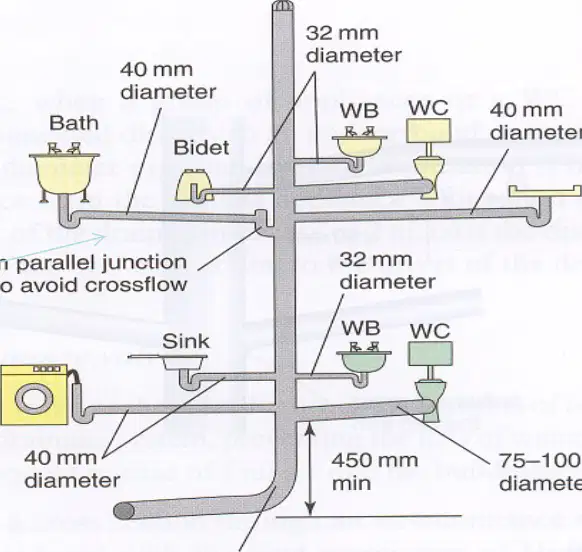
What is the maximum distance from appliances to the soil stack for a 32mm waste pipe according to the image?
1.7m
3.0m
4.0m
6.0m
What is the minimum radius for a long radius bend on a pipe?
32 mm
40 mm
200mm
75–100 mm
What can drastically reduce the dimensions and distances of the pipework in a primary ventilated stack system?
Increasing the water flow
Introducing bends to change direction
Making the pipework steeper
Using larger diameter pipes
What is the purpose of the soil and vent pipe in a primary ventilated stack system?
To carry rainwater from the roof
To terminate above a window for maintenance purposes
To allow the system to operate at atmospheric pressure
To supply water to the building
Where is the access point typically located in a primary ventilated stack system?
At the top of the stack
Alongside the stack
At the base of the stack
Inside the building
What is done to the redundant waste connections?
They are being extended
They are being insulated
They are being replaced
They should be capped off
What is the function of the rainwater pipe in the image?
To provide additional ventilation to the stack
To carry waste water to the sewer
To carry rainwater from the roof
To serve as an access point for maintenance
What is the minimum height for the lowest connection to the soil stack in low-rise buildings according to the image?
450mm
750mm
500mm
1000mm
How much does the minimum height for the lowest connection to the soil stack increase for buildings up to five storeys?
It remains the same
Increases to 500mm
Increases to 750mm
Decreases to 450mm
State the maximum length of a 32mm waste pipe outlet from a washbasin with no bends that connects to a primary ventilated stack.
1.5 meters
1.7 meters
4 meters
10 meters
If bends had to be fitted to the waste pipe of the washbasin mentioned above, how would this affect the installation requirements?
The maximum length of the pipe would increase
The maximum length of the pipe would decrease
The maximum length of the pipe would remain the same
The pipe would require additional ventilation
What type of bends should be avoided at the base of a soil stack?
Long radius bends
Short radius bends
Swept bends
Double bends
Name the British Standard for gravity drainage systems inside buildings.
BS EN 752
BS EN 12056
BS EN 10056
BS EN 1124
Which part of the Building Regulations deals with foul water drainage?
Part H
Part P
Part L
Part F
What type of traps are most suitable for appliances connected to a primary ventilated soil stack?
Bottle traps
P-traps
S-traps
Anti-siphon traps
Can the waste pipe diameter be reduced at the outlet of a trap?
Yes, it can be reduced
No, it should be the same size
Yes, but only if the pipe is longer than 3 meters
No, it should be increased
What are the four different sanitation systems stated in BS EN 12056 that the UK adopts?
I, II, III, and V
I, II, III, and IV
II, III, IV, and V
I, III, IV, and V
Which type of sanitation system does the UK specifically adopt according to BS EN 12056?
Single stack system with partial bore branch discharge pipes
Single stack system with full bore branch discharge pipes
Secondary ventilated stack system
Stub stack
Which four sanitary pipework systems are used in the UK?
Primary stack system, secondary stack system, ventilated branch discharge system, and stub stack
Primary ventilated stack system, secondary ventilated stack system, ventilated branch discharge system, and stub stack
Primary stack system, secondary stack system, non-ventilated branch discharge system, and full stack
Primary ventilated stack system, secondary stack system, ventilated branch discharge system, and full stack
What is the maximum length of a 32mm waste pipe outlet from a washbasin with no bends that connects to a primary ventilated stack?
1.2m
1.5m
1.7m
2.0m
If bends had to be fitted to the waste pipe of the washbasin mentioned above, how would this affect the installation requirements?
The measurements would be slightly reduced.
The measurements would be drastically reduced.
The measurements would be slightly increased.
The measurements would remain the same.
What type of bends should be avoided at the base of a soil stack?
P bends
S bends
Knuckle bends
U bends
Name the British Standard for gravity drainage systems inside buildings.
BS EN 12056
BS EN 10056
BS EN 11256
BS EN 13056
Which part of the Building Regulations deals with foul water drainage?
Part H1
Part F1
Part B1
Part L1
What type of traps are most suitable for appliances connected to a primary ventilated soil stack?
S traps
P traps
U traps
Bottle traps
Can the waste pipe diameter be reduced at the outlet of a trap?
Yes, it can be reduced significantly.
Yes, but only by a small amount.
No, it must not be reduced.
It can be reduced if it is a secondary pipe.
Which sanitation system does the UK adopt according to BS EN 12056?
System I
System II
System III
System IV
What is the maximum length of a 32mm waste pipe outlet from a washbasin with no bends that connects to a primary ventilated stack?
1.2m
1.5m
1.7m
2.0m
What should be avoided at the base of a soil stack?
Elbow bends
Straight pipes
Knuckle bends
P traps
Which British Standard is mentioned for gravity drainage systems inside buildings?
BS EN 12506
BS EN 12056
BS EN 13056
BS EN 11506
According to the image, what part of the Building Regulations deals with foul water drainage?
Part G
Part H1
Part K
Part M
Which type of trap is most suitable for appliances connected to a primary ventilated soil stack?
S traps
P traps
Bottle traps
Gully traps
Is it permissible to reduce the waste pipe diameter at the outlet of a trap?
Yes, it is recommended
Yes, but only in commercial installations
No, it must not be reduced
No, unless a special adapter is used
What is the maximum distance a vent pipe can be located from any appliance in a ventilated branch discharge system to protect water trap seals from induced or self-siphonage?
500mm
750mm
1000mm
1500mm
What is the purpose of air admittance valves (AAV) in a plumbing system?
To prevent water from flowing back into the appliance
To release excess water pressure into the sewer
To allow air into the system but prevent foul odours from escaping into a dwelling
To filter contaminants from the water supply
When is a ventilated branch discharge system typically installed?
When there is a risk of overpressure in the pipes
When the water supply is contaminated
When there is a risk of losing a trap seal on a larger installation due to waste pipe runs
When the installation is too small for standard plumbing methods
What is the purpose of the rodding eye in a ventilated branch discharge system?
To provide access for clearing blockages
To regulate water pressure
To measure water flow
To heat the water
What does the branch ventilating pipe connect to in a ventilated branch discharge system?
The main discharge stack
The main ventilating stack
The water supply
The heating system
Where does the branch discharge pipe lead to in a ventilated branch discharge system?
To the heating system
To the water supply
To the sewer
To the rodding eye
What is the function of the main ventilating stack in a ventilated branch discharge system?
To carry waste to the sewer
To supply water to the fixtures
To provide ventilation to the system
To distribute heat throughout the system
What is the main purpose of a secondary ventilated stack system in plumbing?
To increase water flow in the discharge pipes
To safeguard against positive and negative air pressure fluctuations
To reduce the amount of water used by appliances
To prevent physical blockages in the discharge stack
In a secondary ventilated stack system, where must the ventilating pipe connect to the discharge stack?
Below the spillover level of the appliance
At the same level as the appliance
Above the spillover level of the appliance
Directly to the sewer

