wayground logo

Free Printable Worksheets

Font size

S
M
L
XL
Worksheets

8th Grade Science Shutdown Review - Chemistry & Physics

Total questions: 45

Worksheet time: 45mins
Name
Class
Date
1.
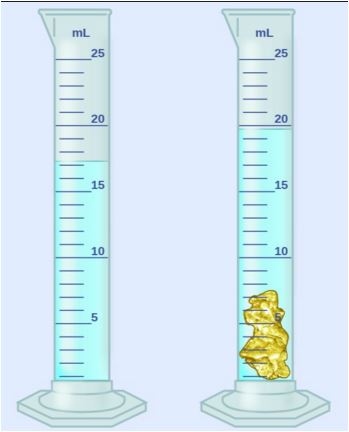
An irregularly shaped piece of gold was lowered into a graduated cylinder holding a volume of water equal to 17 ml. The height of the water rose to 20 ml. If the mass of the gold was 27 g, what was its density?
a)
9 g/mL
b)
10.5 g/mL
c)
6.5 g/mL
d)
8 g/mL
2.

Match the following

a)

Periodic Table

1.

All known elements arranged in order by atomic number.

b)

Family/Group

2.

Vertical columns of elements that have the same amount of valence electrons.

c)

Period

3.

Horizontal rows of elements that have the same number of electron shells. 

d)

Atomic Mass/Mass Number

4.

The average number of protons and neutrons in one atom of an element.

e)

Metal

5.

Elements that are malleable, ductile, and good conductors; typically shiny.

3.

How many electron shells does the pictured atom have?

a)

1

b)

2

c)

3

d)

4

4.

An atom has 10 protons, 15 neutrons and 10 electrons what is its mass number.

a)

20

b)

10

c)

35

d)

25

5.
What is the atomic number of the atom pictured? 
a)
9
b)
10
c)
18
d)
19
6.

Which of the following determines the identity of an element?

a)

number of protons

b)

atomic mass

c)

number of neutrons

d)

number of shells

7.

2 CH2CO3OH

Number of C: ​ (a)  

Number of H: ​ (b)  

Number of O: ​ (c)  

Choose from the below words
4
6
8
2
3
1
5
7
9
10
8.

Match the element to the number of atoms it has.

2 Al(C2H3O4)2

a)

aluminum

1.

2

b)

carbon

2.

8

c)

hydrogen

3.

12

d)

oxygen

4.

16

9.

The atoms of a certain element each contain 11 protons and 1 valence electron. Which statement correctly identifies this element and describes its chemical reactivity?

a)

The element is sodium, and it is highly reactive

b)

The element is fluorine, and it is highly reactive

c)

The element is sodium, and it is not very reactive

d)

The element is fluorine, and it is not very reactive

10.

In this model, which particle determines the reactivity of this atom?

a)

Particle W

b)

Particle X

c)

Particle Y

d)

Particle Z

11.

Elements in the same group or column have the same ...

a)

# of valence electrons and similar properties

b)

# of electron shells

c)

# of protons

d)

Mass Number

12.

How many NEUTRONS are in an atom of Fluorine?

a)

9

b)

18.9984

c)

10

13.

Chose all properties of metal:

a)

Brittle

b)

Shiny

c)

Malleable

d)

Good Conductors

e)

Ductile

14.

Chose all properties of

non-metal:

a)

Brittle

b)

Dull

c)

Malleable

d)

Good Conductors

e)

Insulator

15.

Which two elements have properties in common?

a)

Nitrogen and Phosphorous

b)

Oxygen and Nitrogen

c)

Sulfur and Nitrogen

16.

Match the following

a)

Located in the nucleus; have a positive charge; and a mass of 1 amu

1.

Protons

b)

Located outside of the nucleus; have a negative charge; and a mass of 1/2000th of an amu

2.

electrons

c)

located in the nucleus; have no charge; and no charge

3.

neutrons

17.

Match the following images to the correct vocabulary

a)

1.

Physical Change

b)

2.

Chemical change

c)

3.

Chemical Property

d)

4.

Physical Property

18.

A chemical change is different than a physical change because in a chemical change...

a)

Chemicals are used

b)

Molecules do not physically touch

c)

A new substance is formed and in a physical change no new substance is formed

d)

The change can be seen but in a physical change it cannot

19.

We know that there was a chemical reaction occurring when 2 clear liquids were mixed together. That is because we show the production of a _____________.

a)

solid.

b)

precipitate.

c)

gas.

20.
What is the Law of Conservation of mass?
a)
Mass is created in a chemical reaction
b)
Mass is created in a physical change
c)
New chemicals formed from a chemical reaction have a larger overall mass than the original reactants
d)
Mass is never created or destroyed
21.

Balanced or Unbalanced: A runner jumping over a hurdle.

a)

balanced

b)

unbalanced

22.

Balanced or Unbalanced: A lamp sitting on a table.

a)

balanced

b)

unbalanced

23.

What is the net force?

a)

900 N unbalanced right

b)

900 N balanced right

c)

0 balanced

d)

0 unbalanced

24.

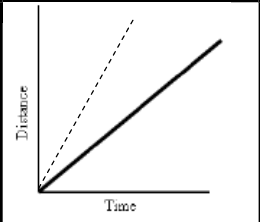
Match the following graphs to the right description.

a)
1.

Speeding up

b)
2.

No acceleration (constant speed)

c)
3.

Slowing down

25.

Match the following

a)

Speed

1.

20 mi/hr

b)

Acceleration

2.

10 km/s2

c)

Velocity

3.

50 m/s North

26.
A car travels 30 miles/hr for 3 hours, calculate the distance it will travel
a)
90 miles
b)
10 miles
c)
600 miles
d)
90 km
27.
What is the speed of a car that travels 400 m in 20 minutes?
a)
20 miles/hr
b)
20 m/min
c)
800 m/min
d)
200 miles/hr
28.
What is happening in this graph from point B to C?
a)
The object is going down a hill.
b)
The object is returning to its starting location.
c)
The object is slowing down.
d)
The object is staying still.
29.
What does this graph represent?
a)
Constant Speed
b)
Acceleration
c)
Not moving
30.

Which one of Newton's laws is shown

a)

3rd law

b)

2nd law

c)

1st law

31.

Which one of Newton's laws are displayed

a)

2nd law

b)

1st law

c)

3rd law

32.

If there is a big mass, it would need a stronger force to accelerate it. Which law does this describe?

a)

3rd law

b)

1st law

c)

2nd law

33.
At which point is potential energy greatest
a)
W
b)
X
c)
Y
d)
Z
34.

Which letter shows where kinetic energy is at is highest point?

a)

X

b)

Y

c)

W

d)

Z

35.
Which energy type?
A mousetrap set and ready to spring
a)
Potential
b)
Kinetic
36.
Which energy type?
An airplane circling in preparation for a landing
a)
Potential
b)
Kinetic
37.
A lamp that plugs into a wall socket draws energy which flows through a thin wire in the bulb causing it to glow. What energy transformations are taking place?
a)
chemical → light → electrical
b)
mechanical → sound → light
c)
thermal → solar → electrical
d)
electrical → thermal → light
38.
When water falls through a dam and turns a turbine connected to a generator, electricity is produced. This electricity is often used to light our homes and offices. Which of the following shows the energy transformations that occurs?
a)
electrical → light → mechanical
b)
chemical → mechanical → electrical
c)
mechanical → chemical → light
d)
mechanical → electrical → light
39.
A wheeled cart is moving to the right at a constant speed.  Two forces of equal magnitude are acting upon the cart. Which of the following best describes the forces and motion of the cart?
a)
Balanced Forces, Constant Speed
b)
Balanced Forces, Acceleration
c)
Unbalanced Forces, Constant Speed
d)
Unbalanced Forces, Acceleration
40.
Sometimes tectonic plates do not move easily past one another, and the plates become stuck. Forces build up, and when the plates finally move, tension is released, as shown below. The sudden movement of the plates is caused by -

a)
the mass of the plates
b)
the weight of the plates
c)
unbalance forces
d)
gravitational force
41.
What is the net force?
a)
40 N left
b)
0 N Balalnced
c)
400 N right
d)
40 N right
42.

Sally jumps on her trampoline. She exerts a force on the trampoline and the trampoline exerts an equal but opposite force back on Sally. This represents

a)

Law 1

b)

Law 3

c)

Law 2

43.
A 10 kg object is accelerated upward at 2 m/s2.  What force is required? 
a)
20 N
b)
2 N
c)
5 N
d)
0 N
44.
A force of 250 N is applied to an object that accelerates at a rate of 5 m/sec2.  What is the mass of the object?
a)
100kg 
b)
1,250kg
c)
50kg
d)
5kg
45.
What is the formula to calculate speed?
a)
S = t/d
b)
S = d/t
c)
S = d x t
d)
S = t x d