
 Worksheets
SCH4U Rates Pre-Review
Total questions: 34
Worksheet time: 27mins
List four factors that affect the rate of a reaction
temperature
concentration
surface area
colour of reactants
catalysts
A temperature increase causes the particles ......
to slow down
to move faster
to orient themselves
to just vibe
How does a catalyst work in speeding up a reaction?
By lowering the activation energy of the reaction
By giving the reaction more energy
By making the particles more available

Both reactions progress at the same rate
Why does a higher concentration increase the rate of reaction?
it decreases the amount of reactants
it lowers the activation energy
it increases the energy of particle collisions
it increases the frequency of particle collisions
Why does a higher temperature increase the rate of a reaction?
it increases both the frequency and energy of particle collisions
it only increases the frequency of particle collisions
it only increases the energy of particle collisions
it reduces the activation energy of the reaction
The ______________is required to break the bonds of the reactants.
Carbonic energy
Activation energy
Plutonic energy
Energi Gaib
When molecules collide with proper orientation and enough energy.
High Temperatures.
The minimum amount of energy needed for colliding particles to react is called
Chemical Energy
Kinetic Energy
Activation Energy
Potential Energy
Adding a catalyst ___________ the activation energy.
Eliminates
Decreases
Doesn't affect
Increases
orientation and direction
energy and orientation
temperature and kinetic energy
To slow down a chemical reaction, you can:
Breaking up a lump of potassium into smaller pieces increases the rate of reaction due to increased
concentration
surface area
temperature
reactants
Decreasing the size of the reaction container means that particles are ___________ together.
Not
Never
Paired
Closer
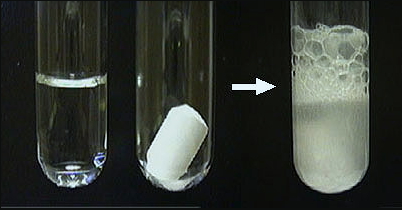
How could we make this reaction between chalk and acid happen more quickly?
Decrease the concentration of the acid
Crush the chalk to increase the surface area
Put the test tube in an ice bath
The major theory of reaction rate is called
Collision theory
Crash theory
Newton's laws
Thermodynamics

This question is about the Maxwell–Boltzmann distribution of molecular energies shown in the figure.
What does the area under the curve represent?
The total energy of the particles.
The total number of particles.
The number of particles that can react with each other.
The total number of particles that have activation energy.

The graph below shows a typical Maxwell-Boltzmann distribution for particles of an ideal gas in a sealed container at a fixed temperature.
Which of the following statements is true?
Position A represents the mean energy of a particle in the container.
Addition of a catalyst moves the position of EA to the right.
The area under the curve to the right of EA represents the number of particles with enough energy to react.
The position of the peak of the curve at a higher temperature is further away from both axes.
The rate of a chemical reaction can be expressed as Δ[R]/Δt, where R is a reactant. Which are the correct units for this expression?
mol L s-1
mol L-1 s
mol L-1 s-1
mol L-1

Which curve in this Maxwell-Boltzmann distribution represents the highest proportion of particles moving the fastest (# of particles vs. speed)?
Black (peak on the left)
Red (peak in the middle)
Blue (peak on the right)
All particles are moving at the same speed
What is the order of reaction with respect to A?
0th


How confident are you about the practice problems on reaction rates and rate laws that we have gone over in class this week?
These are easy!
These are challenging, but I like them and understand so far.
I'm trying to keep up, but I have to do a lot of studying on my own.
I'm lost, sorry Miss V!
For a reaction 2A + B --> 2C, with the rate equation:
Rate = k [A]2 [B]
The order with respect to A is 1 and the order overall is 1
The order with respect to A is 2 and the order overall is 2
The order with respect to A is 2 and the order overall is 3
The order with respect to B is 2 and the order overall is 3
The order with respect to B is 2 and the order overall is 2

