
 Worksheets
Plate Tectonics & Continental Drift
Total questions: 31
Worksheet time: 16mins
Name
Class
Date
1.
According to Wegener’s hypothesis of continental drift,
a)
Earth’s surface is made up of seven major landmasses moving because of convection currents.
b)
the continents do not move.
c)
Earth is slowly cooling and shrinking.
d)
the continents were once joined together in a single landmass but have since separated.
2.
What is Pangaea?
a)
the name of a German scientist
b)
the name of the supercontinent that existed millions of years ago
c)
another name for continental drift
d)
the name of an ancient fossil
3.
Which of the following is the best evidence that Earth's continents were once in vastly different positions than they are today?
a)
Penguins are found only in the Southern Hemisphere.
b)
Fossils of tropical plants are found in the Arctic & Antarctica.
c)
Volcanoes encircle the Pacific Ocean.
d)
Major rivers form deltas from continental erosion.
4.
Which type of evidence was NOT used by Alfred Wegener to support his continental drift hypothesis?
a)
evidence from landforms
b)
evidence from fossils
c)
evidence from human remains
d)
evidence from climate
5.
Most geologists rejected Alfred Wegener’s idea of continental drift because
a)
they were afraid of a new idea.
b)
Wegener was interested in what Earth was like millions of years ago.
c)
Wegener used several different types of evidence to support his hypothesis.
d)
Wegener could not identify a force that could move the continents.
6.
In sea-floor spreading, molten material rises from the mantle and erupts
a)
along the edges of all the continents.
b)
along mid-ocean ridges.
c)
in deep-ocean trenches.
d)
at the north and south poles.
7.
What happens to the age of rocks as you move away from a mid-ocean ridge?
a)
They get younger.
b)
They get older.
c)
They increase in age then decrease in age.
d)
All rocks on the ocean floor are the same age.
8.
The process by which the ocean floor sinks beneath a deep-ocean trench and back into the mantle is known as what?
a)
convection
b)
continental drift
c)
subduction
d)
conduction
9.
Most geologists today think that the movement of Earth’s plates is caused by what?
a)
conduction
b)
earthquakes
c)
Earth's magnetic field
d)
convection currents in the mantle
10.
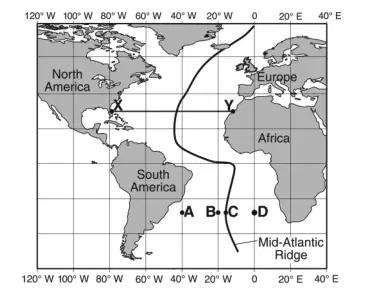
The diagram below shows the Mid-Atlantic Ridge. Points A through D are locations on the ocean floor. Samples of ocean-floor bedrock were collected at points A, B, C, & D. Which sequence shows the correct order of the age of the bedrock from OLDEST to YOUNGEST?
a)
D, C, B, A
b)
A, D, B, C
c)
C, B, D, A
d)
A, B, D, C
11.
The geological theory that states that Earth’s plates are in constant, slow motion is the theory of
a)
plate tectonics
b)
subduction
c)
sea floor spreading
d)
continental drift
12.
True or False: The pattern of magnetic stripes on the ocean floor is different on either side of a mid ocean ridge.
a)
True
b)
False
13.
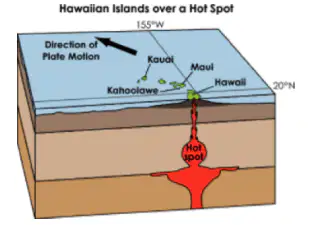
The Hawaiian Islands were formed over a "hotspot" as shown in the diagram below. Which island formed first?
a)
Hawaii
b)
Kahoolawe
c)
Kauai
d)
Maui
14.
A rift valley forms at a
a)
convergent plate boundary
b)
divergent plate boundary
c)
transform boundary
d)
deep-ocean trench
15.
The area where two tectonic plates meet
a)
mantle
b)
focus
c)
plate boundary
d)
convection
16.
What are the three pieces of evidence for sea-floor spreading?
a)
Puzzle-Like Shapes, Magnetic Stripes, Molten Material
b)
Drilling Samples (Age of sea floor), Fossils, and Molten Material
c)
Molten Material, Movement, Shifting of Plates
d)
Molten Material, Magnetic Stripes, Drilling Samples (Age of the sea floor)
17.
According to the principles of density warm fluids
a)
rise because they are more dense
b)
sink because they are more dense
c)
sink because they are less dense
d)
rise because they are less dense
18.
The youngest parts of the seafloor are usually found near:
a)
the continents
b)
a trench
c)
a mid-ocean ridge
d)
extinct volcanoes
19.
Which of the following is MOST responsible for the formation of new crust at the edge of a tectonic plate?
a)
mountain building at a continent-continent convergent boundary
b)
magma rising up from the mantle at a divergent boundary
c)
two tectonic plates sliding past one another at a transform boundary
d)
subduction of one oceanic plate under another ocean plate at a convergent boundary
20.
In 1968, the Deep Sea Drilling Project began extracting sediment cores from the ocean floor. Analysis of these cores has since shown that the ocean basins are very young compared to the accepted age of the Earth. No rocks older than 180 million years have been found. The cores further indicate that ocean sediments are absent at the mid-ocean ridge and get thicker moving away from the ridge. This evidence helped confirm what aspect of the plate tectonic theory?
a)
Sea-floor spreading
b)
Paleomagnetic (Earth's magnetic field) reversals
c)
Existence of land bridges
d)
Location of the lithosphere
21.
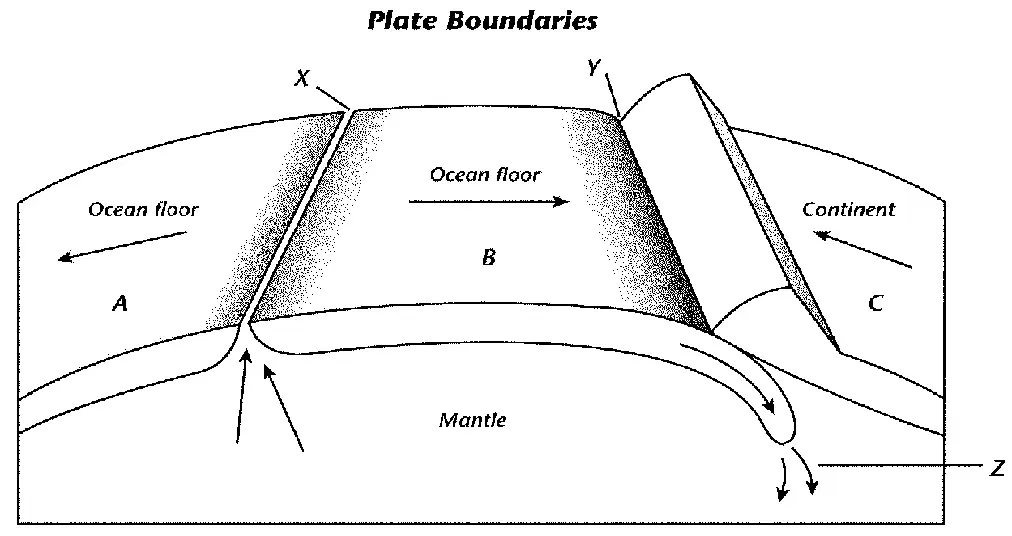
Which type of plate boundary occurs at X?
a)
divergent
b)
convergent
c)
transform
22.
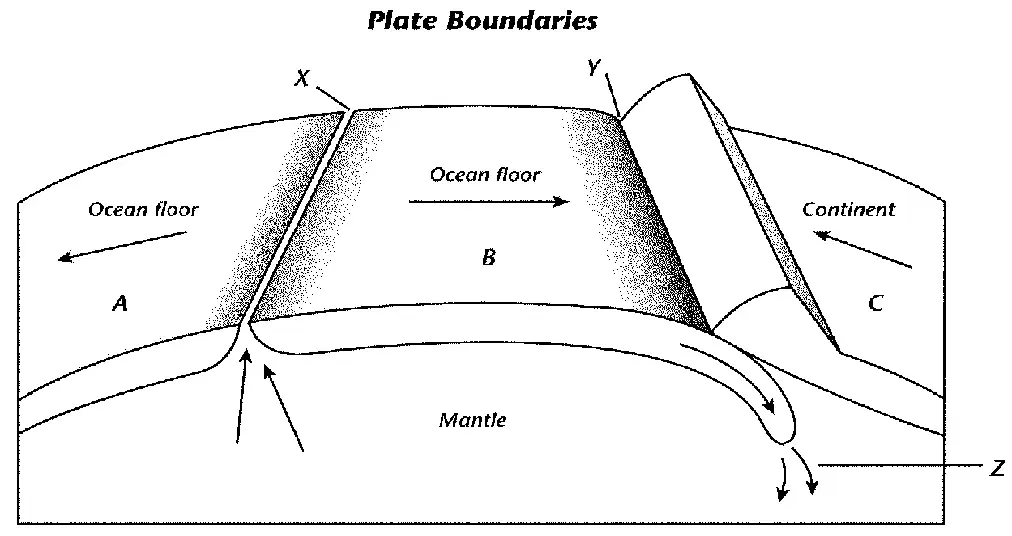
According to the Plate Boundaries diagram below, what feature of earth occurs at X?
a)
continental rift valley
b)
mid-ocean ridge
c)
pangaea
d)
deep-sea trench
23.
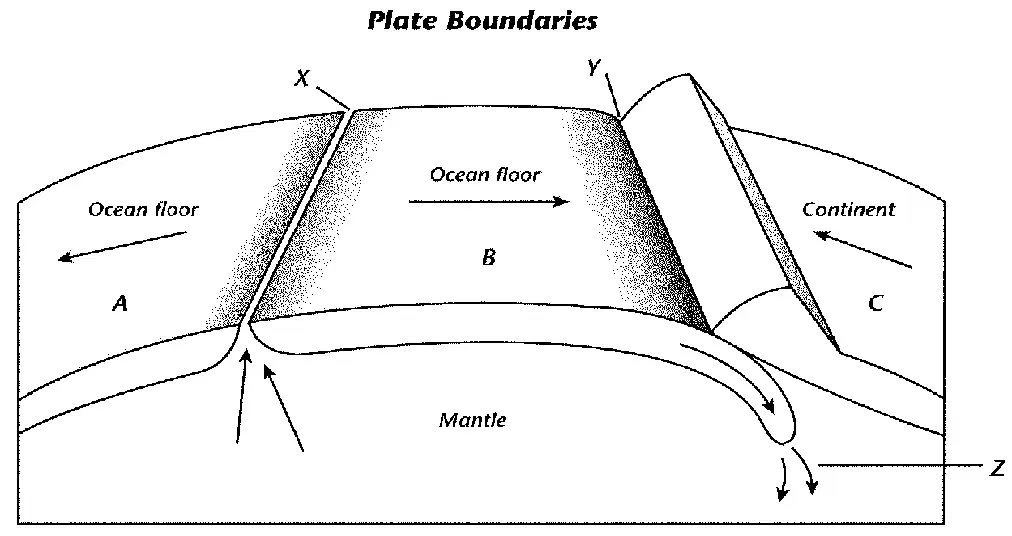
Which type of boundary occurs at Y?
a)
divergent
b)
convergent
c)
transform
24.
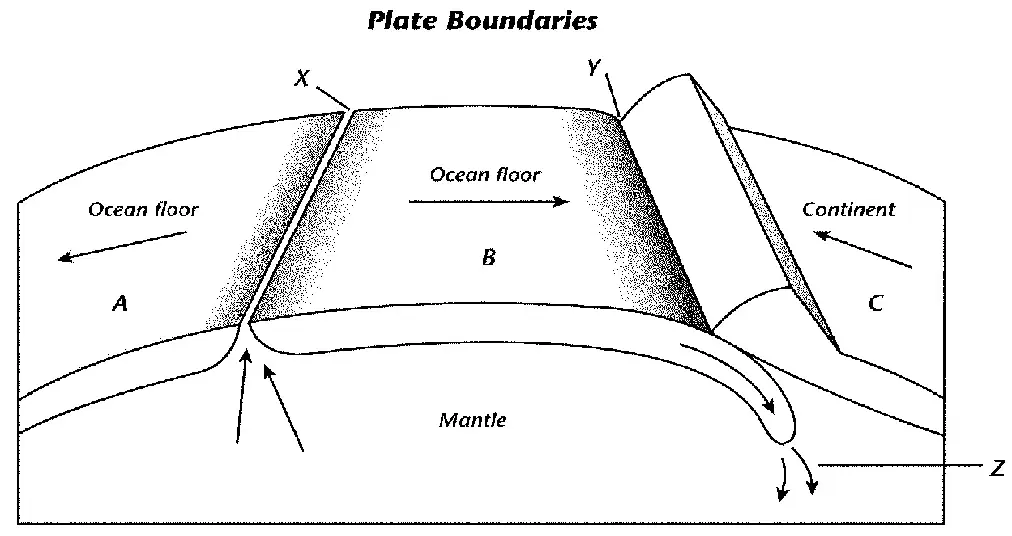
According to the Plate Boundaries diagram below, what geologic feature occurs at Y?
a)
continental rift valley
b)
mid-ocean ridge
c)
pangaea
d)
deep-sea trench
25.
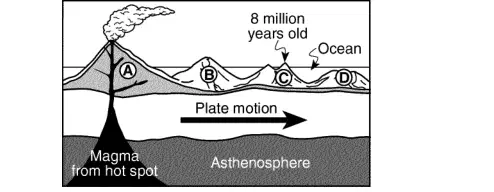
The cross-section below shows a hot spot resulting in a chain of volcanic mountains labeled A, B, C, and D. The geologic age of volcano C is shown. What are the most likely geologic ages of volcanoes B & D?
a)
B is 5 million years old & D is 12 million years old.
b)
B is 2 million years old & D is 6 million years old.
c)
B is 9 million years old & D is 9 million years old.
d)
B is 10 million years old & D is 4 million years old.
26.
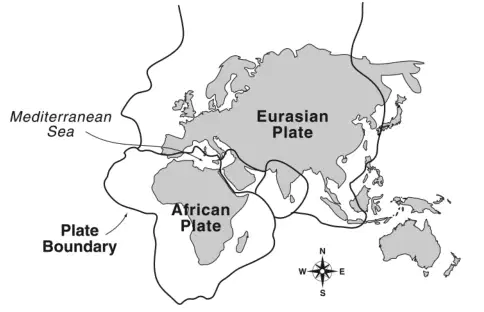
The African Plate is moving North toward the Eurasian Plate. What will most likely happen if this movement continues for many million years?
a)
Volcanoes will form and erupt at the plate boundary.
b)
The African plate will force the Eurasian plate to break into several pieces.
c)
The size of the Mediterranean Sea will increase and mountains will form on both sides.
d)
The Mediterranean Sea will shrink and mountains will form.
27.
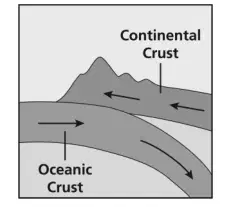
The following diagram shows the motion of two plates. Which of these explains the feature that can form at the boundary of these two plates?
a)
A broad canyon-like valley because the two colliding plates act like a plow, digging out any soil in the plates' paths.
b)
Island arc because the ocean plate melts underneath the continental plate, forming volcanic mountains that eventually becoming islands.
c)
Volcanic mountain range because the ocean plate melts underneath the continental plate, forming explosive composite volcanoes on the continent.
d)
Folded mountain range because the two colliding plates have equal composition and density, causing both to fold and form wide, thick mountains.
28.
New crust is being produced at a mid-ocean ridge. How does this affect Earth's crust?
a)
The total amount of crust is always increasing.
b)
The new crust is denser than older crust.
c)
The total amount of crust is always decreasing.
d)
The older crust is recycled at subduction zones.
29.
Which convergent zone does NOT result in subduction of a plate?
a)
ocean-ocean convergence
b)
continent-continent convergence
c)
continent-ocean convergence
30.
What did scientists use to map the oceans floor?
a)
Satellite
b)
Echo-location
c)
Space Shuttles
d)
Sonar
31.
If there are MORE mid-ocean ridges than subduction zones, what happens to the ocean?
a)
It gets larger
b)
It gets smaller
c)
It sinks
100 %

