
 Worksheets
C1.1 Unit Test 4
Total questions: 97
Worksheet time: 1hrs 18mins
The past: habitual events and specific incidents: Right or wrong?
I'd been hiding in the bushes for over an hour before I realized that everyone else had gone home.
right
wrong
The past: habitual events and specific incidents: Right or wrong?
My brother climbed a tree when he slipped and fell.
right
wrong
The past: habitual events and specific incidents: Right or wrong?
I wasn't surprised when my car broke down - it had made a funny noise all morning.
right
wrong
The past: habitual events and specific incidents: Right or wrong?
Most days we rode our bikes to school, but sometimes we were catching the bus.
right
wrong
The past: habitual events and specific incidents: Right or wrong?
I'll never forget the day my father used to forget to pick me up from school.
right
wrong
The past: habitual events and specific incidents: Right or wrong?
When we were kids, our mother would always give us a packed lunch and send us out to play for the day.
right
wrong
The past: habitual events and specific incidents: Right or wrong?
Emma's grandparents would live in an old farmhouse in the heart of the countryside.
right
wrong
The past: habitual events and specific incidents: Right or wrong?
Matt was always losing his glasses when he was younger.
right
wrong
The past: habitual events and specific incidents: Right or wrong?
When we got home from school that evening, our parents still decorated the hall.
right
wrong
The past: habitual events and specific incidents: Right or wrong?
I burst into tears when I saw what my brother had done to my favorite doll.
right
wrong
Choose the correct form. Sometimes both options may be correct:
My little sister was sitting on the side of the pool when she suddenly ..... in.
fell
used to
was falling
all are correct
Choose the correct form. Sometimes all options may be correct:
We ..... on holiday to the same place every year when I was a kid.
used to go
went
would go
all are correct
Choose the correct form. Sometimes all options may be correct:
Ed isn't looking forward to his first day as a security guard - he isn't used to ..... at night.
work
working
works
all are correct
Choose the correct form. Sometimes all options may be correct:
When I got to the airport, I realized that I ..... my passport at home.
had been leaving
had left
was leaving
all are correct
Choose the correct form. Sometimes all options may be correct:
When I lived in Paris, I ..... breakfast in a café.
always had
would always have
always used to have
all are correct
Choose the correct form. Sometimes all options may be correct:
I felt terribly guilty when I saw what I .....
did
had been doing
had done
all are correct
Choose the correct form. Sometimes all options may be correct:
Rob had a shower as soon as he got home because he .....
jogged
had been jogging
had jogged
all are correct
Choose the correct form. Sometimes all options may be correct:
There ..... a bus stop on the corner of my street, but recently they moved it.
used to be
were
would be
all are correct
Choose the correct form. Sometimes all options may be correct:
Emma can't get used to ..... with her parents again after having her own flat.
lived
live
living
all are correct
Choose the correct form. Sometimes all options may be correct:
In the summer, my dad ..... us all ice creams after school.
bought
used to buy
would buy
all are correct
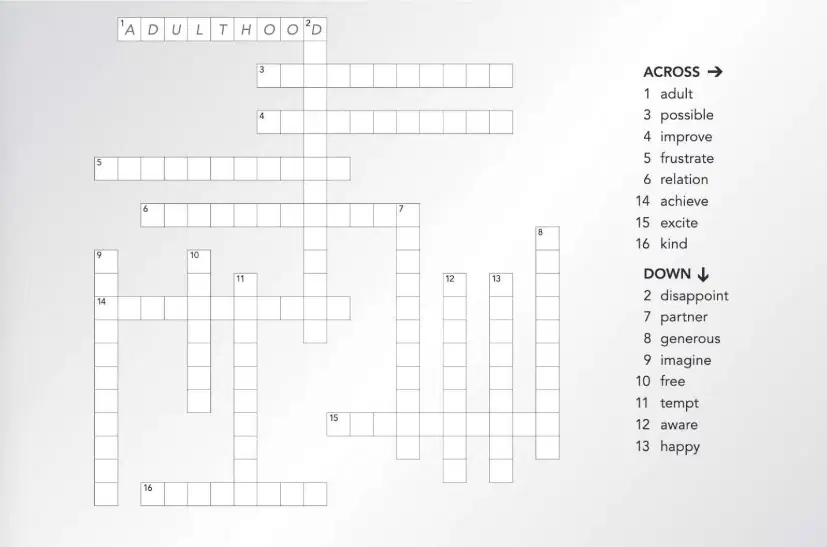
Complete the crossword with the abstract noun of the words:
Number 1
(a)
Complete the crossword with the abstract noun of the words:
Number 2
(a)
Complete the crossword with the abstract noun of the words:
Number 3
(a)
Complete the crossword with the abstract noun of the words:
Number 4
(a)
Complete the crossword with the abstract noun of the words:
Number 5
(a)
Complete the crossword with the abstract noun of the words:
Number 8
(a)
Complete the crossword with the abstract noun of the words:
Number 10
(a)
Complete the crossword with the abstract noun of the words:
Number 11
(a)
Complete the crossword with the abstract noun of the words:
Number 12
(a)
Complete the crossword with the abstract noun of the words:
Number 13
(a)
Complete the crossword with the abstract noun of the words:
Number 14
(a)
Complete the crossword with the abstract noun of the words:
Number 15
(a)
Complete the crossword with the abstract noun of the words:
Number 16
(a)
Complete the sentences with the correct form of the word in brackets:
They met at primary school and their (a) has lasted for 20 years. (friend)
Complete the sentences with the correct form of the word in brackets:
In many tribal communities, the (a) of the older generation must never be questioned. (wise)
Complete the sentences with the correct form of the word in brackets:
There were lots of kids of my age in my (a) when I was growing up. (neighbour)
Complete the sentences with the correct form of the word in brackets:
Ruth tried to hide the (a) in her eyes as she left the house forever. (sad)
Complete the sentences with the correct form of the word in brackets:
We had a big family (a) for my dad's 80th birthday. (celebrate)
Complete the sentences with the correct form of the word in brackets:
I must remember to renew my gym (a) before the end of the month. (member)
Complete the sentences with the correct form of the word in brackets:
My grandmother will be staying in a nursing home until she has fully recovered from her (a) (ill)
Complete the sentences with the correct form of the word in brackets:
We dread our history lectures because every week we nearly die of (a) (bored)
Complete the sentences with the correct form of the word in brackets:
Young children show great (a) about the world they live in. (curious)
Complete the sentences with the correct form of the word in brackets:
We all looked at Hannah in (a) when she announced that she was resigning. (amaze)
Complete the sentences with the abstract noun of the word in brackets:
Rosie's face burned with (a) when the teacher caught her cheating. (ashamed)
Complete the sentences with the abstract noun of the word in brackets:
It's important to be able to express (a) without losing your temper. (angry)
Complete the sentences with the abstract noun of the word in brackets:
Children's lives are in (a) every time they cross the road outside the school. (dangerous)
Complete the sentences with the abstract noun of the word in brackets:
The intense (a) between the two communities eventually resulted in violence. (hate)
Complete the sentences with the abstract noun of the word in brackets:
The whole country mourned the (a) of the former president. (dead)
Complete the sentences with the abstract noun of the word in brackets:
There is a (a) among some young people that education is a waste of time. (believe)
Complete the sentences with the abstract noun of the word in brackets:
Jack felt a real sense of (a) after his best friend emigrated to Australia. (lose)
Complete the sentences with the abstract noun of the word in brackets:
The teacher forgot my name again. Honestly - he's got a terrible (a) (remember)
Pronouns - Choose the correct answer:
This is a delicious cake. Did you make it .....?
you
your
yourself
Pronouns - Choose the correct answer:
..... needs to listen to both sides of the story in order to find out the truth.
One
We
You
Pronouns - Choose the correct answer:
Two of my friends aren't talking to ..... because they'd had a big argument.
each other
ourselves
themselves
Pronouns - Choose the correct answer:
As soon as he woke up, Brad ..... and left the house.
washed and dressed
washed and dressed himself
washed and dressed oneself
Pronouns - Choose the correct answer:
The receptionist accompanied us to the meeting and said we should help ..... to tea and coffee.
ourselves
us
oneselves
Pronouns - Choose the correct answer:
One has an obligation to ..... friends, and it's important not to let them down.
ones
one's
ones'
Pronouns - Choose the correct answer:
When a guest leaves ....., we recommend locking the door.
your
one's
their
Pronouns - Choose the correct answer:
I much prefer travelling .....
by my own
by myself
on myself
Complete the conversations with a suitable pronoun:
A: Who hasn't handed in (a) homework?
B: Me. Sorry. Here it is.
Complete the conversations with a suitable pronoun:
A: What a gorgeous dress! Where did you get it?
B: Well, actually, I made it (a)
Complete the conversations with a suitable pronoun:
A: Why isn't Judy with Pete tonight?
B: They're not going out with (a) any more.
Complete the conversations with a suitable pronoun:
A: What do you think about climate change?
B: In my opinion, it's about time (a) started taking it seriously.
Complete the conversations with a suitable pronoun:
A: I've just been promoted!
B: Well done! You must be really proud of (a) !
Complete the conversations with a suitable pronoun:
A: Why don't you join the army?
B: I don't know. (a) say it's really tough.
Complete the conversations with a suitable pronoun:
A: Who's Grace going round Europe with?
B: No one. She's going by (a)
Complete the conversations with a suitable pronoun:
A: People say (a) shouldn't sit in a draught.
B: Rubbish! There's nothing wrong with a bit of fresh air.
Lexical areas - Circle the correct word or phrase to complete the collocations:
To my ..... amazement, I got the job!
complete
full
Lexical areas - Circle the correct word or phrase to complete the collocations:
Doing an internship abroad can be a good ..... move.
career
job
Lexical areas - Circle the correct word or phrase to complete the collocations:
There's ..... opposition to the plan to close our local cinema.
high
strong
Lexical areas - Circle the correct word or phrase to complete the collocations:
My uncle has a ..... temper, but he doesn't stay angry for long.
fast
quick
Lexical areas - Circle the correct word or phrase to complete the collocations:
I had another piece of cake because I didn't want to ..... my grandmother's feelings.
damage
hurt
Lexical areas - Circle the correct word or phrase to complete the collocations:
Rosie has a high-powered job, so she's ..... a lot of pressure at the moment.
below
under
Lexical areas - Circle the correct word or phrase to complete the collocations:
Walkers who experience adverse weather should ..... refuge in a cave.
look for
seek
Lexical areas - Circle the correct word or phrase to complete the collocations:
I've got a ..... relative in Canada, but I've never met her.
distant
far
Lexical areas - Circle the correct word or phrase to complete the collocations:
We haven't booked accommodation yet, but we have ..... itinerary.
an approximate
a rough
Lexical areas - Circle the correct word or phrase to complete the collocations:
Can I ask you some questions? It'll only take a ..... of minutes.
couple
pair
Replace the bold word in the sentences with a more informal word or expression:
I'm much less spontaneous than my siblings.
br..... and s.....
(a)
Replace the bold word in the sentences with a more informal word or expression:
A man called this morning wanting to speak to you.
g (a)
Replace the bold word in the sentences with a more informal word or expression:
Most of the residents are opposed to the construction of a nuclear power station near the town.
a (a)
Replace the bold word in the sentences with a more informal word or expression:
Both of my sisters resemble my mother.
L..... L.....
(a)
Replace the bold word in the sentences with a more informal word or expression:
Why did your tennis coach resign?
qu (a)
Replace the bold word in the sentences with a more informal word or expression:
Increasing our market share is going to be a difficult task.
j (a)
Replace the bold word in the sentences with a more informal word or expression:
I had a long conversation with my aunt yesterday.
c (a)
Replace the bold word in the sentences with a more informal word or expression:
Does your new job come with any benefits?
p (a)
Replace the bold word in the sentences with a more informal word or expression:
You don't require any previous experience to apply for the job.
n (a)
Replace the bold word in the sentences with a more informal word or expression:
It was an ill-fated relationship, they broke up after six months.
u (a)
Complete the sentences with an idiom containing the word in brackets:
I have a ..... ..... that something is going to go wrong with this new project. (gut)
(a)
Complete the sentences with an idiom containing the word in brackets:
She told a ..... ..... because she didn't want to get into trouble. (white)
(a)
Complete the sentences with an idiom containing the word in brackets:
In my job, it's important to focus on the ..... ..... and not be distracted by the details. (picture)
(a)
Complete the sentences with an idiom containing the word in brackets:
I ..... the instructions ..... ..... ....., but I couldn't get the printer to work. (letter) (include the instructions in your answer).
(a)
Complete the sentences with an idiom containing the word in brackets:
Although my father-in-law is incredibly rich, he's very ..... ..... ..... and always makes me feel at home. (earth)
(a)
Complete the sentences with an idiom containing the word in brackets:
If you keep your ..... ..... ..... ..... all year, you should get the results you want. (grindstone)
(a)
Complete the sentences with an idiom containing the word in brackets:
She ran away in ..... ..... ..... ....., so nobody saw her. (dead)
(a)
Complete the sentences with an idiom containing the word in brackets:
I tried to ..... your ..... at the party, but you didn't see me. (eye) (include your in your answer)
(a)
Complete the sentences with an idiom containing the word in brackets:
..... ..... ..... did you get lost? My directions couldn't have been clearer. (earth)
(a)
Complete the sentences with an idiom containing the word in brackets:
One of my co-workers is a real ..... ..... ..... .....; he's always asking stupid questions. (pain)
(a)

