

Wayground logo

Free Printable Worksheets

Font size

S
M
L
XL
Worksheets

Revision quiz topic 4,5,6

Total questions: 25

Worksheet time: 13mins

Name
Class
Date
1.

Which one of the followings does not produce magnetic fields?

a)
A bar magnet
b)
A current carrying conductor
c)
A capacitor
d)
The Earth
2.

What is a magnetic field?

a)
Lines with arrows
b)
Area of magnetic force around a magnet
c)
Number of magnetic lines flowing through a closed surface
d)
A region around a magnet where a magnetic force can be experienced
3.

The direction of magnetic field around a current carrying straight wire can be determined by using the right hand grip rule. Which one of the statements is true?

a)
Thumb represents magnetic field
b)
Thumb represents electric current
c)
Other fingers represent magnetic force
d)
Other fingers represent electric current
4.

By using the right hand grip rule, the direction of magnetic field around a coil carrying current can be determined. What is the direction shows by fingers?

a)

magnetic force

b)

electric current

c)

magnetic field

d)

North pole

5.

When an electron is released at right angle into a uniform magnetic field, it will move in a

a)
circular path.
b)
straight line.
c)
helical path.
d)
none of these.
6.

If electric current in a conductor flows in a direction parallel to the magnetic field, the magnetic force acts on the conductor will be

a)
maximum.
b)
negative.
c)
zero.
d)
infinity.
7.

If currents in two parallel straight wires are flowing in the opposite direction, the force between the wires will be

a)
attractive.
b)
repulsive.
c)
zero.
d)
attractive or repulsive depending on the material of wires.
8.

If currents in two parallel straight wires are flowing in the same direction, the force between the wires will be

a)
attractive.
b)
repulsive.
c)
zero.
d)
attractive or repulsive depending on the material of wires.
9.

Which of the following statements is NOT TRUE about magnetic flux?

a)
It is independent of surface area.
b)
It is the product of the normal component of the surface area with the magnetic flux density.
c)
It is zero if the magnetic field is parallel to the surface area.
d)
It represents the total magnetic field lines passing through a surface area.
10.

An emf will be induced in a coil by

a)
moving one end of a bar magnet through the coil
b)
moving the coil toward one end of the bar magnet.
c)
holding the coil near a second coil while the electric current in the second coil is increasing
d)
all of the answers
11.

According to the Faraday's law, condition for an e.m.f. to be induced in a closed circuit loop is with the presence of

a)
a magnetic field.
b)
magnetic materials.
c)
an electric current.
d)

rate of change of magnetic flux.

12.

The magnitude of induced emf in a coil depends on the following factors EXCEPT

a)
the magnitude of the magnetic field through a coil.
b)
the number of turns of the coil.
c)
the magnetic force on the coil.
d)
the surface area of the coil.
13.

A straight conductor is moving across a uniform magnetic field. Which of the following DOES NOT affect the value of induced emf in the conductor?

a)
Magnetic density of the field
b)
Length of conductor
c)
Cross-section area of rod
d)
Speed of moving rod
14.

Process of producing an induced emf in the coil due to a change of current flowing through the same coil known as

a)
self inductance
b)
mutual inductance
c)
magnetic flux
d)
flux linkage
15.

Process of producing an induced emf in the coil due to a change of current flowing through another coil known as

a)
self inductance
b)
mutual inductance
c)
magnetic flux
d)
flux linkage
16.

Mutual induction happened when an induced emf produced in a

a)
solenoid due to the change of current in another solenoid
b)
closed loop due to the motion of the wire
c)
solenoid due to the change of current in the same solenoid
d)
coil due to the change in magnetic field
17.

An alternating current is a current which changes

a)
its magnitude as well as its direction.
b)
only its direction but not its magnitude.
c)
only its magnitude but not its direction.
d)
neither magnitude nor direction changes.
18.

Root mean square current is defined as the value of

a)
the average maximum current
b)
d.c which produces power at the same rate as an a.c in a given resistor
c)
alternating voltage and current at particular instant of time t.
d)
current which flows in altenate directions at regular intervals.
19.

What is the phase relationship between the current and the voltage in pure resistor circuit?

a)
In phase with the voltage.
b)

Leads the voltage by 90o

c)

Lags the voltage by 90o

d)

Leads the voltage by 45o

20.

What is the phase relationship between the current and the voltage in pure capacitor circuit?

a)
In phase with the voltage.
b)

Leads the voltage by 90o

c)

Lags the voltage by 90o

d)

Leads the voltage by 45o

21.

What is the phase relationship between the current and the voltage in pure inductor circuit?

a)
In phase with the voltage.
b)

Leads the voltage by 90o

c)

Lags the voltage by 90o

d)

Leads the voltage by 45o

22.

When the frequency of an AC source is increase, the inductive reactance will
a)
decrease directly with frequency
b)
increase directly with frequency
c)
increase as square of frequency
d)
decrease inversely with frequency
23.

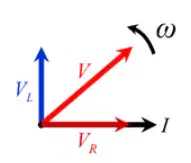
This phasor diagram refers to

a)
Pure inductor circuit
b)
RL circuit
c)
RC circuit
d)
RCL circuit
24.

Which of the following statements is TRUE concerning the impedance of an RLC circuit?

a)
The impedance is equal to resistance at resonant frequency.
b)
The impedance depends only on the values of resistance.
c)
The impedance is equal to capacitance at resonant frequency.
d)
The impedance depends only on the values of capacitance and inductance.
25.

Resonance in a RLC series circuit occurs when

a)

XL is greater than XC.

b)

XC is greater than XL.

c)

(XL – XC)² is equal to R².

d)

XC is equal to XL.
