wayground logo

Free Printable Worksheets

NEW

Font size

S
M
L
XL
Worksheets

Year 9 - Unit 1 revision

Total questions: 35

Worksheet time: 24mins

Name
Class
Date
1.
this is the symbol for a _____?
a)
switch
b)
light 
c)
battery
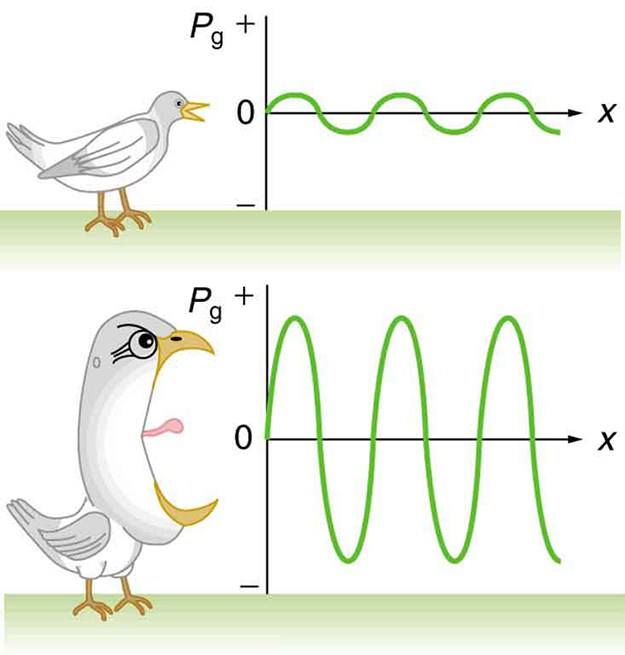
d)
wires
2.
This is the symbol for a ...
a)
Wire
b)
Battery
c)
Buzzer
d)
Fuse
3.
This is the circuit symbol for ...
a)
an AC current source
b)
a DC current source
c)
an ammeter
d)
a voltmeter
4.
This is the circuit symbol for ...
a)
an AC current source
b)
a DC current source
c)
an ammeter
d)
a voltmeter
5.
This is the symbol for a _____?
a)
Lamp
b)
Water wheel
c)
Loudspeaker
d)
Motor
6.
What is the unit of Current?
a)
Amps
b)
Watts
c)
Volts
d)
Joules
7.
Choose the corrrect sentence.
a)
This circuit will work because it is an open circuit
b)
This circuit will work because it is a closed circuit.
c)
This circuit will NOT work because it is an open circuit.
d)
This circuit will NOT work because it is a closed circuit.
8.
What kind of circuit is this?
a)
series
b)
parallel
9.
This picture is an example of what kind of circuit?
a)
Series
b)
Complete
c)
Broken
d)
Parallel
10.

What is the unit of electric power

a)

ampere

b)

volt

c)

watt

d)

ohm

11.

A wave that has the vibration parallel to the direction of the wave is called:

a)

Longitudinal

b)

Transverse

12.

A wave that has the vibration perpendicular to the direction of the wave is called:

a)

Longitudinal

b)

Transverse

13.

What does point C represent?

a)

Amplitude

b)

Trough

c)

Crest

d)

Wavelength

14.

What does point A represent?

a)

Amplitude

b)

Wavelength

c)

Crest

d)

Trough

15.
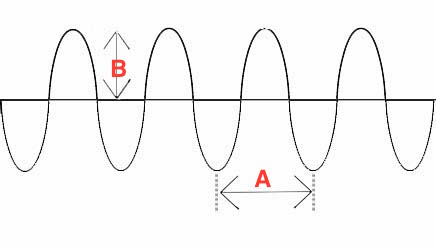
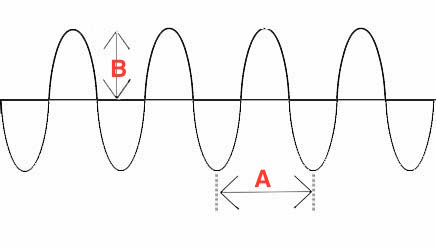
What property of the wave is represented by the letter "B"?
a)
amplitude
b)
crest
c)
trough
d)
wavelength
16.
What property of this wave is represented by the letter "A"
a)
amplitude
b)
crest
c)
trough
d)
wavelength
17.
The highest point on a wave is:
a)
the crest
b)
the trough
c)
the top
d)
the coast 
18.
The lowest point on a wave is the:
a)
Amplitude
b)
Crest
c)
Trough
d)
Wavelength
19.
The number of wavelengths that pass a point each per second is:
a)
frequency
b)
period
c)
longitudinal 
d)
transverse wave 
20.
When the frequency of a wave increases, what happens to the wavelength?
a)
The wavelength is not directly affected by the frequency of a wave.
b)
The wavelength increases.
c)
The wavelength decreases.
d)
More specific information is needed to form a conclusion about the wavelength.
21.
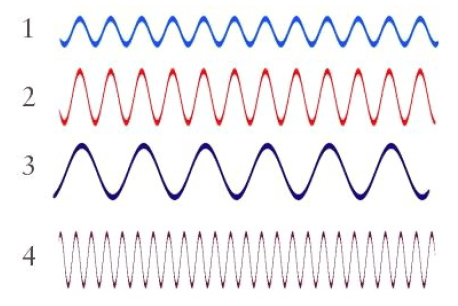
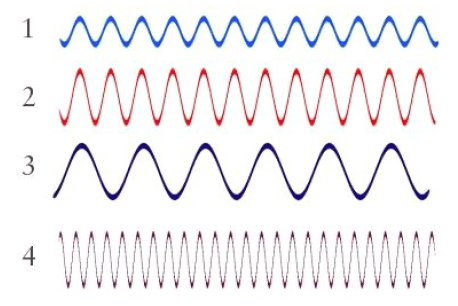
Which wave in the diagram has the greatest frequency?
a)
1
b)
2
c)
3
d)
4
22.
Which wave in the diagram has the greatest wavelength?
a)
1
b)
2
c)
3
d)
4
23.
This is the unit used to measure the volume of a sound. 
a)
Decibel
b)
Medium
c)
Vibration
d)
Oscilloscope
24.
If you want to change the pitch of a sound, you have to change the ___
a)
frequency
b)
amplitude
c)
speed
d)
volume
25.

Bats use ________ to locate mosquitoes in the air.

a)

solar

b)

ecology

c)

echolocation

d)

refraction

26.
A part in a longitudinal wave where the particles are spread apart
a)
compression
b)
rarefaction
c)
crest
d)
trough
27.
The part of a longitudinal wave where the particles of the medium are close together.
a)
rarefaction
b)
compression
c)
crest
d)
trough
28.
Material (matter) through which a wave travels
a)
medium
b)
Doppler Effect
c)
sound
d)
pitch
29.
When a sound is louder what measurement gets bigger?
a)
Frequency 
b)
Amplitude 
c)
Wavelength 
d)
Crest
30.

Which of the following accurately describes the Voltage of resistors in series?

a)

The voltage stays the same throughout the circuit

b)

The voltage across each resistor adds up to the total voltage of the circuit

c)

The voltage is 0 throughout the circuit

d)

Multiplying the voltage across each resistor is equal to the total voltage throughout the circuit

31.

Which of the following accurately describes the current of resistors in series?

a)

The current stays the same throughout the circuit

b)

The current through each resistor adds up to the total current of the circuit

c)

The current is 0 throughout the circuit

d)

Multiplying the current through each resistor is equal to the total current throughout the circuit

32.

Which of the following accurately describes the Voltage of resistors in parallel?

a)

Voltage is zero through out the circuit

b)

The voltage across each resistor adds up to the total voltage of the circuit

c)

The voltage stays the same throughout the circuit

d)

Multiplying the voltage across each resistor is equal to the total voltage throughout the circuit

33.

What is the definition of electrical current?

a)

The opposition to the flow of electrons

b)

The rate of flow of charge

c)

The work done on each coulomb of charge

d)

Electrons moving around

34.

The voltage drop across R1 is ______________________________ V.

a)

20

b)

30

c)

40

d)

50

35.
a)
A2 = A3
b)
A2 + A3 = A1
c)
A1 + A2 = A3
d)
A4 = A2 - A3