
 Worksheets
REVIEW 1
Total questions: 50
Worksheet time: 54mins
liquid state has .................... shape
definite
indefinite
..................... it is the amount of matter in an object
mass
volume
matter
....................... is the change of matter from liquid state to gaseous state
condensation
melting
evaporation

choose the correct answer
Vaporization at the surface does not occur until a liquid is heated to its boiling point
Vaporization that occurs within a liquid is called evaporation
Vaporization that occurs on the surface of a liquid is called evaporation
Vaporization that occurs on the surface of a liquid is called boiling
What is the boiling point of water at sea level?
0°C
100°C
212°F
37°C
What is the temperature at which a liquid boils?
Freezing point
Melting point
Boiling point
Condensation point
What does Charles's law state?
Volume of a gas is not affected by temperature
Volume of a gas remains constant with increasing temperature
Volume of a gas increases with increasing temperature
Volume of a gas decreases with increasing temperature
What happens to the volume of a gas inside a balloon when it is in cold air?
The volume remains constant
The volume increases
The volume decreases
The volume becomes zero
What is thermal contraction?
A decrease in pressure as temperature decreases
An increase in pressure as temperature increases
An increase in volume as temperature increases
A decrease in volume as temperature decreases
What happens to the kinetic energy of gas particles when the temperature decreases?
It becomes zero
It increases
It remains constant
It decreases
What is the result of gas particles slowing down due to a decrease in temperature?
They move closer together
They stop moving
They move further apart
They remain at the same distance
What is thermal expansion?
An increase in volume as temperature increases
An increase in pressure as temperature increases
A decrease in pressure as temperature decreases
A decrease in volume as temperature decreases
What changes during expansion and contraction of a gas?
The size of gas particles
The shape of gas particles
The number of gas particles
The color of gas particles
What remains the same during expansion and contraction of a gas?
The size of gas particles
The number of gas particles
The color of gas particles
The shape of gas particles
What is the reason for the balloon appearing partially deflated in cold air?
Gas particles escape from the balloon
Gas particles move further apart
Gas particles increase in size
Gas particles slow down and get closer together
What happens to the gas particles when the balloon is returned to a warm place?
They stop moving
They slow down and get closer together
They speed up and move further apart
They escape from the balloon
What is the effect of an increase in temperature on the volume of a gas?
The volume becomes zero
The volume increases
The volume remains constant
The volume decreases
What is the effect of a decrease in temperature on the volume of a gas?
The volume increases
The volume remains constant
The volume becomes zero
The volume decreases
What is the change in the average kinetic energy of gas particles when the temperature decreases?
It increases
It decreases
It becomes zero
It remains constant
What is the change in the average kinetic energy of gas particles when the temperature increases?
It decreases
It remains constant
It becomes zero
It increases
What is the reason for the balloon appearing inflated in warm air?
Gas particles increase in size
Gas particles move further apart
Gas particles escape from the balloon
Gas particles slow down and get closer together

What Gas law does the graph show?
Boyles'
Charles'
Combined Gas Law

The following graph shows what Gas Law?
Boyles'
Charles'
Combined Gas Law
In CHARLES'S LAW, volume and temperature have a ______ proportionality.
direct
inverse
linear
exponential
In BOYLE'S LAW, when Pressure increases then the Volume must...
Increase
Decrease
In BOYLE'S LAW, what type of relationship do pressure and volume have?
Direct
Inverse
No relationship
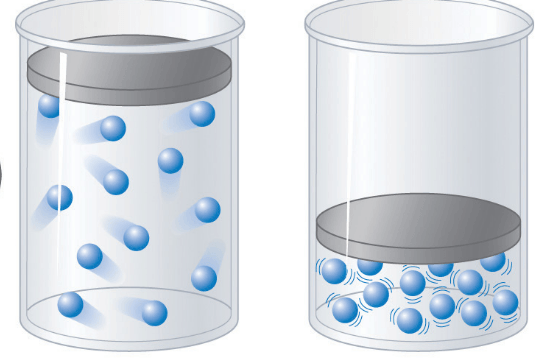
Which container will have a lower pressure?
left
right
they both have the same pressure
For a given sample of a gas, what must remain constant if Boyle's law is to be applied?
pressure and volume
pressure and temperature
volume and amount of gas
temperature and amount of gas

What will happen to the volume of a balloon if you put it into hot water?
Volume will increase
Volume will decrease
Volume will not change


This graph shows:
Boyle's Law
Charles' Law

Each of the flasks shown above have different volumes (they are different sizes) but the temperature of each flask is the same. In which flask will the pressure be the highest?
Flask 1
Flask 2
Flask 3
Flask 4
Which of these is under greater pressure?


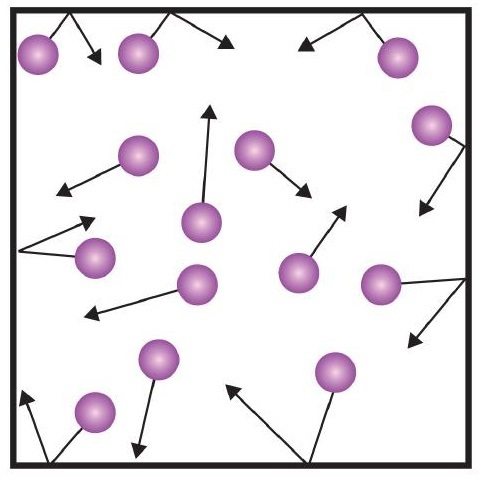

As long as the temperature does not change, as the volume _____ the pressure _____.
increases, increases
increases, decreases
decreases, decreases
decreases, stays the same

How would the pressure of the gas in an air tank change if more gas particles are added?
pressure stays the same
pressure increases
pressure decreases
pressure is minimal

