wayground logo

Free Printable Worksheets

NEW

Font size

S
M
L
XL
Worksheets

Chapter 15 and 16 Test

Total questions: 31

Worksheet time: 34mins
Name
Class
Date
1.
Which of the following is a legislative tool used in the United States to permit or prohibit certain land uses, as well as to limit density and to guide the direction of growth?
a)
zoning
b)
municipal governance
c)
qualitative data
d)
census
e)
infilling
2.
The Metropolitan Transit Authority (MTA) is an independent corporation rather than a government organization, and it runs the public transportation system in New York City and the surrounding areas. Which of the following describes a challenge that is likely to result based on the way this agency is structured?
a)
The MTA has the power to make spending decisions but not the power to tax the region’s residents, which prevents it from generating sufficient income.
b)
The MTA is controlled by the state government, rather than the city government, which results in bureaucratic delays when the state and city disagree
c)
The MTA has the power to use income generated from the city’s infrastructure budget if the city agrees with how the funds will be used, which results in funding delays.
d)
The MTA is accountable to New York City but not the state of New York, which creates unclear lines of accountability and a lack of cooperation between the city and the state.
e)
The MTA’s decisions are influenced more by its board of directors than by governmental officials, which results in excessive fares and administrative charges.
3.
Which term refers to the process of development of dense concentrations of people into settlements?
a)
urbanization
b)
suburbanization
c)
globalization
d)
expansion diffusion
e)
chain migration
4.
How does a metacity differ from a megacity?
a)
a metacity has a larger population than a megacity.
b)
a metacity includes the central city and its suburbs.
c)
a metacity includes multiple urban areas along an urban corridor.
d)
a metacity is defined by its cultural influence rather than its population size.
e)
a metacity is defined by the rate of growth rather than overall population size.
5.
Which factor had the greatest influence on the location and growth of Chicago?
a)
the advent of the railroad.
b)
proximity to natural resources.
c)
favorable climate
d)
rich agricultural soil
e)
advances in communication technology.
6.
Which of the following is the best definition of an urban area?
a)
a city and its surrounding suburbs
b)
an area with high population density
c)
a large area of land on the outskirts of the city
d)
an area within the boundaries served by the government
e)
a group of several adjacent metropolitan areas forming a continuous region
7.
Which of the following defines Chicago's position in relation to infrastructure of the United States?
a)
situation
b)
site
c)
absolute location
d)
transition zone
e)
vernacular region
8.
Which of the following describes a primate city?
a)
it is disproportionately large in relation to the next largest cities in that country.
b)
it is surrounded by walls like a forest.
c)
it is linked by colonial administrators to an imperial power.
d)
it is primarily concerned with its role as a religious center.
e)
it is roughly half the size of the largest city in that country.
9.
What is the definition of a megacity?
a)
a city with a population of more than 10 million people.
b)
an unincorporated area that lacks city services.
c)
a city that lies on the outskirts of a major metropolitan area.
d)
an urban area that has population growth of greater than 10 percent.
e)
a city that is more that twice the size of the next largest city in that country.
10.
What factor influences a city's population density?
a)
the predominant type of housing
b)
the wealth of residents
c)
the age of the city
d)
the model that best describes the city
e)
the city's public transportation system
11.
According to central place theory, which of the following has the highest threshold and range?
a)
museum
b)
movie theater
c)
supermarket
d)
playground
e)
hair salon
12.
Where are many metropolitan areas that are growing into megacities found?
a)
in peripheral and semi-peripheral countries in Asia and Africa
b)
in core countries in Asia
c)
in core countries in Europe
d)
in core countries in North America
e)
in semi-peripheral countries in South America
13.
Which term describes a suburb that has grown rapidly into a large, sprawling city with more than 100,000 residents?
a)
boomburb
b)
exurb
c)
infill
d)
megacity
e)
edge city
14.
Mexico City, Dakar and Paris are all what types of cities?
a)
primate cities
b)
enclaves
c)
edge cities
d)
world cities
e)
megacities
15.
Mexico City, Dakar and Paris are all what types of cities?
a)
primate cities
b)
enclaves
c)
edge cities
d)
world cities
e)
megacities
16.
Which invention(s) contributed to most to urban sprawl?
a)
the automobile
b)
the railroad
c)
the internet
d)
subways and streetcars
e)
the telephone and telegraph
17.
What is the major industry of Houston, Texas?
a)
oil and energy
b)
iron and steel
c)
computer technology
d)
automobile manufacturing
e)
mine and mineral processing
18.
What is the purpose of zoning?
a)
to allow only specific land uses in various areas of a city
b)
to encourage sustainable use of land and natural resources
c)
to provide support for people who cannot afford to live within a city
d)
to discourage residents from settling in certain areas of a city
e)
to identify and develop vacant parcels of land within previously built areas
19.
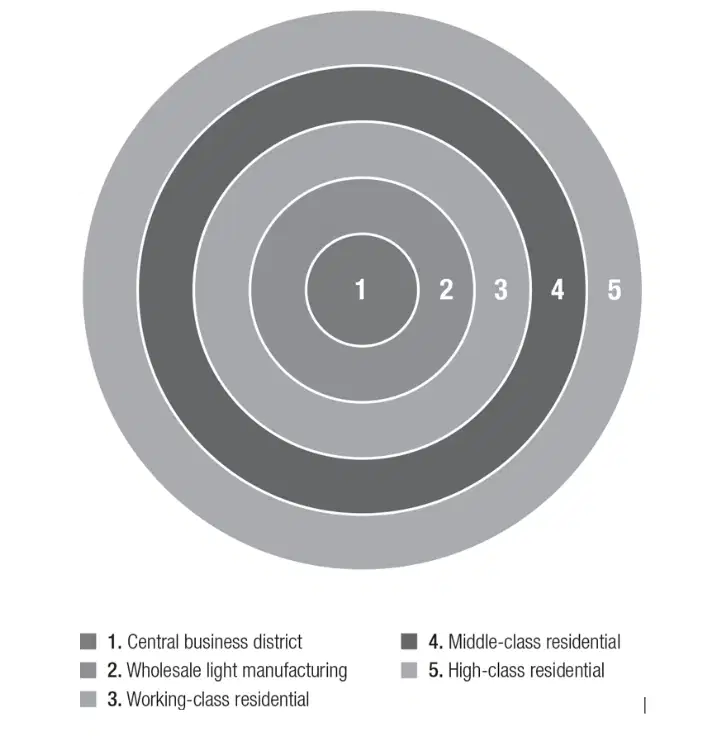
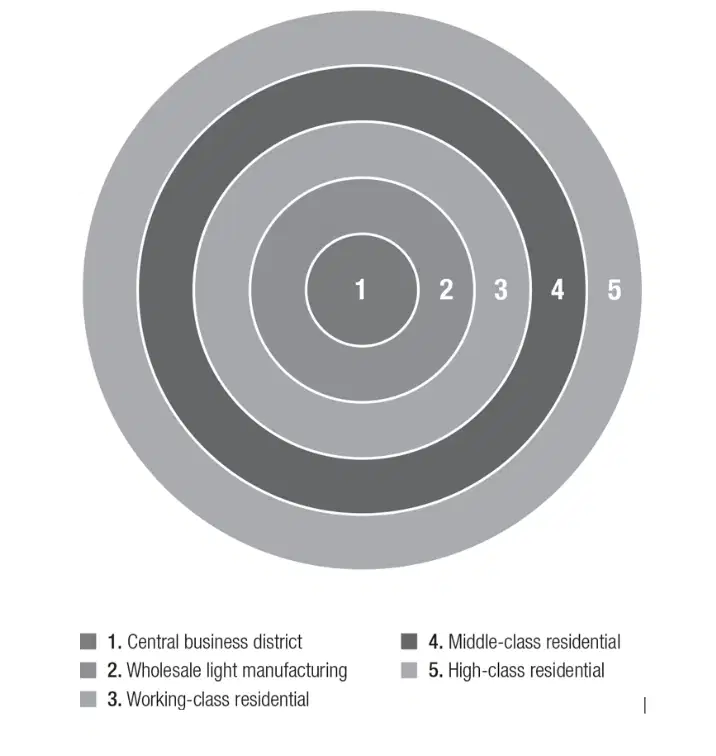
Which conclusion about cities is fundamental to this model?
a)
a city grows outward from the central business district in a series of rings.
b)
land values increase exponentially as a city grows in population.
c)
a city grows around major transit routes.
d)
a city grows around several competing functional regions or nodes.
e)
land t a city's outer rings is the most expensive and desirable.
20.
Which model is this?
a)
Burgess Concentric Zone
b)
Hoyt Sector
c)
Galactic City
d)
Multiple-Nuclei
e)
Latin American City
21.
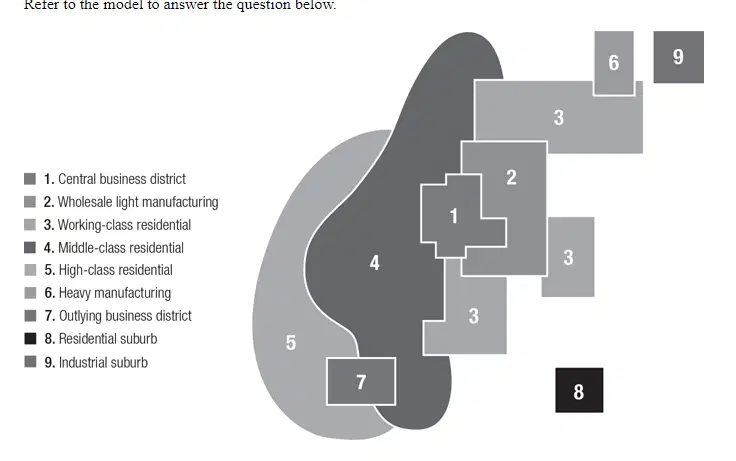
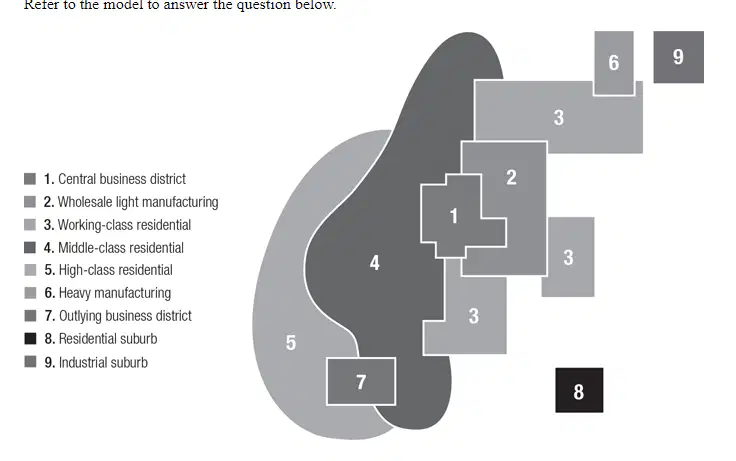
Which model is this?
a)
Burgess Concentric Zone
b)
Hoyt Sector
c)
Galactic City
d)
Multiple-Nuclei
e)
Latin American City
22.
Which statement is the best explanation for the location of node 5 in the model?
a)
affluent residents can afford the more expensive land far away from the CBD.
b)
affluent residents want to live far from industrial residential areas.
c)
affluent residents are pushed far from the CBD by working class and middle class residents
d)
affluent residents want to live far from the noise and pollution of heavy manufacturing
e)
affluent residents want to live as close as possible to wholesale light manufacturing
23.
Which model is shown here?
a)
Burgess Concentric Zone Model
b)
Demographic Transition Model
c)
Distance Decay Model
d)
Gravity Model
e)
Hoyt Sector Model
24.
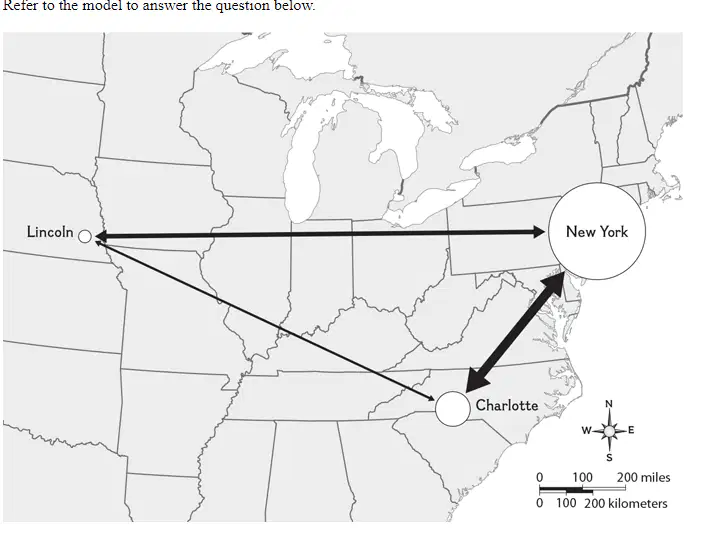
Which model is shown here?
a)
there is a clearly defined area in which people will travel regardless of goods or services.
b)
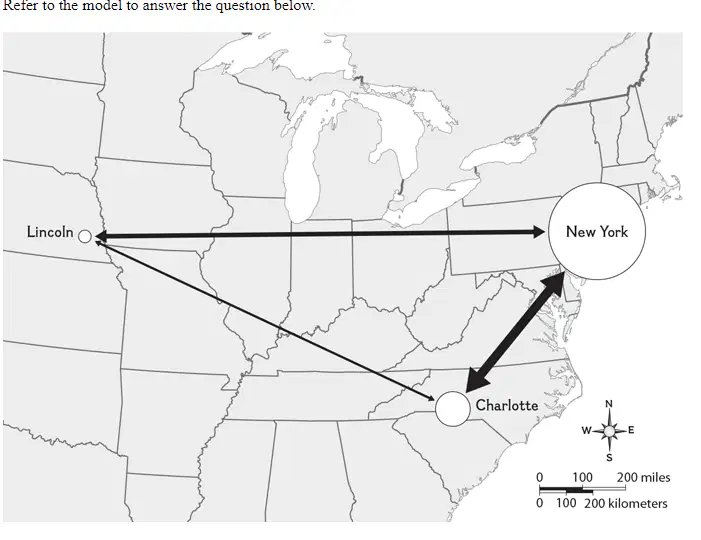
countries serve as independent entities in which cities compete for prominence
c)
the interactions between two cities depends on ethnic and cultural similarities
d)
the interactions between two cities depends on their size
e)
countries have one large city that serves as its economic and cultural hub
25.

What is the primary purpose of urban planning?

a)

To ensure sustainable development and use of land within urban areas

b)

To increase the population density of cities

c)

To decrease the reliance on public transportation

d)

To promote the growth of suburban areas

e)

To reduce the economic activities within city centers

26.

Which of the following best describes the concept of a 'green belt' in urban planning?

a)

A zone dedicated to industrial development

b)

An area reserved for the construction of residential buildings

c)

A ring of land maintained as parks, agriculture, or other types of open space to limit the sprawl of an urban area

d)

A district within a city designated exclusively for the growth of technology companies

e)

A pathway designed to facilitate the movement of wildlife across urban areas

27.
This is the rapid, often poorly planned spread of development from an urban area outward into rural areas
a)
urban sprawl
b)
metropolitan area
c)
rural fringe
d)
whooping cough
28.
Increasing public transit is one way to get people in a metropolitan area to drive less. What is public transit?
a)
A network of buses, trains, and other vehicles used for moving passengers.
b)
not allowing people to build developments on farmland
c)
replacing an abandoned factory with a new apartment building
d)
when all the 7th graders get in Ms. Dodor's beetle and go to Taco Bell
29.

An area of housing built on the edge of a city...

a)

suburb

b)

mixed-use development

c)

urban core

d)

mass transit

30.

A major city and the surrounding suburbs are often referred to as a ...

a)

metropolitan area

b)

urban core

c)

rural

d)

infill

31.

The concept of filling in empty spaces in a city or redesigning old buildings is called...

a)

infill

b)

mixed-use development

c)

urban sprawl

d)

public transit