
 Worksheets
YEAR 10 EASTER TERM ECONOMICS REVISION BOOK 2024
Total questions: 120
Worksheet time: 3600secs

At which phase in the Demographic Transition model is the most population growth occurring?
Stage 1
Stage 2
Stage 4
Stage 5
Overpopulation occurs when
a population exceeds its carrying capacity
a population is less than its carrying capacity
According to the theory of demographic transition, how many different phases of population growth a country has to pass through?
Two
Three
Four
Five
The stage-2 of the theory of demographic transition is indicative of
High birth rate and high death rate
High birth rate and low death rate
Low birth rate and high death rate
Low birth rate and low death rate
The stage-1 of the theory of demographic transition is indicative of
High birth rate and high death rate
High birth rate and low death rate
Low birth rate and high death rate
Low birth rate and low death rate
The stage-3 of the theory of demographic transition is indicative of
High birth rate and high death rate
High birth rate and low death rate
Low birth rate and high death rate
Low birth rate and low death rate
At present Nigeria is passing through which stage of the theory of demographic transition?
First stage
Second stage
Third stage
Fifth stage
Theory of demographic transition is given by....
Malthus
Coale and Hoover
Smith
Ricardo
Population Explosion occurs in _____ stage of the theory of Demographic Transition.
First stage
Second stage
Third stage
Fifth stage
As per Theory of Demographic Transition, in the first stage, Birth rate is high due to.....
illiteracy
Wide-spread Poverty
Superstition/ Beliefs
All of the above
As per Theory of Demographic Transition, in the first stage, Death rate is high due to.....
Malnutrition
Poor medical facilities
Lack of hygiene
All of the above
As per the Theory of Demographic Transition, in the First Stage, population growth rate is .......
Very high
Very low
remains stable
Nothing can be said
As per the Theory of Demographic Transition, in the Second Stage, population growth rate is .......
Very high
Very low
remains stable
Nothing can be said
The NATURAL INCREASE
Is the number of people living in an area
Is the number of people who died in a year
is the difference between the people who were born and who died
Is the difference between the people who can drive and the people who can't
POPULATION...
Is the number of people watching TV
Is the number of people that can drive
Is the number of people living in an area
Is the number of people who died in a year
A CENSUS is used for...
Count the animals living in a place
Count the people that can swim
Count the people living in an area
Collect information abouf kids
A POPULATION PYRAMID tells us...
How population change over time
How population grows every year
How population moves
How population decreases
The number of deaths compared to the total number of people in a population
death rate
doubling time
population decline
birth rate

1. In Malthus’ 1798 book suggests there are diminishing returns to and a fixed amount of land. It follows in his argument that growing populations will eventually _____________________________. *
shrink as the land will not produce enough food to support the population’s needs
grow further as people switch from farming to fishing in oceans
stagnate

2. In general, the predictions of the Malthusian model have shown to be ___________________ during recent history.
100% true
relevant to a certain extent, particularly for less economically developed countries
relevant to only more economically developed countries
100% incorrect
The largest number of individuals of a population that the environment can support is known as...
carrying capacity
population crash
lag phase
mutualism
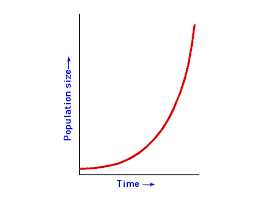

Why was Malthus's theory deemed 'a failure' by critics?
He didn't think about it enough
He failed to look at technological advances
He didn't have the materials to continue his studies
He couldn't prove it
What is Malthus book called?

A large increase in crop production in developing countries achieved by the use of fertilizers, pesticides, and high-yield crop varieties.
Green Revolution
Blue Revolution
Sustainable Development
Malthusian Theory
Which of the following is the term for people moving into a new country?
Immigration
Emigration
Urbanization

Based upon the population pyramid, which of the following statements is true?
Most of their population is older
Their population is growing
There are many more boys in this country than girls
What problem is NOT caused by high population density?
Limited resources
More space
Unemployment rises
Malthusian Theory claims that
population grows arithmetically while food supply grows geometrically
population grows geometrically while food supply grows arithmetically
population and food supply grow at the same route
populations will adapt and find new food sources
Population density is defined as
the number of people that can be supported with a given number of resources
the number of resources a population can produce
the amount of people in a given area
the pattern of people laid out in a given area
Population distribution is defined as
the number of people that can be supported with a given number of resources
the number of resources a population can produce
the amount of people in a given area
the pattern of people laid out in a given area
What did Malthus' theory propose?
Population growth would lead to famine and societal collapse
Improved agricultural practices would lead to famine and societal collapse
Technological advancements would lead to famine and societal collapse
Population growth is not a direct threat to global food security
What theory proposed in 1798 suggests that population growth will outpace resources?
Darwin's Theory of Evolution
Newton's Laws of Motion
Einstein's Theory of Relativity
Malthus' Theory
What theory proposed by Thomas Malthus in 1798 states that population growth will outpace the availability of resources?
The Principle of Population
Malthusian Catastrophe
Controversial Theory
Resource Management Theory
What is a pressing issue that impacts food supply?
Climate change
Technological advancements
Population growth
Economic instability

What is population?
The number of people who live in a particular area.
The number of babies that born in a particular area.
The number of people that die in a particular area.
The number of immigrants that live in a particular area.

Why does the population of a country change?
Because of its birth rate.
Because of its death rate.
Because of its migration
All are correct.

What is birth rate?
The number of babies born in a specific place during a specific time.
The number od people who died in a specific place during a specific time.
The number of people that comes to a country.
The number of people that leaves a country.
What is death rate?
The number of babies born in a specific place during a specific time.
The number of people who died in a specific place during a specific time.
The number of people that comes to a country.
The number of people that leaves a country.
What is immigration?
The number of babies born in a specific place during a specific time.
The number of people who died in a specific place during a specific time.
The number of people that arrives to a country.
The number of people that leaves a country.
What is emigration?
The number of babies born in a specific place during a specific time.
The number of people who died in a specific place during a specific time.
The number of people that arrives to a country.
The number of people that leaves a country.

Immigration and birth rate helps to...
Increase population
Decrease population
Emigration and death rate helps to...
Increase population
Decrease population

What is population density?
The number of inhabitants per square kilometre.
The number of people that live in a specific area.

People tent to live in places where...
There is a good climate.
There are job opportunities.
There are good services
All are correct
One reason the world is growing so quickly is because...
The world has infinite resources for everyone
Birth rate is higher than death rate
There are more and more places for people to live
Death rate is higher than birth rate
What is the world's most populous country?
India
China
U.S.
Mexico
The approximate population of the world today is..
7.6 Million
6.7 Billion
6.7 Million
7.6 Billion
Birth Rate + Migration - Death Rate =
population growth
population density
Population divided by Area =
population density
population growth
It is an organization which is formed voluntarily by a group of people to conduct economic activities that are beneficial and respond to the need and aim of it's members.
Market
Cooperatives
Economy
Sufficiency
Cooperatives are involuntarily organization to all people.
TRUE
FALSE
Cooperatives has certain objectives in managing business which is to help its members.
TRUE
FALSE
Cooperatives is managed by democratic principles.
TRUE
FALSE
The cooperative society that performs a combination of the functions of other types of cooperative societies is called
consumer cooperative
multipurpose cooperative
producer cooperative
thrift and credit cooperative
Computer manufactures in a area could form
producer association
chamber of commerce
costumer association
credit and drift
Which of the following relies on government for its initial capital
co=operative society
public corporation
private limited company
public limited company
Which of the following is NOT an important reason for government ownership of industries?
provision of essential services
making high profits
avoiding duplication of services
preventing private monopoly
Main objective of cooperative society is
make profit
collect interest
none
Which of the following is not a feature of a cooperative society?
Separate legal status
Profit share on patronage
No government control
Voluntary association
All the members of cooperative society have ____________ interest
Different
Verse
none
Which of the following is the feature/s of a cooperative society?
Open membership
limited liability
State control
Profit motive
Public Sector Enterprises are owned by ?
State Government
Central Government
Both of these
None of these
Select the appropriate examples for Public Corporations.
Broadcasting
Central Bank
Nigeria Railway Corporation
Nigeria Port Authority
Government companies are managed by ?
State Government
Board of Directors
Ministers
Central Government
Select the appropriate features for public enterprise.
Private owners
perpetual succession
to make profit
not to make profit
owned and control by the covernment
Public corporation is set up by the Act of parliament
True
False
What does PLC stand for?
Public Limited Company
Profit/Liability Curve
Princesses Like Crowns
Probably Locking Cages
What is the simple difference between a public and private limited company?
A public limited company is public and a private limited company is private.
There are no differences.
The public limited company can quote shares in a stock exchange while a private limited company cannot.
One does not deal with shares while the other does.
What is are some characteristics of a public limited company?
A name, unlimited liabilities, perpetual succession
A name, limited liabilities, perpetual succession
A single person, shares, advertisements
A song, a dance, a clown
What are some documents required for the formation of a public limited company?
Article and memorandum of association.
A car.
An already established business.
A private jet.
What are the main managers/owners of a public limited company called?
Owners and managers
Bosses and mentors
Directors and shareholders
Principals and boards
What is one advantage of a public limited company?
They get free food.
They can tell private limited companies what to do.
They can buy an unlimited amount of vehicles.
Shares are easily transferable.
What is one disadvantage of a public limited company?
Stock market vulnerabilty
Limited liabilities.
They cannot buy cars.
They cannot buy shares.
What does PLC stand for?
(a)
What are the owners of private and public limited companies called?
Stakeholders
Managers
Board of directors
Shareholders
What does PLC stand for?
(a)
How many people own a sole trader business?
3
2
1
20
A sole trader is
a business with one employee
a business selling one product
a business with one owner
a business with one shop/office
What is unlimited liability?
A sole trader has responsibility for
preparing the accounts of the business
all aspects of their business
selling the products
completing spreadsheets
A sole proprietor has to share the profits the business makes. True or False?
Select TWO true statements that relate to a sole trader.
Sole traders have limited liability
Sole traders get to make all their own decisions about the business
Sole traders may find it harder to raise funds for the business
Sole traders usually get more holidays than partners or directors
Which type of business has the most trouble getting financing?
Sole Trader
Partnership
Both
Neither
Unlimited Liability is?
Sole traders have unlimited liability.
TRUE
FALSE
What are 3 of the benefits of being a sole trader?
Easy to establish
Keep all the profit
Get to make all the decisions
Unlimited liability
Decision is taken in partnership firm
Individually
By the partner who has invested more money
By anyone
Mutually ( all partners together)
A _______________ partner is one does not take part in the day to day running of the business.
Active
Sleeping
Secret
Nominal
Seema and Beena partnered together to provide food and clothing to the needy by collecting it from the neighbourhood. Can this be called a partnership firm
Yes
No
Maybe
None of the above
What is the partnership written agreement known as?
Partnership Contract
Partnership Act
Agreement
Partnership Deed
Which is not a feature of a partnership business?
Easy Formation
Mutual Agency
Limited Liability
Two or more person
Which is not a feature of a partnership business?
Easy Formation
Mutual Agency
Limited Liability
Two or more person
To start a partnership business, what should be the minimum number of partners?
2
10
4
20
What is the general definition of a partnership in business?
A partnership is a type of corporation
A legal relationship between two or more individuals who share the profits and liabilities of the business.
A business owned and operated by a single individual
A type of business structure that is not recognized by law
What is the general definition of a partnership in business?
A partnership is a type of corporation
A legal relationship between two or more individuals who share the profits and liabilities of the business.
A business owned and operated by a single individual
A type of business structure that is not recognized by law
No paperwork (charter or agreement) is required to start which type of business?
Partnership
Franchise
Sole Proprietorship
Corporation
Which type of business allows the owner to keep all of the profit for him/herself?
Partnership
Franchise
Sole Proprietorship
Corporation
Which business depends on just one person for the skills and talents to run the business?
Sole Proprietorship
Partnership
Corporation
Franchise

