
NEW
Font size
 Worksheets
IA - Aero Propulsion
Total questions: 12
Worksheet time: 6mins
Following combustion, the working fluid in a turbojet enters a:
compressor
turbine
condenser
boiler

What is the name of the section labeled 3?
Combustor
Compressor
Fan
Turbine
Which of the following is most efficient at high speeds?
Turbo-prop
Low by-pass turbofan
High by-pass turbofan
Pure turbojet

What type of engine is pictured?
Internal Combustion
Turbojet
Turbofan
Turboprop

What is the purpose of an afterburner?
to increase thrust
to increase efficiency
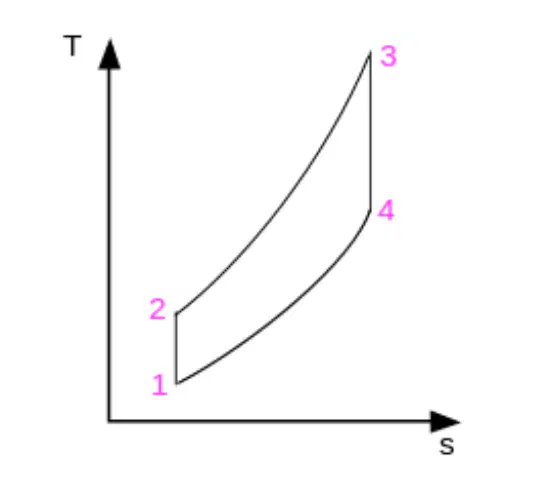
Which process is represented by 1-2 in the Brayton cycle diagram?
isobaric compression
isothermal compression
isentropic compression
isochoric compression
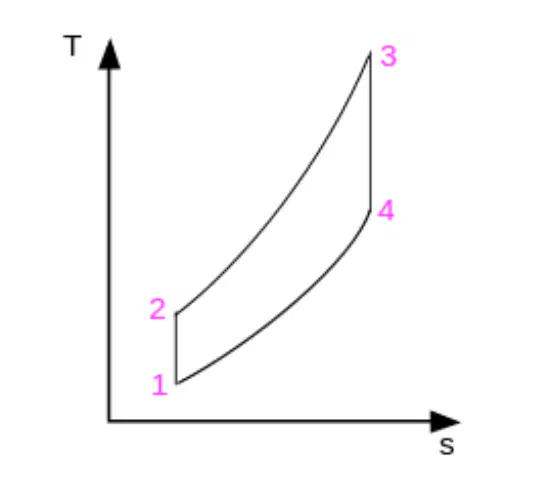
Which processes shown in the Brayton cycle diagram are isobaric?
2-3 and 4-1
1-2 and 2-3
3-4 and 4-1
1-2 and 3-4
A gas turbine engine has a pressure ratio of 26. Assuming the engine cycle can be represented by the air-standard Brayton cycle, what will be the cycle efficiency?
26%
60.6%
0.6%
74%
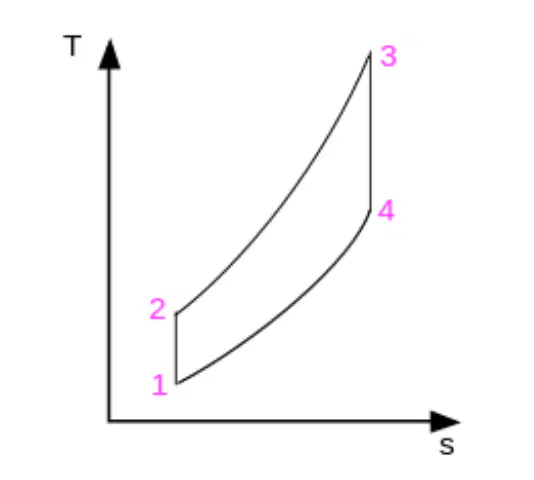
The Brayton cycle diagram shown represents which gas turbine hardware?
1-2: combustion, 2-3: compressor, 3-4: exhaust, 4-1: turbine
1-2: turbine, 2-3: exhaust, 3-4: compressor, 4-1: combustion
1-2: exhaust, 2-3: compressor, 3-4: combustion, 4-1: turbine
1-2: compressor, 2-3: combustion, 3-4: turbine, 4-1: exhaust
Turboprops are most efficient in:
High speed, high altitude operations.
Low speed, low altitude operations.
For a thermodynamically ideal turbo-jet, the combustion process can be considered:
adiabatic
isentropic
isothermal
isobaric
For a thermodynamically ideal turbo-jet, the process that occurs through the outlet nozzle is:
isentropic compression
isothermal compression
isentropic expansion
isothermal expansion

