
NEW
Font size
 Worksheets
8202L3HWPPT7Q2
Total questions: 39
Worksheet time: 20mins
What must the pressure in the system be in relation to the resistance offered by the fitting for the system to flow?
Less than the resistance
Equal to the resistance
Greater than the resistance
Not related to the resistance
What is the equivalent of 1 bar in kPa according to the plumbing material document?
10 kPa
100 kPa
1000 kPa
1 kPa
What is the purpose of cold water storage cisterns in domestic properties?
To heat water for domestic use
To assist in the delivery of cold water to appliances at low pressure
To store hot water for domestic use
To generate water pressure for appliances
Why are cold water storage cisterns (CWSC) no longer required with the introduction of certain systems?
Because of the introduction of solar water heating systems
Due to the introduction of electrical water heating systems
With the introduction of combination boilers and unvented hot water systems (high pressure)
After the implementation of water conservation regulations
Where do traditional designs store cold water in a plumbing system?
In the basement
In the loft area in a cistern
Outside the building
In the kitchen
What is the purpose of using head pressure in traditional plumbing designs?
To heat the water
To distribute hot water through the house
To distribute cold water through the hot water cylinder via a cold feed
To reduce water usage
According to BS 6700, what is the recommended minimum storage of cold water for indirect systems that supply both cold and hot water outlets?
115L
230L
150L
200L
If a cistern is only supplying either the hot or the cold water outlets, what can the minimum storage be reduced to?
115L
230L
150L
200L
What has been changing over recent years in plumbing systems?
The increase in the use of traditional cisterns
The preference for systems that require more stored water
The use of combination boilers and unvented systems that do not require stored water
The requirement for larger cisterns
What is the primary use of bronze pumps in hot water systems?
They are used to increase water pressure.
They are used for secondary hot water circulation.
They are used to purify water.
They are used to heat the water.
Why are bronze pumps preferred for use with potable supplies?
Because they are cheaper than other materials.
Because they have a longer lifespan.
Because they do not corrode when in contact with oxygenated water.
Because they can increase the temperature of the water.
What is the purpose of installing bronze pumps via a secondary circulation return system in a large building?
To reduce the water usage in the building.
To filter the water more effectively.
To overcome a dead leg and provide an even distribution to all outlets.
To generate electricity for the building.
Which other type of pump can be used on cold water supplies according to the note?
Copper pumps
Iron pumps
Stainless steel pumps
Plastic pumps
What is the purpose of secondary hot water circulation pumps in a typical hot water installation?
To increase water pressure at the main inlet
To allow the circuit of hot water to be much closer to the outlet point
To cool down the hot water before it reaches the outlet
To filter impurities from the hot water
What type of valve is recommended for use in the secondary return 1/4 of way down cylinder?
Check valve
Pressure relief valve
22mm or 28mm full-way gate valve or lever type spherical ball valve
Thermostatic mixing valve
Where is the secondary return connection located in a typical hot water installation?
At the main water inlet
At the lowest point of the installation
At all appliances
Near the water heater
What is the purpose of single and twin impeller pumps in a plumbing system?
To decrease the water pressure and supply
To boost the water pressure and supply within a system
To measure the water pressure and supply within a system
To filter the water in a plumbing system
What does a twin impeller pump boost in a plumbing system?
Only hot water
Only cold water
Both hot and cold water
Neither hot nor cold water
What does a single impeller pump boost in a plumbing system?
Only hot water
Only cold water
Both hot and cold water
Either the hot, cold or blended water
Why is an understanding of both positive and negative head situations important for sizing pumps?
It is necessary for the maintenance of the pump
It is required for the installation process only
It is fundamental knowledge for the system the pump will be fitted to
It is not important for sizing pumps
Why should the connection feed to the cylinder be higher than the cold water so that the hot water runs out first?
To ensure the cold water is used first
To prevent air bubbles from forming in the pipes
To make sure the hot water runs out first for efficiency
To prevent the mixing of hot and cold water
What is the purpose of making the connection at 30-60° to the cylinder?
To allow the air to be expelled through the open vent pipe
To increase water pressure to the shower pump
To create a direct connection to the cylinder
To prevent the hot water from running out first
What could happen if air was allowed to get into the shower pump?
The pump would operate more efficiently
The pump would become quieter
The pump would fail due to air getting trapped around the impeller
The pump would increase the water temperature
What is an alternative connection direct to the cylinder using an Essex flange?
A connection to increase water flow
A connection to decrease water temperature
A connection to prevent air from entering the pump
A connection to mix hot and cold water
What is the purpose of using a twin impeller booster pump in plumbing?
To decrease water pressure for both hot and cold feed.
To increase water pressure for both hot and cold feed.
To measure the water flow in the pipes.
To filter impurities from the water.
What is the function of an Essex flange in the context of a twin impeller pump installation?
To regulate the temperature of the water.
To measure the amount of water passing through.
To avoid any ingress of air.
To change the direction of water flow.
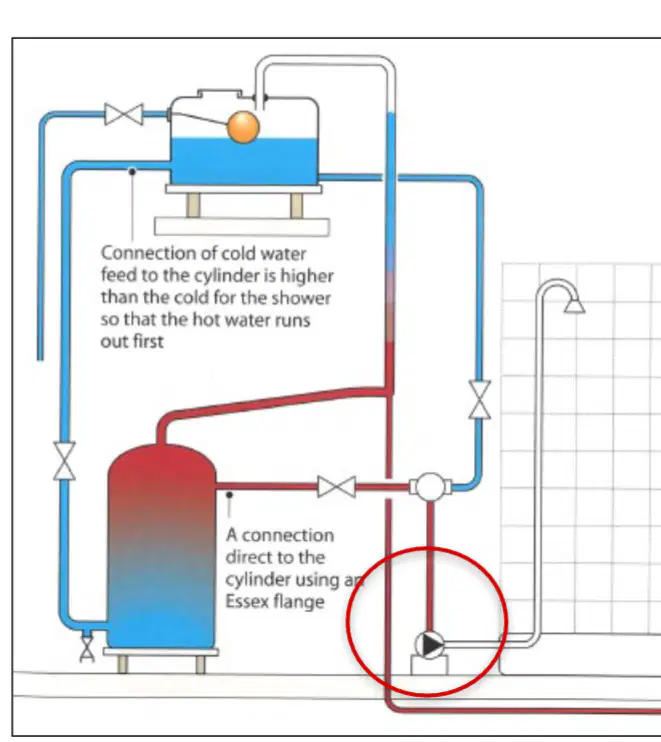
What is the purpose of the pump in the diagram
To ensure that cold water is heated first before hot water
To provide a direct connection for cold water to the shower
To pump blended water
To regulate the water pressure to the shower
Where can a single impeller booster pump be used in relation to the mixer valve?
Before the mixer valve
After the mixer valve
Instead of the mixer valve
Not related to the mixer valve
What does a single impeller booster pump do to the water pressure?
Decreases the water pressure
Maintains the water pressure
Boosts the water pressure
Filters the water
Which type of shower heads is a single impeller booster pump commonly used on?
'Deluge' or 'drench-type' shower heads
'Rainfall' shower heads
'Handheld' shower heads
'Fixed' shower heads
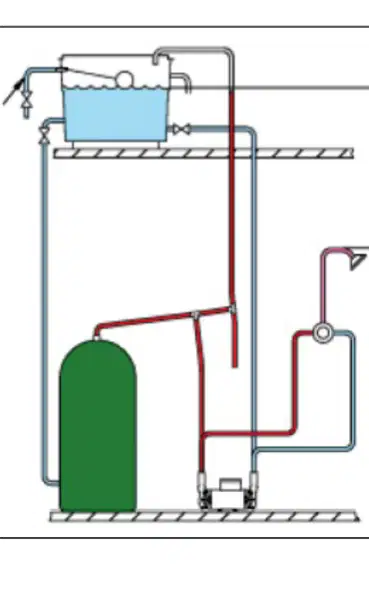
What type of head is operated by a flow switch under natural flow of water?
Negative head
Neutral head
Positive head
Static head
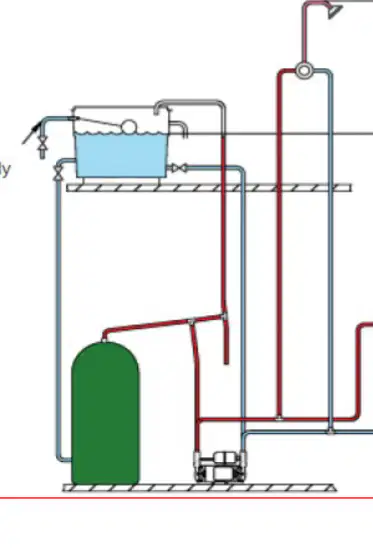
What type of head is operated by a flow switch under a 'charge'?
Positive head
Neutral head
Negative head
Dynamic head
What is positive head in pump sizing?
When the pump is pulling water from a tank that is below the pump
When the pump is pumping water to a level that is above the existing CWSC
When the pump is pumping water to a level that is below the existing CWSC
When the pump is pumping water from the base of a tank to a lower level
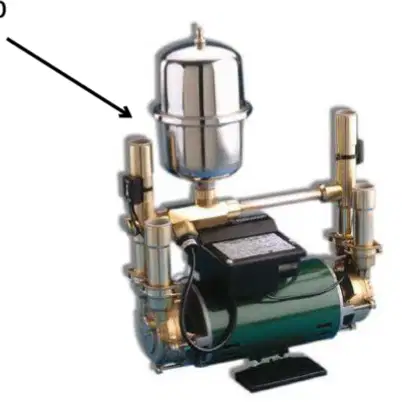
Identify the type of pump shown on the right side of the image.
Negative head pump
Positive head pump
Submersible pump
Centrifugal pump

Identify the type of pump shown on the left side of the image.
Negative head pump
Positive head pump
Submersible pump
Centrifugal pump
What is another name for a positive head pump?
Centrifugal pump
Regenerative pump
Submersible pump
Turbine pump
What is required to activate a positive head pump?
An electrical outlet
A natural head or flow of water
A battery
Manual cranking
How is the pump activated in a positive head pump system?
By a pressure sensor
By a magnetic flow switch
By a timer
By a temperature gauge
What happens if the flow rate is not great enough in a positive head pump system?
The pump will overheat.
The pump will activate a reed switch.
A negative head pump will have to be used.
The pump will automatically shut off.

