
Font size
 Worksheets
Psychology
Total questions: 56
Worksheet time: 31mins
According to the biological approach, what may be a fundamental cause of dysfunctional behaviour?
Social learning
Genetic cause
Classical conditioning
Stressful life events
The nature of dysfunctional behaviour according to the psychodyanmic perspective may be caused by?
It is a result of unresolved conflict between the id and superego
It is solely based on operant conditioning
It is always caused by traumatic childhood experiences
It is a consequence of internal processing of information like a computer
What metaphor is employed to illustrate the complexity of human psychology and its issues?
A river's unpredictable flow
A garden with both weeds and flowers
A computer's software glitch
An intricate maze with multiple exits
According to a behaviourist theory. which dysfunctional behaviour is learnt?
Genetic inheritance
Operant conditioning
Information processing
Environmental triggers
How may stressful environments influence individual behaviour?
By directly modifying an individual's genetic structure
Through the development of coping mechanisms that may be maladaptive
By enhancing cognitive functions to better deal with stress
By reducing the impact of genetic predispositions on behavior
What does the Biological perspective suggest as a primary factor influencing psychological disorders?
Environmental influences
Imbalances in neurotransmitter levels
Psychoanalytic conflicts
Cultural factors
What does the Psychodynamic perspective suggest is a cause of dysfunctional behaviour?
Classical conditioning
Genetic causes
Psychological factors, such as traumatic childhood experiences
The environment and individual response to it
According to the Behaviourist perspective, how is dysfunctional behaviour acquired?
Through genetic inheritance
By internal processing of information
As a result of psychological factors
Through learning and conditioning
What does the Humanistic perspective emphasize as a trigger for dysfunctional behaviour?
Information processing issues
Environmental factors and individual responses
Operant conditioning
Genetic factors
What does the Biological approach in psychology provide explanations for?
Only genetic behaviors
Only neurochemical processes
Only evolutionary aspects of behavior
All aspects of psychological functioning and human behavior
Which of the following are proponents of the Biological approach particularly interested in?
Astrology and human behavior
Economics and financial decision-making
Genetics, Neurochemistry, Brain structure, and Evolutionary factors
Political science and public policy
How might damage to certain parts of the brain affect an individual according to the Biological approach?
It has no significant impact.
It could influence psychological functioning.
It improves cognitive abilities.
It only affects physical health.
What aspect of human behavior does the Biological approach's evolutionary perspective focus on?
Historical analysis of human societies
Adaptive behaviors for mate selection and survival
Technological advancements
Artistic expression
Characteristics that are inherited from generation to the next are known as what?
Acquired traits
Environmental factors
Genetic instructions
Psychological characteristics
What is the debate called that discusses the extent to which a psychological characteristic is determined by genes or environment?
The nature-nurture debate
The genetic-environmental debate
The characteristic development debate
The heredity debate
What is the term used to describe the genetic code that is 'written' in the DNA of individual cells?
Phenotype
Genotype
Chromotype
Allele
What term refers to the physical appearance that results from inherited genetic information?
Genotype
Chromotype
Phenotype
Allele
What is the term used to describe the genetic code that is 'written' in the DNA of individual cells?
Phenotype
Chromosome
Genotype
Allele
What term refers to the physical appearance that results from inherited genetic information?
Genotype
Phenotype
Gene expression
Genetic trait
Can the genotype of an individual be determined solely by observing their phenotype?
Yes, always
No, because the phenotype may not express all the genes present
Yes, but only in some cases
No, because the phenotype is not related to genetics
If someone has brown eyes (a dominant trait) but also carries a gene for blue eyes (a recessive trait), what can be said about their phenotype and genotype?
What percentage of genes do monozygotic twins share?
25%
50%
75%
100%
What is the term used to describe the probability that a pair of individuals will both have a certain characteristic, given that one of the pair has the characteristic?
Genetic likelihood
Hereditary probability
Concordance rate
Twin similarity
How much of their genes do dizygotic twins typically share?
25%
50%
75%
100%
What do twin studies offer researchers the opportunity to investigate?
The effectiveness of educational programs
The relative contributions of genetic and environmental influences
The impact of diet on intelligence
The influence of peers on personality development
According to Gottesman (1991), what is the concordance rate for schizophrenia in MZ twins?
About 17%
About 48%
About 40.4%
About 7.4%
What is the concordance rate for schizophrenia in DZ twins as suggested by Gottesman (1991)?
About 17%
About 48%
About 40.4%
About 7.4%
According to Joseph (2004), what is the concordance rate for schizophrenia in MZ twins?
About 17%
About 48%
About 40.4%
About 7.4%
According to Joseph (2004), what is the concordance rate for schizophrenia in DZ twins?
About 17%
About 48%
About 40.4%
About 7.4%
What do twin studies suggest about the genetic component of schizophrenia?
There is no genetic component to schizophrenia.
There is a moderate genetic component to schizophrenia.
There is a strong genetic component to schizophrenia.
Twin studies are inconclusive about the genetic component of schizophrenia.
Why can't schizophrenia be accounted for by genetics alone according to twin studies?
Because the concordance rate for twins is 100%.
Because the concordance rate for twins is not 100%.
Because MZ twins have less environmental similarity than DZ twins.
Because DZ twins have a higher concordance rate than MZ twins.
What could explain the higher concordance between MZ twins compared to DZ twins?
MZ twins have less genetic similarity than DZ twins.
MZ twins have less environmental similarity than DZ twins.
Greater environmental similarity rather than genetic similarity.
DZ twins elicit more similar treatment than MZ twins.
What is a limitation of twin studies mentioned in the material?
They have large sample sizes.
They always provide reliable findings.
They have very small sample sizes and findings may not be reliable.
They only use MZ twins for the studies.
According to Gottesman's studies, what is the chance of a child developing schizophrenia if both parents suffer from the disorder?
1%
46%
10%
25%
What has been shown to increase the risk of developing schizophrenia?
Greater financial wealth
Greater educational attainment
Greater degree of genetic relatedness
Greater social status
What does current research suggest about the causes of schizophrenia in family studies?
Genes are the only factor in developing schizophrenia.
Environmental factors and rearing patterns play no role in the development of schizophrenia.
Schizophrenia concordance rates in families may have more to do with environmental factors than heredity.
If genes were the only cause of schizophrenia, the concordance rates would be less than 100%.
According to the text, what would the concordance rates for schizophrenia be if genes were the sole cause?
Less than 100%
Exactly 50%
Exactly 100%
The text does not specify a percentage.
How is the theory that we are predisposed to certain disorders by our genes viewed?
As a deterministic theory that guarantees the development of the disorder.
As a suggestion that genes have no influence on the development of disorders.
As an indication that predisposition by genes ensures a 50% chance of developing the disorder.
As a non-deterministic theory that does not necessarily result in the development of the disorder.
What are adoption studies in the context of genetics?
Studies that focus on the adoption process and its psychological effects
Studies of genetically related individuals who have been reared apart due to being adopted
Studies that compare the genetics of adoptive parents to their adopted children
Research on the long-term health outcomes of adopted individuals
According to Tienari (2000), what percentage of the adoptees whose biological mothers had been diagnosed with schizophrenia also received a diagnosis of schizophrenia?
2%
6.7%
10%
15%
What was the percentage of control adoptees who received a diagnosis of schizophrenia in Tienari's study?
2%
6.7%
10%
15%
The study by Tienari (2000) was conducted in which country?
Sweden
Finland
Norway
Denmark
What type of cells does the nervous system use to carry messages from one part of the body to another?
Neurons
Glial cells
Red blood cells
Muscle cells
Which two main systems comprise the human nervous system?
Central Nervous System and Peripheral Nervous System
Somatic Nervous System and Autonomic Nervous System
Endocrine System and Lymphatic System
Cardiovascular System and Digestive System
What are the two components of the Central Nervous System (CNS)?
Brain and Spinal Cord
Heart and Brain
Lungs and Liver
Kidneys and Pancreas
Which aspects of human behaviour are under neural control according to the learning material?
Decision making and problem solving
Breathing and eating
Running and jumping
Sleeping and dreaming
What are the two subdivisions of the Peripheral Nervous System (PNS)?
Central and Peripheral NS
Somatic and Autonomic NS
Sympathetic and Parasympathetic NS
Brain and Spinal Cord
What is the largest part of the brain?
Cerebellum
Brainstem
Cerebrum
Cortex
What percentage of the brain's total mass does the cerebrum constitute?
50%
75%
85%
95%
What is the outer surface of the cerebellum known as?
Cerebral hemisphere
Cerebral cortex
Brainstem
Cerebral lobe
How many hemispheres is the cerebrum divided into?
2
3
4
5
Into how many parts is each hemisphere of the cerebrum divided?
2
3
4
5
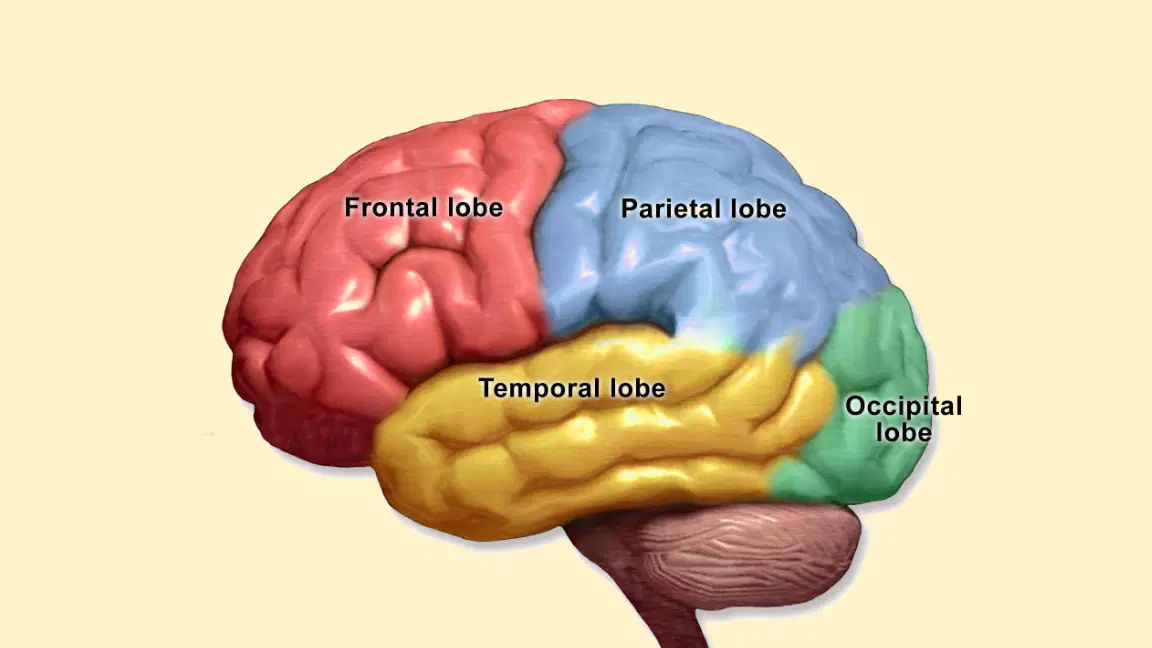
Which lobe of the brain is responsible for processing visual information?
Frontal lobe
Parietal lobe
Temporal lobe
Occipital lobe
Which lobe of the brain is located at the front and is associated with reasoning, motor skills, higher level cognition, and expressive language?
Frontal lobe
Parietal lobe
Temporal lobe
Occipital lobe
Which lobe of the brain is involved in the perception and interpretation of sounds and language?
Frontal lobe
Parietal lobe
Temporal lobe
Occipital lobe
Which lobe of the brain is associated with processing tactile sensory information such as pressure, touch, and pain?
Frontal lobe
Parietal lobe
Temporal lobe
Occipital lobe

