
NEW
Font size
 Worksheets
6035DRPPT4Q2
Total questions: 28
Worksheet time: 1hrs 24mins
What is a spigot trap primarily used for?
To filter drinking water
To connect a washing machine or dishwasher to the plumbing system
To heat water for a sink
To measure water usage

What is this?
P trap
Strap
P trap with spigot
S trap with spigot

What is this?
In line trap
self sealing valve
Slim line trap
Easy trap
Where is a spigot trap commonly located?
Above a sink
In the attic
Below a sink
Outside the house
What is the allowed depth of seal for bath traps designed for the restricted area under a fitted bath?
38mm
50mm
25mm
45mm
If a bath is discharging to a hopper or gulley trap, what is the allowed trap seal depth?
50mm
38mm
45mm
25mm
Why are bottle traps not suited for use under a sink?
Because they are too large.
Because they are not visually appealing.
Too easily blocked
Because they are too expensive.
Where are chrome finish bottle traps sometimes installed?
Underneath sinks with hidden pipes
Where there are exposed waste pipes
Inside walls for better insulation
In outdoor settings for durability
On what principle do shower traps operate?
A) A unique principle different from all other traps
B) Similar principle to bottle traps
C) Similar principle to grease traps
D) No specific principle
What is the depth of seal provided by shower traps?
A) 20mm
B) 30mm
C) 50mm
D) 100mm
How is access for cleaning provided in shower traps?
A) Via a fixed waste grill
B) Via a removable waste grill
C) Via a trap door
D) No access for cleaning is provided
What is the purpose of using anti-vac or resealing traps?
To increase water flow in the system
To alleviate the problem of trap seal loss due to siphonage
To reduce the cost of plumbing installations
To hold during an air test
When should a standard trap be used instead of an anti-vac trap?
When the system is not designed correctly
When there is a high risk of trap seal loss
When the system has been designed and installed correctly, and there is no problem with trap seal loss
When additional appliances are added to the system
Why are anti-vac traps not advised on new installations?
They are too expensive
They do not alleviate the problem of trap seal loss
They may not hold during an air test
They are difficult to install

What is the purpose of the small air admittance valve located on the body of the traps shown in the image?
To regulate the flow of waste water
To allow a small amount of air into the waste pipe under negative pressure to avoid siphonage
To filter out debris from the waste water
To provide a visual indication of the waste water level
What is avoided by the design of resealing traps?
Positive pressure.
The need for additional sealant.
Negative pressure and siphonage.
The need for regular maintenance.
What does a self-sealing waterless valve use to create an airtight seal?
A layer of water
A thin neoprene rubber tube
A plastic membrane
A metal clamp
What is the purpose of the airtight seal created by the self-sealing waterless valve?
To regulate water flow
To measure water pressure
To stop the noxious smell entering the property
To filter impurities from water
How does the membrane of a self-sealing waterless valve function?
It opens under the flow of water and remains open
It closes as soon as water starts flowing
It opens under the flow of water from the appliance and closes after the discharge has finished
It does not open or close during the flow of water
What problem does the self-sealing waterless valve remove?
The problem of high water pressure
The problem of negative pressure
The problem of water leakage
The problem of loud noise
What does the absence of a water seal in a self-sealing waterless valve prevent?
Possible leakage
Possible siphonage
Possible blockage
Possible corrosion
What is a benefit of the self-sealing waterless valve in terms of noise?
It creates a high-pitched noise
It operates with a rhythmic tapping
It operates silently
It reduces noise only during high flow
Can additional appliances be installed on the same discharge branch as the self-sealing waterless valve without affecting performance?
Yes, but only with a water seal
No, it will always affect performance
Yes, but only one additional appliance
Yes, additional appliances can be installed without affecting performance
What aspect of pipework is no longer restricted by using a self-sealing waterless valve?
Pipework material
Pipework length
Pipework diameter
Pipework color
Is the gradient restricted when using a self-sealing waterless valve?
Yes, it is strictly regulated
No, but it requires special fittings
Yes, it must be at a 45-degree angle
No, the gradient is not restricted
What is the name of the valve shown in the image that does not require water to seal?
Gravity-based valve
Self-sealing waterless valve
Pressure-seal valve
Manual shut-off valve

What is the diameter of the main waste pipe when using self-sealing waterless valves according to the diagram?
50mm
40mm
32mm
25mm
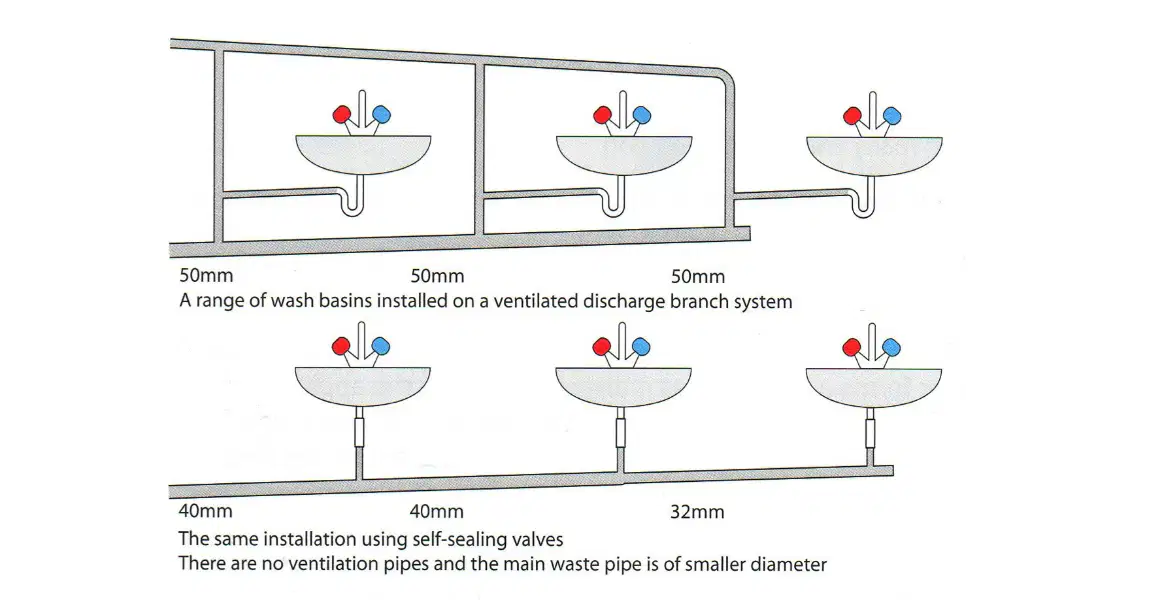
What is the diameter of the ventilation pipes in the installation using self-sealing valves as shown in the diagram?
50mm
40mm
32mm
There are no ventilation pipes

