
NEW
Font size
 Worksheets
Continuous Improvement Quiz
Total questions: 38
Worksheet time: 19mins
What is the meaning of continuous improvement?
A) A one-time initiative to improve processes
B) A process that is improved yearly
C) The ongoing effort to improve products, services, or processes
D) A strategy to improve employee performance
What are the benefits of applying continuous improvement techniques?
A) Decreased efficiency and productivity
B) Increased costs and time consumption
C) Improved processes and competitive advantage
D) Reduced innovation and adaptability
Which cycle defines each stage of continuous improvement?
A) Research – Develop – Analyze – Implement
B) Plan – Do – Check – Act
C) Start – Action – Feedback – End
D) Design – Build – Launch – Evaluate
What are the different categories of waste defined in continuous improvement?
A) Types of environmental waste
B) Categories of financial waste
C) Different categories of wasted time
D) The various types of inefficiencies in a process
What is the main concept behind Incremental Continuous Improvement?
Making large, disruptive changes to achieve goals
Maintaining the status quo to ensure stability
Systematically and ongoing approach to enhance performance and reach goals
Focusing on high-cost solutions for improvement
Which of the following is NOT a characteristic of Incremental Continuous Improvement?
Doing things better
Doing things faster
Doing things in a more complex way
Doing things cheaper
At what levels can the approach of Incremental Continuous Improvement be applied?
Only at the organizational level
Only at the individual level
Only at the team level
At any level, from individual to team to organization
Incremental Continuous Improvement can be applied to which of the following aspects of work?
Only products
Only services
Only systems and methods
Any aspect of work, such as products, services, processes, systems, methods, or skills
What is the first step in the main steps of continuous improvement?
Monitoring and evaluating the outcomes
Defining objectives and metrics
Making adjustments
Generating and prioritizing ideas for improvement
Which of the following is NOT a step in the main steps of continuous improvement?
Analyzing the current situation
Identifying gaps or issues
Ignoring the feedback
Learning from the feedback
What should be done after generating and prioritizing ideas for improvement in the continuous improvement process?
Taking a break
Planning and executing the changes
Skipping the evaluation
Redefining objectives
Why is continuous improvement essential for any team or organization?
It leads to decreased customer satisfaction and loyalty.
It results in higher costs and increased waste.
It can lead to increased customer satisfaction and loyalty, improved quality and reliability of products or services.
It reduces employee engagement and motivation.
What are some benefits of continuous improvement beyond product quality and customer satisfaction?
Reduced innovation and creativity.
Decreased employee engagement and motivation.
Better alignment and collaboration across functions and departments.
Less adaptability and resilience to market conditions.
What is one of the benefits of applying incremental continuous improvement techniques according to the text?
Decreased efficiency and productivity
Increased efficiency and productivity
Reduced employee engagement
Deterioration of employee relationships
According to the text, what does continuous improvement focus on that enhances employee engagement and relationships?
Strict adherence to processes
People and relationships
Reducing the number of tools used
Increasing the complexity of tasks
What is the result of employees feeling like they are part of a continuous improvement process?
They feel less engaged and invested in the success of the company
They have worse relationships with managers
They are more engaged and invested in the success of the company
The work environment becomes less positive
What is one of the benefits of applying incremental continuous improvement techniques?
Decreased innovation and staying behind the competition
Increased innovation and staying ahead of the competition
No impact on innovation or competitive position
Increased costs and reduced efficiency
What does continuous improvement encourage you to do?
Avoid making any changes to your process
Explore new ways to improve your process constantly
Stick to traditional methods without exploring new ideas
Make large, costly changes to see if they are effective
What can you do by making small changes ?
Ignore new ideas as they are not worth pursuing
Test out new ideas quickly and cheaply to see if they're worth pursuing
Spend a lot of money on new ideas without testing them
Make drastic changes that are difficult to reverse
What is the result of having a system in place for making small changes on an ongoing basis?
You will eventually stop improving
You will make improvements only once
You will never stop improving
You will lose track of the improvements made
How many steps are there in the Plan-Do-Check-Act (PDCA) cycle?
Three
Four
Five
Six
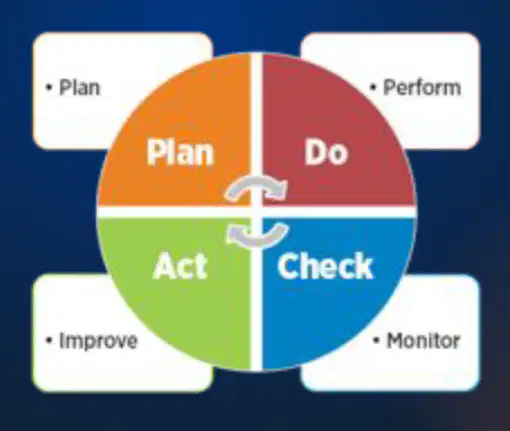
According to the image, what should be done after the PDCA cycle is completed once?
It should be stopped and a new cycle should be started.
It should be reported to the management.
It should be repeated again for continuous improvement.
It should be documented as a successful project.
What is the PDCA cycle primarily used for?
Carrying out change
Measuring financial success
Hiring new employees
Organizing company events
What is the first step in the PDCA Process?
Do
Check
Act
Plan
What does the 'C' in PDCA stand for?
Create
Control
Check
Complete
What is the purpose of the 'Act' step in the PDCA Process?
To plan the next project
To act on anything that went wrong to avoid future errors
To check the results of the project
To document the process
How is the PDCA process described in terms of its application to projects?
Inflexible and rigid
Only applicable to large projects
Flexible and can be applied to a project as a whole or each of the tasks within it
Only applicable to individual tasks and not the whole project
What is the primary focus during the "Do" stage of implementation?
Developing a new plan
Training the team and ensuring they have the correct equipment
Evaluating the results of the plan
Brainstorming for ideas
What does the "Do" stage emphasize according to the image?
Do what you said you would do
Do what is easiest first
Do everything at once
Do only what is necessary
What does the Check stage involve?
Creating a detailed plan for future actions.
Measuring performance and checking that plans have been implemented as written.
Brainstorming new ideas for project improvement.
Finalizing the project and delivering the end product.
Why is it important to document everything in the Check stage?
To have evidence for the next stage.
To create a backup of the current project.
To share the results with the media.
To start the planning stage again.
What is the aim of the PDCA process when applied to a problem?
To provide a temporary solution
To help you get to a solution through constant repetition of the process until that solution is achieved
To implement a one-time fix
To ignore the problem
How does the PDCA cycle support continual improvement?
By providing a step-by-step guide that is followed once
By facilitating continual improvement in whatever it is applied to
By focusing on quick fixes rather than long-term solutions
By repeating the cycle only when there is a new problem
What happens when the PDCA cycle is applied to something without a definite solution, such as the improvement of a business as a whole?
The cycle is discontinued
The cycle is only used for initial planning
The cycle would repeat indefinitely, incrementally improving that system every time
The cycle focuses on individual problems rather than the system
When should the PDCA Cycle be used according to the learning material?
Only when a project is failing and needs to be saved
When starting a new improvement project
Exclusively during the final stages of a project
Only when dealing with customer service issues
What is one of the purposes of the PDCA Cycle as mentioned in the learning material?
To ignore data collection and analysis
To avoid defining work processes
To plan data collection and analysis in order to verify and prioritize problems or root causes
To maintain the status quo without change
What is considered a type of waste in the context of work?
Value-creating work
Incidental work
Overproduction
Pulling a tool up and down and clamp fixture
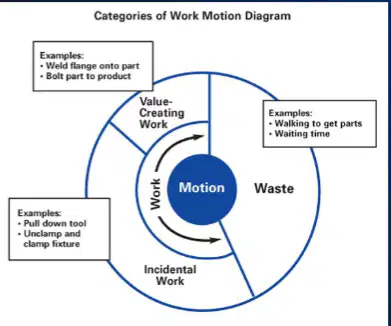
What does the diagram in the image represent?
A process flowchart
A work motion diagram
An organizational chart
A waste segregation chart

