
 Worksheets
H 2.6 Proteins
Total questions: 25
Worksheet time: 13mins
What is the monomer or building block of proteins?
glucose
nucleotides
amino acids
lipids
How are proteins built?
Condensation
add water
make a bond
hydrolysis
What is another name for a protein?
fat
sugar
amino acid
polypeptide
What can make an enzyme not work?
changing the pH
change the shape
changing the temperature
change the size

All proteins
have a unique structure that determines their unique function.
are exactly the same in function but different in structure.
are exactly the same in structure but different in function.
are enzymes.

How many different amino acids are there that make proteins?

What is this molecule called?
nucleotide
fatty acid
amino acid
monosaccharide
glycerol

Which colored box highlights the amino group?
Darker Blue (left)
Turquoise (top)
Orange (right)
Red (bottom)
Purple (middle)

Which colored box is different for every amino acid?
Darker Blue (left)
Turquoise (top)
Orange (right)
Red (bottom)
Purple (middle)

Which colored box highlights the carboxyl?
Darker Blue (left)
Turquoise (top)
Orange (right)
Red (bottom)
Purple (middle)
Which statement about enzymes is FALSE?
They are made from amino acids
They can be used multiple times
They lower the energy needed for reactions
A single enzyme has many different functions
Enzymes and Substrates bind at the enzymes...
Active Site
Enzyme Site
Activation Site
Product Site


If a methyl group (-CH3), which does not like water, were at the 'R', the amino acid would likely be:
Hydrophobic
Hydrophilic
Ionic
Acidic

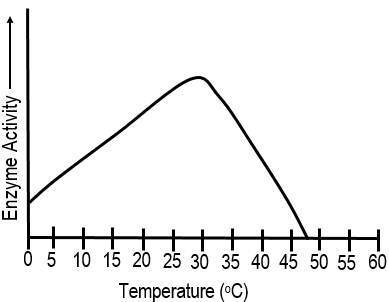
The rate of hydrolysis of protein, using an enzyme, was studied at different temperatures. Which of the following graphs would be obtained?


Essential amino acids are defined as the amino acids which
are necessary for building proteins
humans must acquire through their diet
plants cannot synthesise for themselves
are produced when any protein is hydrolysed.

State how many amino acid molecules joined to form this section of protein?
4
5
6
7
Amino acids contain
an amine group and a carbonyl group
an amine group and a carboxyl group
an amide group and a carbonyl group
an amide group and a carboxyl group
When proteins in foods are denatured, what effect does this have?
the are able to dissolve which make it easier to cook with
the texture of food is changed
the food goes off
no effect
What type of bond is primarily responsible for the secondary structure of a protein?
Hydrogen bonds
Peptide bonds
Disulfide bridges
Van der Waals forces

