
 Worksheets
6.3 Characteristics Practice
Total questions: 40
Worksheet time: 4hrs 24mins


The graph represents a function.
true
false

Which best describes the increasing and decreasing of the graph?
Decreasing and then increasing
Increasing and then decreasing
Increasing Only
Decreasing Only

Describe the following graph.
Increasing
Decreasing
Vertical
Horizontal

Determine which type of function the following is:
Linear
Quadratic
Exponential
Not a function

Determine which type of function the following is:
Linear
Quadratic
Exponential
Not a function
What kind of Function is y = -5x + 17 ?
Linear
Absolute Value
Quadratic
Exponential
None of the above
Line
Curve
Piecewise
Which type of Function will always have a Constant Rate of Change
Quadratic
Linear
Exponential
All of the Above
A Quadratic Function will always
Have a max or min
Have symmetry
Both increase and decrease
All of the Above

This function is
increasing
decreasing
increasing then decreasing
decreasing then increasing
Which of the following graphs appropriately marks the axis of symmetry?


What are the characteristics of linear functions?
Linear functions have a constant rate of change and a straight line graph.
Linear functions have a negative rate of change and a parabolic graph.
Linear functions have an exponential rate of change and a zigzag graph.
Linear functions have a variable rate of change and a curved graph.
What are the characteristics of quadratic functions?
Quadratic functions have a V-shaped graph.
Quadratic functions are made up of lines
Quadratic functions can only be written in the form f(x) = ax^2 + bx + c^2.
Quadratic functions are second-degree polynomial functions that have a U-shaped graph called a parabola and can be written in the form f(x) = ax^2 + bx + c.


Which function family is represented by this equation?
Linear
Exponential
Quadratic
Absolute Value


Pick a function that best models the following situation: The speed of a roller coaster from start to finish.
Exponential
Linear
Quadratic
Neither
This function has a common ratio
Linear
Quadratic
Exponential
None of the above
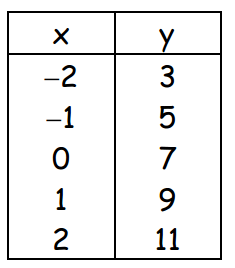
This function has a common second difference.
Linear
Quadratic
Exponential
None of the above
What is the y-intercept of the function: f(x)=2(4)x ?
2
4
(4)x
8
What is the initial value of f(x)= a⋅bx
x
b
a

Write the equation of the exponential function for the given table.
HINT: STAT EDIT STAT --> CALC #0
y=3x
y=12(3)x
y=3(4)x
y=4(3)x

The table shows some of the points on the graph of a quadratic function.
What is the range of the quadratic function?
All real numbers greater than or equal to −1
All real numbers less than or equal to 3
All real numbers less than or equal to −3
All real numbers greater than or equal to −7


What is the range of this function?
y > 2
y > 0
y < 2
All real numbers

What is the equation of the horizontal asymptote for following exponential function?
y = 1
y = 2
y > 1
(0, 2)

For the linear graph, identify the slope and y-intercept and write the slope-intercept form of the equation.
Slope (m) = -1/2
y-intercept (b) = 4
y = -1/2x + 4
Slope (m) = 1/2
y-intercept (b) = 4
y = 1/2x + 4
Slope (m) = -2/1
y-intercept (b) = 4
y = -2x + 4


Write the equation of the exponential function for the given graph.
y = 2(2)x
y = 2(1)x
y=1(21)x
y = 1(2)x

What type of function is this and why?
Linear Function ; common 1st difference
Quadratic Function ; common 2nd difference
Exponential Function; common ratio
Not a Function
What type of function does this equation represent?
f(x)=(x+1)(x−3)
Linear Function
Quadratic Function
Exponential function
Not a Function
All Exponential Functions have a ________________.
Common Ratio
Common 1st Difference
Common 2nd Difference
None of these
Consider the functions f(x)=3+10x , g(x)=2x and h(x)=5x2 .
Which function will have the greatest output when x=5
f(x)
g(x)
h(x)
What type of function can model the story below?
The value of a rare collectable item is appreciating at 15% per year.
Linear because this has a constant rate of change.
Exponential because this grows at a constant percent rate
Quadratic because this is a projectile motion model

