Wayground logo

Free Printable Worksheets

Font size

S
M
L
XL
Worksheets

EOU 11 Review

Total questions: 26

Worksheet time: 42mins

Name
Class
Date
1.

Which of the following sets of animals would be the most closely related?

a)

Animals in the same order

b)

Animals in the same genus

c)

Animals in the same class

d)

Animals in the same family

2.

The American lobster (Homarus americanus) is most closely related to which of the following organisms?

a)

Cape lobster (Homarinus capensis)

b)

Common lobster (Homarus gammarus)

c)

Patagonian lobsterette (Thymops birsteini)

d)

Scarlett clawed lobster (Nephropsis atlantica)

3.

Black panthers (Panthera onca) are a color variant of a species of large cats.  Black panthers would be most closely related to what organism listed below?

a)

Tiger (Panthera tigris)

b)

Cheetah (Acinonyx jubatus)

c)

Puma (Puma concolor)

d)

Jaguar (Panthera onca)

4.

Which of the following pairs of organisms from the table shown to the left would be the most closely related?

a)

Desert iguana and Box turtle

b)

Chuckwalla and Bush anole

c)

Box turtle and Bush anole

d)

Desert iguana and Chuchwalla

5.
Binomial nomenclature is the ____________ system for naming organisms.
a)
Numerical
b)
Symbolical
c)
two word
d)
alphabetical
6.
Binomial Nomenclature uses the __ and ___ name to identify an organism
a)
Latin & English
b)
Class & order
c)
Kingdom & species
d)
Genus & species
7.
What is an autotroph?
a)
an organism that can make their own food. 
b)
an organism that cannot make their own food
c)
Herbivore
d)
Omnivore
8.
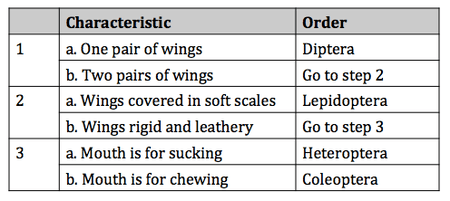
A dichotomous key for insects is given. To what order does an insect with two pairs of scaly wings belong?
a)
Coleoptera
b)
Heteroptera
c)
Diptera
d)
Lepidoptera
9.
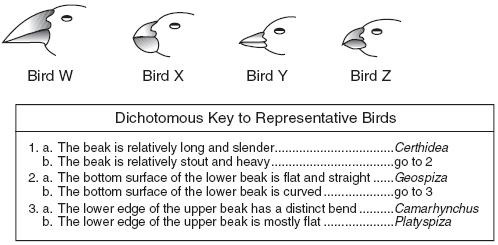
What is the name of bird W?
a)
Certhidea
b)
Geospiza
c)
Camarhynchus
d)
Platyspiza
10.
The first part of a scientific name is an organism's _______________ and the second part is its ________________.
a)
species, genus
b)
phylum, order
c)
class, spices
d)
genus, species
11.
A student discovers an arachnid with a segmented abdomen, long legs, and a tail with no stinger. The student uses the dichotomous key below to identify it. Which arachnid has the student found?
a)
Whip Scorpion
b)
Wind Scorpion
c)
Daddy long legs
d)
Scorpion
12.

Which organism is more similar to a chimpanzee, an orangutan or a dog?

a)

orangutan--they share the same FAMILY

b)

Dog --they share the same CLASS

c)

orangutan--they share the same ORDER

13.

What 3 taxonomic groups are shared by all 4 organisms?

a)

species, genus & family

b)

Kingdom, phylum & order

c)

kingdom, phylum & class

14.

Using the chart above, what is the scientific name of the Tiger

a)

tigris Panthera

b)

Felidae Panthera

c)

Panthera tigris

15.

The lion and the tiger belong to different species as shown in the chart above. What is the scientific name of the Lion?

a)

Panthera tigris

b)

Felidae Panthera

c)

Panthera leo

16.

A scientist sees the organism shown to the right in an aquarium and uses a key to help classify the species.Based on the key what species did the scientist observe?

a)

Aulostomus

b)

Gymnothorax

c)

Bothus

d)

Aetobatus

17.

Where is the alligator and T. rex's common ancestor?

a)

Point A

b)

Point B

c)

Point C

d)

Point D

18.

What distinguishes zebras from from giraffes?

a)

un-branching horns (in males)

b)

even number of toes

c)

fur

d)

carnivorous teeth

19.
Which kingdoms are prokaryotic?
a)
Archaebacteria and Animalia
b)
Eubacteria and Archaebacteria
c)
Fungi and Protista
d)
Plantae and Eubacteria
20.
In which kingdom do I belong if I am unicellular, autotrophic, and eukaryotic?
a)
Archaebacteria
b)
Protista
c)
Animalia
d)
Plantae
21.
What is the difference between Archaebacteria and Eubacteria?
a)
Eubacteria are eukaryotic.
b)
Archaebacteria are multicellular.
c)
Archaebacteria can live in extreme environments.
d)
Archaebacteria are found everywhere.
22.
Which kingdom contains multicellular, heterotrophic organisms whose cells have NO cell walls?
a)
Protista
b)
Fungi
c)
Plantae
d)
Animalia
23.
Animals must eat other organisms for food, so they are classified as...
a)
heterotrophs
b)
autotrophs
c)
eukaryotic
d)
prokaryotic
24.
These organisms are best classified as...
a)
eukaryotic, multicellular, and heterotrophic
b)
eukaryotic, multicellular, and autotrophic
c)
eukaryotic, unicellular, and heterotrophic
d)
prokaryotic, multicellular, and heterotrophic
25.
Identify the kingdom...
Unicellular organisms with no nuclei found living in the superheated waters of a hot spring.
a)
Archaebacteria
b)
Eubacteria
c)
Fungi
d)
Protista
26.
Identify the kingdom...
Multicellular organism with cell walls made of chitin found growing on a decomposing manure pile.

a)
Archaebacteria
b)
Eubacteria
c)
Protista
d)
Fungi