
 Worksheets
Interim Review
Total questions: 219
Worksheet time: 3hrs 17mins

What is a high tide?
Sea pulled TOWARD the moon where Earth is CLOSEST to the moon
Sea pulled AWAY from the moon where Earth is FARTHEST to the moon
Sea pulled AWAY from the moon where Earth is CLOSEST to the moon


Wha type of tide would this arrangement of earth-moon-sun create?
full moon tide
new moon tide
neap tide
spring tide


_______are daily changes in ocean water.
Waters
Tides
Colors
Earths

Tides are caused by the difference in the gravitational force of the ________ and ________ across the ________.
earth, sun, moon
sun, mars, jupiter
sun, moon, earth
tide, water, sun

The difference in gravitational force is called _________.
Tidal Force
Fun Tides
Tidal waters
Ocean Force
The tidal force exerted by the ______ is stronger that the tidal force exerted by the _______.
earth, ocean
sun, moon
moon, stars
moon, sun
The moon is mainly responsible for the tides on Earth because it is _________ _________.
much closer
far away
behind the sun

The bulges that occur in the Earth's oceans are called ______ _______.
low waters
low tides
high tides
big dips
____ ____ occur in the spaces between the high tides.
High tides
Medium tides
Low tides
Super tides
Low tides is simply a term given to water that is lower than ___ _____.
high tide
sea level
low tide
the ocean

As the _____ revolves around the Earth and Earth rotates, the tidal bulge moves around the Earth.
sun
ocean
Earth
moon

The tidal bulge follows the movement of the _____.
moon
sun
Earth
ocean

Because the tidal bulge follows the moon;s revolution-Many places on Earth experience ___ high tides and ___ low tides each day.
4 and 4
1 and 1
2 and 2
3 and 3

Because the moon is so much closer than the sun, the moon's gravitational force is much stronger than that of the ___.
sun
earth
moon
sea
The moon's effect on tides is _____ as strong as the sun's effect.
trice
once
twice
four times

The combined gravitational forces between the sun, moon, and earth result in different ______ _______.
ocean waves
tidal ranges
sea level
sun rays

The _____ _____ is the difference between the levels of ocean water at high tides and low tides. That range depends on the sun-Earth-moon;s position.
ocean waves
mountain level
sea level
tidal range

_____ Tides occur when the Sun, the Earth, and the Moon are in a __________ line.
Spring, straight
Neap, straight
High, zigzag
Low, zigzag

_____ ______ occur when the Sun, the Earth, and the Moon are in a ______ degree angle.
Spring tides. 90°
Neap tides, 90°
High tides, 90°
Low tides, 90°

What does this illustration tell you about the tides?
There are 4 seasons
There are 4 quarters
There are 2 spring tides and 2 neap tides
The earth is at the top of the illustration

What type of tide does this represent?
Neap
Full
Quarter
Spring

What type of tide does this represent?
Spring
low
Neap
high


flat-topped seamount
abyssal plain
mid-ocean ridge
guyot
rift
the underwater edge of a continent
continental slope
trench
continental shelf
abyssal plain

The Mariana __________ is the deepest known place on Earth
Volcanoe
Seamount
Ridge
Trench
The two MAIN types of water found on Earth are
lake water
freshwater
saltwater
river water
Approximately which percentage of Earth's surface is covered in water?
30%
90%
80%
50%

Why is Earth often called the 'Blue Planet'?
Most of Earth is covered in land.
Earth's sky causes it to appear blue.
Most of Earth is covered in water.
The blue color of space causes it to appear blue.
About how much of Earth's water is SALTWATER?
97%
67%
3%
1%

Most drinking water comes from
lakes
groundwater
oceans
reservoirs
What happens when polar ice caps melt?
tectonic plates move
sea levels rise
sea levels fall

Which of the following statements is TRUE?
Most of the water available on Earth is drinkable.
Most of the freshwater on Earth is found in oceans.
Most of the water available on Earth is not drinkable.
Most of the freshwater on Earth is groundwater.

Aquifers are sources for
oil
saltwater
silica
freshwater

Most ocean WAVES are caused by
differences in temperature
surface winds
differences in amounts of sunlight
differences in density
Which of the following does NOT affect SURFACE Currents?
Density
Global winds
Coriolis Effect
Continental Deflection
The patterns of SURFACE currents are affected by
high and low tides
global winds and the Coriolis Effect
the Moon's gravitational pull
the Sun's gravitational pull

What do we call a giant wave caused by an earthquake on the ocean floor?
Breaker
Tidal Bore
Surface Current
Tsunami

Ocean CURRENTS are caused by
earthquakes on the ocean floor
volcanoes on the ocean floor
differences in temperature at different depths
differences in ocean organisms at different depths
Which statement BEST describes how heat move through the world's oceans?
Cold water moves away from the equator and picks up heat at the poles.
Heat energy is transported from the equator to the poles.

What causes TIDES?
the pull of Earth's gravity
the pull of the Moon's gravity
the pull of the ocean's gravity
the pull of the ocean's waves

What type of TIDE occurs when the Sun and the Moon are positioned at a right angle in relation to the Earth?
Neap Tide
Spring Tide
Diurnal Tide
Mixed Tide

A _________ tide occurs when the Sun, the Moon, and the Earth are aligned.
neap
high
low
spring

Which number symbolizes an abyssal plain?
1
3
7
4

What symbolizes a rift valley?
6
7
4
3
Approximately what percentage of Earth's surface is covered in oceans?
80%
30%
50%
90%
Aquifers are sources of
saltwater, which is pushed through turbines to make energy.
oil, which is drilled from the aquifers and use to power homes.
freshwater, which is used for drinking, bathing, and watering crops.
silica, which is used to make glass
Which best describes why Earth is called the 'blue planet'?
The blue color in space causes it to appear blue.
Most of Earth is covered in land causing it to appear blue from space.
The blue from Earth's sky causes it to appear blue from space.
Most of Earth is covered in water, causing it to appear blue from space.
Which of the following will occur when groundwater rises to the surface?
reservoirs
springs
aquifers
estuaries
Which of the following happens when polar ice caps melt?
Tectonic plates move.
Sea levels fall.
Sea levels rise.
Tsunamis occur.
Which of the following are examples of groundwater?
wells, geysers, and ponds
aquifers, lakes, and streams
wells, oceans, and rivers
springs, aquifers, and wells
Where does MOST of our drinking water come from?
lakes
oceans
groundwater
reservoirs
97% of our water is unusable because
it is located in glaciers and polar ice caps.
it has a high salinity.
it is located in our freshwater lakes and rivers.
it is located underground.
What can be concluded by the fact that: 97% of our water is in oceans, 2% of our fresh water is in polar ice caps, and 1% is either surface water or groundwater?
Most of the water available on Earth is drinkable.
Most of the freshwater on Earth is found in oceans.
Most of the water available on Earth is not drinkable.
Most of the freshwater on Earth is groundwater.
Which two processes connect the oceans to all of Earth's reservoirs?
transpiration and precipitation
evaporation and precipitation
infiltration and evaporation
condensation and infiltration
Which process of the water cycle BEST restores groundwater?
transpiration
run-off
condensation
infiltration
Which statement BEST describes the connection between oceans and aquifers?
Water infiltrates from oceans into the atmosphere where it collects and falls as transpiration, condensing into the ground to refill aquifers.
Water transpires from oceans into the atmosphere where it collects and falls as precipitation, evaporating into the ground to refill aquifers.
Water condenses from oceans into the atmosphere where it collects and falls as evaporation, infiltrating the ground to refill aquifers.
Water evaporates from oceans into the atmosphere where it collects and falls as precipitation, infiltrating the ground to refill aquifers.
Select three processes of the water cycle that are necessary for it to rain.
condensation, evaporation, precipitation
evaporation, precipitation, deposition
evaporation, sublimation, precipitation
transpiration, evaporation, precipitation
To keep on living, all living things need _____.
some form of water
electricity
salt water
How much of the surface of the Earth is covered in water?
more than two-thirds
about half
less than half
Most of the water on earth is _____
in large lakes
in the oceans
trapped in glaciers
What kind of water is found in rivers, ponds, wetlands, and streams?
hard water
fresh water
salt water
Freshwater contains _____.
less than 0.1% salt
no salt at all
more than 1% salt
Which field of science deals with the Earth's surface?
astronomy
geography
biology
What percent of the water on the planet is salty?
about 50%
about 75%
about 97%
What percent of the planet's total water supply is freshwater?
about 3%
about 10%
about 50%
What percent of the planet's water is locked up freshwater in frozen glaciers or underground?
less than 1%
about 2%
about 5%
In North America, a large source of freshwater is _____
the Great Lakes
the Atlantic Ocean
Lake Mead
the Pacific Ocean
If all of the Earth's water were placed into a gallon jug, the freshwater would equal _____.
a single teaspoon
a single tablespoon
half a cup
a single cup
Ice caps and glaciers are where _____ is stored.
surface water
groundwater
frozen water
salt water
Wells are dug to where _____ is stored.
surface water
frozen water
groundwater
salt water
Rivers and lakes are examples of ______.
salt water
frozen water
surface water
groundwater
Saline water is _______.
groundwater
frozen water
surface water
salt water
Only 3% of water on Earth is fresh water. About 2% of that water is not available for human consumption because
It is frozen
It is polluted
It is salty
It is in the aquifer
What percent of Earth water is readily available for use?
97%
1%
55%
71%
Where is most of Earth's water located?
lakes
ice caps
rivers
oceans
How much of the Earth surface is covered by water?
97%
3%
71%
25%

Where is underground water stored?
with surface water
moving with runoff
in an aquifer
in the ocean
Approximately what percent of Earth water is salt water?
79%
97%
70%
3%
Which of these is not a source of fresh water?
ocean
rivers
lakes
glaciers
What percent of Earth water is found in glaciers and ice caps?
2%
3%
71%
97%
Which is in correct order from largest to smallest
oceans, lakes and rivers, glaciers, groundwater
ground water, glaciers, ocean, rivers and lakes
rivers and lakes, ocean, groundwater, glaciers
ocean, glaciers, groundwater, rivers and lakes
Which of these contain the greatest amount of fresh water?
ocean
rivers and lakes
groundwater
glaciers and ice caps

Identify the Pacific Ocean
1
2
3
4

Identify the Atlantic Ocean
1
2
3
4

Water underground is stored in ____________.
aquifers
reservoirs
wells
depositories

The graphic shows that only 3% of the Earth's water is fresh water. The graphic also shows that of this 3%, almost all of it is contained in two reservoirs. What are the two reservoirs that contain almost all of Earth's fresh water?
glaciers and groundwater
streams and estuaries
marshes and swamps
lakes and rivers
What effect does the sun have on surface water?
It causes it to boil
It causes it to rain
It causes it to sink
It causes it to evaporate
When water vapor is cooled and forms droplets of liquid water
Condensation
Evaporation
Transpiration
Runoff

What is precipitation?
Sweat from our bodies on hot days
Warm rain but not cold snow or sleet
Gas that we use in furnaces or ovens
Any form of water that falls from the sky
The process when plants release water vapor from their leaves is called _____________.
precipitation
evaporation
transpiration
condensation

What step of the water cycle does this picture show?
Condensation
Runoff
Precipitation
Evaporation

What are formed when water vapor condenses and come together?
Clouds
Mountains
Transpiration
Valleys

Is precipitation any form of water that falls back to earth?
Yes
No
When clouds fill with water and can't hold anymore, the water falls from the clouds as -
precipitation
clouds

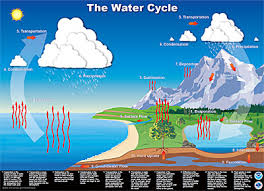
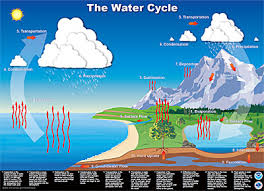
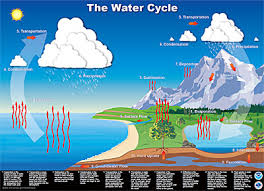
When changing from a liquid to a gas, the water molecules are ____________________________.
freezing and moving away from each other.
evaporating and moving away from each other
condensing and moving closer to each other
evaporating and moving closer to each other
When changing from a liquid to a solid, the water molecules are ____________________________.
freezing and moving away from each other.
evaporating and moving away from each other
condensing and moving closer to each other
freezing and moving closer to each other
Water in its gas form is called ____________________,
water vapor
precipitation
ice
air
This provides the power to keep the water cycle running.
The Sun
The Earth
The wind
living things
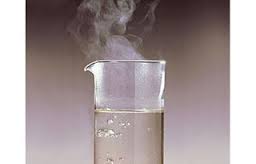
Water in its gas form is called ____________________,
water vapor
precipitation
ice
air


Gravity causes ___________________ to occur.
condensation
precipitation
evaporation
none of the above
This provides the power to keep the water cycle running.
The Sun
The Earth
The wind
living things
Which example is a form of precipitation?
Dew
Fog
Frost
Hail
Rain and snow are two different forms of precipitation that fall on Earth's surface. Which factor is responsible for there being different forms of precipitation?
Evaporation
Run-off
Temperature
Transpiration
Groundwater moves from a lower elevation to a higher elevation.
true
false
Aquifers are __________.
not a part of the water cycle
underground water
caused by evaporation
none of the above
What causes condensation?
is not part of the water cycle
water vapor does not change and becomes a liquid
water vapor heats up and becomes a liquid
water vapor cools and becomes a liquid
Which of the following can cause an increase in density that results in a deep ocean current?
The sun heats the water’s surface.
A warm wind blows across cold water.
An iceberg melts, adding fresh water to ocean water.
Warm water loses energy to its surroundings and cools.
Which of the following movements of ocean water has the greatest direct effect on the growth of producers?
upwelling
deep current
surface current
convection current
Which three factors most directly affect surface currents in the oceans?
upwelling, convection, and the sun’s energy
deep currents, convection currents, and surface winds
dissolved solids, dissolved gases, and the sun’s energy
surface winds, the Coriolis Effect, and continental deflection
How does convection cause ocean currents?
During the process of convection, energy is transferred to the atmosphere, forming winds. These winds power surface currents.
During the process of convection, the heating of surface water by the sun results in upwelling.
During the process of convection, energy in warm water is lost to its surroundings. The water cools, becomes denser, and sinks.
During the process of convection, more minerals and gases dissolve in warm water. This increases the density of the warm water and causes it to sink.
Stream like movements of water
Ocean Currents
Continental Deflections
Coriolis Effect
Upwelling
Currents change direction by hitting the continents or other large landmass.
Ocean Currents
Continental Deflections
Coriolis Effect
Upwelling
Because the Earth rotates on its axis, circulating air is deflected toward the right in the Northern Hemisphere and toward the left in the Southern Hemisphere.
Ocean Currents
Continental Deflections
Coriolis Effect
Upwelling

Dom makes a table to compare the percentage of various gases in the atmosphere to the percentage of gases dissolved in the ocean. His table is shown below.
Which of the gases listed in Dom’s table is less common in ocean water than it is in the atmosphere?
argon
oxygen
nitrogen
carbon dioxide
Movements of ocean water located far below the surface.
Ocean Currents
Convection Currents
Deep Currents
Surface Currents
Currents are on the surface or less than a 100 meters deep (330 feet)
Ocean Currents
Convection Currents
Deep Currents
Surface Currents
The Gulf Stream carries _____________ water from the east coast of The United States to the West coast of Europe.
Cold
Warm
Freezing
Fresh
Warm water from surface currents replaces colder denser water that sinks to the ocean floor.
Ocean Currents
Convection Currents
Deep Currents
Surface Currents
Winds on the surface cause the warm surface water to be replaced with the colder more nutrient rich water.
Ocean Currents
Continental Deflections
Coriolis Effect
Upwelling
Surface Currents are driven mainly by
Coriolis Effect
Wind
Upwelling
Moon

Ocean currents affect climates around the world. Based on the map, which area MOST likely has a warmer climate than expected?
1
2
3
4

What causes surface currents north and south of the equator to move in different directions?
Gases in the ocean
The rotation of the Earth
Temperature differences
Continental deflection
What famous current did Nemo’s dad ride?
Gulf Stream
East Australian Current
Brazilian Current
Western Pacific Current
Regular movements of water far below the oceans surface are called
Warm Currents
Deep Currents
Shallow Currents
Surface Currents

Regular movements of water far below the oceans surface are called
Warm Currents
Deep Currents
Shallow Currents
Surface Currents
Which best describes the Gulf Stream?
A cold ocean current that cools the weather off near Australia.
A cold ocean current that helps decrease global warming.
A warm ocean current that influences weather along the east coast of the U.S. and up toward Europe.
A warm ocean current that influences weather in Cuba and moves toward Antarctica.

Why is upwelling (deep water moving to the surface) important?
Upwelling makes the ocean more salty.
Upwelling provides nutrient rich water that sustains life
Upwelling controls the tides
Upwelling helps sailors to navigate the seas
Salinity is
The salt content of a substance
The Pepper content of a substance
The circulation of hot and cold matter
the weather pattern of a region

Deep Ocean currents caused by
Global Wind Patterns
Earth's Rotation
Differences in density
All of the above
As you go deeper in the ocean, the water is colder and less salty.
True
False

What do we call the constantly moving system of deep-ocean circulation driven by differences in temperature and salinity?
California Current
Global Conveyor Belt
Surface Currents
Gulf Stream
Where would I find the most dense ocean water?
At the surface
In the middle
At the bottom
Lake Michigan
Near the North Pole, the water is super cold and salty, so it _______________.
sinks
rises
evaporates
condenses

In both the Indian and Pacific Oceans, deep water begins to warm up and ______________, joining back in with the Gulf Stream.
sinks
rises
freezes
evaporates

Warm water is __________ cold water.
more dense than
less dense than
the same density as

Salt water is ____________ fresh water.
more dense than
less dense than
the same density as

