wayground logo

Free Printable Worksheets

Font size

S
M
L
XL
Worksheets

Cardiovascular Study guide

Total questions: 48

Worksheet time: 42mins

Name
Class
Date
1.

Hey there, science enthusiasts! Ready to dive into the world of medical terminology? Which suffix rockets to the end of a word to indicate inflammation?

a)

-megaly

b)

-itis

c)

-ous

d)

-pathy

2.

Hey there, science enthusiasts! Ready to dive into the world of medical terminology? Which suffix rockets to the end of a word to indicate inflammation?

a)

-megaly

b)

-itis

c)

-ous

d)

-pathy

3.

Get ready for a brain teaser! Which suffix magically transforms a word to mean something has gotten bigger, as if by magic? (a)  

Choose from the below words
-pathy
-itis
-ous
-megaly
4.

heart

a)

nephro

b)

cardio

c)

opthalmo

d)

myo

5.

cephalo

a)

skin

b)

liver

c)

head

d)

eye

6.

blood

a)

hepato

b)

opthalmo

c)

hemat

d)

bio

7.

muscle

a)

oto

b)

cyto

c)

myo

d)

derm

8.

neuro

a)

lung

b)

kidney

c)

head

d)

nerve

9.

lung

a)

cyto

b)

nephro

c)

pulmo

d)

hepato

10.

arterio

a)

vein

b)

artery

c)

heart

d)

blood

11.

cell

a)

oto

b)

bio

c)

cyto

d)

myo

12.

Macro- means

a)

small

b)

large

c)

enlarged

d)

black

13.
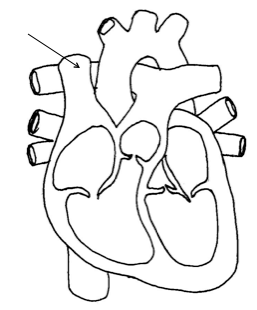
Name this part.
a)
Superior vena cava
b)
Right ventricle
c)
Inferior vena cava
d)
Pulmonary vein
14.
Name this part.
a)
Pulmonary veins
b)
Left atrium
c)
Aorta
d)
Pulmonary artery
15.
Name this part.
a)
Right atrium
b)
Left ventricle
c)
Right ventricle
d)
Left atrium
16.
Name this part.
a)
Left ventricle
b)
Pulmonary artery
c)
Right atrium
d)
Pulmonary veins
17.
Name this part.
a)
Superior vena cava
b)
Right ventricle
c)
Right atrium
d)
Inferior vena cava
18.
Name this part.
a)
Right ventricle
b)
Pulmonary artery
c)
Left ventricle
d)
Right atrium
19.
Which side of the heart pumps oxygen-rich blood to the rest of the body?
a)
Right
b)
Left
20.
Which side of the heart pumps blood into the lungs?
a)
Right
b)
Left
21.
______ carry blood to the heart.
a)
Arteries
b)
Veins
c)
Capillaries
d)
Vena Cava
22.
_____ carries blood away from the heart.
a)
Blood cells
b)
Veins
c)
Capillaries
d)
Arteries
23.
The arteries that feed the heart muscle
a)
Capillaries
b)
Coronary
c)
Chordae teindineae
d)
Coronary sinus
24.
Which valve(s) prevents backflow from of blood into the ventricles?
a)
Semilunar Valves
b)
Cardiac Valve
c)
Mitral Valve
d)
Tricuspid Valve
25.
The _____ valve lies between the right atrium and right ventricle.
a)
bicuspid
b)
aortic semilunar
c)
pulmonary
d)
tricuspid
26.

The bottom of the heart; points towards the left hip and rests on the diaphragm

a)

aorta

b)

base

c)

apex

d)

artery

27.

Outer covering of heart wall

a)

Pericardium

b)

Epicardium

c)

Myocardium

d)

Endocardium

28.

Receiving chambers of the heart

a)

septum

b)

Ventricles

c)

Atria

d)

valves

29.

Discharging chambers of the heart

a)

septum

b)

Ventricles

c)

Atria

d)

valves

30.

Divides left and right side of the heart

a)

septum

b)

Ventricles

c)

Atria

d)

valves

31.

Carries blood away from the heart

a)

artery

b)

vein

c)

septum

d)

cardium

32.

What is 9?

a)

right ventricle

b)

left atrium

c)

right atrium

d)

left ventricle

33.

What is 10?

a)

superior vena cava

b)

aorta

c)

septum

d)

pulmonary artery

34.

What part of the electrical conduction system is labelled A?

a)

SA Node

b)

AV Node

c)

AV Bundle

d)

Bundle Branches

e)

Purkinje Fibers

35.

What part of the electrical conduction system is labelled D?

a)

SA Node

b)

AV Node

c)

AV Bundle

d)

Bundle Branches

e)

Purkinje Fibers

36.

Which letter is representing the Purkinje fibers which are the final area of signal transmission before the ventricles completely contract?

a)

A

b)

B

c)

C

d)

D

e)

E

37.
During atrial contraction and ventricular filling,
a)
the AV valves are open
b)
the semilunar valves are open
c)
the ventricles are contracted
d)
the atria are relaxed
38.
What is the sequence of events in the transmission of an impulse through the heart muscle?
 a: AV node
 b: AV bundle
 c: SA node
 d: Through the atria
 e: Through the ventricles
 f: Bundle branches
 g: Purkinje fibers 
a)
d, b, a, c, f, g, e

b)
c, d, a, b, f, g, e

c)
b, a, d, c, f, g, e

d)
f, g, d, c, b, a, e

39.

The heart’s natural pacemaker is termed the:

a)

sinoatrial node

b)

atrioventricular node

c)

bundle of His/atrioventricular bundle

d)

left and right bundle branches

e)

Purkinje fibers

40.

Which part starts the first step in the electrical conduction system?

a)

sinoatrial node

b)

AV node

c)

AV Bundle branches

d)

Purkinge fibers

41.

Which part would be second in the electrical conduction system?

a)

sinoatrial node

b)

AV node

c)

AV Bundle branches

d)

Purkinge fibers

42.

Diastole is associated with

a)

contraction of the heart

b)

relaxation of the heart

c)

myocardial infarction

d)

angina

43.

Which of the following is represents a cardiac cycle?

a)

PQRST

b)

QT interval

c)

QRS Complex

d)

PR Interval

44.
The number of times the heart ventricles beat in one minute is known as?
a)
Heart Rate
b)
Stroke Volume
c)
Cardiac Output
45.

Recording of electrical changes that occur during the cardiac cycle is referred to as

a)

blood pressure reading

b)

ECG

c)

QRS wave

d)

T Wave

46.
Which of the following is not a direct indicator of a person's cardiac health?
a)
Heart Rate
b)
Blood Pressure
c)
EKG
d)
Temperature 
47.

What does depolarization result in?

a)

relaxation

b)

contraction

c)

repulsion

d)

attraction

48.
What is going on in the heart during the R-wave or QRS complex
a)
SA node triggers depolarization in atria
b)
AV node triggers depolarization in ventricle, the main pumpung action
c)
Delay caused by the SA node
d)
Repolarization of the ventricle