
 Worksheets
Cells/ Plants and Animals
Total questions: 20
Worksheet time: 20mins
A scientist plans to make models of three kinds of cells: oak leaf, fern leaf, and squirrel muscle. Which model(s) will have Chloroplasts? *
only the squirrel muscle cell
only the fern leaf cell
the fern leaf cell and the oak leaf cell
all three of them
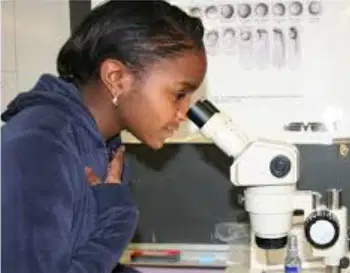
The picture below shows a student observing part of a living thing. Which claim could the student shown below support with evidence from her observation?
Animal cells and plant cells have different organelles.
A plant cell is too small to be seen without using a microscope.
An animal cell is too small to be seen without using a microscope.
The cell membrane of an animal cell is thinner than the cell membrane of a plant cell.
Which statement about cytoplasm is true?
Only animal cells have cytoplasm.
Cytoplasm surrounds and protects cells.
Plant cells use cytoplasm to carry out photosynthesis.
Cytoplasm is a jelly-like substance (liquid) that fills the space around a cell's nucleus and other organelles.
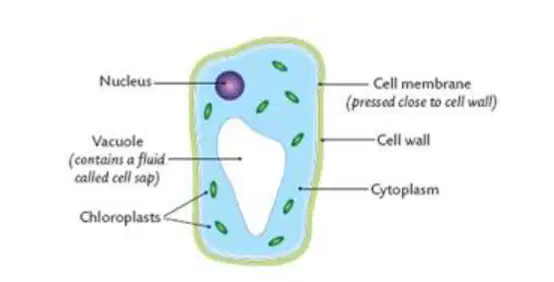
Which part of the cell model is the organelle that directs most of the cell's activities?
Cytoplasm
Cell Wall
Chloroplasts
Nucleus
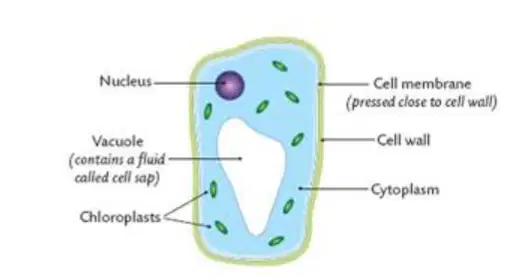
Does the image below show a plant cell or an animal cell?
Animal
Plant
Not sure - there is not enough information given
Neither plant nor animal
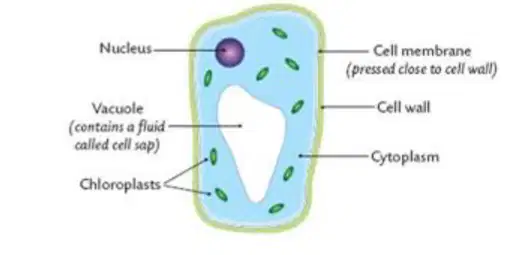
How did you know which type of cell is shown?
Animal Cells all have relatively straight sides and have cell walls and chloroplasts.
Animal Cells are always bigger than plant cells.
Plant cells are the only type of cells that have cell walls & chloroplasts.
Plant cells are generally round and don't have cell walls or chloroplasts.
Which is the best evidence that plants and animals are made up of tiny cells?
Plant and animal cells have similar parts.
Some plant cells are visible with a hand lens.
Scientists believe cells are the building blocks of all living things.
Scientists use microscopes to study and make images of plant and animal cells.
A student uses a microscope to study a leaf cell. The student also looks at a cat cell. Then, the student draws a diagram of each of the cells. Which parts does the student draw ONLY in the diagram of the leaf cell? Select the TWO parts.
nucleus
cell wall
cytoplasm
chloroplast
cell membrane
Which part of the cell controls the movement of substances into and out of the cell?
Cell Membrane
Cell Wall
Cytoplasm
Chloroplasts
Which animal type makes up a MAJORITY of all animals on Earth?
Fish
Amphibians
Invertebrates
Mammals
What are the characteristics of an amphibian?
Live on land, cold-blooded, scaly skins, lay gelatinous eggs
Can live on land and water, lay jelly-like eggs, gills or lungs, cold-blooded
Hair or fur, warm-blooded, live births, feed milk to young
Feathers, lungs, eat with bills or beaks, lay hard-shelled eggs, hollow bones
What are the characteristics of a mammal?
Live on land, cold-blooded, scaly skins, lay gelatinous eggs
Can live on land and water, lay jelly-like eggs, gills or lungs, cold-blooded
Hair or fur, warm-blooded, live births, feed milk to young
Feathers, lungs, eat with bills or beaks, lay hard-shelled eggs, hollow bones
What are the characteristics of a bird?
Live on land, cold-blooded, scaly skins, lay gelatinous eggs
Can live on land and water, lay jelly-like eggs, gills or lungs, cold-blooded
Hair or fur, warm-blooded, live births, feed milk to young
Feathers, lungs, eat with bills or beaks, lay hard-shelled eggs, hollow bones
What are the characteristics of a reptile?
Live on land, cold-blooded, scaly skins, lay gelatinous eggs
Can live on land and water, lay jelly-like eggs, gills or lungs, cold-blooded
Hair or fur, warm-blooded, live births, feed milk to young
Feathers, lungs, eat with bills or beaks, lay hard-shelled eggs, hollow bones
True or False: Vascular plants have no tissue in which water and food can move.
True
False
True or False: Vascular Plants can be classified by seed producers and non-seed producers.
True
False
Which answer shows examples of Non-Vascular plants?
Apple trees and lemon trees
Pine trees and ferns
Roses, violets, and lilies
Mosses, liverworts, and hornworts
A sea turtle is an example of a(an)
Bird
Fish
Amphibian
Reptile
A lobster is an example of a(an)
Bird
Invertebrate
Amphibian
Reptile
A green tree frog is an example of a(an)
Bird
Invertebrate
Amphibian
Reptile

