
Font size
 Worksheets
Midterm Exam Review
Total questions: 164
Worksheet time: 5hrs 10mins

What is an Ocean?
small body of water
large body of water

about _____% of the Earth's water can be found in our oceans.
25%
67%
72%
97%

The graph shows the distribution of water on Earth's surface. Where is the most water located?
Ground water
Oceans
Glaciers and ice-caps
Surface water
The graph shows the distribution of water on Earth's surface. Where is the most freshwater located?
Ground water
Oceans
Glaciers and ice-caps
Surface water
approximately what percent of earth water is salt water
87
79
97
9
Water underground is stored in
aquifers
wells
reservoir

According to the pie graph. What is the most abundant salt found in seawater?
Sodium
Chlorine
Magnesium
Potassium
Which part of the ocean would have the lowest salinity?
in areas near melting glaciers
in areas near the equator
in areas with the highest temperatures
in areas where there is little rainfall

According to the graph, as the density in water increases, what happens to the salinity?
Decreases
Increases
Stays the same


Approximately _____ percent of Earth's water is freshwater.
97
1
3
10
Water can exist on Earth as...
solid ice
liquid water
the gas water vapor
All of above

_________ is held in layers of rock called aquifers. We can pump water up from these areas, so humans can use it.
groundwater
wetland
glacier
Which of the following items could be used to represent the sun in a model of the water cycle?
a large container
ice
a heat lamp
water
What could you add to a model of the water cycle to help condensation happen faster?
a heat lamp
warm water
ice cubes
salt
Water droplets sticking to the top of a model of the water cycle represent what process?
evaporation
transpiration
condensation
precipitation
Water droplets dropping from the top of a model of the water cycle back into the container represents what process?
evaporation
transpiration
condensation
precipitation
Why does the water level in a water cycle model stay about constant?
Because evaporation decreases the water level but precipitation adds water back.
Because precipitation decreases the water level but evaporation adds water back.
Because transpiration decreases the water level but condensation adds water back.
Because evaporation increases the water level but precipitation decreases the water level.

This picture of the mirror shows an example of--
precipitation
transpiration
evaporation
condensation

This picture shows -
evaporation
condensation
precipitation
transpiration

This photograph shows a beach on a partly sunny day. Which of the following is an interaction between the sun and the ocean that results in clouds forming near the beach?
Energy from the sun causes precipitation over the ocean.
Energy from the sun causes water to evaporate from the ocean.
Light from the sun reflects off the surface of the ocean.
Light from the sun decreases the amount of water vapor in the air over the ocean.

The image shows various stages in the water cycle. During which stage does water flow back towards the sea as runoff?
W
X
Y
Z

A student draws a model to represent the precesses involved in the water cycle, as shown. To which process is the formation of clouds related?
Condensation
Evaporation
Freezing
Melting

What is the energy source that drives the water cycle?
The moon T
The heat from our home in the winter all around the world
The sun
he heat generated solely from the core of the earth

The movement caused within a fluid by the tendency of hotter and therefore less dense material to rise, and colder, denser material to sink under the influence of gravity, which consequently results in transfer of heat. ____________________
Evaporation
Convection
Precipitation
Transpiration
Which factor determines whether precipitation will be in the form of rain or snow?
air pressure
wind
humidity
temperature
What is the MAJOR role of the Sun in the water cycle?
It causes evaporation
It allows plants to grow
It provides heat for organisms
It transmits light

Which process is occurring at the arrow labeled 4?
Transpiration
evaporation
condensation
precipitation
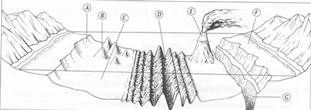
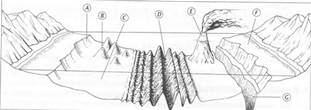
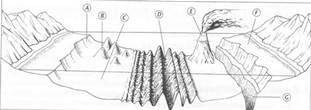
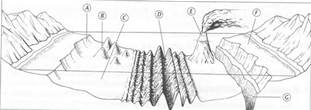
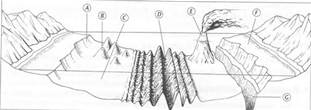


C
Evaporation
Transpiration
Sublimation
Condensation
Precipitation


________ and _______ affect the ocean's density and cause the Global Conveyor Belt to travel
gravity and the Coriolis Effect
temperature and salinity
wind and climate
temperature and the Coriolis Effect
What distinguishes a tsunami from other types of ocean waves?
The wave energy of tsunamis increases as the water depth decreases.
A tsunami forms when a large volume of water is suddenly displaced up or down.
A tsunami is caused by the disruption of deep ocean currents by volcanic eruptions.
The wave height of a tsunami is much lower in the center of the ocean than it is near shore.
A _______ is a disturbance that transfers energy through matter.
Salinity
Wave
Temperature
Density
_____ is how salty is the water
Salinity
Wave
Temperature
Density
. _____ is how hot or cold is the water
Salinity
Wave
Temperature
Density
_____ is how salty is the water
Salinity
Wave
Temperature
Density
What causes most waves?
Gravity
Wind
Underwater Volcanoes
Underwater landslides


Which body has the greater effect on Earth's tides?
Sun
Saturn
Moon
Venus

High tides and low tides each happen _____ times per day.
4
2
1
24
Spring tides have the largest tidal ranges because...
the earth, moon, and sun are aligned for greater gravitational force.
the moon has the strongest gravitational force.
the sun has the most gravitational force.
none of the above
During a neap tide, the sun, moon, and earth are at a ___________ angle.
360 degree
23.5 degree
45 degree
90 degree

What is a high tide?
Sea pulled TOWARD the moon where Earth is CLOSEST to the moon
Sea pulled AWAY from the moon where Earth is FARTHEST to the moon
Sea pulled AWAY from the moon where Earth is CLOSEST to the moon
The tidal force exerted by the ______ is stronger that the tidal force exerted by the _______.
earth, ocean
sun, moon
moon, stars
moon, sun

The bulges that occur in the Earth's oceans are called ______ _______.
low waters
low tides
high tides
big dips

The tidal bulge follows the movement of the _____.
moon
sun
Earth
ocean

Identify this diagram
The ozone layer
The greenhouse effect
The troposphere

Which two describe the layer: Troposphere
Layer closest to earth
The hottest layer
Layer farthest from earth
Where weather occurs

In which layers of the atmosphere does temperature decrease as altitude increases? Check all that are true.
Troposphere
Stratosphere
Mesosphere
Thermosphere

Which atmosphere layer contains the Aurora Borealis?
Troposphere
Mesosphere
Thermosphere
Stratosphere
In which atmosphere layer does weather occur?
Exosphere
Troposphere
Mesosphere
Stratosphere
Why is it difficult to breathe at higher altitudes?
There is less oxygen as altitude increases.
There is a larger amount of carbon dioxide as altitude increases.
Gases in the atmosphere become thinner as altitude increases.
It is difficult to breathe cold air.

The mixture of gases that surrounds Earth is the ______________.
atmosphere
stratosphere

Heating food in a microwave oven.
Conduction
Convection
Radiation

The butter on top of the pancake melted.
Conduction
Convection
Radiation

Air conditioner cooling the hot room.
Conduction
Convection
Radiation

Ironing a wrinkled shirt.
Conduction
Convection
Radiation

Laying under the sun to get tan.
Conduction
Convection
Radiation

An ice cube melts when you hold it in your hand.
Conduction
Convection
Radiation

You feel hot after reading for a long time under a lamp.
Conduction
Convection
Radiation
On a hot summer day, a student dropped an ice cube onto a park bench. Within minutes, the ice cube melted. Which best describes the process the student observed?
radiation
combustion
conduction
convection

A boy touches a stove and gets burned. What transfer of heat caused his hand to get burned?
radiation
conduction
convection
combustion
What is the initial source for global winds and convection in the atmosphere?
heat from the Earth's core
the rotation of the Earth
Moon's gravity
unequal heating of the Earth by the sun
Which statement correctly defines wind?
The movement of air from areas of low pressure to areas of high pressure
The movement of air to a colder area in the atmosphere.
The movement of air from areas of high pressure to areas of low pressure.
The movement of air pushed around and bouncing off Earth's surface.
The Coriolis effect causes ___________.
the Earth to rotate on its axis
earthquakes
global winds to move in a curved path instead of a straight line
the Earth to revolve around the sun


What happens when a cold drink sits in a hot room?
It remains cold
It gets warmer
It starts boiling
It starts to freeze
When two things are the same temperature:
They have the same number of molecules
Their molecules stop moving
Their molecules move at the same average speed
Heat transfer between the two things stops
Heat from the Sun reaches Earth through which type of heat transfer?
Conduction
Radiation
Convection
All of the above
Convection currents occur:
Only in liquids
When a dense substance is warmer than a less dense substance
In both liquids and gases
Weakly in solids
All of the following are examples of convection currents, excerpt:
Warm air rising in a house
Cold water sinking to the bottom of the lake
Water flowing through pipes
Steam from hot soup rising into the air
What is the original source of most of the energy that people use?
Energy that reaches Earth’s surface by radiation from the Sun.
Energy that reaches Earth’s surface by convection from the Sun.
Energy that reaches Earth’s surface by radiation from Earth’s core.
Energy that reaches Earth’s surface by conduction from Earth’s core.
What percentage of the water on Earth is salt water?
97%
80%
60%
95%
What is a front?
A boundary that forms between two air masses
When two clouds are in the sky
The point where the beach meets the ocean
What type of weather is associated with a high-pressure system?
High-pressure: Stormy weather and rain
High and Low Pressure systems have the same weather
High-pressure: Clear skies and calm air or gentle breezes
What type of weather occurs after a cold front?
Cooler weather
Warmer weather
More sunshine
Less clouds
What type of weather occurs after a warm front?
Stormy, cold weather
Warm, clear weather
Snow
Very dark, cloudy skies
How is thunder created?
Thunder is the sounds created when the clouds run into each other.
Thunder is the sound created by the sun's rays shining.
Thunder is the sound created by the rapid expansion of air along a lightning strike.
What is the difference between a storm watch and a storm warning?
-Storm watch: is given when the severe weather has been spotted or is expected within 24 hours
-Storm warning: is given when the conditions are ideal for severe weather
-Storm watch: is given when the conditions are ideal for severe weather
-Storm warning: is given when the severe weather has been spotted or is expected within 24 hours
When are hurricanes most likely going to occur?
Hurricanes are likely to occur when tornadoes move over cold arctic ocean waters. Near the poles, cold ocean water provides the energy that can turn a high-pressure center into a violent storm.
Hurricanes are likely to occur when thunderstorms move over warm tropical ocean waters. Near the equator, warm ocean water provides the energy that can turn a low-pressure center into a violent storm.
When is hurricane season?
Hurricane season is from October to the end of January
Hurricane season is from June to the end of November
Hurricane season is from November to the end of May
What type of weather is associated with a low-pressure system?
Low-pressure: Stormy weather and rain
High and Low Pressure systems have the same weather
Low-pressure: Clear skies and calm air or gentle breezes
Select all types of severe weather.
Thunderstorms
Tornadoes
Hurricanes
Rain
What is a large volume of air in which temperature and moisture are nearly the same throughout?
Air mass
Front
Tornado
Hurricane
In a low pressure system, air ...
rises and cools
sinks and warms
What is created from the rapid expansion of air?
Thunder
Lightning
Thunderstorms
Storm Surge
What fuels and makes hurricanes strengthen?
Warm tropical ocean water
Cold artic ocean water
Where are most tornadoes found?
Tornado Lane
Tornado Alley
Tornado Street
Tornado Road
Which of the following does not define an air mass?
Temperature
Mass
Moisture
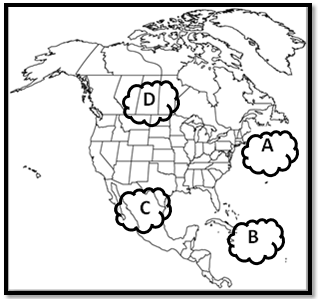


When air masses collide or interact with one another, what formation always occurs?
Fronts are formed
High amounts of wind
Thunderstorms form
Extreme weather occurs

The following are all types of severe weather except
Thunderstorms
Heavy Rain
Hurricanes
Tornadoes

_____ is an intense local storm with strong winds, heavy rain, frequent cloud to ground lightning, thunder and sometimes hail.
tornadoes
hurricanes
storm surges
thunderstorms

_____ is a strong tropical low pressure system with strong winds, heavy rains and storm surge.
tornadoes
hurricanes
lightning
thunderstorms

In the southern hemisphere of the earth hurricanes circle __________.
clockwise
counter-clockwise
up and down
front to back
In the northern hemisphere of the earth hurricanes circle __________.
clockwise
counter-clockwise
up and down
front to back
The center of the hurricane is called the __________.
bullseye
point
nose
eye
The sea water that starts a hurricane gets warm from ________________.
volcanoes
the moon
lightning
the sun
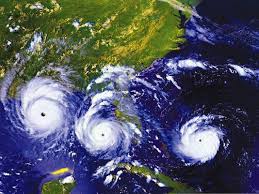
Where do hurricanes form?
In the warm waters of the Atlantic Ocean near the equator
In the cool waters of the North Sea
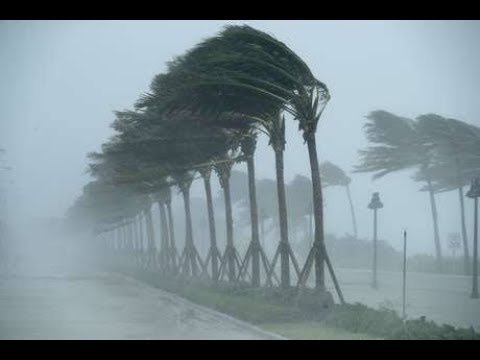
A hurricane is a very powerful storm.
false
true

