
 Worksheets
Anemia, Cancer, HIV/AIDS
Total questions: 35
Worksheet time: 6hrs 50mins
Which of the following patients are at most risk for developing iron deficiency anemia?
A 25-year-old female who was recently diagnosed with celiac disease
A 67-year-old female with a hemoglobin level of 14
A 30-year-old man who consumes a lot of red meat
How would red blood cells appear in a person with iron deficiency anemia?
Hypochromic and microcytic
Normochromic and microcytic
Hypochromic and macrocytic
In anemia, cardiac output _________.
Increases
Decreases
Stays the same
How would blood cells appear in a person with hemolytic anemia?
An increased number of reticulocytes in the circulating blood
A decreased number of reticulocytes in the circulating blood
Hypochromic and microcytic
Microcytic and normochromic
Hereditary spherocytosis is mostly transmitted as ________.
An autosomal recessive trait
An autosomal dominant trait
A bacterial infection
a viral infection
Which patient below is at MOST risk for pernicious anemia?
A 25 year old female who reports craving ice
A 66 year old male whose peripheral blood smear showed hypochromic red blood cells
A 75 year old male who recently had surgery on the ileum
All the patients listed are at risk for pernicious anemia
Which of the following is a sign and symptom of pernicious anemia?
Extreme hunger
Paresthesia of the hands and feet
Racing thoughts
Nuchal rigidity
A patient's hematocrit is greater than 60%. Which of the following symptoms do you anticipate this patient to have?
Spoon shaped nails
Craves chewing ice
Hypoxia
Pale gums
What is the normal range for CD4 T cells?
150--200 cells/uL
200--500 cells/uL
800--1000 cells/uL
True or false: Testing for HIV status is recommended for all women when they become pregnant, as well as at the time of labor and delivery.
True
False
After a serious motor vehicle accident, a patient is quickly rushed to the ER and is suffering from post hemorrhagic anemia. Based on the information provided, which of the following is NOT something you would expect from their blood smear test?
Normocytic
Normochromic
High number of reticulocytes
Hypochromic
True or false: Benign tumors have lost their ability to suppress the genetic program for cell proliferation. However, benign tumors still have the program for normal cell differentiation.
True
False
______ is the loss of cell differentiation in cancerous tissue.
Genetic instability
Carcinoma in situ
Anaplasia
A patient with ________ is likely to experience bone pain and is at risk for fractures.
adenocarcinoma
Kaposi sarcoma
Leukemia
______ deficiency anemia is a megaloblastic anemia that produces neurological manifestations.
Vitamin B 12
Folic Acid
Iron
_____ is characterized by the premature destruction of red cells. The inherited versions of this type of anemia are: sickle cell anemia, thalassemia, and hereditary spherocytosis.
Iron deficiency anemia
Megaloblastic anemias
Hemolytic anemias
A characteristic of cancer cells is the ability to proliferate even in the absence of ________.
Seeding
Growth factors
Radiation
antigen expression
Cancer cells have all of the following features EXCEPT:
Unlimited life-span
Antigen expression
High cell-to-cell adhesion
Person A’s last partner just informed them that they have tested positive for HIV. Person A immediately gets tested and the results are negative. Knowing this, Person A assures their new partner, Person B, that their results were negative, so they do not need to use protection during intercourse. Is what person A said correct?
Yes, because tests today are highly accurate and can detect HIV must sooner.
No, because it takes 1-3 months (or possibly even 6 months) before an
individual’s test results show they are positive for HIV. But during that time
they can still infect others.
Yes, because even if person A does test positive several months later, it is not
possible to transmit the virus before seroconversion has taken place.
You are educating a group of nursing students on what actions would lower the risk of transmission of HIV from mother to child. Which statement made by the student indicates a need for further teaching?
Having a cesarean delivery could help lower the risk of transmission.
Feeding her baby formula instead of breast milk would help lower the risk of
transmission.
Refraining from kissing her baby would help lower the risk of transmission.
Which of the following CD4 counts indicates that an HIV infected patient has developed AIDs?
A patient that has a CD4 count of more than 1,000 cells/uL.
A patient has a CD4 cell count of less than 200 cells/uL.
A patient that has a CD4 cell count of more than 500 cells/uL.
A patient who had unprotected sex with an HIV infected person about a month prior reports experiencing a headache, fever, sore throat, fatigue, myalgias, and lymphadenopathy. Which phase of HIV infection is this patient most likely experiencing?
AIDS
The Latent period
The primary phase
HIV can be transmitted through all of the following body fluids EXCEPT:
Breast milk
Blood
Semen
Saliva
Vaginal fluids
True or false: Those who are homozygous for the abnormal hemoglobin S (HbS) gene develop the sickle cell trait.
True
False
True or false: People with sickle cell trait normally have symptoms of sickle cell disease.
True
False
A woman diagnosed with breast cancer asks the nurse how a malignant tumor in her breast could spread to other parts of her body. The nurse answers that a malignant neoplasm is made up of less well differentiated cells that have which of the following abilities? [SATA]
Break loose
Reinvade their original site
Enter the circulatory or lymphatic system
Be excreted through the alimentary canal
Form secondary malignant tumors at other sights
A nurse is assessing a toddler who has AIDS. Which of the following findings is an indication of an opportunistic infection?
Koplik spots
Peripheral neuropathy
Chancre
Candidiasis
A nurse is teaching a client who has pernicious anemia. The nurse should encourage the client to increase consumption of which of the following foods?
Eggs
Squash
Kale
Tofu
A nurse is providing discharge teaching to a client who has aplastic anemia. Which of the following statements indicates that the client understands the instructions?
“I need to stay active to prevent blood clots in my legs.”
“If I have a bad headache, I can take aspirin to get rid of it.”
“I should eliminate uncooked foods from my diet for now.”
“I should eat more iron-fortified cereal to strengthen my blood.”
A nurse is caring for a school-aged child who has sickle cell anemia. Which of the following actions should the nurse plan to take to help decrease the risk of a vaso-occlusive crisis?
Provide adequate fluid intake throughout the day
Provide oxygen at 2 L/min via nasal cannula
Administer a blood transfusion
Give ibuprofen to manage pain
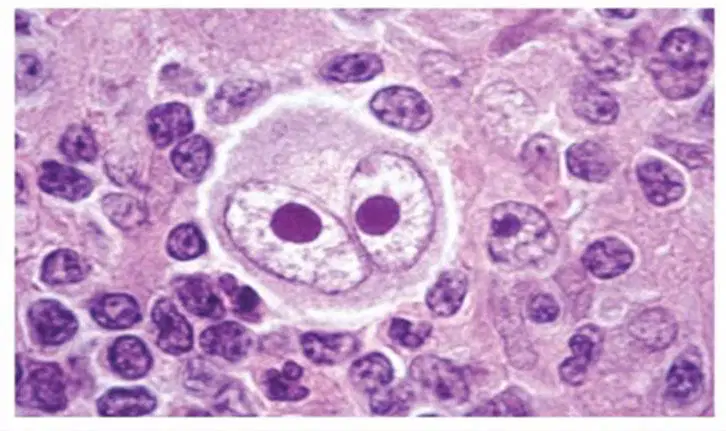
In what cancer would these owl-eye shaped cells show up in?
Non Hodgkin’s lymphoma
Hodgkin’s lymphoma
Kaposis sarcoma
Cardiac sarcoma
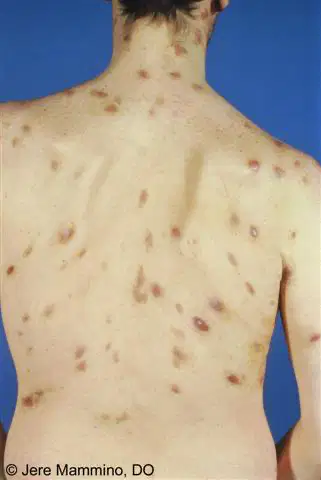
A patient with _______ (shown in the image) who is under the age of 60 is very likely to have HIV/AIDS.
Non Hodgkin’s lymphoma
Kaposi sarcoma
Psoriasis
Vitiligo
A nurse is caring for a client who has human immunodeficiency virus (HIV). Which of the following types of isolation should the nurse implement to prevent the transmission of HIV?
Protective isolation
Droplet isolation
Standard precautions
Airborne precautions
A nurse is assessing a client who has Kaposi’s sarcoma. Which of the following findings should the nurse expect?
Nonproductive cough, fever, and shortness of breath
Lesions on the retina that produce blurred vision
Onset of progressive dementia
Reddish-purple skin lesions
Because___________ expand slowly, they can develop a fibrous capsule, which is responsible for the sharp line of demarcation between the tumor and adjacent tissues.
Malignant Tumors
Benign tumors
Adenocarcinomas

