
 Worksheets
Earth Science Review
Total questions: 38
Worksheet time: 36mins

Where do convection cycles happen?
core
mantle
crust
Convection cycles move in the mantle. How does this affect the crust?
crust has no motion
crust moves in random direction
crust moves in same direction convection cycle moves
What is magma made of?
solid rock
melted rock
small pieces of sediment

What layer of earth changes because of the convection cycle?
Crust
Core
Mantle
If magma increases in temperature (get hot) what will happen?
It moves down (sinks)
It moves up (rises)
Which of the following is one reason Earth's tectonic plates to move?
energy from the Sun
magnetic Pole Reversal
convection currents in the mantle
faults in Mountain Ranges
Rocky or rigid outer part of Earth consisting of the brittle crust and the top part of the upper mantle
Lithosphere
Oceanic Crust
Continental Crust
Asthenosphere
Mantle convection is the very slow creeping motion of Earth’s solid silicate mantle caused by convection currents carrying heat from the interior to the planet's surface.
Lithosphere
Earthquake
Convection Currents
Core
In the region where two continental plates collide, what geological feature MOST often forms?
an ocean
a volcano
a river valley
a mountain chain
Crustal plates that pull apart from one another MOST likely form
volcanic island arcs
strike-slip faults
oceanic trenches
rift zones
Which statement best describes why fossils of the same land-dwelling species have been discovered in both South America and Africa?
The organism migrated to two continents
The organisms were separated by the formation of new mountain ranges
The organisms became extinct due to climate change on these continents
These organisms once lived on one large landmass that later split into two continents
A satellite image can help scientist locate the area where two plates have diverged by showing the existence of
Plateaus
Mountains
Rift Valleys
Grassy Plains
P waves are
compression waves
transverse waves
S waves are
compression waves
transverse waves
The two kinds of seismic waves that travel inside earth are?
p waves, s waves
rayleigh waves, love waves
p waves can travel through
liquid and solid
solid
liquid
s waves can travel through
solid and liquid
liquid
solid
An Earthquake happens on the North pole. Will people on the South pole be able to measure p waves?
yes
no
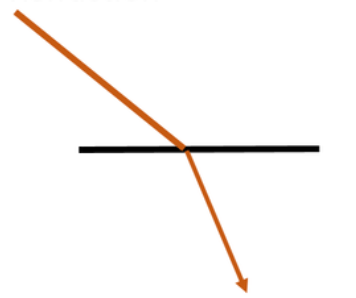
The image is depicting
reflection
refraction
rarefaction
rarefractflection
water, ice, wind or gravity
moves fragments of rock
and soil.
water, ice, wind or gravity
deposit rock sediments
and soil in a new place.
Earth’s crust into smaller
and smaller pieces.
water, ice, wind or gravity
moves fragments of rock
and soil.
water, ice, wind or gravity
deposit rock sediments
and soil in a new place.
Earth’s crust into smaller
and smaller pieces.
water, ice, wind or gravity
moves fragments of rock
and soil.
water, ice, wind or gravity
deposit rock sediments
and soil in a new place.
Earth’s crust into smaller
and smaller pieces.
What geologic feature will occur at a hot spot ?
volcano
folded mountain
deep sea trench
crevasse
A prime example of an area over a hot spot is :
Japan
the Andes Mountains
the East African Rift
the Hawaiian Islands


Cracks or breaks in earth's crust where plates slip past each other
subduction
faults
mid-ocean ridge
san andreas

What type of plate boundary is shown in the picture
convergent
divergent
transform
faults
Plates boundary where plates slide or move past each other
divergent
continental drift
transform
convergent
The type of geological event that occurs under transform boundaries
folded mountains
earthquakes
volcanoes
tsunamis

What plate boundary is shown in the picture?
convergent
divergent
transform
neither

