wayground logo

Free Printable Worksheets

Font size

S
M
L
XL
Worksheets

Year 7 Science - Mega Quiz (Class vs Class)

Total questions: 64

Worksheet time: 55mins

Name
Class
Date
1.

Producers are organisms in food webs that make their own food by harnessing sunlight. What is the other name given to this category of organism?

2 lines
2-5.

The Interactions in a Food Web

Trophic levels in a food web involve various organisms interacting with each other. Producers, such as plants, form the base of the food chain, while consumers, including herbivores, carnivores, and omnivores, feed on them. This interaction between producers and consumers is crucial for the balance of the ecosystem.

Carnivores play a vital role in a food web by controlling the population of herbivores. They help maintain the balance of the ecosystem by preventing herbivores from overgrazing on producers. This relationship between carnivores and herbivores is essential for the overall health of the ecosystem.

Competition and symbiosis are common occurrences in ecosystems. Organisms compete for resources such as food, water, and shelter. Symbiotic relationships, on the other hand, involve mutually beneficial interactions between different species. Understanding these dynamics is key to comprehending the complexity of food webs and ecosystems.

2.

What do trophic levels in a food web involve?

a)

Various organisms interacting with each other

b)

Weather patterns affecting plant growth

c)

Human activities impacting ecosystems

d)

Chemical reactions in the atmosphere

3.

What role do carnivores play in a food web?

a)

Controlling the population of herbivores

b)

Providing energy to producers

c)

Regulating the climate

d)

Supporting the growth of omnivores

4.

What are common occurrences in ecosystems?

a)

Competition and symbiosis

b)

Cooperation and isolation

c)

Predation and parasitism

d)

Migration and hibernation

5.

How do producers contribute to the food chain in a food web?

4 lines
6.
Food of almost any kind can be traced back to what?
a)
the sun
b)
animals
c)
plants
d)
soil
7.
This diagram is a model of which of these?
a)
food web
b)
food pyramid
c)
food chain
d)
life cycle
8.
Which of these is an example of a producer?
a)
snake
b)
worm
c)
human
d)
grass
9.
Which of these is a consumer?
a)
sun
b)
human
c)
trees
d)
plants
10.
Which of these keeps prey populations under control?
a)
apex predator
b)
zebra
c)
producer
d)
decomposer
11.
When a millipede breaks down dead and decaying material, it is acting as what?
a)
a decomposer
b)
an apex predator
c)
a producer
d)
prey
12.
Which animal is the apex predator in this food web?
a)
eagle
b)
mouse
c)
spider
d)
snake
13.
Which of these does most of the decomposing on Earth?
a)
bacteria and fungi
b)
millipedes
c)
worms
d)
roaches
14.
What might happen if there were no apex predators in this ecosystem?
a)
zebra population would grow fast
b)
other animals wouldn't have enough grass to eat
c)
the food web would be out balance
d)
all of the above
15.
What is the primary source of energy in most ecosystems?
a)
Water
b)
Soil
c)
Sunlight
d)
Air
e)
Fire
16.
Which of the following animals is a strict carnivore?
a)
Deer
b)
Rabbit
c)
Wolf
d)
Gorilla
e)
Cow
17.
In the grassland biome, which animal is considered a primary consumer?
a)
Lion
b)
Cheetah
c)
Gazelle
d)
Hyena
e)
Zebra
18.
Which of the following animals is an apex predator in the ocean ecosystem?
a)
Clownfish
b)
Octopus
c)
Shark
d)
Sea Turtle
e)
Jellyfish
19.
What are the specialized body parts or behaviors that help an animal survive in its environment called?
a)
Adaptations
b)
Prey
c)
Herbivore
d)
Predator
e)
Omnivore
20.
In the polar biome, which animal is an apex predator?
a)
Penguin
b)
Polar Bear
c)
Seal
d)
Arctic Fox
e)
Walrus
21.
Living things depend on many different _________ in order to survive.
a)
resources
b)
environments
c)
ecosystems
d)
interactions
22.
Environments include both _____ and _____ things.
a)
resources; factors
b)
air; water
c)
living; nonliving
d)
buildings; animals
23.
For populations to continue to survive, some organisms in the population must _________.
a)
grow
b)
reproduce
c)
eat
d)
die
24.
Characteristics such as height, hair color, and eye color are ________ factors.
a)
environmental
b)
ecosystem
c)
population
d)
genetic
25.
Ecosystems depend on organisms to ________ with each other to maintain stability.
a)
interact
b)
build
c)
eat
d)
grow
26.
Organisms are the ________ things in an ecosystem.
a)
factors
b)
nonliving
c)
resources
d)
living
27.
Air, water, and sunlight are all ________ components of an ecosystem.
a)
factors
b)
nonliving
c)
man-made
d)
living
28.
Plants compete for air, water, ________ within ecosystems.
a)
space, and sound
b)
sunlight, and wind
c)
space, and sunlight
29.
An invasive species is a plant or animal that is ________ to an ecosystem.
a)
not native
b)
just visiting
c)
beneficial
d)
not friendly
30.
When taken to a new habitat, non-native plants often threaten native plants of the new habitat.  Why do they do this?
a)
Non-native plants are able to mutate rapidly
b)
Non-native  plants cause native animals to relocate
c)
Non-native plants are able to be used for medicine
d)
Non-native plants compete with native plants for resources
31.

Kudzu is a quick-growing East Asian climbing plant with reddish-purple flowers.

Kudzu has overgrown many parts of southern Missouri in the USA and native ground plants have disappeared from the area. This is an example of:

a)
Parasitism between kudzu and the native plants
b)
A predator prey relationship between ground plants and kudzu
c)
Competition occurring between the native and invasive species
d)
Commesalism occurring between the kudzo and native plants
32.

Red fox - introduced or native?

a)

introduced

b)

native

33.

Brushtail possum - introduced or native?

a)

introduced

b)

native

34.

Echidna - introduced or native?

a)

introduced

b)

native

35.

Wedge-tailed eagle - introduced or native?

a)

introduced

b)

native

36.

Rabbit - introduced or native?

a)

introduced

b)

native

37.

Sparrow - introduced or native?

a)

introduced

b)

native

38.

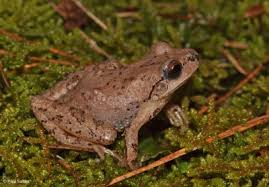
Toad - introduced or native?

a)

introduced

b)

native

39.
What is an invasive species?
a)
A native (naturally found) species which are added to an area. 
b)
A non-native (not naturally found) species added to an area. 
c)
A keystone species in an environment
d)
none of the above
40.
What will most likely happen to a species of fish if all the female fish are caught?
a)
The male fish will move away.
b)
The male fish will build homes to raise their young.
c)
The species will not survive.
d)
The young fish will starve.
41.
Which of these describes a species that has become extinct?
a)
fewer members of the species are dying than being born
b)
more members of the species are dying than being born
c)
very few members of a species are alive
d)
all members of a species have died
42.
What would most likely happen if a bird species had fewer and fewer offspring each year?
a)
The species would move to another ecosystem.
b)
There would be too many birds.
c)
The species would become endangered.
d)
Predators of the species would increase in number.
43.

This dying out or extermination of a species.

a)

Endangerment

b)

Extinction

c)

Ecologically Extinct

d)

Extinct Species

44.

It refers to the variety of all species, living things, and ecosystems on Earth

a)

Community

b)

Species Population

c)

Biological Diversity

d)

Organisms

45.

What are the two types of causes of extinction?

a)

Natural Causes of Extinction

b)

Standard Causes of Extinction

c)

Anthropogenic Causes of Extinction
(Human related)

d)

Civil Causes of Extinction

46.

The endangered black rhinos is hunted for what?

a)

its horns

b)

its eyes

c)

its meat

47.

What endangered animal is the largest land mammal?

a)

Hippos

b)

Rhinos

c)

African Elephants

48.

The endangered giant pandas mostly eat only one thing. What is it?

a)

small rodents

b)

bamboo

c)

carrots

49.

What is poaching?

a)

when people hunt wild animals illegally

b)

eating wild animals

c)

saving wild animals

50.

What does it mean when an animal is extinct?

a)

Something once lived but no longer exists.

b)

Animals that is at risk of extinction.

c)

Place that protects animals at risk.

51.

Which biome covers roughly 3% of Australia's total forest cover?

a)

Tropical Rainforest

b)

Grassland (Savannah)

c)

Temperature Forest

d)

Desert

52.

Which biome covers roughly 10% of Australia?

a)

Tropical Rainforest

b)

Grassland (Savannah)

c)

Temperature Forest

d)

Desert

53.

Australia's tropical rainforest biome is mainly located...

a)

Along the south coast

b)

Along the east coast

c)

In the south-west

d)

In central Australia

54.

Which biome covers roughly 70% of Australia's landmass?

a)

Tropical Rainforest

b)

Grassland (Savannah)

c)

Temperature Forest

d)

Desert

55.

Marsupials give birth to live young and rear them in a pouch. Give an example of a marsupial species found in Australia.

(a)  

56.

Barnacles create home sites by attaching themselves to whales. In this relationship, the whales are neither harmed nor benefited. What type of symbiosis is this relationship?

a)

parasitism

b)

commensalism

c)

mutualism

57.

Egrets feed in fields among cattle. The egrets get easy access to the insects that are stirred up by the cattle, and the cattle do not care if the egrets are there or not. What type of symbiosis is this relationship?

a)

mutualism

b)

commensalism

c)

parasitism

58.

All the living and nonliving things in an area.

a)

Symbiosis

b)

Competition

c)

Food web

d)

Ecosystem

59.

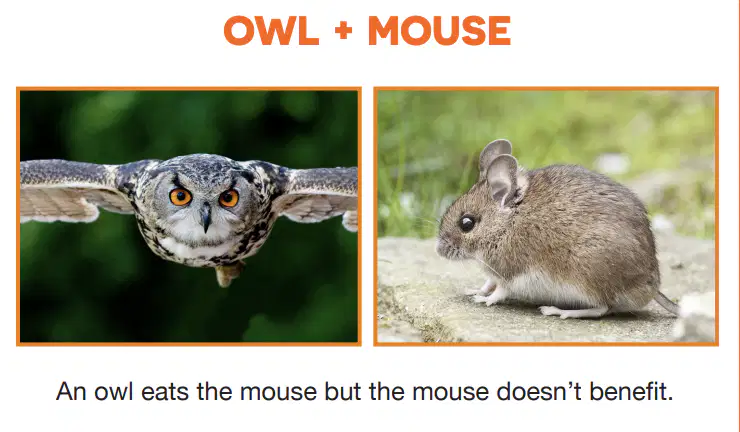
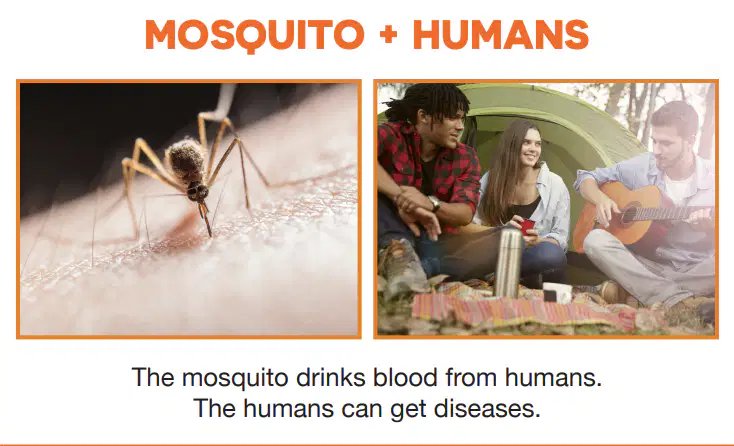
What is this type of relationship?

a)

Parasitism

b)

Competition

c)

Predation

d)

Commensalism

60.

 Interaction between organisms of two different species.

a)

Competition

b)

Mutualism

c)

Symbiosis

d)

Commensalism

61.

Relationship in which both of the organisms benefit.

a)

Mutualism

b)

Parsistism

c)

Predation

d)

Commensalism

62.

What is this type of relationship?

a)

Parasitism

b)

Competition

c)

Predation

d)

Commensalism

63.

Hermit Crabs live in shells made and then abandoned by snails.

a)

Commensalism

b)

Parasitism

c)

Competition

64.
Commensalism is where one organism is benefiting and the other organism is _____________________. 
a)
not effected
b)
helped
c)
harmed
d)
hurt
65.
In a mutual relationship, both organisms are ________________. 
a)
hurt
b)
not effected
c)
harmed
d)
benefiting 
66.
A tick is a parasite to a horse. Which statement best describes the relationship between the tick and the horse? 
a)
a.  The tick helps the horse get food. 
b)
a.  The tick harms the horse by feeding on its blood. 
c)
a.  The horse harms the tick by feeding on its blood. 
d)
The tick does not affect the horse. 
67.
 Mrs. Bush’s cat has fleas. A flea is a parasite that gets its energy from Dante’s blood. How are the flea and the cat affected in this relationship? 
a)
Both organisms are helped.
b)
Both organisms are not affected.
c)
One organism is helped and one organism is not effected.
d)
One organism is helped and another organism is harmed.