
 Worksheets
Ecosystems Benchmark Quizziz Question Pool
Total questions: 37
Worksheet time: 19mins
Name
Class
Date
1.
Photosynthesis is an _____________ chemical reaction. It _____________ energy.
a)
exothermic, absorbs
b)
exothermic, releases
c)
endothermic, absorbs
d)
endothermic, releases
2.
_____________ is a green pigment that is important for photosynthesis.
a)
Producer
b)
Chlorine
c)
Chlorophyll
d)
Chloroplast
3.
Which of the following symbiotic relationships is considered parasitism?
a)
Tapeworm in a human intestine
b)
Bees transporting pollen from flowers
c)
A remora(sucker fish) swimming under a shark
d)
Birds eating the insects uncovered by a cow.
4.
What is the name of the organism a parasite harms?
a)
Parasite
b)
Host
c)
Prey
d)
Predator
5.
In ecological relationships, an organism is considered harmed if it is limited in its ability to:
a)
photosynthesize, consume, and react.
b)
consume, produce, and decompose.
c)
survive, hunt, and reproduce.
d)
survive, grow, and reproduce.
6.
In a relationship where one organism consumes another, what name is given to the organism that does the harm?
a)
Host
b)
Predator
c)
Parasite
d)
Prey
7.
Ants and acacia trees have a mutualistic relationship because_______
a)
They both benefit from living with each other.
b)
They are a part of the same ecosystem.
c)
They are both adapting.
d)
The ants eat the tree.
8.
What symbols best describe mutualism?
a)
+ +
b)
+ -
c)
- -
9.
What model best symbolizes parasitism?
a)
+ +
b)
+ -
c)
- -
10.
What type of relationship is commensalism?
a)
One species benefits and the other is unharmed
b)
Both species benefit from the relationship
c)
One species benefits while the other is harmed
d)
Competitions between two species
11.
The anemone provides the clownfish with protection and shelter, while the clownfish provides the anemone nutrients in the form of waste. What type of relationship is this?
a)
Mutualism
b)
Commensalism
c)
Parasitism
d)
Predation
12.
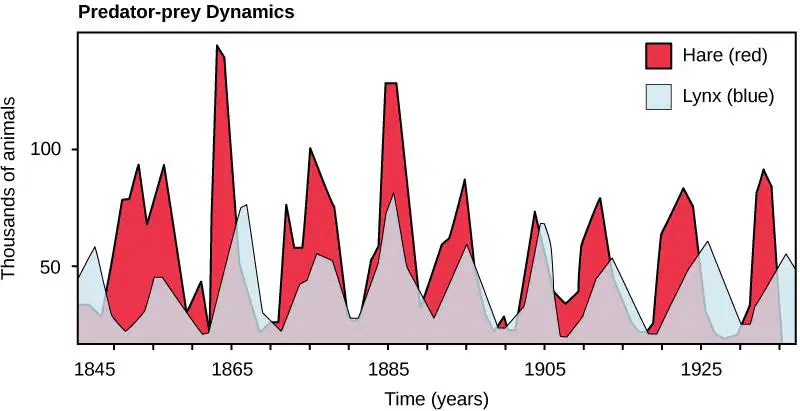
Using the Predator-prey Dynamics graph, which is the predator?
a)
Hare
b)
Lynx
13.
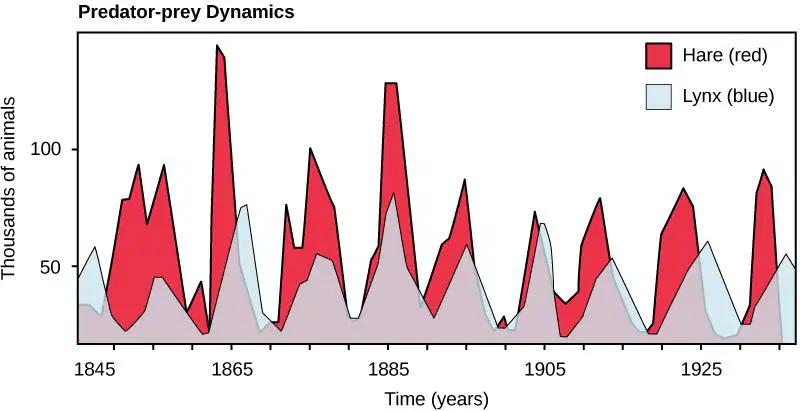
Using the Predator-prey Dynamics graph, which is the prey?
a)
Hare
b)
Lynx
14.
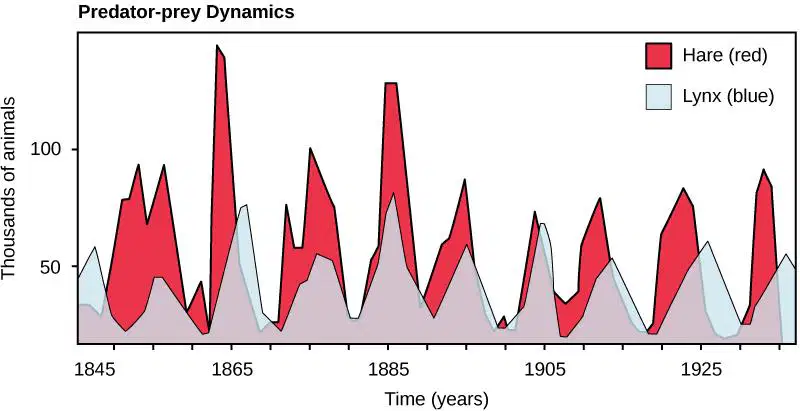
Using the graph, during what year was the hare's population the greatest?
a)
1845
b)
1865
c)
1885
d)
1905
15.
A _____________ is an organism that captures energy and matter to produce sugar.
a)
producer
b)
photosynthesis
c)
chloroplast
d)
chlorophyll
16.
True or false: Producers require sunlight, carbon dioxide, and oxygen to survive.
a)
True
b)
False
17.
____________ are cell structures that uses the sun's energy to make sugar.
a)
Producers
b)
Chlorophylls
c)
Organisms
d)
Chloroplasts
18.
Which organism is not a producer?
a)
plants
b)
mushrooms
c)
phytoplankton
d)
algae (cyanobacteria)
19.
The products of photosynthesis are:
a)
glucose (sugar)
b)
glucose (sugar) and oxygen (02)
c)
carbon dioxide (CO2) and oxygen (02)
d)
sunlight, carbon dioxide (CO2), water(H20)
20.
True or false: Carbon dioxide is absorbed through the roots of a plant and transported to the chloroplast.
a)
True
b)
False
21.
Mike thinks that photosynthesis can take place at night. Mike's evidence is that plants don't die at nighttime.
Which statement the most correct?
a)
Mike is correct. Plants can use photosynthesis at night because all of the reactants are present.
b)
Mike is correct. Plants can use photosynthesis at night because all of the products are present.
c)
Mike is incorrect. Plants cannot use photosynthesis at night because all of the reactants are not present.
d)
Mike is incorrect. Plants cannot use photosynthesis at night because all of the products are not present.
22.
True or false: Carbon dioxide is a reactant of photosynthesis.
a)
True
b)
False
23.
True or false: Sunlight is a reactant of photosynthesis.
a)
True
b)
False
24.
True or false: Oxygen is a reactant of photosynthesis.
a)
True
b)
False
25.
True or false: Water is a product of photosynthesis.
a)
True
b)
False
26.
True or false: Glucose is a product of photosynthesis.
a)
True
b)
False
27.
True of false: Photosynthesis converts solar energy into chemical energy in the form of glucose.
a)
True
b)
False
28.
True of false: All living things are made up of matter.
a)
True
b)
False
29.
True of false: All living things have a life cycle; meaning they will grow, mature, and eventually die.
a)
True
b)
False
30.
True of false: All living things respond to their environment.
a)
True
b)
False
31.
True of false: All living things get energy from food.
a)
True
b)
False
32.
True or false: An ecosystem is an area or region made up of only the living things.
a)
True
b)
False
33.

What are biotic factors in this ecosystem? Select the best option.
a)
owl, grass, rodent, and tree
b)
clouds, air, and moonlight
c)
only the grass and the tree
d)
only the owl and the rodent
34.

What are the producers in this ecosystem? Select the best option.
a)
owl, grass, rodent, and tree
b)
clouds, air, and moonlight
c)
only the grass and the tree
d)
only the owl and the rodent
35.

What are the consumers in this ecosystem? Select the best option.
a)
owl, grass, rodent, and tree
b)
clouds, air, and moonlight
c)
only the grass and the tree
d)
only the owl and the rodent
36.

What are abiotic factors in this ecosystem?
a)
owl, grass, rat, and tree
b)
clouds, air, and moonlight
c)
only the grass and the tree
d)
only the owl and the rat
37.
Extra credit: What is the best example of a food chain? Select the best option.
a)
sunlight ---> rodent ---> corn ---> owl
b)
sunlight <--- corn <--- rodent <--- owl
c)
sunlight ---> corn ---> rodent ---> owl
d)
owl <--- rodent ---> corn ---> sunlight
100 %

