
 Worksheets
Periodic Trends
Total questions: 20
Worksheet time: 30mins
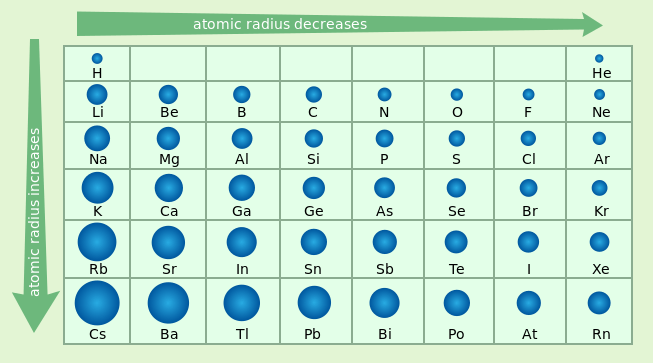
Why does radius decrease as you move across a period?
because electrons are being added
because protons are being added
because energy levels are being lost
because energy levels are being added
Which of the following has the largest electronegativity value?
neon
fluorine
carbon
lithium
The ability of an atom to attract another atom's electrons to itself is called
electronegativity
ionization energy
periodic trend
coulombic attractin
For which of these properties does lithium have a larger value than potassium?
radius
atomic mass
ionization energy
atomic number
Why does radius increase as you move down a period?
protons are being added
ionization energy is increasing
protons are getting weaker
energy levels are being added
As you move left to right across a period, ionization energy
increases
decreases
says the same

What term is used to describe "The energy required to remove an electron from 1 mole of gaseous atoms"
Elements that have a high electronegativity
Give up their electrons easily.
Have a higher attraction between nucleus and electrons.
Have more electron shells.
Down a group, atomic radii .....
Increases
Decreases
What has the greatest electronegativity out of Cl and Al?
Cl
Al
What has the largest radius out of Cl and Cl-?
Cl
Cl-
Across a period, ionisation energies..
Decrease
Increase
As you move across a period, what happens to the nuclear charge in the atoms?
It increases because more protons are added.
It decreases because protons are taken away.
It stays the same.

What idea is this cartoon showing?
chlorine is more electronegative than hydrogen
chlorine has more energy levels than hydrogen
hydrogen is more electronegative than chlorine

Which of these halogens has the largest atomic radius?
fluorine, F
chlorine, Cl
bromine, Br
iodine, I

Which of the following elements is the most electronegative?
Hydrogen, H
Aluminum, Al
Oxygen, O
Cesium, Cs

